
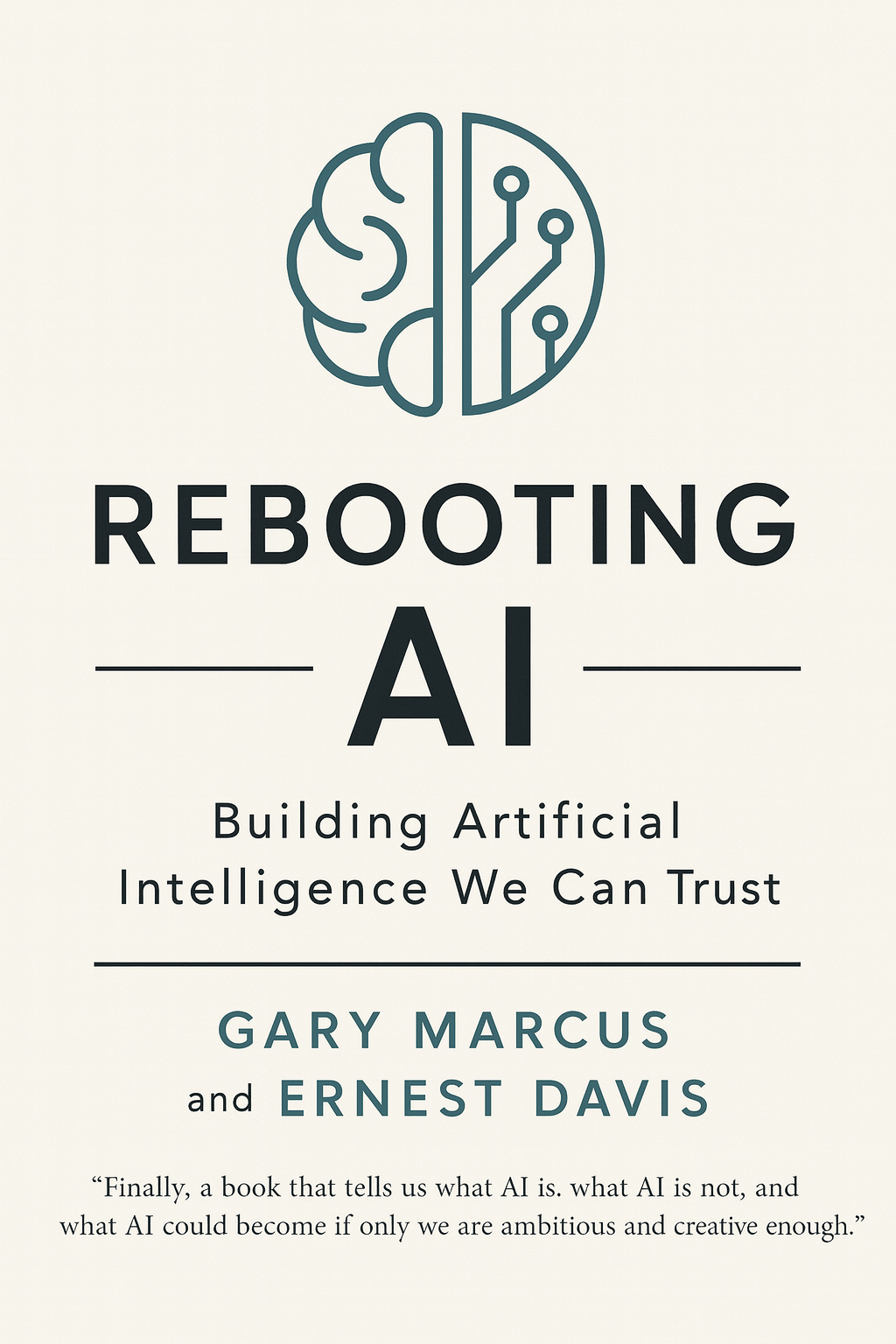
Rebooting AI: Building Artificial Intelligence We Can Trust
"Rebooting AI: Building Artificial Intelligence We Can Trust" offers a clear-eyed examination of artificial intelligence, tracing its history, current capabilities, and future challenges. The course begins by analyzing the persistent gap between early AI promises and actual progress, setting the stage for a realistic understanding of what AI can and cannot do. It then addresses the real-world consequences of deploying AI systems, highlighting social, ethical, and safety risks that arise when technology outpaces oversight. Through case studies and critical discussion, listeners gain insight into why technical limitations matter beyond the lab. The series moves on to dissect the strengths and weaknesses of deep learning, the dominant approach in modern AI, and explains why its reliance on large datasets and narrow tasks restricts broader intelligence. The course then explores the difficulties machines face in true language comprehension and inference, using examples from machine reading and robotics. Drawing on cognitive science, it contrasts human learning—flexible, efficient, and context-aware—with current AI approaches. The final lectures focus on the need for common-sense reasoning and trustworthy AI, outlining what it will take to build systems that can be relied upon in high-stakes environments. Each lecture builds on the last, providing a structured path from foundational issues to the requirements for a safer, more robust AI future.
Opening the Gap: Chapters 1-1
Opening the Gap: Chapters 1-1
Gary Marcus and Ernest Davis open their examination of artificial intelligence with a stark thesis: a vast chasm separates current AI capabilities from the inflated expectations created by media hype and industry promotion. Despite remarkable technical advances and widespread enthusiasm, contemporary AI systems fail catastrophically when confronting real-world complexity they weren't explicitly trained to handle. The authors present compelling failures that expose this dangerous disconnect between demonstration and deployment.
The 2018 fatal Uber self-driving accident in Arizona illustrates this gap with tragic clarity. The autonomous system repeatedly misclassified a pedestrian walking a bicycle, categorizing the victim as various objects but never recognizing the fundamental danger of a person in the roadway. This wasn't a minor technical glitch but a failure of basic understanding that no human driver would make.
Google Duplex provides another revealing case study of AI's limitations masked by impressive demonstrations. The system amazed audiences with human-like phone conversations complete with natural speech patterns and hesitations, suggesting breakthrough conversational ability. However, the technology proved extremely limited in scope, working only in tightly controlled scenarios, leading Google to quietly retreat from its initial ambitious vision.
These examples reveal a troubling pattern across contemporary AI development. Systems perform impressively in controlled environments and carefully selected demonstrations but fail unpredictably when encountering the messy, unpredictable situations that characterize actual deployment. The gap between laboratory success and real-world reliability remains dangerously wide.
Marcus and Davis identify deep learning as both the dominant paradigm in contemporary AI and a fundamentally limited approach. While deep learning excels at pattern recognition when provided with massive training datasets, it lacks robust understanding, common sense reasoning, and the ability to generalize beyond its training distribution. The authors argue this isn't simply a matter of needing more data or computing power.
The failures of deep learning systems reveal fundamental limitations rather than minor bugs that incremental improvements can fix. Image recognition systems can be fooled by imperceptible noise into misclassifying a turtle as a rifle, demonstrating brittleness no human vision would exhibit. Natural language systems fail to grasp that a person cannot occupy two locations simultaneously, along with other failures of basic physical and social reasoning.
These errors expose the core weakness of deep learning: it operates by finding statistical correlations in training data rather than building genuine mental models of how the world functions. Systems perform well on familiar inputs that resemble their training distribution but fail unpredictably when encountering novel situations. This brittleness makes them unreliable for deployment in contexts requiring robust understanding and flexible reasoning.
The AI community and technology industry bear responsibility for overselling current capabilities, driven by incentives that reward hype over honest assessment. Impressive demonstrations and carefully selected successes dominate public discourse while failures and fundamental limitations receive insufficient attention. This creates a dangerous cycle where expectations diverge ever further from reality.
Building truly trustworthy AI requires moving beyond pure deep learning to incorporate symbolic reasoning, structured knowledge representation, and cognitive models inspired by human intelligence. Marcus and Davis acknowledge deep learning's genuine breakthroughs and continuing importance but insist it cannot serve as the sole foundation for artificial intelligence. Multiple approaches must be combined rather than relying exclusively on a single paradigm.
The chapter frames the book's mission: providing an honest assessment of AI's current state, identifying critical gaps in capability, and charting a path toward more robust systems. The authors aim to cut through promotional rhetoric and examine what contemporary AI can and cannot actually accomplish. Only through clear-eyed evaluation can the field develop systems capable of handling real-world complexity with genuine reliability and trustworthiness.
Stakes and Risks: Chapters 2-2
Artificial intelligence is increasingly being deployed in high-stakes environments, where the consequences of failure can be severe. The authors argue that the real danger lies not just in the technical limitations of AI systems but in the overconfidence that developers, companies, and policymakers place in these systems. This overconfidence can lead to premature deployment in life-and-death situations without adequate safety measures.
The systemic issues in AI deployment are multifaceted. One major concern is the lack of robust testing and validation processes. AI systems are often evaluated based on their performance in controlled environments or on benchmark datasets, which do not accurately reflect the complexity and unpredictability of real-world scenarios. This creates a false sense of security, as systems that perform well in tests may fail catastrophically when faced with novel situations.
Another issue is the incentive structure within the AI industry. Companies are driven by the need to demonstrate progress and innovation, which can lead to the overselling of AI capabilities. This hype cycle creates unrealistic expectations and pressures developers to deploy systems before they are ready. Policymakers, eager to harness the potential of AI for economic and social benefits, may also push for rapid deployment without fully understanding the risks involved.
The authors highlight the importance of transparency and accountability in AI deployment. Without clear explanations of how AI systems make decisions, it is difficult to assess their reliability and trustworthiness. This opacity is compounded by the "black box" nature of many AI models, which makes it challenging to identify and rectify errors. In high-stakes environments, such as healthcare or autonomous vehicles, this lack of transparency can have dire consequences.
The chapter also discusses the ethical implications of AI deployment. The use of AI in areas like criminal justice and hiring can perpetuate existing biases and inequalities. AI systems trained on biased data can produce discriminatory outcomes, leading to unfair treatment of individuals based on race, gender, or other characteristics. The authors argue that addressing these ethical concerns requires a fundamental rethinking of how AI systems are designed and deployed.
To mitigate these risks, the authors propose several recommendations. First, they call for more rigorous testing and validation processes that go beyond standard benchmarks. This includes stress-testing AI systems in diverse and unpredictable environments to ensure they can handle real-world complexity. Second, they advocate for greater transparency and interpretability in AI models, allowing stakeholders to understand and trust the decisions made by these systems.
Finally, the authors emphasize the need for a cautious and measured approach to AI deployment. Rather than rushing to implement AI in critical areas, they argue for a focus on building systems that are genuinely reliable and trustworthy. This requires a shift away from the current emphasis on performance metrics and towards a more holistic understanding of AI's capabilities and limitations.
In conclusion, the chapter underscores the importance of recognizing the systemic issues in AI deployment and the overconfidence that can lead to premature and unsafe implementation. By addressing these challenges, the authors believe it is possible to harness the potential of AI while minimizing the risks and ensuring that these systems are used responsibly and ethically.
Deep Learning and Its Limits: Chapters 3-3
In the quest for building artificial intelligence that can be trusted, the limitations of deep learning have become increasingly apparent. While deep learning has achieved remarkable feats in specific areas like image recognition and game playing, its inability to generalize beyond training data remains a significant hurdle. This lecture shifts focus from reiterating these limitations to exploring alternative AI paradigms that promise to overcome these challenges.
The core issue with deep learning is its reliance on pattern matching without genuine understanding. This approach works well in controlled environments but falters in real-world applications where unpredictability is the norm. To address this, researchers are turning to hybrid systems that integrate symbolic reasoning and structured knowledge representation.
Symbolic reasoning, a cornerstone of classical AI, involves manipulating symbols and rules to perform logical inference. Unlike deep learning, which relies on statistical correlations, symbolic reasoning allows for explicit representation of knowledge and the ability to reason about it. This approach enables systems to understand and manipulate abstract concepts, making them more adaptable to new situations.
Structured knowledge representation is another critical component of hybrid AI systems. It involves organizing information in a way that reflects the relationships and hierarchies inherent in the real world. This structured approach allows AI systems to access and utilize background knowledge, providing a foundation for reasoning and decision-making.
By combining these elements, hybrid AI systems aim to achieve a level of understanding that deep learning alone cannot provide. For instance, in natural language processing, hybrid systems can go beyond pattern matching to comprehend the meaning and context of language. This capability is crucial for tasks like reading comprehension, where understanding the nuances of language is essential.
In robotics, hybrid systems offer the potential to overcome the limitations of current AI models. While deep learning excels at tasks like object recognition, it struggles with understanding the physical properties and interactions of objects. By incorporating symbolic reasoning, robots can develop a more comprehensive understanding of their environment, enabling them to perform complex tasks with greater reliability.
The integration of symbolic reasoning and structured knowledge representation also addresses the issue of explainability in AI. Deep learning models are often criticized for their "black box" nature, where the decision-making process is opaque and difficult to interpret. Hybrid systems, on the other hand, provide a more transparent framework, allowing for better understanding and trust in AI decisions.
Despite the promise of hybrid AI systems, challenges remain. Integrating symbolic reasoning with deep learning requires overcoming technical hurdles, such as developing efficient algorithms for combining these approaches. Additionally, creating comprehensive knowledge bases for structured representation is a complex task that demands significant effort and resources.
However, the potential benefits of hybrid AI systems make these challenges worth pursuing. By moving beyond the limitations of deep learning, these systems offer a path toward AI that can reason, understand, and adapt to the complexities of the real world. This approach aligns with the vision of building artificial intelligence that is not only powerful but also trustworthy and reliable.
In conclusion, the exploration of hybrid AI paradigms represents a significant step forward in the development of artificial intelligence. By integrating symbolic reasoning and structured knowledge representation, these systems promise to overcome the brittleness of deep learning and achieve a level of understanding necessary for real-world applications. As research in this area progresses, the potential for creating AI that can truly comprehend and interact with the world becomes increasingly attainable.
Reading and Understanding: Chapters 4-5
Speaker 1
Chapters 4 and 5 argue that AI systems, despite their impressive performance on benchmarks, fundamentally lack true language comprehension. They excel at pattern matching but fail to understand the meaning behind the words. This distinction is crucial, as it reveals the limitations of current AI technologies.
Speaker 2
Exactly. The authors highlight the Winograd Schema Challenge as a prime example of this gap. Consider the sentence: 'The city councilmen refused the demonstrators a permit because they feared violence.' Who feared violence? Humans can easily infer that 'they' refers to the city councilmen. But AI systems struggle with such pronoun disambiguation because they lack the contextual understanding that humans naturally possess.
Speaker 1
So, it's not just about recognizing words but understanding the relationships and implications between them?
Speaker 2
Precisely. The authors provide numerous examples where AI systems falter. For instance, when faced with sentences that require understanding of physical properties or social dynamics, AI often fails. Consider the sentence: 'The trophy doesn't fit in the brown suitcase because it's too big.' Humans understand that 'it' refers to the trophy, not the suitcase. But AI systems, without a grasp of spatial reasoning, often get it wrong.
Speaker 1
But can't these systems be trained with more data to overcome these limitations?
Speaker 2
The authors argue that more data isn't the solution. AI systems trained on vast datasets still lack the ability to generalize beyond their training. They can match patterns but don't understand the underlying concepts. This is evident when questions are rephrased or presented in a slightly different context, leading to significant drops in performance.
Speaker 1
So, the problem is deeper than just data volume?
Speaker 2
Yes, it's about the architecture of these systems. Current AI lacks the cognitive structures that humans use to understand language. Humans use a combination of prior knowledge, context, and reasoning to interpret language, something AI systems can't replicate with pattern matching alone.
Speaker 1
The authors also mention linguistic puzzles. How do these further illustrate AI's limitations?
Speaker 2
Linguistic puzzles, like the Winograd Schema, challenge AI to understand context and relationships. For example, 'The man couldn't lift his son because he was so weak.' Who was weak? Humans understand it's the man, but AI systems often misinterpret such sentences because they don't grasp the causal relationships involved.
Speaker 1
So, what's the proposed solution?
Speaker 2
The authors advocate for hybrid systems that combine deep learning with symbolic reasoning. This approach would allow AI to not only recognize patterns but also understand and reason about them. By integrating structured knowledge and logical inference, AI could achieve a level of comprehension closer to human understanding.
Speaker 1
It sounds like a significant shift from current practices.
Speaker 2
It is. The authors emphasize that without this shift, AI will remain limited in its ability to truly understand language. The goal is to move beyond surface-level pattern matching to systems that can reason about meaning, context, and relationships, much like humans do.
Human-Mind Insights: Chapters 6-6
Chapter 6 examines what artificial intelligence can learn from human cognition, arguing that understanding human thinking is essential for building robust and trustworthy AI systems. Human intelligence fundamentally relies on rich cognitive models of the world, common sense reasoning, and remarkable generalization from limited examples, capabilities that current deep learning systems conspicuously lack. Marcus and Davis emphasize that humans construct abstract representations and mental models enabling reasoning about causality, physics, psychology, and social interactions from remarkably early ages.
Research demonstrates that infants as young as a few months old show surprise when objects behave in physically impossible ways, suggesting either innate or rapidly acquired intuitions about how the world operates. This early cognitive sophistication extends to multiple forms of reasoning including analogical thinking, counterfactual reasoning, and the ability to construct and manipulate mental simulations of scenarios never directly experienced. Children can acquire new concepts from just one or a few examples, while neural networks typically require thousands or millions of training instances.
This sample efficiency stems from humans' ability to leverage prior knowledge, make inferences based on abstract principles, and transfer learning across domains. Human cognition integrates bottom-up perceptual processing with top-down expectations and knowledge, allowing us to make sense of ambiguous or incomplete information in ways that pure pattern-matching systems cannot replicate. The contrast between human and machine learning efficiency reveals fundamental differences in underlying cognitive architectures.
Language and symbolic reasoning play critical roles in human intelligence, providing powerful tools for abstract thought, communication of complex ideas, and accumulation of cultural knowledge across generations. Marcus and Davis stress that human reasoning involves manipulating symbols and variables in rule-governed ways, not merely statistical pattern recognition. Humans naturally engage in compositional thinking, combining basic concepts systematically to understand novel situations and generate creative solutions.
Developmental psychology research demonstrates that even young children engage in sophisticated causal reasoning, understanding that actions have consequences and that hidden mechanisms explain observable phenomena. This contrasts sharply with AI systems that excel at identifying correlations but struggle with causation, unable to answer what-if questions or reason about interventions. The gap between correlation and causation represents a fundamental limitation in current machine learning approaches.
Human common sense encompasses vast amounts of implicit knowledge about how the world works, what goals and motivations drive behavior, and what outcomes are plausible in different contexts. This common sense knowledge is largely tacit and difficult to articulate explicitly, yet it remains essential for navigating everyday situations and making reasonable judgments. AI systems lack this foundational understanding that humans acquire naturally through experience and social learning.
Marcus and Davis conclude by arguing that building AI systems capable of truly understanding and interacting with the world requires incorporating insights from cognitive science about representation, reasoning, and learning. They suggest that hybrid approaches combining neural networks with symbolic reasoning, structured knowledge representations, and built-in inductive biases reflecting core cognitive principles offer more promising paths forward than pure deep learning alone. The chapter makes a compelling case that human intelligence provides not just inspiration but essential architectural principles for creating AI systems that are more capable, interpretable, and trustworthy.
The authors' analysis reveals that current AI limitations stem from missing cognitive components rather than insufficient data or computational power. Human-like intelligence requires systems that can reason causally, generalize efficiently, and apply common sense to novel situations. These capabilities emerge from cognitive architectures fundamentally different from today's dominant deep learning paradigms.
Ultimately, the chapter advocates for AI research that takes human cognition seriously as a source of design principles rather than merely a benchmark to surpass. By understanding how humans build mental models, reason symbolically, and learn efficiently from limited data, researchers can develop more robust artificial intelligence systems. This cognitive science-informed approach promises AI that better handles uncertainty, explains its reasoning, and operates reliably in real-world contexts.
Common Sense, Trust, and the Future: Chapters 7-8
AI systems, despite their prowess in specific tasks like playing chess or recognizing images, fundamentally lack common sense. This deficiency has profound implications for trust and safety in AI deployment. The inability of AI to understand basic physical and causal relationships, such as knowing a coffee cup remains on a table unless moved, highlights a critical gap in its cognitive architecture. This gap is not merely a data problem but an architectural one, where current systems excel at pattern matching without genuine understanding.
The authors argue that scaling neural networks with more data will not spontaneously generate common sense. The problem lies in the architecture, which focuses on statistical correlations rather than understanding. This lack of understanding leads to brittleness, where systems can be easily fooled by adversarial examples—imperceptible changes that cause AI to misclassify objects with high confidence. Such vulnerabilities expose deeper structural problems, as seen in high-profile failures like racially biased facial recognition and gender-discriminatory hiring algorithms.
The opacity of AI systems compounds the trust problem. When even creators cannot explain specific decisions, debugging becomes challenging, and establishing accountability for failures is nearly impossible. Trust in AI requires consistent reliability, recognition of limitations, and graceful degradation—qualities that current AI systems lack. The authors emphasize that without addressing brittleness, trust cannot be built.
To address these issues, the authors propose hybrid systems that combine deep learning's pattern recognition with symbolic reasoning. These systems should be capable of representing abstract concepts, handling compositionality, and performing logical inference. They suggest looking to developmental psychology's concept of 'core knowledge'—innate systems for understanding objects, agents, numbers, and space—as potential blueprints for AI architectures.
The authors also stress the importance of interpretability and accountability in AI deployment. Systems must be able to explain their reasoning processes to ensure safety and build trust. This requires developing tools and methodologies that allow for transparent decision-making and error analysis. By prioritizing interpretability, developers can create AI systems that are not only powerful but also reliable and trustworthy.
Concrete steps for integrating common sense reasoning into AI architectures include developing hybrid models that incorporate both neural networks and symbolic reasoning. These models should be designed to understand and reason about the world in a way that mirrors human cognition. This involves building systems that can learn from fewer examples, generalize across different contexts, and apply common sense knowledge to novel situations.
The authors argue that AI research must move beyond current deep learning paradigms and embrace a more holistic approach that incorporates insights from cognitive science. By understanding how humans build mental models, reason symbolically, and learn efficiently from limited data, researchers can develop AI systems that are more capable, interpretable, and trustworthy.
Ultimately, the authors call for greater skepticism about AI capabilities and more rigorous testing beyond standard benchmarks. They advocate for prioritizing safety and interpretability over raw performance, ensuring that AI systems demonstrate reliable performance across diverse contexts. Until systems can explain their reasoning and operate reliably in real-world scenarios, they should not be deployed in critical applications where human welfare is at risk.