
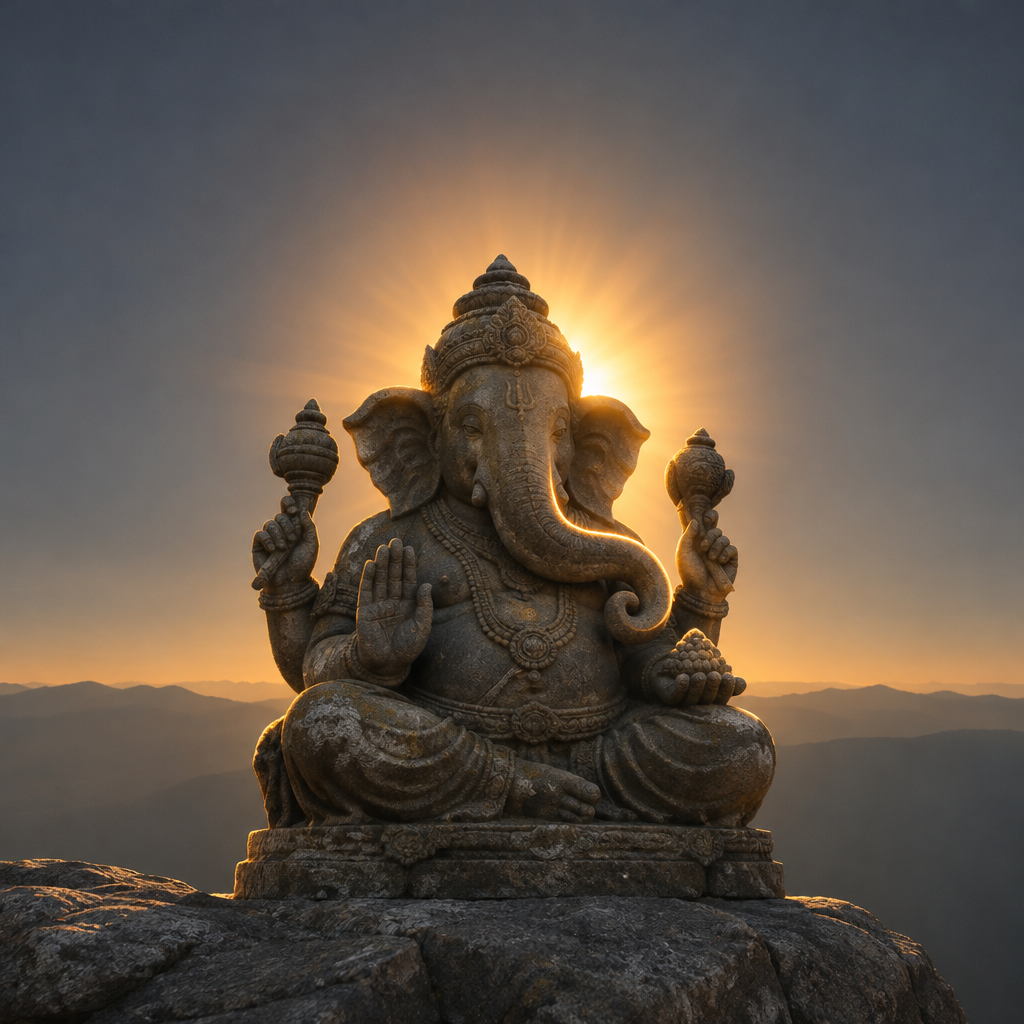
What Gaṇeśa’s Curved Trunk Teaches About Obstacles
This six-lecture course examines the Vakratunda prayer to Ganesha, moving from the story of Sage Vyasa and the Mahabharata to the meaning of the curved trunk, the broken tusk, and the radiance of ten million suns. Lecture 1 shows how absolute light removes shadows, using the negotiation between Vyasa and Ganesha to explain that obstacles disappear when consciousness is fully illuminated. Lecture 2 replaces the image of Ganesha as a bulldozer with the example of architect Anaya, who solved an unstable valley by designing a flexible bridge instead of demanding solid ground. Lecture 3 compares the trunk's bend to water flowing around stone, arguing that curved intelligence reaches farther than straight force and that the mighty form is sustained by this capacity to bend without breaking. Lecture 4 presents the broken tusk as the tool Ganesha used when his pen snapped, teaching that personal limitations become instruments when the work must continue. Lecture 5 applies the prayer to daily delays, showing that the real obstacle is internal resistance rather than external traffic. Lecture 6 concludes that success is alignment with the whole rather than the absence of problems, so that endeavors remain free from obstacles because the practitioner no longer stands apart from the outcome.
The Light of Ten Million Suns
The Light of Ten Million Suns
The quill had to keep moving. That was the agreement — and if it stopped, the whole recitation would end.
What gets me about the Vakratunda Mahakaya verse is that it doesn't begin with a request. It begins with a form. Vakratunda: the curved trunk. Mahakaya: the great body. The verse spends its first breath on what Ganesha looks like, not on what the devotee needs. There's a logic in that sequence, Kurt, and it mirrors something any honest person knows about asking for help — you have to see clearly who you're asking before you name what you need. Scholar M. K. Dhavalikar, who spent years examining the historical evidence around Ganesha's origins, noted that the deity's development is genuinely difficult to trace. Even so, an inscription from eight hundred and sixty-two of the common era has been treated as one of the early documented tributes to the elephant-headed god. The devotion runs deep, and it runs old.
Now, consider the verse's central image: Suryakoti samaprabha. Radiance equal to ten million suns. That is not a measurement of astronomy. The verse itself makes no such claim. It is a poetic image of overwhelming brightness, the kind of light that makes shadow structurally impossible. Think of it this way: a single candle in a dark room creates contrast, light here, shadow there. Add another candle, the shadow shifts. But at a certain point — and I, no, this is the thing that struck me — at a certain threshold of brightness, there is no surface left for a shadow to land on. That is what ten million suns means as an image. Obstacles, in this framework, are not forces to be defeated. They are, in a sense, absences of light. Which is why the prayer doesn't ask Ganesha to fight anything. It asks him to illuminate.
And the curved trunk, Kurt — Vakratunda — carries its own intelligence here. A trunk that bends can reach around a corner, can navigate what a straight line cannot. In many artistic representations of Ganesha across different regions and periods, the curve of the trunk varies, but the curve is always there. It is a recognizable feature, one that the verse names first, before the radiance, before the request. In the Hindu traditions that have honored Ganesha as a presiding figure of beginnings, that adaptability is not incidental to his nature — it is central to it. The form itself is the teaching. A, what's the word, a shape that refuses rigidity.
The word Nirvighna, which the verse carries toward its close, means "without obstacles" or "unhindered." Then comes Sarvakaryeshu — in all undertakings. Then Sarvada — always. Each word widens the scope of the request. It moves from this moment to every moment, from this task to every task. That compression of meaning is worth sitting with. The prayer doesn't say "help me finish this one thing." It says, in every work I will ever touch, at every hour I will ever face, let there be no impediment. And importantly, one contemporary resource that presents this verse also honestly notes that its precise scriptural origin has not been verified, despite the verse's wide circulation. That honesty, I think, matters. It doesn't diminish the prayer's force. It actually sharpens it — because the prayer persists not because an institution mandates it, but because people keep reaching for it.
So when you bring your own undertaking into this — the work that is still ahead of you, whose obstacles may not yet have names — the verse is offering something specific, Kurt. It is saying: orient yourself first toward the light. Not toward the problem. Not toward the wall. Toward the source of radiance that makes walls irrelevant. The sequence is deliberate. Form, then light, then request. See clearly, then ask. Because a request made in full sight of what you're asking and why you're asking carries a different quality than a request made in the dark. That is what this prayer, in its structure, quietly insists on.
The Bulldozer Myth
Speaker 1
The way I understood it was simple. Say the prayer before a big project, and Ganesha shoves the rubble off the road.
Speaker 2
The bulldozer version. And it makes sense why people hold it. He's worshipped before major undertakings, tied to beginnings, wisdom, removing obstacles.
Speaker 1
So what's wrong with it?
Speaker 2
Picture an architect starting a big project—we'll call her Anaya. An illustrative case. She's hired to bridge a valley where the ground keeps shifting.
Speaker 1
And she prays for solid ground.
Speaker 2
Right. She wants the site to change. The soil, the, the whole valley. Which is the one thing she can't touch.
Speaker 1
Fair.
Speaker 2
What she can change is the design. So she drops the rigid span and draws a bridge that flexes with the ground.
Speaker 1
Okay, but where's Ganesha? That's just good engineering.
Speaker 2
Look at the name. Vakratunda means curved trunk. The prayer calls him curved-trunked, mighty-bodied, sun-bright, and asks that undertakings be free of obstacles.
Speaker 1
Free of obstacles. Not free of shifting soil? That feels like a, a convenient—
Speaker 2
Read it. It's a petition for unobstructed action across one's undertakings. Not a guarantee of outcomes. The valley stays. Her work stops being blocked.
Speaker 1
Sneaky.
Speaker 2
Stranger still, traditions say he doesn't only remove obstacles. He places them in some people's way.
Speaker 1
Places them? I'm not taking that on faith. Who says so?
Speaker 2
Britannica, among others, describes that two-sided role.
Speaker 1
That's a description, not a scene. Show me him actually blocking someone.
Speaker 2
His birth story. In a widely told version, Parvati makes a child while bathing and sets him to guard the entrance. Shiva returns. The child bars his way.
Speaker 1
His own father.
Speaker 2
Shiva's action costs the boy his head, and an elephant's head is placed on him so he lives again. Britannica notes variants, but here the god of obstacles begins as one.
Speaker 1
So the obstacle was a boundary. Maybe a test.
Speaker 2
Which is why the bulldozer image cracks. Some obstacles carry meaning. They aren't just nuisances to crush.
Speaker 1
Then how does Anaya tell which is which? Because if every wall is a lesson, then the—
Speaker 2
One test. Would the wall survive if she dropped her plan? Shifting soil, yes. Needing a rigid span, no. That was her plan talking.
Speaker 1
Mm. But what if a barrier is unsafe? Or unjust? I won't bend around that.
Speaker 2
Agreed. Adapting there means accepting harm. That barrier gets challenged, not worked around.
Speaker 1
And the redesign... what has to stay true for it to count?
Speaker 2
The purpose. People still cross, safely. Lose that, and it's surrender wearing adaptation's clothes.
Speaker 1
Does the imagery back this, or are we reading engineering into statues?
Speaker 2
Images vary. The Ashmolean has one holding his broken tusk. Britannica reads his mouse vehicle as power over obstacles. Goads, sweets, they change. So read what's actually depicted, in its setting.
Speaker 1
Setting meaning... where?
Speaker 2
The Smithsonian notes images at temple entrances, invoked when projects start. It holds a seated Hoysala sculpture from Karnataka, twelfth or thirteenth century, and a manuscript painting from Nepal.
Speaker 1
So he guards thresholds. Beginnings.
Speaker 2
For scribes and authors too. Lord of the Ganas, Shiva's attendant hosts. Celebrated each late summer in the ten-day Ganesh Chaturthi.
Speaker 1
Okay, I'm choosing. I'd pray for steadiness, not luck. I'd ask for clarity before acting, knowing that planning, effort and circumstances still matter.
Speaker 2
I'd choose the same. And against the objection that it's just engineering... the prayer is what turned Anaya's eyes from the soil to the drawing. The road stays. The intelligence bends.
The Wisdom of the Bend
A stone Ganesha, carved around the tenth century, sits with a bowl of sweets near his hand. He could simply lean forward and take it. He doesn't. The trunk bends, curls, and reaches the bowl the way a hand never could. What gets me is how ordinary the gesture looks, and how, how much it holds. In the same sculpture, the Met notes, he holds his broken tusk like a cornucopia, an image of abundance. So the sweetness arrives by the curve. Not by the lunge. Keep that bowl in mind, Kurt, because I want to follow one thing all the way through: what a bend actually does.
Now, the sensible way to read the opening words goes like this. Mahakaya means great-bodied, the mighty form. So the power must live in the mass. Big body, big push, obstacle gone. I held that reading, honestly, and it's not foolish. Force does move things. But notice the order. The verse says Vakratunda first, curved-trunked, and only then Mahakaya, great-bodied. The bend is named before the bulk. One honest caveat, though. The curve in Vakratunda is first a physical description of an elephant's trunk. Reading it as a lesson in adaptability is a philosophical move, not a literal translation. I'm making that move on purpose, and you should know it.
So think of a stream meeting a stone. Step one, the water arrives, full speed. Step two, it, it doesn't stop to argue with the rock. It slides along the face of it. Step three is the one that surprised me. The detour costs the water almost nothing. Its path changes. Its volume doesn't, and neither does its direction, which is still downhill toward the sea. The route bends. The destination never moves. Which is why a longer route can arrive sooner. A straight line only wins when the line is open. If there's a rock in the way, slipping around it can be quicker than trying to push it aside. And the trunk works like that stream, the, what's the word, the same muscle that can heave a log can pluck a single sweet from a bowl. Strength and delicacy, in one bending tool.
The Met's teaching material frames this in a way I didn't expect. It compares the elephant's force with the rat's knack for finding a small passage through. The rat can gnaw through obstacles too. Two animals, two ways of clearing a path toward a goal. One shoves, one squeezes. The Met's comparison gives us a practical pair of images: elephant-force and rat-sized access. Now begin where our earlier discernment has already brought us. Once you know a barrier is neither injustice nor a necessary boundary, the question is not whether to surrender your purpose. It is how to continue wisely. Shrink the verse to one person's day: a writer at dawn, a stuck paragraph, a deadline. Ten million suns, aimed at one blank page.
So when do you push, and when do you bend? Use three pushes as a test. If each push moves something, even a little, keep going. If three pushes return the same result, preserve the purpose and vary the route. Then send the rat first: run a small, reversible experiment before making a larger change. A stalled work problem does not require a full restart. Try a new approach with one report, one client, or one afternoon. If it slips through, widen it. In a team argument, stop picking a winner. Keep the momentum of one proposal and test the narrow passage offered by the other. The elephant supplies force. The rat finds the gap.
The Ganapati Atharvashirsha carries a Ganesha Gayatri that invokes both the single-tusked one and the curved-trunked one, asking him to inspire. Both, side by side. Keep both images with you: the tusk for resolve, the curved trunk for responsive action. The curved trunk does not tell you to abandon strength. It teaches strength to become precise, responsive, and proportionate to the task. Preserve the purpose. Vary the route. Test the next small move before you commit to the larger one.
The Price of the Pen
Speaker 1
This sculpture bugs me. One tusk is whole, and the other is just a stub, snapped off.
Speaker 2
That stub has a name. Ekadanta, usually read as one-tusked. The uneven face is how people spot him in an image.
Speaker 1
Okay, but statues chip. Why is the broken one the famous one?
Speaker 2
Because of a writing story. The sage Vyasa dictates the Mahabharata, one of the two great Sanskrit epics beside the Ramayana. Ganesha writes it down.
Speaker 1
Why him, of all gods, holding the pen?
Speaker 2
He's worshipped before major undertakings and tied to scribes and authors. So, so the patron of beginnings takes dictation. And he sets terms: Vyasa must not interrupt his recitation.
Speaker 1
He bargains?
Speaker 2
They both do. In a popular telling, Vyasa answers back: Ganesha must understand each verse before writing it.
Speaker 1
Clever. That slows the scribe down. So what actually breaks?
Speaker 2
The pen. Mid-dictation, it fails. Stopping would break the deal, so he snaps off his own tusk and keeps writing.
Speaker 1
His own tooth.
Speaker 2
The price of keeping his word was part of himself.
Speaker 1
So the stub in the sculpture isn't damage. It's, it's a tool he chose.
Speaker 2
That's the reading. Though honestly, Britannica describes another telling, where the tusk shatters when Shiva gives him the elephant's head.
Speaker 1
Then which one's real?
Speaker 2
That puzzle pulled in a scholar, Moriz Winternitz. His eighteen ninety-eight article discusses a Grantha manuscript of the epic and Kshemendra's Bharata-mañjarī.
Speaker 1
And?
Speaker 2
No scribe in either. He reported that in the Journal of the Royal Asiatic Society.
Speaker 1
So the whole story's invented.
Speaker 2
Hold on. That's the wrong turn a lot of people take. Later, the Bhandarkar Oriental Research Institute built a critical edition, comparing well over a thousand manuscripts. Picture a hall stacked to the ceiling.
Speaker 1
And the scribe made the—
Speaker 2
Its editors treat him as a later addition, outside the reconstructed main text. Weighing manuscript witnesses isn't copying one page or every retelling.
Speaker 1
Then the story loses its—
Speaker 2
No. Leaving it out is a claim about manuscript evidence. It doesn't erase the episode's weight in later devotion. The familiar version and the oldest recoverable one just differ.
Speaker 1
But why would anyone add a scribe at all?
Speaker 2
Take a guess. Why would they?
Speaker 1
Maybe because the epic was, what's the word, spoken more than written?
Speaker 2
Yes. It shows bards, sutas, reciting from memory during rituals, with formulaic repetitions. Writing barely appears outside a late opening passage. The scribe story stitches oral telling to the written record.
Speaker 1
And one sage dictating the whole thing?
Speaker 2
Tradition credits Vyasa, but it's unlikely one person wrote it. It's layered, built over time, told orally and in writing across South and Southeast Asia.
Speaker 1
Last time, we learned to vary the route without abandoning the purpose. This image asks a different question: what if continuing requires a real cost?
Speaker 2
Then the one tusk becomes the focus. When a wiser route is not available, the tusk asks what limited cost may serve the work.
Speaker 1
I don't buy that as a rule. Martyrdom is cheap. People burn themselves up and call it devotion.
Speaker 2
That's a real risk. So test it. Does the cost serve the commitment? Does the work actually continue? Can you do the job without giving up more than you need to? He gave one tusk, not both.
Speaker 1
Mm. And the limitation-becomes-strength line? Not every hardship hides a gift.
Speaker 2
Agreed. Think of a writer whose laptop dies before a deadline. Writing longhand forced cleaner sentences. Does that skill improve this week's draft? If not, it was just a loss.
Speaker 1
So what would change my mind about the scribe story being late?
Speaker 2
A manuscript from the epic's early layers carrying the episode, set beside Winternitz's Grantha copy. Until someone finds one, I hold it as later, and still alive in how people live it.
The Traffic Jam of the Mind
A weekday morning. You're six minutes behind, and the light ahead turns red for the third time in a row. You glance at the clock, then the light, then the clock again, as if staring might speed it up. Your hands tighten on the wheel. Your jaw sets. And a sentence starts running in your head: of course, today of all days, this is so, so typical. Notice that there are two things happening in that car. One is a red light. The other is a story about the red light. What gets me, Kurt, is how quickly the second one arrives, and how much louder it is.
Earlier, Anaya faced a real barrier in the ground beneath her bridge. This morning's red light is real too. But the obstacle we will examine is not the road, and not a problem to redesign. It is the mental momentum that continues after the moment has passed. The invocation “Vakratunda Mahakaya” can accompany that inward work: the practice of noticing what remains in us after a frustration has already begun to pass.
Find the joint where that case comes apart. The red light lasts about a minute. The story about it can last all morning. Researchers Matthew Killingsworth and Daniel Gilbert sampled people's thoughts through their phones during ordinary days. They found people were thinking about something other than what they were doing nearly as often as they were thinking about the task itself. Nearly as often. I didn't expect it to be that even. Psychologists call this mind wandering: thought drifting away from whatever is in front of you. In a separate study, Kalina Christoff and colleagues asked people about their focus during a sustained attention task. Errors climbed before people reported off-task thought, even when they hadn't noticed they'd drifted. And the wandering mind wasn't idle. It recruited planning regions too.
So the light turns green, and the traffic clears. But the jam, the, the inner one, rides with you into the building. You walk into a conversation still carrying the red light. Think of it as a switching cost. Joshua Rubinstein, David Meyer, and Jeffrey Evans showed that changing tasks takes time, and the cost grows as the rules get more complex. Cues helped people prepare and reduced the cost, but switching still took time. The American Psychological Association adds that old settings leak into the new task. Your irritation at the intersection, in other words, shows up as a sharp reply to a colleague. Which is why the bodily cue matters: a tight grip, a held breath. When you feel it, pause. Name the task you're actually in, and the next step.
Taking the observer's seat means watching the irritated thought arrive, like a car passing, and labeling it: there's the story about my bad luck. You don't argue with it. You just stop riding in it. But acceptance has a counterfeit: resignation. Accepting you're late doesn't mean shrugging. It means you text ahead, own the delay, and arrive steady. Meet the delay responsibly, then release the mental replay. And to test whether the prayer is working on you or on the roads, track two things across a week of recitations. How many delays happened. And how long the irritation lasted afterward. If the delays stay the same while the irritation shrinks, your response changed.
So notice the inward obstacle, Kurt: not the intersection, but the mental replay that continues after it. Notice the tight thumb, the held breath, and the old irritation entering a new task. Tomorrow you'll see it precisely. Your thumb pressing into the steering wheel after the light has changed. The light changes when it changes. Your practice is noticing when the delay has ended, but your mind is still carrying it.
The Architecture of Success
Speaker 1
At the footbridge design review, the plans are spread across the table. The load calculations are complete, the budget is approved, and the wind data is still unopened.
Speaker 2
The team is ready to commit. But before concrete is poured, one question matters: what might these plans be assuming?
Speaker 1
You mean the bridge can hold its weight and still fail in the wind?
Speaker 2
Yes. Gusts can arrive in rhythm with the deck's natural sway, like pushes timed to a child's swing. Each small push can build the motion.
Speaker 1
From small pushes.
Speaker 2
So, one question to chase. Was the team's decision bad, or was the team unlucky?
Speaker 1
Easy. It failed, so the decision was bad.
Speaker 2
Careful. That judges by outcome. Judge only what they knew then. Did anyone flag sway? Did someone get overruled?
Speaker 1
And if nobody could have known?
Speaker 2
Then it's a setback, not a blind spot. The evidence is a skipped review, an ignored warning, a known test left unused. A genuinely new force is different.
Speaker 1
Okay, but where's the prayer? This feels like engineering again.
Speaker 2
Earlier, we learned to preserve the purpose and change the route. Before choosing either, this line asks us to see clearly. Suryakoti samaprabha invokes radiance like ten million suns.
Speaker 1
Not brightness for its own sake.
Speaker 2
No. Illumination for the moment before commitment, when an assumption can still be questioned and a warning can still be heard.
Speaker 1
Then it asks. Nirvighnam kuru me deva.
Speaker 2
Make my work unhindered. Sarvakaryeshu sarvada, all undertakings, always. But it's a devotional request, not a guarantee of worldly success. And its scriptural origin isn't established. It's a traditional prayer.
Speaker 1
Then what does the request ask of the builders?
Speaker 2
It is a devotional request, not a guarantee. It asks them to seek clarity before proceeding: to examine what they know, what they assume, and what they have chosen not to examine.
Speaker 1
So the prayer is just a—
Speaker 2
No. It is an orientation for discernment. Before launch, write down the assumptions. Invite a reviewer whose task is to dissent. Then name who can authorize extra cost.
Speaker 1
And when do they quit?
Speaker 2
Establish the stopping rule before money and pride begin to argue. If the sway tests fail twice, stop, whatever has already been spent.
Speaker 1
Because the spent money starts arguing for itself.
Speaker 2
The obstacle wasn't just the wind. It was the team refusing to look.
Speaker 1
That's the part the polite version leaves out.
Speaker 2
It is. The wall in the way may be a force we could not foresee, or it may be a warning we chose not to face. The difference matters before commitment.
Speaker 1
So success isn't a bridge with no wind.
Speaker 2
No. Ten million suns do not stop the wind. They let the builders see it.
Speaker 1
And if they won't look?
Speaker 2
Two years of work, and a bridge nobody can cross.