
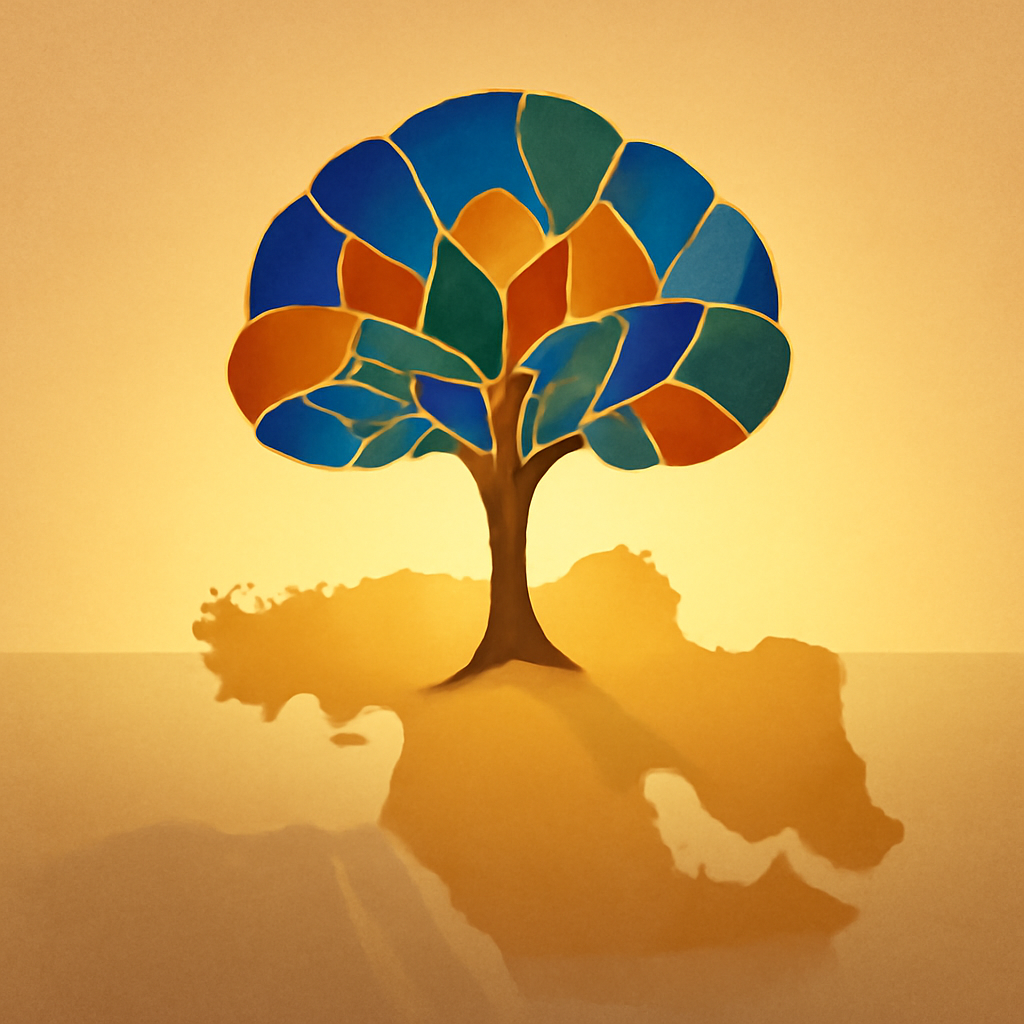
What Built the Middle East’s Living Mosaic
This 18-lecture course provides a 90-minute overview of art and culture across Arabic-speaking countries and the wider Middle East, covering the past, present, and future. It distinguishes the Arab world—defined by Arabic language across twenty-two states—from the broader Middle East that includes Persian, Turkish, Kurdish, Armenian, and Amazigh traditions. The course opens with the historical foundations of cross-cultural exchange between Byzantine, Sassanid, and Islamic traditions, then examines calligraphy as sacred geometry, architecture built around courtyards and light manipulation, pre-Islamic oral poetry evolving into modern novels, and the Maqam system of quarter-tone music. Regional spotlights cover the Maghreb's Amazigh tilework and Gnaoua music, Egypt's role as cultural exporter, the Levant's multi-confessional heritage, and the Arabian Peninsula's maritime and Nabati traditions. Non-Arab influences receive dedicated attention through Persian miniatures, Ottoman skylines, and Kurdish carpet-weaving. The course traces how European colonialism prompted the Nahda and nationalist art movements, surveys Egyptian cinema's Golden Age and modern Musalsalat television dramas, and treats food as social ritual through meze and coffee-house culture. Contemporary sections address visual arts from Hurufiyya to street art, diaspora hybrid identities in literature and hip-hop, gender and religious constraints on creative expression, and artistic responses to conflict through digital documentation and preservation. Final lectures examine AI, gaming, virtual heritage, and climate-driven urbanism, showing how the region continues to create new forms while maintaining its core pattern of cultural exchange and storytelling.
The Living Mosaic: An Introduction to a Multidimensional Region
The Living Mosaic: An Introduction to a Multidimensional Region
A term that shapes how the entire world thinks about this region was coined not by a historian, not by a diplomat, but by a naval strategist. Alfred Thayer Mahan, an American military thinker, popularized the phrase "Middle East" in 1902. His concern wasn't culture. It was control — specifically, the strategic corridor between British India and the Suez Canal. That origin matters, O, because it tells you something important right away: the label was imposed from outside, for reasons that had nothing to do with the people living there.
Now, the first thing to get straight is the difference between two overlapping but distinct ideas. The "Arab World" is a defined political and linguistic category. It comprises 22 countries belonging to the Arab League, stretching from Morocco on the Atlantic coast all the way to Oman on the Arabian Sea. Arabic is an official language in every one of them. Arabic is, in fact, the fifth most spoken language globally, and it has been one of the six official languages of the United Nations since 1973. The "Middle East," by contrast, is a geographic and geopolitical concept — broader, fuzzier, and, as Mahan's origin story shows, shaped by outside perspectives. It includes countries like Iran, Turkey, and Israel, where Arabic is not the primary language. That distinction, the Arab World versus the wider Middle East, is the, the foundational split this entire course is built on.
Think of it this way: the Arab World is a thread — a long, richly colored thread. The Middle East is the whole tapestry. And that tapestry contains threads you might not expect. Persian, spoken in Iran, carries one of the world's great literary traditions. Turkish connects a Central Asian heritage to a Mediterranean present. Kurdish communities, spread across Turkey, Iraq, Iran, and Syria, maintain a distinct cultural identity that no single national border contains. Armenian communities, some of the oldest Christian populations on Earth, have shaped the art and architecture of the Levant for centuries. And then there are the Amazigh people — the indigenous inhabitants of North Africa, whose linguistic and cultural heritage predates the seventh-century Arab-Islamic expansion. The Amazigh, sometimes called Berbers, are not a footnote. They are a foundation. Their presence is a reminder that even within the 22-country Arab League, the story is never, never simple.
Here's where the monolith stereotype starts to crack — and it cracks fast. For example, consider that a musician in Marrakech, a poet in Baghdad, a filmmaker in Beirut, and a calligrapher in Riyadh all operate within what gets lazily labeled "Arab culture." But their dialects are so different they might struggle to follow each other's casual conversation. Their religious practices, their food, their relationship to the state, their experience of gender — all of it diverges sharply. The key idea is this: treating the region as a single cultural block doesn't just flatten the picture. It actively misleads. It erases the Coptic Christian heritage of Egypt, the Jewish communities of Yemen and Morocco, the Druze traditions of the Levant, the Sufi orders of Sudan. The sub-regions we'll use as cultural anchors throughout this course — the Maghreb, the Nile Valley, the Levant, the Arabian Peninsula, and Iraq — each carry their own aesthetic logic, their own historical wounds, their own creative energy.
So the metaphor that holds all of this together — the one worth writing down — is the living mosaic. A living mosaic: not a fixed image, but a pattern that shifts as new pieces are added, broken, or rearranged. Once more, slowly — the image. A living mosaic: not a fixed image, but a pattern that shifts as new pieces are added, broken, or rearranged. That's the takeaway, O. The region's cultures are not relics. They are not uniform. They are alive, contested, and constantly in conversation with each other and with the world. Remember that frame as we move forward, because every lecture in this course is really about one question: who gets to add a piece to the mosaic, and who decides where it goes?
Historical Foundations: The Crossroads of Civilizations
Speaker 1
Alright, so last time we landed on this image of a living mosaic — cultures that shift and rearrange rather than stay fixed. And I keep thinking, where does that pattern actually start? Like, historically, what's the first layer?
Speaker 2
That's the right question to pull on. And the honest answer is — it starts earlier than most people expect. We're talking urban settlements in Mesopotamia by the fifth millennium BCE. The Sumerians had a written record by the late fourth millennium.
Speaker 1
That far back?
Speaker 2
That far back. And Egypt's civilization was taking shape at roughly the same time. So before we even get to the Islamic period, there are already thousands of years of layered exchange happening in this region.
Speaker 1
So the, the crossroads idea isn't a metaphor. It's literally geographic.
Speaker 2
Exactly. Bronze and Iron Age empires in Mesopotamia and Egypt were already shaping Levantine societies — places like Ugarit and Phoenicia. And here's a detail that stops most people cold.
Speaker 1
What's that?
Speaker 2
At Ugarit, on the Syrian coast, scribes in the thirteenth century BCE were using a cuneiform script where the signs represented alphabetic letters. And archaeologist Carole Roche-Hawley documented five writing systems and eight languages coexisting in that one city.
Speaker 1
Eight languages.
Speaker 2
Eight languages. One city. Thirteenth century BCE. That one city makes the larger point: this region is better understood as culturally diverse than uniform.
Speaker 1
That reframes everything. So by the time the Islamic caliphates arrive, they're not entering a blank slate.
Speaker 2
Not remotely. The Sasanian dynasty had ruled from 224 to 650 CE. Before Muslim rule, artists across these lands had worked under Byzantine or Sasanian patronage. Both left deep artistic and administrative legacies.
Speaker 1
And the early Islamic artists — what did they actually do with those legacies?
Speaker 2
Here's where the wrong answer is tempting. The wrong answer is: conquest erased everything and something entirely new began. The right answer is messier and more interesting.
Speaker 1
Which is?
Speaker 2
Artists who had worked under Byzantine or Sasanian patronage simply continued using familiar forms and techniques — now for Muslim patrons. The Met makes this point directly. The transition was gradual, not a rupture.
Speaker 1
Can someone give me a concrete example of that? Like, something you can actually see?
Speaker 2
The Dome of the Rock. Commissioned by Abd al-Malik around 691–692 in Jerusalem. It combines Greco-Roman, Byzantine, and Sasanian elements. The mosaics use winged vegetal motifs — that's a Sasanian visual language, placed inside an Islamic monument.
Speaker 1
Wait, say that again, slower — the date.
Speaker 2
Commissioned by Abd al-Malik around 691–692. And those mosaics are not decoration for decoration's sake. They're a statement about who the new patrons are and what traditions they're drawing from.
Speaker 1
Yeah. So it's adaptation, not erasure.
Speaker 2
Adaptation. That's the word. And the same logic applies to metalwork. Encyclopaedia Iranica notes that Islamic-era Persian metalwork shows direct continuity with Sasanian metalwork. New rulers, same craft traditions.
Speaker 1
Now, the Silk Roads — I want to make sure our listener has the right picture there, because I think most people imagine one road.
Speaker 2
Right, and that's the, the classic misconception. UNESCO is clear: it was a network of connected land and maritime routes, not a single road. The label itself was coined in the nineteenth century for networks that were already ancient.
Speaker 1
And what was actually moving along those routes? Because it wasn't just silk.
Speaker 2
Goods, yes — but also religions. Buddhism, Christianity, Islam, Zoroastrianism, Manichaeism. And artistic techniques. Think of luster-painted ceramics: the Met traces them from ninth-century Iraq spreading to Egypt, Syria, Iran, North Africa, Spain.
Speaker 1
That's a remarkable radius for a pottery technique.
Speaker 2
It really is. And the exchange wasn't one-directional. Chinese ceramics reaching Islamic lands from the ninth century inspired local makers — and some blue-and-white porcelain designs later drew on Islamic metalwork. The influence ran both ways.
Speaker 1
The takeaway for someone listening is — what they might assume was isolated invention often reflects cross-cultural adaptation.
Speaker 2
That's it exactly. The key idea is this: early Islamic art developed by drawing on established local traditions rather than eliminating them. Multiple languages coexisted, just as they had at Ugarit two thousand years earlier. The mosaic pattern is that old.
Speaker 1
Which means next time someone sees a geometric tile pattern or a mosque dome, they're looking at centuries of negotiation between traditions — not one culture's invention.
Speaker 2
Exactly. That's the thing they'll start noticing — the seams where one tradition meets another, visible right there in the ornament.
Script as Spirit: The Art of Arabic Calligraphy
A calligrapher in medieval Baghdad mixed honey, black soot, and saffron to make ink. Not paint. Not dye. Ink. And the surface he wrote on had been treated with starch, egg white, and alum to give it just the right resistance. Before a single letter appeared, the craft had already begun. That level of preparation tells you something. This wasn't utility. This was devotion.
Last time, we saw how early Islamic art adapted rather than erased the traditions it encountered. Earlier traditions — absorbed, transformed, continued. Now, that same logic applies to writing itself. Arabic calligraphy is, at its core, the artistic practice of handwriting Arabic script to convey harmony, grace, and beauty. UNESCO's definition is that precise. Twenty-eight letters, written right to left. What began as a practical need — making text clear and legible — became the primary visual art form across a vast region.
Here's a common misconception. People often assume calligraphy rose to prominence simply because Islam forbids images. That's, that's not quite right. Figurative art did flourish in many Islamic contexts — illustrated manuscripts, court paintings, ceramic decoration. The real driver was something more specific. The Qur'an was understood as direct divine speech, transmitted in Arabic. That status elevated the Arabic letter itself. The Qur'an's transmission in Arabic helped give calligraphy its high status. Calligraphy became a form of worship. And from there, it spread to architecture, ceramics, textiles, coins — every surface that could carry meaning.
Now, the key idea is that Arabic calligraphy is not one style. It's a family of distinct scripts, each with its own visual logic. From the tenth through the thirteenth centuries, a proportional system was codified. Letters were measured using rhombic, diamond-shaped dots — a unit of scale tied to the pen itself. From that system came what are called the Six Pens: naskh, thuluth, muhaqqaq, rayhani, tawqi', and riqa'. The Six Pens: naskh, thuluth, muhaqqaq, rayhani, tawqi', and riqa'. Each one differs in stroke weight, letter proportion, and rhythm.
Think of Kufic as architecture in ink. Angular letters, extended horizontal strokes — it dominated early Qur'ans and monumental inscriptions on buildings. Then naskh arrived: rounder, clearer, easier to read at small sizes. It became the workhorse of manuscripts and, eventually, of printed Arabic text. Thuluth is the, the grand one — larger, more ornate, used for headings and architectural inscriptions where visual impact mattered most. Meanwhile, Maghribi script developed in Spain and North Africa, and nasta'liq originated in Iran and Central Asia, spreading eastward. Same Arabic alphabet. Radically different visual personalities.
The calligrapher's primary tool was the qalam — a reed pen, chosen for its flexibility. Inks were made from soot, ox gall, gum Arabic, or plant essences. Before paper reached the Islamic world from China around the eighth century, scribes worked on papyrus and parchment. And the tools themselves? Shears, knives, inkwells, pen boxes — these could be made from precious materials, elaborately decorated. The instrument of writing was treated with the same reverence as the writing it produced. That means calligraphy appeared on manuscripts, yes — but also on marble carvings, embroidered textiles, metal etchings, and the walls of mosques.
Here's a detail worth sitting with. The Met notes that calligraphic ornament could carry a talismanic dimension — not just aesthetic appeal, but protective power. Not every viewer of an inscription could even read it. The visual form carried meaning independent of literacy. That logic runs directly into the present. Contemporary calligraphers use markers and synthetic paint. Spray paint goes on walls, signs, and buildings — calligraffiti, a form that fuses classical proportion with urban public space. Digital designers adapt the same stroke principles to screens. UNESCO recognizes Arabic calligraphy as a contemporary practice used across diverse communities.
The takeaway, O, is this. Calligraphy is not decoration applied to a surface. It is the surface's reason for existing. A single letter can be developed into an ornamental knot. A word can be shaped to resemble a brushstroke. The script is the art. Remember that the next time you see Arabic writing on a building, a tile, a piece of fabric — even a logo. You're not looking at text that happens to be beautiful. You're looking at a tradition that decided, centuries ago, that beauty and meaning are the same thing. Beauty and meaning are the same thing. That's the bet this entire tradition made. And it held.
Sacred Spaces and Urban Landscapes: Architecture of the ME
Speaker 1
Alright, so last lecture we landed on this idea that calligraphy isn't decoration applied to a surface — it is the surface's reason for existing. And I keep thinking, that same logic must apply to buildings, right?
Speaker 2
It absolutely does. And the connection is tighter than most people expect. The same impulse that shaped the letter shaped the room.
Speaker 1
So where does someone even start with Middle Eastern architecture? Because the range is enormous.
Speaker 2
Start with the mosque, because it's the, the foundational building type. And the origin story is surprisingly humble.
Speaker 1
How humble?
Speaker 2
The Met traces the early mosque back to the Prophet Muhammad's house in Medina. A mud-brick residence. Organized around an enclosed courtyard. A sheltered prayer area on one side.
Speaker 1
That's it?
Speaker 2
That's it. And from that courtyard logic, everything else grew.
Speaker 1
So walk our listener through the components — what are the key elements that actually define a congregational mosque?
Speaker 2
Right. So the qibla wall is oriented toward Mecca. Set into that wall is the mihrab — a niche that marks the direction. And here's a common misconception worth correcting.
Speaker 1
Which is?
Speaker 2
People assume the mihrab is where an imam stands to lead prayer. It's not. It's a directional marker. Its job is to orient worshippers, not to contain a person.
Speaker 1
Yeah, I had that wrong.
Speaker 2
Most people do. Then you have the minbar — the pulpit used for the Friday sermon. And the sahn, the open courtyard, which is often the heart of the whole complex.
Speaker 1
And the minaret?
Speaker 2
The minaret is the vertical marker — the call to prayer, the skyline signal. But the proportions and form vary wildly by region. An Ottoman minaret is a pencil. A Maghrebi minaret is a square tower.
Speaker 1
That's a striking contrast. So the same functional elements produce completely different visual results depending on where you are.
Speaker 2
Exactly. And that's the key idea — function is shared, form is local. Think of the Selimiye Mosque in Edirne. The architect Sinan used a single great dome supported by eight pillars.
Speaker 1
Wait, say that again, slower — the structural move.
Speaker 2
One great dome, supported by eight pillars. And around it, Sinan built a full külliye — a library, madrasas, a covered market, courtyards. The mosque is the anchor of a whole social ecosystem.
Speaker 1
So it's not just a prayer hall. It's, it's infrastructure.
Speaker 2
That's the right word. And the financing mechanism behind that infrastructure is called a waqf — a religious endowment. A donor would dedicate property or income to fund a mosque, a school, a fountain, a hospital.
Speaker 1
All connected?
Speaker 2
All connected. The waqf is what kept these complexes running for centuries without state budgets. It's how premodern cities actually functioned — markets, baths, caravanserais, all woven together through endowment.
Speaker 1
So the city itself is a financial instrument.
Speaker 2
In a sense, yes. And the physical form reflects that. Plain exterior walls on a traditional home aren't a lack of ornament — that's the wrong answer people reach for.
Speaker 1
What's the right answer?
Speaker 2
Deliberate design. The exterior protects privacy and deflects heat. The interior is where life happens — the courtyard, the fountain, the carved screens called mashrabiyas that filter light and air.
Speaker 1
Mashrabiyas — those are the latticed wooden screens?
Speaker 2
Right. They regulate airflow, reduce glare, and let someone inside see out without being seen. Climate control and social privacy in one element.
Speaker 1
And windcatchers do something similar?
Speaker 2
Windcatchers catch prevailing breezes at height and channel them down into rooms below. Thick walls absorb daytime heat and release it slowly at night. Water channels cool the air through evaporation. The whole building is, it's a passive climate system.
Speaker 1
For someone listening who's new to this — think of it like a building that does what your thermostat does, but with geometry instead of electricity.
Speaker 2
That's exactly it. And then there's muqarnas — the element that really stops people.
Speaker 1
Describe it.
Speaker 2
Clustered niche-like forms, stacked to mediate the transition between a flat wall and a dome. The Met calls the effect honeycomb-like, or stalactite. Geometrically, each tier steps inward.
Speaker 1
So it's solving a structural problem — how do you move from a square room to a circular dome — but it becomes the most ornate thing in the building.
Speaker 2
Structure becomes spectacle. And you see that logic in buildings across regions and periods.
Speaker 1
And the diversity across those traditions is real, not superficial.
Speaker 2
Very real. Sana'a's tower houses are rammed earth and brick, with geometric gypsum façades. Shibam in Yemen packs tall mud-brick towers into a walled city.
Speaker 1
Mud brick, multiple stories?
Speaker 2
Multiple stories. At the start of the 17th century, Shah Abbas I shaped Isfahan's Meidan Emam as a public square bordered by arcades, mosques, a palace pavilion, and a bazaar entrance. One square, bringing civic functions together.
Speaker 1
Jerusalem’s Old City brings sacred geographies, markets, homes, processional routes, and communities of Judaism, Christianity, and Islam into unusually close proximity.
Speaker 2
Which is the point UNESCO keeps making. A historic city is more than its landmark buildings. It's the social practices, the economic processes, the natural setting — all of it together.
Speaker 1
The takeaway for our listener, then?
Speaker 2
The building is more than just a building. Next time someone walks past a latticed screen on a window, or notices a honeycomb ceiling in a photograph — that's centuries of climate logic, social design, and geometric ambition, all compressed into one surface.
The Power of the Word: Literature and Oral Traditions
A man rides into a rival camp. No sword. No army. Just words. In pre-Islamic Arabia, that was enough. Poets were not entertainers on the side. They were, the, the closest thing a tribe had to a press secretary, a lawyer, and a general rolled into one. A skilled poet could praise allies in verse that spread across the desert faster than any messenger. And a well-aimed satire could humiliate a rival clan for generations. Arabic poetry has a long history as both literary art and a record of communal identity. Poets spoke for their communities. They praised allies and satirized rivals. The word was a weapon, and everyone knew it.
Last time, we moved through buildings designed to orient bodies, shape light, and gather communities. But long before words covered a dome, marked a mihrab, or filled a manuscript, they lived in the voice. In much of the region, language was not simply information. It was performance, memory, and public power. Pre-Islamic Arabic poems were transmitted orally, sometimes for centuries, before Muslim scholars in the eighth and ninth centuries collected and edited them into written form. That gap matters. Oral transmission is not passive storage. Performers shaped the poems as they recited them. Emphasis shifted. Lines were added. The poem arrived on the page already changed by every voice that had carried it. The qaṣīdah, a long Arabic ode, developed in oral performance and was later preserved in written form. Its history is, it's a perfect illustration of how oral and written literature can overlap rather than replace each other.
The most celebrated examples of that pre-Islamic tradition are the Muʿallaqāt. Their history belongs to a tradition shaped by oral transmission and later preservation in writing. The Muʿallaqāt are a celebrated group of long poems associated with pre-Islamic Arabic poetry. The number included varies by anthology, which is itself a clue. There was no fixed original. Different scholars made different choices. And the diversity doesn't stop there. Nabati poetry is a vernacular tradition from Bedouin communities of the Arabian Peninsula and Gulf, linking oral expression with social and historical memory. In Lebanon, al-zajal is folk poetry recited or sung at family occasions and in everyday life. Al-zajal performances can take the form of poetic jousts, O, poets exchanging challenging verses while musicians and audiences join in. UNESCO notes that these exchanges can serve as a social outlet and even help resolve conflicts.
Now consider a tradition carried by women's voices in domestic settings. Palestinian hikaye is a women's narrative tradition. Traditionally narrated in domestic settings, by women, to women and children. The stories addressed family and social concerns. They could critique society from women's perspectives. Hikaye performances rely on spoken language, emphasis, rhythm, and vocal inflection to hold listeners' attention. No stage. No instrument. Just voice and room. Arabic literary culture includes both formal literary Arabic and regionally varied spoken dialects. Hikaye, for example, is narrated in rural fallahi or urban madani dialect, not in classical Arabic. That distinction matters. Spoken dialects carried stories in voices distinct from formal literary Arabic.
Now, the wrong answer about The Thousand and One Nights is one most people hold with total confidence. The wrong answer is: it's a single Arab book, written by one author, with a stable set of stories. The right answer is messier and far more interesting. The Nights has no single stable original collection. Scholarship describes it as a composite work shaped over centuries, with stories transmitted orally and added in different places and periods. Its stories draw on traditions from India, Iran, Iraq, Egypt, and Turkey. Persian storytelling traditions contributed significantly. And here's the detail that stops people cold. Many stories especially familiar to Western audiences, including Aladdin and Ali Baba, were added notably in later European adaptations. Aladdin and Ali Baba were added in later European adaptations. The frame story, Scheherazade delaying her execution through storytelling, is what holds the whole composite together. Narration itself becomes the survival mechanism.
Arabic literature didn't stop at the oral or the classical. It developed into modern forms, including the novel. Egyptian writer Naguib Mahfouz received the Nobel Prize in Literature for works written in Arabic. That achievement was a landmark. It signaled to a global audience that Arabic-language literature carried the full weight of world literature. And the Armenian epic tradition deserves a mention here too. The Daredevils of Sassoun recounts a hero defending his homeland. UNESCO documents 160 variants of it. One hundred and sixty. Some sections are sung as rhyming verse. The tradition is performed in a lyrical, rhythmically delivered style. One epic, 160 different shapes, O, showing how oral literature can live in many variants.
The key idea across all of this is that the word in this region was not just text on a page. It was performance, memory, social glue, political weapon, and survival strategy. UNESCO notes that mass media and disruption of social life can threaten the continuity of an oral tradition. That's the pressure these forms are under right now. The takeaway, O, is this. Next time you hear someone describe a story as "just a folk tale," remember what folk tales actually did. Lebanese al-zajal exchanges could help strengthen cohesion and resolve conflicts. They let Palestinian women critique power from inside a domestic room. They kept an Armenian hero alive across 160 versions. The word moved. It kept moving. And the tradition that started with a poet riding into a rival camp with nothing but language is still, right now, finding new forms to carry itself forward.
Rhythms of the Heart: Maqam and Musical Heritage
A woman stands at a microphone in Cairo. She hasn't sung a single note yet. The audience is already leaning forward. She begins a phrase. Holds it. Bends it. The crowd calls back — not applause, something more urgent. A kind of collective exhale. She repeats the phrase, slightly differently. They call back again. This goes on for hours. That exchange, between Umm Kulthum and her audience, is one of the most documented musical phenomena of the twentieth century. Her repertoire spanned religious, sentimental, and nationalistic songs. A mechanism underneath it — the invisible architecture shaping the notes she bent — was the maqam.
Last lecture, O, we landed on this: the word in this region was not just text. It was performance, memory, and survival strategy. Music carries the same weight. Now, the key idea for this lecture is that maqam is not a scale. That's the wrong answer, and it's the one most people reach for first. A maqam is a framework of pitches, characteristic melodic motifs, and customary ways of shaping a melody. Britannica is precise about this. The identity of a maqam includes more than its notes — performers and knowledgeable listeners recognize characteristic melodic gestures and a distinctive musical character. A maqam is a framework, not a scale. Think of it like the difference between knowing the rules of chess and knowing how a grandmaster plays. Same board. Completely different thing.
So how does it actually function? A maqam has pitches, yes. But it also has characteristic phrases — melodic gestures that signal which maqam you're in. It has customary paths for moving between related modes. And it has a sense of where the melody should go and how it should resolve. Maqamat are principally melodic frameworks. Rhythmic patterns are a related but distinct organizing dimension — they don't collapse into each other. Now, the wrong answer about Middle Eastern music is one you've probably heard: that it all uses quarter-tones. That's, that's not quite right. Performance doesn't reduce neatly to equal quarter-tones. The system is more fluid than that. Two forms of improvisation sit at the heart of performance. Taqsim is instrumental — a player moves through a maqam, visits related modes, and often returns to the starting point. Layali is vocal — a singer explores a maqam through expressive, often extended syllables. Both are live navigation, not recitation.
For example, Iraqi maqam shows how this framework becomes a full performance tradition. It's a major Iraqi classical vocal tradition with a large repertoire of songs and a close relationship to Arabic poetry, both classical and colloquial. The ensemble that anchors it traditionally includes the santur, the jawzah spike fiddle, the dumbak drum, and the daff tambourine. Each instrument has a role. The santur carries melodic weight. The percussion holds the rhythmic frame. The lead singer's improvisation moves against and with all of it. And the settings? Private gatherings, coffeehouses, theatres. The music moves between intimate and public without losing its character.
Here's where it gets interesting for you, O. The maqam concept doesn't stop at Arabic music. It has related counterparts — Turkish makam, Azerbaijani mugham, Central Asian shashmaqom, and Persian concepts like dastgah and gusheh. Same family. Different branches. And here's the detail that stops people cold: Arabic and Turkish maqam names often have Persian origins. Iranian cultural influence shaped the system during its formative period. The names traveled with the music. Shashmaqom — the name literally means six maqoms — developed in urban centers of Central Asia, in what is now Uzbekistan and Tajikistan. Its repertoire is transmitted primarily from master to student, because conventional notation can record its general framework. The nuance lives in the relationship, not the page. Meanwhile, Moroccan Gnawa brings together music, ritual, and brotherhood practices, mixing sacred and secular elements, reflecting interactions among African ancestral practices, Arab-Muslim influences, and Amazigh cultural traditions.
In 1932, musicians and scholars gathered in Cairo for a congress on Arab music. The congress used recording technology as part of its scholarly work — making it an early large-scale international forum to document Arab musical practices through recordings. They debated modes, instruments, songs, education. The future of the tradition, argued out in real time. That debate points to something the music itself already knew. The oud — a short-necked, pear-shaped lute found across much of the Middle East and North Africa — had been carrying these conversations for centuries before anyone wrote them down. The word for what happens when a performance fully lands is tarab. Repetition, improvisation, audience response, poetic delivery — all of it building until the room is, the room is changed. That's not a metaphor. It's the mechanism.
The takeaway, O, is this. Maqam is a bet the tradition made — that music is not a fixed object delivered to a passive audience. It's a live negotiation between performer and room. Remember that the next time you hear a melody that bends in a way you didn't expect, that holds a note longer than feels comfortable, that makes the room lean in before the resolution arrives. That bend is not decoration. It is the point. You'll start noticing it — in a film score, in a restaurant, in a recording you've heard a hundred times. The maqam may have been there. Now you'll hear it.
Regional Spotlight: The Maghreb and the Nile Valley
A storyteller in Marrakesh's Jemaa el-Fna arrives before sunset. No stage. No ticket booth. He sets down a small mat, clears his throat, and begins. Within minutes, a circle of listeners forms around him. He's not reciting a fixed text. He's adapting older material, improvising for this crowd, tonight. UNESCO notes that Jemaa el-Fna's oral performers renew older material by adapting and improvising it for contemporary audiences. That square holds storytellers, musicians, food vendors, and healers, all at once. It's a living cultural space, not a museum exhibit. And it's under pressure. Urban development and tourism are changing what the square can sustain.
To understand a region, begin with a specific place and a specific practice. Jemaa el-Fna shows how public performance, commerce, memory, and tourism meet in one square. From there, the Maghreb comes into view: commonly North Africa west of Egypt, though its boundaries and meanings remain debated. The Maghreb cannot be understood through Arabic heritage alone: Amazigh languages, Mediterranean exchange, Islamic dynasties, Ottoman connections in parts of the region, European colonialism, and African ties all matter.
Think of the Maghreb as a surface that has been written on, erased, and written on again, many times over. Phoenician and Roman networks connected it to wider Mediterranean worlds. Roman-era North Africa developed flourishing urban centers, particularly in parts of present-day Tunisia, Algeria, and Morocco. After the Arab conquests, local Amazigh populations and dynasties shaped the region's political and cultural history from within. Medieval dynasties, the Idrisids, Aghlabids, Fatimids, Almoravids, Almohads, each left distinct marks. Then French colonial rule arrived. It affected language, education, and cultural identity. It also shaped how North Africa was described and studied from outside. Colonial categories influenced later national narratives in ways that are, that are still being untangled.
Here's a detail worth sitting with, O. Morocco's constitution recognized Tamazight as an official language alongside Arabic. That was a significant legal change for Amazigh language and identity. And yet, even after recognition, Arabic and French literature both remain part of the Maghreb's literary landscape. Independence and state-led Arabization did not end French-language writing. The, the literary field stayed genuinely multilingual. That means a Moroccan writer today might choose Arabic, French, or Tamazight, and each choice carries a different set of political and cultural stakes. The language you write in is not just a tool. It's a position.
Now, the Nile Valley. The Nile links Egypt and Sudan, but it does not erase the distinct histories of Nubian, Egyptian, Coptic, Sudanese, and other communities. Nubia sits in the middle of that story. The Kingdom of Kush was a major ancient power whose heartland included Meroe and associated sites in present-day Sudan. The archaeological sites at Meroe preserve pyramids, temples, and palaces documenting Kushite political, religious, and artistic life. And here's the detail that stops people cold. Nubian communities produced written languages of their own. Meroitic script appeared in antiquity. Old Nubian was later written using an adapted alphabet based largely on Coptic letters. Meroitic remains only partly understood, in part because researchers lack bilingual texts that would make decipherment easier.
The construction of the Aswan High Dam threatened archaeological sites in Nubia with inundation. UNESCO coordinated an international salvage campaign. It led to the relocation of major monuments, including the temple complexes at Abu Simbel and Philae. The scale of that campaign is, it's easy to underestimate. It involved archaeological work at hundreds of sites and the recovery of thousands of objects, in addition to moving the threatened temples themselves. Coptic Christian art and material culture are also part of Egypt's historical record. Nubian monuments preserve evidence spanning ancient Egyptian, Ptolemaic, Roman, and Christian traditions. The Met's account of Nubia highlights the region's role as an intermediary between the Mediterranean and sub-Saharan Africa, including in the movement of luxury goods such as ivory.
The Maghreb makes language choice and public cultural space especially visible; the Nile Valley foregrounds Nubian history, monument preservation, and the politics of river landscapes. Together, these cases show why regional labels are starting points for inquiry, not final explanations. Remember that the next time you see a photograph of a pyramid in Sudan, not Egypt. Or hear a Moroccan writer interviewed in French. Or read that a script from antiquity is still only partly decoded.
Regional Spotlight: The Levant and the Arabian Peninsula
A stonemason in northwestern Arabia, sometime in the first century CE, carved a tomb facade into a sandstone cliff. No mortar. No scaffolding in the modern sense. Just chisels, rope, and an eye for proportion. The finished facade had pilasters, eagles, and Nabataean inscriptions. It was one of 94 decorated tombs at a site now called Hegra. Hegra preserves 111 monumental tombs in total, along with wells that demonstrate the Nabataeans' hydraulic expertise. That combination, monumental carving and water engineering, in a landscape most people would call empty, is the first clue that the Arabian Peninsula's cultural story is not what the stereotype suggests.
This lecture follows a specific contrast. Levantine cities and the Arabian Peninsula were connected by commerce, pilgrimage, mobility, and family networks, yet their cultural geographies developed differently. In the Levant, dense cities became meeting places for empires, faiths, and markets. Across the Peninsula, desert routes, ports, and coastal waters shaped forms of hospitality, craft, and work. The Arabic-speaking world is not identical to the wider Middle East, and neither region can be reduced to a single cultural pattern.
Think of Aleppo. From the second millennium BCE, it sat at the intersection of trade routes. Hittites, Assyrians, Arabs, Mongols, Mamelukes, Ottomans, each ruled it in turn. That succession left a physical record. A thirteenth-century citadel. A twelfth-century Great Mosque. Madrasas, palaces, caravanserais, hammams, all layered into one urban fabric. One city, many centuries, many hands. That density is central to Levantine urban life. In Jerusalem, the Umayyad Dome of the Rock, completed in 691, remains a defining landmark within a sacred urban landscape shared, contested, and interpreted by multiple religious communities.
Now, not all Levantine culture lives in stone. Palestinian dabkeh is a group dance performed at weddings, graduations, and festivals. UNESCO's record specifies eleven dancers, regardless of gender. The number is precise because the dance depends on coordinated communal movement: a line holds rhythm, steps land together, and participation becomes visible. The majlis, found in several Peninsula societies and beyond, is a gathering space for receiving guests, deliberating on community matters, and practicing hospitality. It is not simply a room; it is a setting where conversation, welcome, and collective decision-making take form.
The Arabian Peninsula is often pictured as isolated desert, but its routes and coastlines connected communities across wide distances. Arabic coffee is a shared living tradition recognized by UNESCO across the UAE, Oman, Qatar, Saudi Arabia, and Jordan. Older people and guests are served first, and a drinker shakes the cup to signal they are finished. This etiquette is social protocol: it marks respect, sequence, and the responsibilities of host and guest. Al Sadu weaving reveals another dimension of Peninsula life. Bedouin women create geometric designs on ground looms using natural fibres, while men shear animals and women clean wool, spin, dye, and weave. The textile records gendered craft labor as well as material design.
And then there is the sea. The historic pearling landscape in Muharraq, Bahrain, includes buildings in the city, offshore oyster beds, part of the shoreline, and Qal'at Bu Mahir, from which boats once departed. UNESCO describes it as a complete example of the cultural tradition and wealth generated by pearling when that trade dominated the Gulf economy. Songs sung aboard the boats encouraged workers and preserve the soundscape of Gulf maritime labor. They point to a history of skilled, dangerous, collective work at sea. Alongside desert textile production, pearling shows how Peninsula life was shaped by both mobile and settled worlds.
Set side by side, these regions show different cultural geographies: Levantine cities shaped by dense urban layering, and Peninsula societies shaped by desert routes, hosting practices, craft production, and maritime work. These practices reveal how belonging is enacted through movement, hosting, making, and work across city, desert, and sea. Next time you see a geometric pattern on a woven textile, or watch someone shake a small cup after a drink, notice the social knowledge involved rather than seeing mere decoration. The cup shake marks a relationship. The pattern carries the trace of making.
Beyond Borders: Persian, Turkish, and Kurdish Influences
Speaker 1
Alright, so last time we landed on this idea that belonging gets enacted through movement, hosting, making, and work — across city, desert, and sea. And I keep thinking, that same logic must apply to the non-Arab traditions in the region.
Speaker 2
It absolutely does. And this is where the map gets genuinely complicated — in the best way.
Speaker 1
So where does someone even start? Because Persian, Turkish, Kurdish — these are not small footnotes.
Speaker 2
They're not footnotes at all. One thing to get straight is that the Arabic-speaking world and the wider Middle East are overlapping, not identical, cultural geographies. Persian and Turkish are not Arabic, and Kurdish communities span several states and languages. They are structurally unrelated.
Speaker 1
Unrelated?
Speaker 2
Completely. And yet they shaped each other profoundly. That's the, the thing that stops people cold.
Speaker 1
Give our listener a concrete example of that shaping.
Speaker 2
Think of Ottoman Turkish. It drew so substantially on Persian and Arabic vocabulary that scholars describe it as a language built from three streams. Persian served as a prestigious literary model — many Ottoman literary forms, genres, and themes derived directly from Persian literature.
Speaker 1
So Persian wasn't just a neighbor. It was, it was the template.
Speaker 2
For court culture, yes. Persian served as a prestigious literary language that helped shape literary Turkic itself. And the borrowing ran both ways — Persian absorbed Turkic vocabulary too.
Speaker 1
That's a much messier picture than the one most people carry around.
Speaker 2
It is. And the wrong answer here is to treat these as isolated national cultures. The right answer is intersecting histories — courts, migration, translation, trade routes.
Speaker 1
Okay, so walk our listener through what that actually looked like at the Ottoman court.
Speaker 2
So at the court of Mehmed the Second, Iranian, Ottoman, and European artists and scholars were all working together. Different artistic repertoires, one court. And when the Ottomans expanded into former Mamluk lands, more Iranian and Arab artists came in.
Speaker 1
And Hagia Sophia — that's part of this story too, right?
Speaker 2
Central to it. After the Ottoman conquest of Constantinople, Hagia Sophia was converted into an imperial mosque and became a major source of inspiration for Ottoman architects. The structural logic — a great dome, the spatial drama — fed directly into later imperial mosque design.
Speaker 1
Wait, say that again, slower — the influence direction.
Speaker 2
Hagia Sophia's dome became a model Ottoman architects built from. And Ottoman architectural forms — domes, pencil-shaped minarets, domed porticoes — then spread across a vast area, while local variations remained.
Speaker 1
So the influence chain goes Byzantine to Ottoman to everywhere else.
Speaker 2
Roughly, yes. And Persian miniature painting is another node in that same network. Safavid painting drew on earlier Timurid court studios. Works made for Ottoman patrons could bear close relationships to Safavid manuscript styles.
Speaker 1
So the, the same manuscript tradition was crossing what we'd now call national borders.
Speaker 2
Constantly. And Persian poet Nezami is a perfect case — his works inspired poets writing in Turkish, Kurdish, and Urdu, and artists illustrated his stories across centuries. One poet, multiple literary traditions downstream.
Speaker 1
Now, Kurdish — because I think our listener might be wondering how a culture without a nation-state holds together.
Speaker 2
That's exactly the right question to ask. The absence of a Kurdish nation-state does not imply the absence of coherent cultural traditions. Kurdish communities span several states and languages.
Speaker 1
Like what, specifically?
Speaker 2
Dengbêj performance is one. It's an oral song tradition — and its contemporary framing as cultural heritage is directly connected to debates about Kurdish language and identity. The singing carries the language when other institutions can't.
Speaker 1
And Newroz — that's Kurdish too, but also much wider?
Speaker 2
Much wider. UNESCO’s multinational inscription for Nowruz includes Iran, Iraq, Türkiye, and other countries. But a tradition shared across borders need not be culturally uniform — Nowruz has different names, practices, and meanings among the communities that celebrate it.
Speaker 1
So the, the festival is the same event and a completely different event depending on where you're standing.
Speaker 2
That's a good way to put it. And carpet motifs work similarly — textile traditions were part of a connected artistic world encompassing Persian and Ottoman production, courtly patronage, and trade. The pattern on a carpet can carry regional identity without a border to enforce it.
Speaker 1
What about communities that aren't Persian, Turkish, or Kurdish but still shaped these cities?
Speaker 2
This is where the picture gets even richer. The Balyan family — Armenian architects — played a significant role in shaping nineteenth-century Ottoman Istanbul. The histories of Armenian, Persian, Turkish, Kurdish, Arab, and other communities are best understood as intersecting histories, not as isolated national cultures.
Speaker 1
So the city itself was a kind of workshop where all these traditions met.
Speaker 2
And the Mevlevi Sema is maybe the clearest example of that synthesis. The Mevlevi order originated in Konya. Its training integrated religious practice with music, poetry, ethics, and movement — the ney flute, vocal sections, the whirling itself.
Speaker 1
But UNESCO flagged something about how it's transmitted now?
Speaker 2
Yes — performances have sometimes been shortened or adapted for tourists, which raises real questions about cultural transmission. When the ceremony becomes a show, what gets lost in the edit?
Speaker 1
[reframe-as-bet] I'd wager the thing that gets lost is exactly the part that can't be photographed.
Speaker 2
Fair wager. The key idea across all of this is that Persianate influence was not confined to Iran — literary and artistic forms traveled through courts, migration, translation, and regional exchange. The influence moved; the borders came later.
Speaker 1
So for everyone listening — the takeaway is that next time they see a geometric carpet pattern, or hear a melody that bends in a way they recognize from earlier in this course, they might now notice the, the seam where Persian met Turkish met Kurdish met Armenian.
Speaker 2
That seam is the actual history. These are intersecting histories, not isolated national cultures. Notice the seam — that's where the real story lives.
Colonialism and the Search for Modern Identity
A young Egyptian student in Paris, sometime in the 1820s, kept a journal. He was astonished by the theater. By the newspapers. By the public debates. What matters here is what followed. And when he came home, he didn't conclude that Egypt needed to become France. He concluded that Egypt needed to reclaim its own capacity for reason and reform. That distinction, between borrowing and becoming, is the, the fault line running through everything in this lecture.
Across the region, O, inherited traditions and new ideas could intersect rather than run in parallel. Influence moved across borders that hadn't been drawn yet. Now those borders get drawn. And the drawing changes everything. The key idea here is that colonialism did not produce one modern Middle Eastern identity. Responses differed across societies, communities, and political movements. Cultural renewal could combine inherited traditions with new ideas. Colonialism did not create a single modern Middle Eastern identity. That's the frame. Hold it.
The nineteenth-century Arab Nahda is often translated as renaissance or awakening. Scholars caution, though, that those European terms can obscure what the Arabic word actually carried. The Nahda was not simply a reaction to Europe. It involved debates about language, freedom, reform, and the past. Its participants developed different visions of modern Arab culture. Think of writers and reformers debating language, freedom, reform, and the past. Or Jurji Zaydan, who wrote historical novels that made Arab history vivid and accessible to a new reading public. These weren't men copying Europe. They were, they were building something.
The wrong answer about the mandate-era settlement is that it was a clean, rational reorganization. It wasn't. The 1916 Sykes-Picot Agreement was a secret Anglo-French wartime arrangement, made with Russian assent, for dividing Ottoman territories into spheres of influence. Later mandate arrangements helped shape several modern regional borders. The League of Nations mandate system presented foreign administration as preparation for self-government, while placing former Ottoman territories under European powers. Syria and Lebanon came under French mandates. Britain administered Palestine and Transjordan, which was administered separately. The, the stated promise of eventual independence existed alongside contested political commitments and competing national aspirations.
In Algeria, French conquest began in 1830. Colonial rule shaped language, education, law, land, and political status for generations. Here's the detail worth sitting with, O. French became an important language of writing and public life in Algeria. But its use did not necessarily mean cultural submission. Algerian writers could appropriate the colonizer's language to describe colonial experience and resist colonial power. Debates over Arabic, French, and Amazigh in Algeria concern schooling, state policy, literary access, and whose history is publicly recognized. They show that independence did not instantly resolve the linguistic structures created under colonial rule.
After the discovery of Tutankhamun's tomb, Egyptian interest in Pharaonic antiquity gained new public and political force. Some nationalists invoked ancient Egypt as part of the case for independence. Egyptian Egyptologists sought greater national control over the Egyptian Museum, the Antiquities Service, excavations, and antiquities. The wrong answer here is that archaeology was purely a colonial instrument. The right answer is messier. Local scholars and nationalists also used archaeological expertise and ancient history to contest foreign control and shape modern identity. Egyptian national identity drew on Arab, Islamic, and Pharaonic pasts. These strands could be combined or contested rather than treated as mutually exclusive.
In Turkey, the republican government replaced the Arabic-based script used for Ottoman Turkish with a Latin alphabet as part of a wider state-led project of national and cultural transformation. That reform altered access to older written materials. It helped create a break in continuity between generations of readers. Different societies. Different instruments. Same underlying pressure: who controls the terms of modern life?
The takeaway, O, is this. Modernity in this region was not a delayed imitation of Europe. It was a negotiation, sometimes forced, sometimes chosen, between inherited traditions and new pressures. Next time you see a map of the Middle East, notice the straight lines. Borders that cut across mountains, rivers, and communities. Several modern regional borders were shaped by wartime agreements and later mandate arrangements. And the cultures that survived those lines, that argued back in the colonizer's own language, that used ancient tombs to make the case for independence, that kept oral traditions alive when scripts were changed overnight, those cultures were not passive. They were not passive. Remember that.
The Silver Screen: Cinema and Television in the Arab World
Speaker 1
Alright, so last time we landed on this idea that modernity in the region wasn't a delayed imitation of Europe — it was a negotiation. And I keep thinking, nowhere is that more visible than cinema.
Speaker 2
That's exactly the right thread to pull. And the starting point is earlier than most people expect.
Speaker 1
How early?
Speaker 2
Lumière screenings in Alexandria in 1896. Almost immediately after cinema emerged in Europe. Though those early screenings primarily served European residents, not local Egyptian audiences.
Speaker 1
1896. So the technology arrived fast — the industry took longer.
Speaker 2
Much longer. The first film made by an Egyptian is Mohamed Bayoumi's short from 1922. And then Aziza Amir's feature, Laila, in 1927 — which is, it's a landmark because Amir was both producer and performer.
Speaker 1
So women were foundational to the industry from the start, not a later addition.
Speaker 2
From the very beginning. And here's the detail that stops people cold — by 1926, 86 cinemas were already operating in Egypt. The exhibition infrastructure was there before the production industry caught up.
Speaker 1
Eighty-six.
Speaker 2
Eighty-six cinemas. Silent era. And then Misr Studios arrives — established in 1934–35 — helping turn Egyptian filmmaking into an organized Arabic-language industry.
Speaker 1
Wait, say that again, slower — the founding.
Speaker 2
Misr Studios, established in 1934–35. And there's a surprising backstory: the Misr Corporation behind it was founded in 1925 with backing from Misr Bank. Early film development was tied directly to nationalist economic institution-building.
Speaker 1
So cinema and nationalism were linked from the financing stage.
Speaker 2
Exactly. And Cairo became a regional hub — Egyptian films circulating widely across the Arab world. The 1940s through the 1960s are what scholars commonly call the golden age.
Speaker 1
What made it golden, specifically?
Speaker 2
musicals, melodramas, stars whose voices people already knew from radio. Singer Mohamed Abdel Wahab linked cinema directly to Arabic popular music. The screen and the song were, they were the same cultural event.
Speaker 1
And that's how Egyptian colloquial Arabic spread so widely?
Speaker 2
That's the mechanism. Film, radio, songs, television — all reinforcing the same dialect. Egyptian Arabic became widely understood across the Arab world not through policy but through entertainment.
Speaker 1
Now, the wrong answer about this period is to treat Egyptian cinema as basically an imitation.
Speaker 2
And that's the wrong answer, yes. The genres overlapped, but the cultural logic was different. Cairo Station from 1958 is a notable work of Egyptian cinema. It's engaging with Egyptian social reality directly.
Speaker 1
Chahine's career spanned more than five decades, right?
Speaker 2
More than five decades. And Egypt's 1952 revolution changed the relationship between cinema and the state — nationalization of parts of the industry brought state patronage and political pressure into the same room.
Speaker 1
And that tension continued—
Speaker 2
It did. And it's not unique to Egypt. Arab cinema is not one national industry. Production conditions, funding, languages, audience pathways — all of it differs across countries.
Speaker 1
Right. So what's the broader picture for the region?
Speaker 2
The Carthage Film Festival, launched in Tunis in 1966, was conceived as a platform for Arab and African cinema — dialogue between filmmakers and audiences across the region, not just a showcase.
Speaker 1
And women directors — where do they fit in this story?
Speaker 2
Documentary filmmaking became a significant form of expression for Arab women directors. Ateyyat El Abnoudy, Jocelyne Saab, Selma Baccar, Mai Masri — documentary's relatively lower production costs offered a route when investment and censorship made features harder.
Speaker 1
Censorship is, it's a constant pressure throughout this whole story.
Speaker 2
Governmental and societal both. Filmmakers encounter restrictions affecting production, exhibition, access to audiences. Saudi Arabia's commercial cinemas were closed for more than three decades — they reopened in 2018.
Speaker 1
And Haifaa Al-Mansour shot Wadjda entirely inside the country in 2012, before the reopening.
Speaker 2
Which makes it a milestone precisely because of those constraints. Now, television — because the shift to satellite changes everything.
Speaker 1
How fast did that shift happen?
Speaker 2
Satellite television transformed Arab media from the early 1990s onward. MBC, founded in 1991, was an early privately owned Arabic-language satellite broadcaster. Before that, national television was dominated by government-controlled news.
Speaker 1
And Al Jazeera comes in 1996.
Speaker 2
1996. Round-the-clock news, live debate, coverage crossing national boundaries. And here's the, the surprising backstory — BBC Arabic Television ran a short-lived experiment in 1994, and some of its staff later formed the core of Al Jazeera's newsroom.
Speaker 1
BBC staff built Al Jazeera.
Speaker 2
The lineage is direct. And satellite didn't only carry news — it popularized reality television and live audience participation across the Arab media landscape. The wrong assumption is that it was purely a political medium.
Speaker 1
So for everyone listening — the takeaway is that the contemporary ecosystem didn't appear from nowhere.
Speaker 2
It grew from a century of negotiation. Today the Doha Film Institute supports projects at development and post-production stages. Independent funds like AFAC finance cinema and documentary work. The infrastructure for Arab cinema is now genuinely regional, not just Egyptian.
Speaker 1
When someone watches Arabic-language television today, they're encountering part of a very long chain — from a Lumière screening in Alexandria to satellite broadcasting and a regional media ecosystem.
Speaker 2
That chain is the story. Notice it.
The Art of the Table: Food and Social Culture
Speaker 1
Alright, so last time we traced how cinema became a negotiation — borrowed technology, local meaning, regional reach. And I keep thinking, food does exactly the same thing.
Speaker 2
It does. And the parallel runs deeper than most people expect. Food is not just what's on the plate. Scholars describe foodways as encompassing the whole social context — fields, markets, kitchens, restaurants.
Speaker 1
So the, the recipe is almost the least interesting part.
Speaker 2
Often, yes. The interesting part is who's in the room, who gets served first, and what that sequence communicates.
Speaker 1
We encountered the majlis and the wider culture of Peninsula hospitality earlier. Here, we zoom in on one ritual within that world: Arabic coffee.
Speaker 2
Perfect example. UNESCO describes Arabic coffee as a daily ritual tied to generosity and hospitality. Guests and older people are served first. Coffee is poured with the right hand. And a drinker shakes the cup to signal they're finished.
Speaker 1
The cup shake is a signal?
Speaker 2
A social protocol. It marks respect, sequence, the responsibilities of host and guest — all compressed into one small gesture.
Speaker 1
And this is recognized across multiple countries, not just one.
Speaker 2
The UNESCO inscription involves the United Arab Emirates, Oman, Qatar, Saudi Arabia, and Jordan. And it's served at weddings, tribal gatherings, majalis associated with reconciliation.
Speaker 1
So the cup is doing diplomatic work.
Speaker 2
Exactly. And coffee's reach goes much further back. Cultivation and trade on the Arabian Peninsula were established by the fifteenth century — grown in what is now Yemen. By the sixteenth century it had spread to Iran, Egypt, Syria, and Turkey.
Speaker 1
Fifteenth century.
Speaker 2
And from there it moved into Ottoman coffeehouses, then to Europe. The, the coffeehouse as a social institution traveled with the drink.
Speaker 1
Now, the wrong answer about all this food culture is that it's uniform across the region —
Speaker 2
Right, stop there. That's the assumption worth correcting first. Shared ingredients and practices do not make the region's cuisines uniform. The diversity is real and regional.
Speaker 1
Give our listener a concrete case of that divergence.
Speaker 2
Think of couscous. Traditional preparation involves growing cereal, grinding it into semolina, rolling it by hand, steaming it. But the accompaniments vary by region, season, and occasion. It's the same grain, completely different dish depending on where you're sitting.
Speaker 1
And couscous crosses national borders in terms of heritage recognition too.
Speaker 2
Algeria, Mauritania, Morocco, and Tunisia — all four share a UNESCO inscription for couscous knowledge. One practice, four countries, no single owner.
Speaker 1
Which brings up something our listener might be wondering — who owns hummus? Who owns baklava?
Speaker 2
one country. Searching for a single national owner of dishes like hummus, baklava, couscous, or dolma is historically misleading. Ottoman cuisine alone drew on culinary traditions associated with Central Asia, Persian and Arab regions, Byzantium, Anatolia, and the Balkans.
Speaker 1
Wait, say that again, slower — the list of traditions.
Speaker 2
Central Asia, Persian and Arab regions, Byzantium, Anatolia, and the Balkans. Palace kitchen registers from the Ottoman period document ingredients and dish names — that's how researchers trace the intersections.
Speaker 1
So the dish is already a negotiation before it reaches the table.
Speaker 2
Often. And the table itself is a social technology. Think of meze — small dishes, shared, paced slowly. The meal is structured to extend conversation, not just deliver calories.
Speaker 1
And flatbread is doing work in that structure too, right?
Speaker 2
Levantine and Iraqi food traditions describe bread used for dipping, wrapping, lining dishes, scooping stews. It's an edible utensil. The bread is part of the service logic.
Speaker 1
Now, Ramadan — because that's a moment when the social dimension of food becomes most visible.
Speaker 2
Iftar, the meal at sunset after the daily fast, varies considerably across the region. There's no single region-wide menu. Dates are documented as a traditional food for breaking the fast — religious and cultural significance combined.
Speaker 1
And when food moves with people — migration, diaspora — what happens to it?
Speaker 2
It becomes portable memory. A study of Palestinian food in Chile argues that food and its memories help sustain connections to homeland and collective identity in diaspora.
Speaker 1
So the recipe is carrying something the passport can't.
Speaker 2
That's a good way to put it. Research on Maghrebian migrants in Turkey found that preparing foods associated with home helps cope with homesickness and express belonging. The kitchen becomes the, the most portable piece of culture someone carries.
Speaker 1
The key idea across all of this, then —
Speaker 2
Is that food is about more than what's on the plate. It's hospitality protocol, social hierarchy, collective memory, and political claim — all at once. UNESCO describes eating together as a foundation of cultural identity and continuity.
Speaker 1
So for everyone listening — the [notice-tomorrow] takeaway is this: next time someone shakes a small cup after a drink, or watches a host pour before serving themselves, they're reading a social text that's centuries old.
Speaker 2
The gesture is the tradition. Notice it — and notice what it's asking of the room.
Modern Visual Arts: From Canvas to Installation
A painter in Baghdad, 1951, holds a manifesto. Not a canvas. A manifesto. Shakir Hassan Al Said's 1951 manifesto for the Baghdad Group for Modern Art is described as Iraq's first art manifesto of its kind. They weren't declaring independence from tradition. They were declaring that tradition and modernity could occupy the same room.
Last time, O, we landed on this: food is hospitality protocol, collective memory, and political claim, all at once. The same logic applies to visual art. What gets made, where it hangs, who funds it, and who interprets it can shape how art is understood. Now, the key idea for this lecture is that modern visual art across Arabic-speaking countries and the wider Middle East is not one unified style. Artists worked within distinct national, linguistic, and political contexts while also exchanging ideas across borders.
Think of Cairo's School of Fine Arts, founded in 1908. Art historian Nada Shabout identifies it as an early institutional landmark in Arab modernism. From there, the, the wave built. Modernist art grew especially strongly from the 1950s through the 1970s, amid decolonization, new nation-states, and fierce debates about cultural identity. The wrong answer here is that postcolonial artists simply copied European styles. The right answer is that they brought local histories and visual inheritances into dialogue with international modernist forms. Different inputs. Genuinely different outputs.
The Baghdad Group drew on Mesopotamian civilizations, Islamic art, and popular forms like traditional carpets. Al Said went further. His One Dimension Group, founded in 1971, treated the Arabic letter as a formal element in modern art, helping shape what is often called Arabic letterism. Here's the detail worth sitting with, O. Al Said connected letters not just to their shapes but to traces of time and material wear, visible in cracked and fissured wall paintings. The letter, for him, was a wound in time. Calligraphy as image, rhythm, texture, and cultural reference, not legible writing.
Meanwhile, in Iran, a parallel experiment was underway. The term Saqqakhaneh was used by critic Karim Emami in 1963 for an emerging style associated with artists who had exhibited at the Third Tehran Biennial in 1962. The name itself carries meaning. Saqqakhaneh refers to public water fountains erected in memory of Shi'i martyrs of Karbala, a source of visual association for these artists. Parviz Tanavoli carried Saqqakhaneh-related motifs across sculpture, painting, and rugs. One artist, multiple mediums.
Contemporary practice expanded well beyond painting. Photography, video, performance, installation, works on paper, all of it now part of the field. For example, Nadia Kaabi-Linke modeled a suspended steel grid on a Venice bridge where undocumented migrant vendors sold counterfeit goods on rugs. The work is about migration, precarity, and invisible labor, not calligraphy, not conflict in the obvious sense. That matters, O. Contemporary Middle Eastern art is not reducible to calligraphy, conflict, or religious identity. Mathaf: Arab Museum of Modern Art in Doha surveys art from the mid-nineteenth century to the present, including painting, sculpture, installation, and video, and extends to connected geographies including Iran, Turkey, and India.
Who owns and interprets this art? The question is real. Works circulate among local publics, Gulf institutions, diaspora collections, and Western museums. Artist archives matter enormously here. Al Mawrid Arab Center for the Study of Art collects and digitizes primary materials related to modern art in Arab countries, because without those archives, the, the history simply doesn't get written. The takeaway, O, is this. [notice-tomorrow] Next time you see Arabic script on a contemporary artwork, notice whether it's asking to be read or asking to be felt. That distinction is the whole argument. Is it asking to be read, or asking to be felt? One question. Centuries of practice behind it.
The Global Arab: Diaspora and Hybrid Identities
Speaker 1
Alright, so last time we landed on this idea that visual art in the region isn't reducible to calligraphy or conflict — it's asking to be felt, not just read. And I keep thinking, that same tension must run through diaspora culture too.
Speaker 2
It does, and it runs even deeper there. Because in diaspora, the question of what to carry and what to leave behind is, it's not metaphorical. It's a daily decision.
Speaker 1
So where does someone even start with Arab diaspora? Because the geography alone is enormous.
Speaker 2
Start with the word itself. The Arabic term is mahjar — it derives from a root meaning to leave or emigrate. And it names both a place of emigration and a whole literary tradition that grew from that leaving.
Speaker 1
A literary tradition named after the act of leaving.
Speaker 2
Exactly. Which tells you something right away about how central departure is to the culture that followed.
Speaker 1
So when did significant migration actually begin?
Speaker 2
Significant migration from Greater Syria — areas of present-day Syria, Lebanon, and Palestine — to the Americas began in the late nineteenth century. It grew around the period before and during the dissolution of the Ottoman Empire.
Speaker 1
And Latin America was a major destination, not just the United States.
Speaker 2
A major one. Migrants from present-day Lebanon, Palestine, and Syria settled in Argentina, Brazil, Mexico, Chile, parts of Central America. The composition shifted over time too — many earlier migrants were Arab Christians, while more recent waves included people of various Muslim confessions.
Speaker 1
So even the migration itself changed character across generations.
Speaker 2
Right. And the identity labels shifted with it — Ottoman, Syrian, Lebanese, Syrian-Lebanese, Arab. People's affiliations developed as national borders were redrawn around them.
Speaker 1
That's a remarkable thing to track. What about the United States specifically?
Speaker 2
Here's where classification becomes its own problem. Until 2024, federal standards classified people with origins in the Middle East or North Africa as White. The U.S. Office of Management and Budget added Middle Eastern or North African as a minimum reporting category that year.
Speaker 1
Wait, say that again, slower — the year.
Speaker 2
The category was added in 2024. Which means decades of census data undercounted or misrepresented the community entirely.
Speaker 1
Decades.
Speaker 2
And the Arab American Institute is clear that Arab Americans live across all fifty states, trace roots throughout the Arab world, and differ in religion, race, gender — the community is not, not a monolith.
Speaker 1
So a wrong answer about diaspora identity is that it's one coherent thing —
Speaker 2
Exactly. That's exactly the wrong answer. Scholarship shows diaspora identity doesn't necessarily become less authentic over generations. It's shaped by the societies where people live and involves ongoing negotiation among national, ethnic, racial, and religious affiliations.
Speaker 1
So it's not dilution. It's, it's reconfiguration.
Speaker 2
Reconfiguration is the right word. And the Mahjar literary tradition is the clearest example of that.
Speaker 1
Walk our listener through what the Mahjar actually produced.
Speaker 2
Think of the Pen League — writers including Khalil Gibran, Ameen Rihani, and Mikhail Naimy, working in the United States. They helped renew modern Arabic poetry, including through the development of prose poetry. Arabic literature, reshaped from New York.
Speaker 1
So the diaspora wasn't receiving culture from the homeland. It was sending new forms back.
Speaker 2
That's the mechanism. And it's multilingual — Mahjar writers worked in both Arabic and English. The tradition itself is transnational from the start.
Speaker 1
And diaspora writing in Latin America followed a similar pattern?
Speaker 2
It did. Poetry published by immigrant and second-generation writers appeared in both Arabic and Spanish. For example, research on the Latin American mahjar describes writers navigating two languages as a creative resource, not a limitation.
Speaker 1
Which connects to something our listener might be wondering — how does diaspora culture actually stay connected to places of origin mechanically?
Speaker 2
Code-switching, translation, remittance networks, and now social media. A poem published in Spanish can carry memories across borders. Writing in English can connect Arab homelands to questions of belonging in the United States. The connection is, it's maintained through practice, not just sentiment.
Speaker 1
And scholarship has examined displacement within homelands as well as abroad.
Speaker 2
That's an important point. Diaspora and displacement can extend beyond physical migration. Research has examined experiences of exile within people's own homelands — internal displacement, occupation, statelessness.
Speaker 1
So the category is wider than most people assume.
Speaker 2
Much wider. And the study of Arab migration remains uneven — scholarship on some destinations, like Argentina and Brazil, is more extensive than on smaller Caribbean communities. The, the full picture is still being assembled.
Speaker 1
[notice-tomorrow] So for everyone listening — next time they encounter a dish, a poem, or a song that seems to belong to two places at once, that's not confusion. That's the mahjar doing its work.
Speaker 2
The hybrid form is the tradition, not a departure from it. Notice that — and notice which language the artist chose to carry it in.
Gender, Religion, and Creative Expression
A manuscript sits in a collection. Copied in Jerusalem. The calligrapher's name is inscribed at the end: Zaynab bint Ahmad al-Maqdisiyya. The date she recorded was 731 AH, which corresponds to 1330 CE. She signed her work. She expected to be known. And yet, for centuries, the dominant story about Islamic calligraphy barely mentioned women at all.
Last time, O, we landed on this: the hybrid form is the tradition, not a departure from it. Diaspora writing, diaspora food, diaspora identity, all of it shaped by negotiation rather than loss. Now, the same logic applies here. The key idea for this lecture is that gender and religion shape creative expression across the region, but neither produces a single uniform experience. Practices vary among countries, communities, religious traditions, and historical periods. Neither gender nor religion produces a single uniform experience. That's the frame. Hold it.
The wrong answer about women and religious art is a common one. The wrong answer is that women appeared in this tradition mainly as subjects, as figures depicted, as symbols. The right answer is messier and more interesting. Women have created, commissioned, collected, interpreted, and curated religious art. A Cairo Museum of Islamic Art exhibition documented women calligraphers across different periods. Zaynab bint Ahmad al-Maqdisiyya is one documented name. There were others. Women's artistic histories can be obscured when works are anonymous or when women lacked access to professional recognition and credit. The, the absence in the record is not evidence of absence from the practice.
Think of what it means when a voice itself becomes the contested object. In Iran, restrictions on women's public solo singing shaped performance opportunities for decades. But policies and enforcement shifted over time. Women could perform in some public settings as members of vocal ensembles even where solo singing before mixed-gender audiences remained restricted. In 1989, composer Hossein Alizadeh founded the Hamāvāyān ensemble, which included a mixed-gender chorus. He described it as an effort to reintroduce women's voices in public. That means the restriction was not total, and the response was not passive. Artists found the, the available space and worked inside it.
Women vocalists in Iran used online platforms to circulate performances despite restrictions on public solo singing. That's not a workaround. That's a continuation of a tradition by other means. During Iran's 2022 Woman, Life, Freedom uprising, women's voices and songs became conspicuous forms of musical and political expression. And debates about women publicly reciting the Qur'an differ among Muslim communities. Some scholars dispute the claim that a woman's voice is inherently forbidden to unrelated men. In Egypt, women's religious chanting has a history that includes performers who became known through radio broadcasts in the early twentieth century. The, the question of who may sing, and where, has not had one settled answer across communities and periods.
For example, Madiha Umar, an Iraqi modernist artist, is recognized by Mathaf: Arab Museum of Modern Art for pioneering early experiments with calligraphy in Arab modern art, helping shape the Hurufiyya movement. We encountered Hurufiyya in lecture thirteen, O, as the tradition that treated the Arabic letter as a formal element rather than legible text. Umar was there at the beginning. And some Palestinian women artists use Christian imagery, including saints and religious symbols, to examine or challenge patriarchal structures in their society. Religious imagery becomes a tool of critique, not just devotion. That's the reframe worth making: religious commitment and experimental or feminist art are not inherently incompatible. They have, in documented cases, been the same project.
The takeaway, O, is this. The next time you encounter a piece of art from this region and your instinct is to ask whether religion permitted it or gender prevented it, notice that instinct. Then ask a different question: who made it, who signed it, and who decided it wasn't worth remembering? Zaynab bint Ahmad al-Maqdisiyya signed her manuscript in 1330. She expected to be known. She expected to be known. That expectation is the tradition.
Art in Times of Crisis: Resistance and Resilience
Speaker 1
Alright, so last time we asked who gets to make art, who gets to speak, and who gets remembered. And I keep thinking: what happens to those questions when making, speaking, or simply preserving memory becomes dangerous?
Speaker 2
That is exactly where this lecture lives. In times of crisis, art does not just depict events; it can protect memory, claim public space, and make survival visible.
Speaker 1
What do you mean, claim space?
Speaker 2
Think of Tahrir Square in 2011. Scholarship on Egyptian revolutionary graffiti describes it evolving from simple slogans into elaborate works — artists painting walls to perform political dissent, not just record it.
Speaker 1
Performing it.
Speaker 2
Right. The wall becomes the argument. And here's a detail that stops most people — those artists often chose early Friday mornings to paint, specifically to avoid disturbances.
Speaker 1
So the timing of the painting was itself a, a tactical decision.
Speaker 2
Completely tactical. And then the 25 January Revolution Graffiti Wall near Tahrir was demolished on September 17, 2015. The protest art and its physical traces became contested objects.
Speaker 1
So the wall gets erased too.
Speaker 2
Which is its own political act. And the same study looks at Turkey's 2013 Gezi protests — graffiti and street art doing the same work, claiming public space through image.
Speaker 1
Now, Palestinian visual culture — that's a longer, deeper version of this story.
Speaker 2
Much longer. Palestinian visual art has been shaped by displacement and political struggle across decades. And there's a specific concept that anchors it — sumud.
Speaker 1
Say that again, slower — the word.
Speaker 2
Sumud — steadfastness, rooted persistence. It names a posture of staying, of continuing to make and exist, as a form of resistance in itself.
Speaker 1
So the act of making art is already the argument.
Speaker 2
Exactly. And think of what that looked like institutionally. In 1978, the International Art Exhibition for Palestine opened in Beirut — about 200 works donated by artists from nearly 30 countries, intended to seed a museum in exile.
Speaker 1
In Beirut. During the Lebanese Civil War.
Speaker 2
During the Lebanese Civil War. Cultural projects organized amid active armed conflict. And then — the archive of that entire exhibition has been described by researchers as almost entirely lost.
Speaker 1
Gone.
Speaker 2
Which makes archival recovery part of the preservation work itself. And in February 1983, Israel bombed the Palestine Research Center in Beirut — PLO archives housed there. Part of the archive was looted and later returned in a prisoner exchange.
Speaker 1
So the archive becomes a, a target.
Speaker 2
The archive is the memory. Destroy it and you attack continuity. Now, the wrong answer here is to assume all regional art gets filtered through conflict. That framing can erase ordinary life, humor, experimentation, artistic autonomy.
Speaker 1
Right. Artists in the region aren't necessarily making work about war.
Speaker 2
Not even close. And collapsing everything into crisis erases the full range. Murals, cartoons, films, poetry — they function differently. Testimony, protest, mourning, therapy, sometimes propaganda. They're not interchangeable.
Speaker 1
So what our listener might be wondering is — what happens to intangible heritage? Not buildings, not paintings, but practices, skills, knowledge?
Speaker 2
UNESCO surveyed displaced Syrians after the conflict began in March 2011. They found cultural expressions, customs, skills — all affected. Shortages of supplies disrupted food preparation and hospitality practices.
Speaker 1
And the, the practitioners themselves — displaced, scattered.
Speaker 2
Right. But here's the reframe. UNESCO describes intangible heritage as a resource for psychological, social, and economic resilience among displaced Syrians — not just something lost, but something that helps people hold together.
Speaker 1
Give our listener a concrete example of that.
Speaker 2
Syrian songs and storytelling used in Jordanian and Lebanese schools welcoming Syrian children — preserving practices while encouraging intercultural exchange. And Syrian corpse washers in Lebanon and Jordan called upon to perform mourning rituals, providing continuity in spiritual practice after displacement.
Speaker 1
That's, that's not what most people picture when they think of cultural preservation.
Speaker 2
No. It's not a museum. It's a ritual in a borrowed room. And displaced Syrians maintained practices through adapted channels — social media, NGO support. The transmission continued, just through different pipes.
Speaker 1
Now, Mosul — because the physical destruction there was documented on a scale that shocked people.
Speaker 2
And the recovery work has been extraordinary. UNESCO's Revive the Spirit of Mosul initiative connects heritage reconstruction with cultural life — creative spaces, festivals, film screenings, training linked to restoration.
Speaker 1
And the Al-Nouri Mosque specifically — there were surprises in the reconstruction?
Speaker 2
Two remarkable ones. In June 2024, the reconstruction team discovered bombs hidden inside the mosque's walls. Heritage restoration in post-conflict settings can uncover continuing physical danger.
Speaker 1
Bombs inside the walls.
Speaker 2
And excavations beneath the prayer hall uncovered remains of a twelfth-century mosque — which UNESCO says were integrated into the reconstruction design. The new building now carries the older one inside it.
Speaker 1
[reframe-as-bet] I'd wager that detail — the older mosque inside the new one — is the thing that will stay with our listener longest.
Speaker 2
Fair wager. And in Afghanistan, the Taliban's return to power in 2021 led many artists to fear repression. The Artistic Freedom Initiative documents the risks artists and cultural workers face — censorship, threats, forced migration — and calls attention to their need for support during resettlement.
Speaker 1
So the danger follows the artist across borders.
Speaker 2
It does. And the key idea across all of this is that crisis and creativity are not opposites. Conflict has paradoxically produced some of the region's most urgent and resilient artistic work — while also destroying irreplaceable things.
Speaker 1
[notice-tomorrow] So for everyone listening — next time they see graffiti on a wall, any wall, they might now wonder what time of morning it was painted, and what the painter was risking.
Speaker 2
The paint on the wall is a decision someone made before dawn. Notice that — and notice whether the wall is still standing.
The Digital Souk: AI, Gaming, and Virtual Heritage
Speaker 1
Alright, so last time we landed on this idea that crisis and creativity aren't opposites — that some of the region's most urgent art came out of its most dangerous moments. And I keep thinking, what happens when the tools themselves change? When the, the medium is digital?
Speaker 2
That's exactly the right pivot. And the stakes are real — because digital tools can preserve things that conflict destroys, but they can also misrepresent them.
Speaker 1
So where does someone even start with digital heritage?
Speaker 2
One reference point is the 2003 UNESCO Charter on the Preservation of the Digital Heritage. It defines digital heritage to include materials created digitally or converted into digital form — software, databases, images, sound, web pages.
Speaker 1
Sound and web pages alongside monuments.
Speaker 2
Right. And UNESCO is clear on one thing that's, that's easy to miss.
Speaker 1
Which is?
Speaker 2
A digital copy is not a substitute for conserving the physical object or living tradition. The scan doesn't replace the wall.
Speaker 1
Yeah. So what does the digital version actually do, then?
Speaker 2
It creates new ways to document, access, and interpret. Think of UNESCO's Dive into Heritage platform — 3D models, interactive maps, geolocated narratives, audiovisual content, all in one place.
Speaker 1
And the first phase of that platform focused specifically on the Arab States region.
Speaker 2
It did. And it's not limited to static models — planned formats include virtual, augmented, and mixed reality. UNESCO describes it as an early platform to bring World Heritage sites and their intangible heritage together for exploration in one place.
Speaker 1
Wait, say that again, slower — the scope.
Speaker 2
World Heritage sites and their intangible heritage, together in one place. Physical monument and living practice, not just the building.
Speaker 1
That's a much wider brief than I expected.
Speaker 2
Most people picture a 3D scan of a ruin. The methods include photogrammetry and 3D laser scanning — but a 2023 account flagged a real practical challenge.
Speaker 1
What challenge?
Speaker 2
Integrating 3D data from different sites and sources. The data can be technically difficult to integrate.
Speaker 1
And there's a, a deeper problem too, right? Beyond the technical one?
Speaker 2
Yes — and this is the one worth sitting with. Digital reconstructions are interpretations. They're shaped by available evidence and curatorial decisions. They should not be presented as certainty where evidence is incomplete.
Speaker 1
So the wrong answer is to treat a reconstruction as a photograph of the past—
Speaker 2
Exactly. A visually accurate model can still be historically misleading if it fills gaps with assumptions and doesn't say so.
Speaker 1
The image looks authoritative even when the evidence isn't.
Speaker 2
Which is why UNESCO's regional documentation work has emphasized capacity-building — training youth and regional specialists alongside the technology itself. The tool and the judgment have to travel together.
Speaker 1
Now, AI — because that's a separate layer on top of all this.
Speaker 2
It is. And the applications are wider than most people expect. At a 2025 UNESCO workshop, a researcher from Tunisia presented machine learning as a tool for identifying and analyzing Roman fortified sites.
Speaker 1
Roman sites. Not Islamic-era monuments.
Speaker 2
Right — which is the point. Regional digital heritage work spans periods and communities well beyond the obvious examples.
Speaker 1
But AI in heritage raises its own problems.
Speaker 2
Accuracy, bias, cultural context. Automated outputs require human review and clear explanation of their limits. The tool doesn't know what it doesn't know.
Speaker 1
And then there's gaming — because that's a whole separate conversation about representation.
Speaker 2
And a genuinely complicated one. Scholarship on video-game culture in the Arab world describes a diverse scene shaped by cultural hybridization, interest in authentic visual representation, and sensitivity to religious and cultural issues.
Speaker 1
So what our listener might be wondering is — are there games actually drawing on Arab, Persian, or ancient regional histories rather than repeating imported stereotypes?
Speaker 2
That's the live debate. Research describes multiple actors and different visions across the scene — it's not one uniform national industry. And Arabic-language access is a substantive design issue: localization affects whether audiences can actually engage.
Speaker 1
For example — what does localization actually involve beyond translation?
Speaker 2
Right-to-left script, Arabic morphology, dialect diversity, code-switching. These aren't cosmetic adjustments. They're structural.
Speaker 1
And the MENA gaming market itself — how significant is it?
Speaker 2
Mobile, console, and PC activity across the region, with Arabic-speaking communities forming one part of a wider and culturally varied market. The, the scale is real, and so is the demand for authentic representation.
Speaker 1
Now, game preservation — that's something I hadn't thought about as a heritage question.
Speaker 2
It's a genuinely underappreciated one. Scholarship compares source code's preservation role to that of a film negative. Preserving a game may require preserving the technological environment needed to run it — not just screenshots.
Speaker 1
[reframe-as-bet] I'd wager most institutions haven't thought about that yet.
Speaker 2
Fair wager. And the same logic applies to digitized collections generally — useful access depends on reliable metadata, language coverage, and permission to use the underlying material.
Speaker 1
So the key idea across all of this is that digital tools open real possibilities and real risks at the same time.
Speaker 2
Exactly. The scan, the model, the AI analysis — each can carry assumptions. They reflect choices about which places, histories, and perspectives get represented. The tool comes with choices.
Speaker 1
[notice-tomorrow] So for everyone listening — next time they encounter a 3D walkthrough of a heritage site, they might now wonder whose decisions filled in the gaps where the evidence ran out.
Speaker 2
That question is the whole argument. Notice what the reconstruction is certain about — and notice what it isn't saying.
Future Vistas: Urbanism, Climate, and Legacy
A city planner in Alexandria opens a map. Not a historical map. A risk map. It shows which neighborhoods could flood when the sea rises. Which streets hold water after a storm. Which foundations are already sinking. Alexandria has carried two thousand years of layered history. Arab and colonial. And now, the same coastline that made it a crossroads is the thing that threatens it. Coastal flooding, sea-level rise, and land subsidence are all documented risks for Alexandria. The World Bank has a joint climate action plan for the city, built on risk assessment and modelling. That map the planner is reading, O, is not just an engineering document. It is a cultural document. Flooding threatens infrastructure and cultural legacy. What floods is memory.
Last time, we landed on this: the digital tool comes with choices. A reconstruction fills gaps with assumptions, and those assumptions shape what gets remembered. Now, the key idea for this final lecture is that the region's future is not one story. The Arabic-speaking world and the wider Middle East are not interchangeable categories. Urban and climate planning must account for different countries, communities, environments, and histories. That distinction, O, the one we opened with in lecture one, holds all the way to the end.
Arab cities face a cluster of interconnected pressures. Urban sprawl. Housing shortages. Pollution. Congestion. Unsustainable water and energy use. UN-Habitat names all of them. Public spaces occupy a limited share of Arab city area. Streets designed for cars rather than people trap heat and exclude the communities most vulnerable to it. UN-Habitat is direct: car-oriented planning and insufficient attention to public space are problems. Women, young people, migrants, displaced people, and people with disabilities are often underserved in infrastructure decisions.
Think of water as the, the thread connecting every other pressure. Climate change adds strain to already scarce water resources across the Arab region. The urban heat-island effect can push nighttime temperatures higher in Arab cities. Flash-flood risk grows when intense rainfall meets impermeable surfaces and inadequate drainage. Now, the wrong answer here is to treat these as separate problems. They are not. Heat drives water demand. Impermeable surfaces worsen floods and reduce groundwater recharge. Drought and flood can hit the same city in the same year. For example, Iran's qanat system shows what long-term water thinking actually looks like. UNESCO reports that 37,000 qanats remain operational in Iran, supplying about eleven percent of the country's water. Ancient underground channels, still working.
Yazd, in Iran, has been adapting to desert conditions for centuries. Qanats bring groundwater to the city. Earthen architecture, courtyards, and underground spaces moderate heat. The historic urban fabric includes traditional districts, bazaars, baths, and religious sites belonging to different communities, including mosques, synagogues, and Zoroastrian temples. That last detail matters. Heritage can record religious diversity within one urban landscape. Masdar City in Abu Dhabi takes a contemporary approach to the same logic. Its downtown is elevated. Shaded, narrow streets are oriented to capture and channel desert winds. Passive design, shading, and energy and water efficiency are built into the urban structure. The principle connecting Yazd and Masdar is the same: adapt use to available resources rather than assuming supply can always expand.
UN-Habitat recommends compact, energy-efficient, low-waste urban development and green infrastructure. It argues that green urbanism should connect building design and energy conservation with local materials, sustainable mobility, and public spaces. That means the future involves more than technical questions. It is a question about inclusion and everyday life. Who gets shade. Who gets a street they can walk. Who gets water that is reliable. I would wager, O, that the cities which survive the next fifty years best will be the ones that treated those questions as design briefs, not afterthoughts. The technology exists. The inherited knowledge exists. The, the gap is political will and equitable planning.
This course opened with a single image: the living mosaic. Not fixed. Not uniform. A pattern that shifts as new pieces are added, broken, or rearranged. Every lecture since has been about who adds a piece and who decides where it goes. Calligraphers. Architects. Storytellers. Filmmakers. Displaced families carrying recipes across borders. Artists painting walls before dawn. The pressures ahead, climate, water, heat, urban exclusion, are real. So is the inheritance. Thousands of years of adapting, exchanging, and making meaning in difficult landscapes. [notice-tomorrow] Next time you see a city map, O, notice what color the public spaces are. Notice how much of the city belongs to people on foot. That ratio is a cultural statement. It tells you whose future the city is being built for. The map is always an argument about who belongs.