
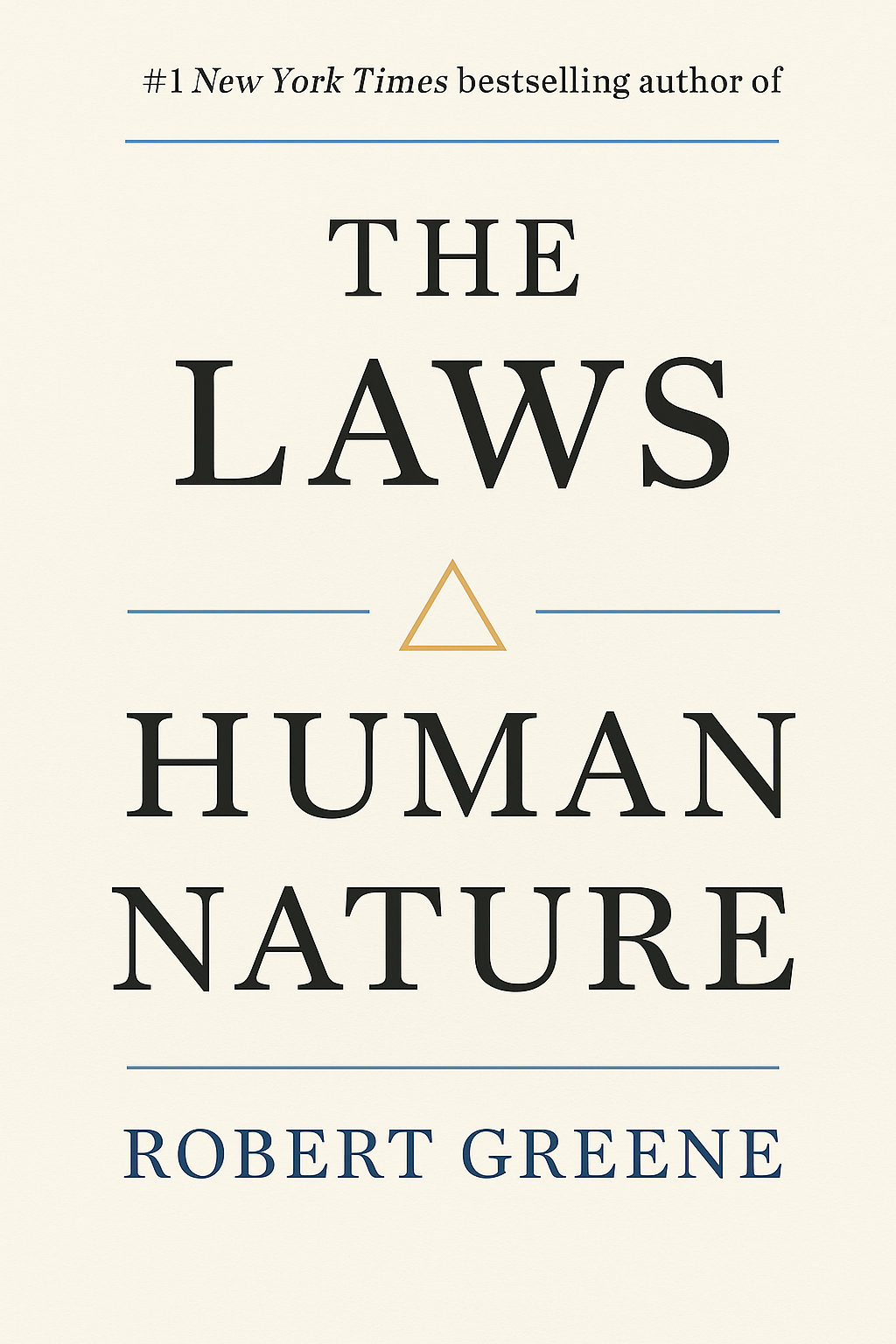
The Laws of Human Nature by Robert Greene
This nine-lecture audio course examines Robert Greene’s Laws of Human Nature, a systematic guide to understanding motivation, influence, and self-sabotage. Lecture 1 introduces the model of human nature, showing how irrationality, emotional bias, and narcissism distort judgment and how disciplined empathy counters these forces. Lecture 2 trains listeners to read character by tracking nonverbal leakage, repeated behavior, and responses under pressure rather than relying on words or appearances. Lecture 3 explains how to lower resistance in others by understanding covetousness, maintaining long-range perspective, and avoiding defensiveness. Lecture 4 contrasts constricted and expansive attitudes, traces self-sabotage patterns, and demonstrates how integrating repressed impulses prevents destructive outbursts. Lecture 5 identifies disguised envy and active or passive grandiosity, replacing fantasy with grounded confidence. Lecture 6 shows how recovering neglected masculine or feminine qualities and anchoring them in a clear purpose prevents drift. Lecture 7 analyzes conformity pressures, court dynamics, and the difference between demanded obedience and earned authority. Lecture 8 examines hidden aggression, passive-aggressive tactics, and the way shared historical conditions shape generational attitudes. Lecture 9 connects personal decisions to historical cycles, confronts death denial, and uses mortality awareness to set priorities. Across these lectures the course supplies concrete methods for decoding social cues, managing internal attitudes, and acting with strategic clarity in personal and professional settings.
From Emotional Blindness to Empathic Awareness
From Emotional Blindness to Empathic Awareness
Welcome to The Laws of Human Nature by Robert Greene — a book that will permanently change how you see every person you've ever misunderstood, including yourself. Most of us assume we're rational, that our choices are driven by logic — but what if the very belief in your own rationality is the biggest illusion you carry? Robert Greene, who wrote this book while recovering from a stroke that temporarily took the use of his left hand and leg, spent years building the case — and the answer is nothing like you expect.
Greene argues that human behavior is not primarily driven by logic or conscious intention. The brain's emotional architecture — far older and more powerful than the rational prefrontal cortex — routinely overrides conscious thought. We then construct post-hoc rationalizations to disguise this from ourselves. Once more, slowly. We construct post-hoc rationalizations to disguise this from ourselves.
This self-deception, the author contends, is the, the single greatest source of confusion and failure in human life. Greene draws on evolutionary psychology, historical case studies, and biographical analysis to extract what he calls laws of human nature. These are recurring behavioral patterns rooted in biology and social conditioning — and they operate whether we acknowledge them or not.
Here's the central paradox Greene identifies: humans are simultaneously the most social of all animals and the most self-absorbed. We depend entirely on cooperation, yet we perceive the world almost exclusively through our own needs, fears, and desires. That gap produces chronic misreading of others — we project our feelings onto people and are perpetually surprised when they seem irrational. The antidote, in the book's view, is what Greene calls deep empathy — not sentiment, but disciplined strategic perspective-taking. This is, no, it's not about being kind for kindness's sake. According to the author, this kind of empathy is the foundation of effective leadership, persuasion, and social navigation. Greene's first law — the Law of Irrationality — uses the Athenian statesman Pericles as its primary model. Pericles exemplified rational mastery: not the absence of emotion, but the ability to observe his emotional states without being controlled by them. The author catalogs specific biases that corrupt thinking — confirmation bias, conviction bias, group conformity, blame bias, and superiority bias among them.
Greene offers concrete practices to counter these patterns. Recognize the physical signals of an emotional hijack, slow your responses in high-stakes moments, and actively seek disconfirming evidence rather than validation. Abraham Lincoln, the author notes, wrote unsent letters to process rage — which is, honestly, a habit most of us could use. The corrective for social contagion is a strong internal identity that anchors you against groupthink and collective panic. Greene's overarching goal is transformation: moving you from passive subject of human nature's forces to clear-eyed, strategic observer.
Greene offers concrete practices to counter these patterns. Recognize the physical signals of an emotional hijack, slow your responses in high-stakes moments, and actively seek disconfirming evidence rather than validation. Abraham Lincoln, the author notes, wrote unsent letters to process rage — which is, honestly, a habit most of us could use.
The corrective for social contagion is a strong internal identity that anchors you against groupthink and collective panic. Tribal instincts make humans acutely sensitive to group approval, and that sensitivity creates real vulnerability to conformity pressure. Cultivating dissenting perspectives — not echo chambers — is, it's the structural defense Greene recommends.
Greene's overarching goal is transformation: moving you from passive subject of human nature's forces to clear-eyed, strategic observer. Rationality, in the author's framework, is not a natural state — it is a discipline practiced continuously against emotional reactivity. It must be practiced continuously against the constant pull of emotional reactivity.
Reading Masks and Measuring Character
Every person you meet is, in some sense, wearing a costume. The author argues that human social life is fundamentally a theater of performance — masks constructed from childhood to project confidence, warmth, or virtue. What lies beneath those masks is almost never what the surface suggests.
Last time, we saw how emotional architecture routinely overrides rational thought, and how self-deception is the deepest source of human confusion. That insight matters here because the same forces that blind us to our own nature also make us easy to deceive by others. The author identifies four recurring mask types — the Performer, the Pleaser, the Rescuer, and the Passive Aggressor — each driven by a distinct psychological need.
Recognizing which mask someone wears, the author contends, gives you critical insight into how they will behave and where they are most vulnerable. The most dangerous individuals are those whose masks are most convincing — charming, socially adept people who have refined their performance over decades. That's, that's the uncomfortable truth: the smoother the surface, the harder the read.
The practical framework the author builds centers on a decisive shift in attention — away from words, toward physical and behavioral signals that are far harder to consciously control. Microexpressions, those fleeting facial movements lasting fractions of a second, often reveal contempt or fear before the person can suppress them. Voice quality — changes in pitch, hesitation, pace — frequently betrays anxiety even when the words are carefully chosen.
Accurate reading, the author argues, requires establishing a behavioral baseline for each individual first. Deviations from that baseline become meaningful signals; without it, you're just guessing. Once more, slowly. Deviations from that baseline become meaningful signals; without it, you're just guessing.
The author also stresses observing people in unguarded moments — under stress, when they believe no one important is watching, or in how they treat subordinates and service workers. These are the situations where maintaining the mask becomes too costly, and authentic character surfaces. It's, no, it's not cruelty to look — it's the clearest data you'll ever get.
The author introduces what they call visceral empathy — not cold intellectual analysis, but genuine attunement to another person's emotional state. This means physically and emotionally inhabiting someone else's perspective to sense what is authentic versus performed. The author cautions, though, that your own biases and emotional triggers can distort everything you observe, so self-awareness is inseparable from reading others accurately. The final insight the author offers is what they call the Law of Compulsive Behavior. The core claim is that character, formed largely in childhood through accumulated habits, is the true driver of behavior — not conscious intention. People repeat the same psychological scripts compulsively throughout their lives, often without any awareness at all. The author uses Anton Chekhov as a model of rare self-awareness — someone who recognized the compulsive pull of patterns instilled by a tyrannical father even as he consciously rejected them. Past behavior, especially under stress or in moments of conflict, is the most reliable predictor of future behavior.
A person's actual track record reveals far more about who they truly are than any polished self-presentation ever could.
So what does all of this mean practically? The author's framework demands one final, decisive move: study the track record, not the pitch. How someone has handled failure, treated people with less power, and behaved when no one important was watching — that's, that's the real data.
Desire, Foresight, and the Art of Lowering Resistance
Last time, the author showed us that character is compulsive — that people repeat the same psychological scripts throughout their lives, often without any awareness at all. That insight matters here because the same unconscious forces that drive behavior also shape desire. Two laws in this book reveal how desire and perception operate beneath the surface — and mastering both gives you a decisive edge.
The author argues that human desire is not triggered by what is fully present and known, but by what is partially hidden, scarce, and just out of reach. Over-explaining yourself, constantly seeking validation — these habits collapse the very mystery that makes you compelling. The more available and transparent you are, the less desirable you become.
The author uses Coco Chanel as the central example here. Chanel's power came not only from talent but from disciplined control over her own narrative — a refusal to be fully legible. She made people feel they were always slightly on the outside of something extraordinary, and, well, that tension is, it's not an accident — it's a strategy.
The author offers four concrete tactics for cultivating this productive tension. Create intermittent absence so your presence is felt more acutely when you return; hint at a rich inner life others aren't fully privy to. Associate yourself with people and symbols that carry exclusivity, and resist explaining your motivations completely — ambiguity preserves the sense that there is always more to discover. The goal, the author contends, is not coldness but a calibrated warmth — enough to draw people in, enough mystery to keep them perpetually curious.
The second law the author addresses is what they call the Law of Shortsightedness — and it targets a different but equally powerful cognitive trap. The author argues that humans are wired to focus on what is immediate and emotionally charged while systematically undervaluing slow-moving forces that ultimately determine outcomes. Most people are, no, they're perpetually surprised by crises that were entirely predictable — because instinctive attention simply cannot track dynamics that unfold over years.
The author's antidote is a disciplined cultivation of long-term thinking — mentally stepping back from the noise of current events to ask what a situation will look like in five, ten, or twenty years. The author contrasts reactive thinking, driven by what is happening right now, with strategic thinking anchored in a clear sense of where you want to be in the future. Once more, slowly. Reactive thinking is driven by now; strategic thinking is anchored in where you want to be.
The author illustrates this with Abraham Lincoln, who absorbed intense criticism by resisting hasty decisions during the Civil War, and with Toyota, which built lasting competitive advantage through slow, methodical improvement. The capacity to see further than others — to resist the pull of the immediate — is, the author insists, not a natural gift. It is a cultivated discipline and one of the rarest advantages a person can develop.
So what does this mean practically — for how you carry yourself, how you make decisions? The author insists these two laws work together: one governs how others perceive and desire you, the other governs how clearly you can see what's actually coming. Miss either one, and you're, you're operating blind in the most consequential moments of your life.
The covetousness law asks you to audit your own transparency — not to become cold, but to stop collapsing the tension that makes you compelling. Ambiguity, the author argues, is not deception; it's the space where other people's imagination does the work for you. That space, once you understand it, becomes one of the most durable forms of social influence available.
The shortsightedness law asks something harder: it asks you to distrust your own sense of urgency. Most pressure you feel is manufactured — by competitors, by media, by internal politics — and the author contends that distinguishing real urgency from noise is, it's the core skill of strategic thinking. Real urgency is rare; most pressure is manufactured.
Lincoln and Toyota aren't, no, they're not exceptional because they had better information — they had better time horizons. The author's argument is that seeing further than others is a discipline, not a talent, and it compounds over time like interest. You train it by repeatedly asking: what will this look like in ten years?
Together, these laws reveal that power flows to those who manage perception and resist the immediate. The author's deeper point is that most people surrender both advantages unconsciously — through over-sharing and through panic. Reclaim them deliberately, and the gap between you and everyone else widens fast.
Transforming Attitude and Integrating the Shadow
Last time, the author showed us that reactive thinking is driven by now, while strategic thinking is anchored in where you want to be. That gap between the immediate and the long-term is, it's not just about decisions — it runs deeper, into the very lens through which you interpret everything. The author's Law of Self-Sabotage argues that this lens, your attitude, is the primary architect of your life circumstances.
Most people operate under a persistent illusion: that unhappiness and failure are caused by external forces — bad luck, difficult people, unfair systems. The author argues the opposite, contending that deeply ingrained attitudes, formed in childhood, function as invisible scripts shaping what we perceive and what outcomes we repeatedly generate. Because these attitudes feel natural and self-evidently correct, we rarely question them — we blame the world instead.
Drawing on Alfred Adler's break from Freudian determinism, the author emphasizes that it is not past trauma itself but the attitude adopted in response to trauma that determines trajectory. People with identical difficult backgrounds can end up with radically different lives depending on the internal orientation they develop. That means attitude is a choice — even when it, it rarely feels like one.
The author identifies several specific negative attitude patterns that function as self-sabotage mechanisms. The hostile attitude interprets neutral social signals as threatening and alienates potential allies; the anxious attitude causes underperformance through excessive self-monitoring. The resentful attitude fixates on perceived injustice and forecloses all forward movement.
Anton Chekhov is the author's central example here — a man who grew up under a tyrannical father in genuine poverty, yet deliberately worked to shed the servility his upbringing had instilled. He famously described the process as squeezing the slave out of himself drop by drop, and that image is, no, it's not metaphor — it's a method. Genuine attitude transformation, the author insists, is not positive thinking or affirmations but honest self-examination and behavioral change sustained over time.
The practical framework the author offers moves through several stages. First, readers must practice radical self-examination — tracing recurring life patterns as fingerprints of a self-sabotaging attitude. Relationships that always fail the same way, opportunities that consistently slip away — these are, the author contends, data points, not coincidences. A key technique the author calls the reversal involves deliberately seeking evidence that contradicts your negative assumptions — cataloging instances where trust was rewarded or luck favored you. This is not naive optimism but a disciplined correction of systematic cognitive bias. Acting as if you already possess a more open, confident orientation can gradually internalize that orientation and make it authentic.
The author's concluding argument is that self-sabotage is not destiny but a habit of mind that, once identified, can be systematically dismantled. Accepting full responsibility for your interpretive framework — while acknowledging you cannot control external events — is, it's the most powerful form of agency available.
That, the author insists, is the foundation upon which all genuine and lasting change in life circumstances is built.
The social dimension matters too, and it's, it's one the author treats as almost mechanical. People projecting suspicion or resentment provoke defensiveness in others, which then confirms their original negative assumptions. Those with genuinely expansive attitudes attract cooperation and goodwill — creating yet another self-fulfilling dynamic, but a constructive one.
The author also stresses that behavior and attitude mutually reinforce each other in ways most people underestimate. Acting as if you already possess a more open orientation can gradually internalize that orientation and make it, no, make it real. Attitude shapes behavior, but behavior also reshapes attitude over time.
The author's concluding argument is that self-sabotage is not destiny but a habit of mind. Once identified, it can be systematically dismantled through honest self-examination and sustained behavioral change. Accepting full responsibility for your interpretive framework is, the author insists, the most powerful form of agency available.
That responsibility does not mean controlling external events — it means controlling the lens through which you interpret them. That distinction is everything, and most people never make it consciously. The author contends this shift is the foundation upon which all genuine and lasting change in life circumstances is built.
Escaping Envy and the Delusions of Grandiosity
Last time, the author showed us that attitude is not destiny — it's a habit of mind that, once identified, can be systematically dismantled. That insight matters here because the same invisible scripts that drive self-sabotage also fuel one of the most dangerous forces in human social life. The author argues that force is envy, and it almost never announces itself openly.
Envy, in the author's view, disguises itself as moral outrage, harsh criticism, or sudden coldness after someone else's good news. People do not say they are envious — they perform it through faint praise, subtle sabotage, and manufactured disapproval. That disguise is, it's precisely what makes envy so difficult to detect and defend against.
The author traces envy's roots to our evolutionary nature as comparative creatures who measure success not in absolute terms but relative to those around us. Crucially, envy does not target those far above us — it targets peers closest in age, profession, and background. A stranger's success is easy to dismiss; a, a colleague's success feels like a verdict on your own worth.
The author identifies specific behaviors that reliably trigger envy — rising too quickly in a hierarchy, making success look effortless, and displaying advantages ostentatiously. The most envied individuals are not always the most successful in absolute terms, but those whose success feels proximate and attainable to their peers. Once more, slowly. The most envied are those whose success feels close enough to sting.
Against this, the author outlines practical defensive strategies centered on managing how success is perceived. Downplaying achievements, attributing good outcomes to luck or collective effort, and making potential enviers feel included rather than diminished — these are, no, they're not weakness, they're strategic intelligence. Displaying genuine vulnerabilities and being generous with credit gives the envious person a psychological release valve that reduces the intensity of their resentment. Equally important is the author's treatment of envy felt internally, which they argue distorts judgment and poisons relationships when left unacknowledged.
The author distinguishes destructive envy, which fixates on tearing others down, from what they call emulative envy — channeling the emotion into productive striving. Envy, honestly examined, reveals what you genuinely want and where your deepest ambitions lie. The antidote, the author contends, is cultivating a stable internal foundation — a secure sense of identity that makes others' achievements feel less like a personal attack and more like proof of what's possible.
The author draws a useful distinction between micro-envy and macro-envy that clarifies where the real danger lives. Micro-envy operates between people in close proximity — colleagues, friends, collaborators — and is far more personally destructive. Macro-envy, directed at distant celebrities or public figures, tends to dissipate without causing lasting harm.
The author also warns against trying to reassure envious people with excessive kindness or explanation. That approach, they contend, often backfires by drawing more attention to the gap between you and them. The, the more you explain your success to someone who resents it, the worse you make it.
What the author ultimately prescribes is psychological maturity — the ability to genuinely appreciate excellence in others without experiencing it as a personal attack. That maturity begins with a stable internal foundation, not external reassurance. Envy, the author insists, is an inescapable feature of human social life, not a flaw to be eliminated.
The author's final argument is that vigilance, strategic social behavior, and honest self-reflection are the only reliable defenses. All three must work together — none of them functions in isolation. Miss one, and envy finds its way through.
The author frames this not as pessimism but as a form of clear-eyed realism about how human social hierarchies actually operate. Envy can be managed effectively rather than allowed to cause lasting damage to relationships, reputations, and careers. That, no, that's not a small thing — it's, it's the difference between a life shaped by resentment and one shaped by genuine ambition.
Inner Wholeness and a Life Directed by Purpose
Last time, the author showed us that envy almost never announces itself openly — it disguises itself as criticism, coldness, or moral outrage. That insight matters here because the same social forces that distort how we see others also distort how we see ourselves. The author's Law of Gender Rigidity argues that one of the deepest distortions begins the moment we're born.
Every person, the author contends, is born with a blend of masculine and feminine psychological qualities — assertiveness and empathy, strategic thinking and emotional receptivity. Social conditioning then forces most people to repress one side entirely, and that suppression is not, no, it's not natural — it's culturally enforced from early childhood. Boys are trained to deny sensitivity; girls are pressured to suppress competitive drive and directness.
Drawing on Carl Jung's concepts of the anima and the animus, the author argues that repressed qualities don't simply vanish. Instead, they operate beneath the surface in distorted forms — erupting as irrational emotional outbursts in men, or manifesting as rigid, domineering behavior in women. Repressed qualities don't disappear; they resurface in distorted, destructive forms.
These repressed qualities also get projected outward onto others, causing people to idealize or demonize members of the opposite sex rather than perceiving them clearly. That projection dynamic is, the author insists, one of the deepest sources of dysfunctional relationships — creating dependency, resentment, and chronic misunderstanding. It's not the other person you're reacting to; it's the part of yourself you've refused to acknowledge.
The author illustrates the power of integration through historical figures who consciously cultivated both masculine and feminine qualities. Queen Elizabeth I combined fierce political cunning with acute emotional attunement, moving fluidly between modes as each situation demanded. Leonardo da Vinci, Abraham Lincoln, and Coco Chanel similarly drew on the full psychological spectrum — achieving results that more rigidly gendered individuals simply could not.
The practical framework the author offers is concrete and progressive. For men, it means slowing down in conversations to listen rather than assert, practicing genuine empathy, and resisting the impulse to immediately rationalize intuitive responses. For women, it means practicing strategic detachment, speaking more directly, and deliberately tolerating conflict without immediately accommodating others.
The author is careful to distinguish this process from performance or identity politics — he's, he's speaking about psychological qualities that exist on a spectrum within every person. He also warns against overcorrection: men who become passive in shedding aggression, and women who become unnecessarily combative in cultivating assertiveness. True integration means holding both qualities simultaneously and deploying them with situational intelligence.
The author frames this integration as a lifelong practice requiring sustained self-examination, honest identification of suppressed qualities, and deliberate exposure to experiences that activate dormant capacities. The payoff is, no, it's not small — individuals who achieve this become more adaptable, more persuasive, and more creatively generative. They no longer need others to carry the psychological qualities they've denied in themselves, which frees them from the projection dynamics that distort so many relationships. Free yourself from projection, and you finally see people as they actually are.
The author's deepest argument is that this integration is not a therapeutic exercise — it's a direct path to greater power and effectiveness. People who achieve it become more adaptable, more persuasive, and more creatively generative in every domain. That's, that's not a small claim — it's the book's central promise for this law.
The author positions inner wholeness as the foundation for richer relationships and more resilient action. When you no longer need others to carry the qualities you've denied in yourself, projection dissolves — and you finally perceive people as they actually are. Free yourself from projection, and you finally see people clearly.
The author frames this as a lifelong practice, not a destination — requiring honest self-examination and deliberate exposure to dormant capacities. Sustained reflection is what incorporates those experiences into your self-concept over time. It's, no, it's not a single insight that changes you — it's the accumulation of small, deliberate acts.
Resisting Conformity and Establishing Legitimate Authority
Last time, the author showed us that inner wholeness — integrating both masculine and feminine psychological qualities — frees you from projection and lets you finally see people clearly. That foundation matters here because the force we're examining now attacks something even more fundamental: your capacity to think for yourself inside a group. The author argues that this capacity is, no, it's not a given — it's something you have to actively defend.
The author's central claim is that group membership degrades individual intelligence, rationality, and moral judgment — not through personal weakness, but through biology. Humans evolved as intensely social creatures for whom exclusion from the group meant death, and that wiring is still running. The drive to mirror others, fit in, and avoid standing out is, the author contends, one of the most powerful forces in human psychology.
The author calls this the 'group effect,' and illustrates it through Solomon Asch's conformity experiments, where individuals denied the clear evidence of their own senses to avoid contradicting group consensus. Once more, slowly. People denied what their own eyes showed them, just to avoid contradicting the group. The author also draws on Gustave Le Bon's crowd psychology, which identified how individuals in crowds regress to more primitive, emotional, and suggestible states. The mechanism is consistent: the social brain — evolved to manage status and belonging — becomes hyperactivated, overriding analytical thinking entirely.
Feelings spread rapidly across groups and amplify: fear becomes panic, excitement becomes mania, and anger becomes mob rage. The author traces this through historical disasters — military blunders, corporate collapses, political catastrophes — where suppressing dissenting voices produced outcomes that seemed rational inside the bubble but were obviously flawed from outside. The pattern, the author insists, is not rare — it's, it's the default. The author's first prescription is awareness: understanding that conformity is an automatic biological pull, not a conscious choice, gives you the mental distance to catch yourself before surrendering your judgment. He advises cultivating what he calls a 'detached' or 'spectator' mindset — the ability to mentally step back from group dynamics and observe them even while physically participating. This means noticing when your opinions shift to match those around you, or when the group's emotional temperature begins to color your own reasoning.
The author also warns that leaders face a compounding version of this problem: subordinates filter information to tell leaders what they want to hear, creating an echo chamber that distorts reality. Leaders then begin mirroring their followers' desires rather than guiding them — a feedback loop where the leader validates the group's biases and the group validates the leader's authority. The antidote is actively soliciting dissenting opinions and rewarding those who bring bad news, not punishing them. The author acknowledges that resisting conformity carries real social costs — hostility, exclusion, the label of troublemaker — and so he counsels strategic rather than confrontational dissent. Choose battles carefully, frame challenges in ways that appeal to the group's stated values, and build credibility so your independent voice actually carries weight. Groups that tolerate internal dissent, the author contends, consistently outperform those that suppress it — and the individual who thinks clearly when the collective is swept up in emotion serves as an anchor that benefits everyone.
The author also recommends maintaining relationships and intellectual influences outside your primary group. Prolonged immersion in a single social circle gradually narrows your sense of what is normal or possible. Diverse perspectives act as a counterweight to the homogenizing pressure of any one group.
The author further advises identifying what he calls the 'shadow culture' within any organization — the unspoken rules and real power dynamics beneath the surface. Understanding that hidden layer lets you navigate group life strategically rather than being unconsciously shaped by it. That distinction, the author insists, is the, the difference between agency and drift.
The author also warns against the 'us versus them' dynamic that groups naturally generate. Demonizing outsiders is, he contends, one of the clearest signs a group has lost its rational footing. Once that dynamic takes hold, it's, it's almost impossible to reverse from inside.
The author's final argument is that groups tolerating internal dissent consistently outperform those that suppress it. The individual who thinks clearly when the collective is swept up in emotion serves as an anchor of rationality that benefits everyone. That capacity is not merely a personal virtue — it is, the author insists, a social necessity.
Hidden Hostility and the Birth of Generational Consciousness
Last time, the author showed us that resisting conformity is not a personal virtue — it's a social necessity, and the individual who thinks clearly when a group is swept up in emotion serves as an anchor for everyone. That foundation matters here because the force we're examining now operates inside those same social environments, but it's, it's far harder to name. The author argues that aggression never disappeared from human life — it simply went underground.
According to the author, aggression is a primal, universal drive that civilization has not overcome but merely disguised. Because open hostility carries real social costs, most people learn to channel competitive and dominance-seeking impulses beneath layers of charm, apparent helpfulness, and even victimhood. The result is a social world where the most dangerous individuals are often those who appear the friendliest.
The author calls this covert form 'passive aggression' — indirect, deniable, and cumulative in its damage. It operates through subtle put-downs framed as jokes, 'helpful' advice that quietly undermines confidence, and guilt deployed as a tool of control. The closer the relationship, the more sophisticated and damaging the disguise tends to be.
Envy, the author contends, is the primary engine driving this behavior — and people rarely admit envy even to themselves. Instead, they rationalize hostility as righteous criticism or principled concern, which is, it's precisely what makes it so hard to detect. Recognizing these patterns requires tracking behavior over time, not reacting to isolated incidents. The author introduces what they call the 'aggressor type' — a personality shaped by early experiences of powerlessness and acutely sensitive to social hierarchies. Key signals include a consistent pattern of reframing conflicts so they are never at fault, a habit of creating dependency, and a tendency to push boundaries incrementally. The author is careful to distinguish this clear-eyed awareness from paranoia — the goal is a more accurate model of human motivation, not blanket distrust. Once aggressive individuals are identified, the author outlines a practical framework for response. The worst reaction is mirroring their hostility directly, since that gives them the confrontation they seek and justifies further escalation.
Controlled assertiveness — a middle path between passive submission and destructive counter-aggression — is, the author insists, the far more effective posture. Specific tactics include strategic mirroring, which reflects the aggressor's own language back at them to expose its unreasonableness without direct accusation. Building alliances with others who have experienced the same person's behavior, and creating gradual distance when the relationship cannot be reformed, are, no, they're not optional extras — they're the core of the strategy. Understanding the root causes of someone's hostility — insecurity, frustrated ambition, past wounds — gives perspective without excusing the behavior. Equally important, the author argues, is the internal dimension of this law. Unacknowledged aggression tends to emerge in distorted forms — procrastination, self-sabotage, displaced anger toward innocent parties. Once more, slowly. Unacknowledged aggression resurfaces in distorted, destructive forms. The goal is not to eliminate aggression but to become its master — channeling competitive energy into focused, goal-directed work rather than letting it leak out destructively.
Those who see aggression clearly, in themselves and in others, and respond with firmness, strategic patience, and emotional intelligence, are, the author contends, far better positioned to protect their interests and navigate the world with genuine skill.
Seizing the Times, Facing Mortality, and Mapping the Work
Last time, the author showed us that covert aggression is the default mode of competitive social life — and that those who see it clearly, in themselves and in others, navigate the world with far greater skill. That foundation matters here because the two laws we're examining now operate on an even larger canvas: one concerns how you read the historical moment you're living in, the other concerns how you relate to the fact that you will die. Both, the author argues, are sources of profound and largely invisible distortion.
The author's Law of Generational Myopia holds that most people are so thoroughly shaped by the spirit of their era that they cannot perceive it clearly. They mistake the values, anxieties, and tastes of their generation for universal truths — which is, it's a kind of blindness that leaves them unable to read cultural shifts or position themselves effectively. The author contends this blindness is not inevitable; it can be overcome through deliberate generational awareness.
The practical framework the author offers is concrete. Study the generation before your own, since current generational identity is largely defined in opposition to the perceived failures of the preceding cohort. Pay close attention to the youngest adults entering the culture — they are, the author insists, the leading edge of change, and their hungers reveal where the culture is actually heading.
The author warns against two symmetrical errors that reflect a failure to think historically. Nostalgia causes people to cling to the aesthetics of a previous era and become irrelevant; uncritical presentism assumes whatever is new is automatically superior. Both errors, the author argues, are just different ways of refusing to think clearly about time.
The deeper philosophical point the author makes is that generational forces have shaped your own instincts and assumptions in ways you may not recognize. Genuine autonomy, they contend, requires examining which of your beliefs are truly your own and which are simply the unexamined inheritance of the era you were born into. Those who achieve this self-knowledge do not merely drift through history — they participate in shaping it.
The author then turns to what they frame as one of the most foundational drivers of human irrationality: the Law of Death Denial. Drawing on cultural anthropologist Ernest Becker's work, the author argues that humans are unique in their conscious awareness of mortality, and that this awareness generates a profound, largely unconscious terror. Rather than confronting that terror, people construct elaborate psychological defenses — investing in careers, ideologies, and national identities partly because these affiliations provide a sense of permanence that transcends individual death.
When these symbolic immortality systems are threatened, people react with disproportionate hostility. The author identifies this as a root cause of tribalism, fanaticism, and political manipulation — leaders throughout history have exploited death anxiety by positioning themselves as protectors against existential threats. Once more, slowly. Death anxiety, channeled by the right demagogue, becomes loyalty and aggression.
The author's proposed antidote is the deliberate, regular practice of meditating on death — the ancient Stoic tradition of memento mori. Rather than producing despair, this confrontation with mortality tends to clarify priorities, strip away trivial concerns, and generate a sharper appreciation for present experience. The author references Marcus Aurelius and Montaigne as exemplars, and connects the practice to modern research on terror management theory, which shows that consciously processed mortality awareness can actually increase prosocial behavior. The practical outcome of accepting death, the author argues, is a transformed relationship to time — one characterized by urgency without panic, depth over accumulation, and a tolerance for others born from the recognition of shared human finitude. That orientation is, no, it's not a philosophical luxury — the author insists it is the foundation of genuine psychological maturity. Recognize when mortality fears are being weaponized against you, resist movements offering false transcendence, and let the awareness of your own finitude become the clearest guide you have.