
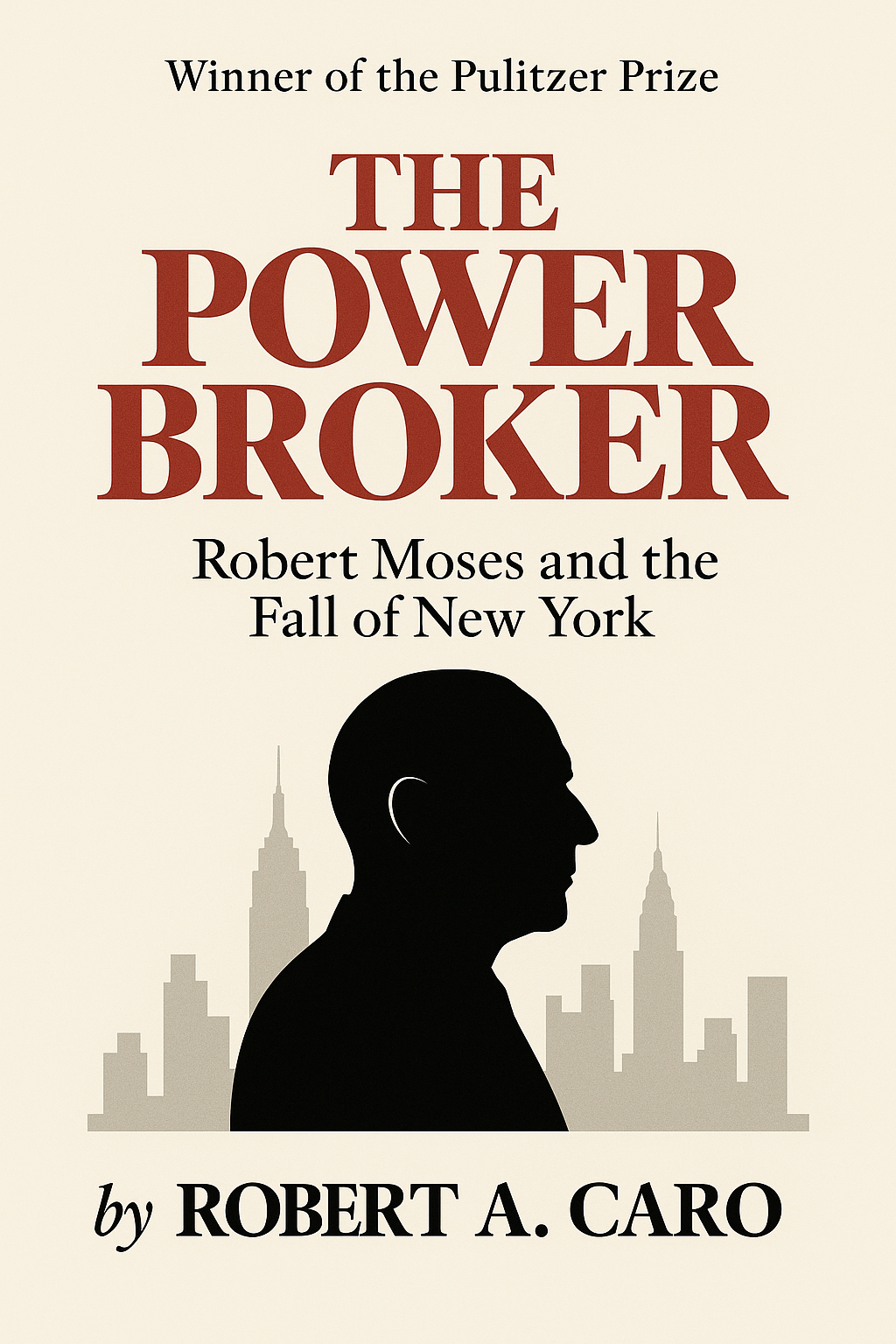
The Power Broker: Robert Moses and The Fall of New York
This audio course offers a structured exploration of Robert Moses’ life and influence, as detailed in Robert Caro’s acclaimed biography. The series begins by examining Moses’ formative years, including his family background, education at Yale and Oxford, and the development of his early ideals about public service and reform. Listeners will then follow his transition from a principled reformer to a key figure in New York City’s political landscape, focusing on his entry into municipal government and the strategies he used to gain and maintain power. The course continues by analyzing how Moses consolidated authority, built complex bureaucratic systems, and directed large-scale public works that transformed New York’s infrastructure. It addresses both the scale of his achievements and the methods he used to secure control. The final lecture assesses the decline of Moses’ influence, the controversies that surrounded his later years, and the enduring legacy—both constructive and contentious—of his projects on the city’s physical and social fabric. Across four lectures, the course provides a clear, chronological understanding of how one individual shaped the modern metropolis, highlighting the interplay between vision, power, and urban change.
The Making of an Idealist: Chapters 1-12
The Making of an Idealist: Chapters 1-12
Robert Caro's opening chapters of The Power Broker reveal how institutional structures and personal trauma combined to create one of America's most formidable power brokers. The story begins not with Moses himself, but with the bureaucratic machinery that would enable his unprecedented dominance. New York's appointed positions in parks and public works had quietly accumulated authority independent of voters through control of contracts, land use, and bond issues.
This system, what Caro calls a line of succession, created the template Moses would perfect into an empire. But the man who would exploit these structures was forged through rejection and resentment. At Yale, despite leading the Yale Daily News and demonstrating academic brilliance, Moses faced exclusion from elite senior societies, likely due to anti-Semitism.
This rejection, combined with his intellectual superiority and extraordinary work capacity, fostered contempt for established social hierarchies. Moses developed a conviction that achievement and merit should triumph over traditional power structures. These formative experiences created a man driven to prove himself through tangible accomplishments while harboring deep resentment toward those wielding power through social connections rather than ability.
Moses's transformation from idealist to power broker occurred through brutal political educations that systematically destroyed his faith in democratic processes. The pivotal moment came at the 1914 Constitutional Convention... where Tammany Hall bosses methodically dismantled his meticulously researched proposals for governmental reorganization. Moses learned that political power, not reasoned argument or good ideas, determined outcomes in American government.
This humiliation fundamentally altered his philosophy, forcing him to abandon academic aspirations and shift from studying reform to pursuing actual power. His early work on Long Island parks provided practical training in wielding that power ruthlessly. Facing opposition from wealthy estate owners, Moses developed his signature tactics: moving quickly to create fait accompli situations, exploiting legal technicalities, and manipulating media narratives.
He learned to present himself publicly... as a selfless reformer fighting private interests... while employing hardball tactics behind the scenes. Moses became a masterful bill drafter, creating complex legal structures with deliberately obscure language that consolidated his authority. These mechanisms insulated him from political oversight while operating through public authorities outside normal governmental constraints.
The chapters trace Moses's evolution from naive believer in merit-based reform to sophisticated operator who understood that achieving his vision required accumulating power through the same mechanisms used by machine politicians he once opposed. The idealist had learned that ends justified means, that opposition should be crushed rather than accommodated. Democratic accountability became... an obstacle to overcome... rather than a principle to honor.
These lessons would shape his next four decades of dominance over New York's physical development. Caro demonstrates how institutional power structures, personal grievances, and political education combined to create a unique force in American governance. What happens when a brilliant mind, scarred by rejection and disillusioned by democratic processes, gains access to unaccountable authority?
The answer would reshape New York's landscape and redefine the relationship between appointed officials and elected government. Moses had discovered that the greatest power... lay not in winning elections... but in controlling the machinery that operated regardless of who won. Armed with this knowledge and driven by both vision and vendetta, he was ready to build an empire that would last nearly half a century.
Rise in City Hall: Chapters 13-25
In the 1930s and 1940s, Robert Moses's rise to power was facilitated by a unique political and social context that prioritized rapid development over social equity. This period was marked by the Great Depression and the subsequent New Deal, which provided unprecedented federal funding for public works projects. Moses, with his keen understanding of bureaucratic structures and political maneuvering, positioned himself as the ideal conduit for these funds, allowing him to execute large-scale infrastructure projects with minimal oversight.
The New Deal era was characterized by a sense of urgency to rebuild and modernize America. This urgency often overshadowed concerns about social equity and democratic processes. Moses capitalized on this climate by presenting himself as a pragmatic and efficient administrator who could deliver tangible results. His ability to secure and manage New Deal funds made him indispensable to political leaders who were eager to demonstrate progress and economic recovery.
Moses's strategy involved consolidating power through appointed positions, which insulated him from electoral accountability. He understood that elected positions were subject to the whims of voters and political tides, whereas appointed roles allowed for greater stability and control. By securing key appointments, such as the head of the Triborough Bridge Authority, Moses gained access to independent revenue streams and decision-making power that were not subject to the same checks and balances as elected offices.
The political climate of the time also played a crucial role in Moses's ascent. Leaders like Mayor Fiorello La Guardia initially supported Moses because of his ability to deliver visible results quickly. La Guardia, a reform-minded mayor, saw Moses as a valuable ally in his efforts to modernize New York City. However, as Moses's power grew, it became clear that his ambitions extended beyond mere infrastructure development. He was building an empire that operated outside the traditional democratic framework.
Moses's projects were often justified by the need for economic revitalization and urban renewal. The political rhetoric of the time emphasized the importance of infrastructure as a means to stimulate economic growth and improve public welfare. This narrative allowed Moses to push through projects that prioritized efficiency and progress over community impact and social justice.
The New Deal funding provided Moses with the resources to undertake massive projects, such as the construction of parks, bridges, and highways. These projects were seen as symbols of progress and modernity, aligning with the national agenda of recovery and development. However, the focus on rapid development often led to decisions that disregarded the needs and voices of marginalized communities.
Moses's approach to urban planning was heavily influenced by the political and economic priorities of the era. The emphasis on speed and efficiency meant that projects were often executed with little regard for public input or democratic processes. This approach was facilitated by the political climate, which valued results over process and allowed Moses to operate with a level of autonomy that was rare for public officials.
As Moses's power grew, so did the criticism of his methods. By the late 1940s, there was growing awareness of the social costs of his projects, particularly the displacement of communities and the lack of accountability in decision-making. However, the political and social context that had enabled his rise continued to shield him from significant opposition.
In summary, the political and social context of the 1930s and 1940s provided Robert Moses with the opportunity to amass power through appointed positions and New Deal funding. The emphasis on rapid development and economic recovery allowed him to execute large-scale projects with minimal oversight, prioritizing efficiency over social equity. This period laid the foundation for Moses's empire, which would continue to shape New York City's landscape for decades.
Consolidating Power: Chapters 26-38
Robert Moses's ascent to unparalleled influence in New York City was marked by his strategic consolidation of power across multiple public authorities and agencies. During the 1930s and 1940s, Moses mastered the art of public authority financing, particularly through the Triborough Bridge Authority, which provided him with independent funding streams. This financial autonomy allowed him to operate beyond the reach of legislative oversight, making him the indispensable conduit for federal infrastructure money. His control over contracts, jobs, and urban development's trajectory was absolute, enabling him to reshape New York City according to his vision.
Moses's power was not just financial but also structural. He created a network of public authorities that operated independently of traditional government constraints. These entities, such as the Triborough Bridge and Tunnel Authority, were designed to be self-sustaining, with revenue streams from tolls and other sources that insulated them from political interference. This setup allowed Moses to bypass normal democratic processes, effectively making him an unelected official with more power than many elected ones.
At the height of his influence, Moses wielded his power to implement systemic changes that had long-lasting impacts on the city's landscape and social fabric. He prioritized automobile infrastructure over public transit, leading to the construction of expressways that cut through neighborhoods, often displacing minority communities. The Cross-Bronx Expressway is a prime example, where Moses chose a route that demolished stable, integrated communities, creating physical and social barriers that would persist for generations.
Moses's approach to urban development was characterized by a disregard for community input and a focus on efficiency and speed. He was known for keeping project plans secret until they were too advanced to be opposed effectively. This strategy of creating fait accompli situations allowed him to push through projects with minimal resistance, further entrenching his power.
The structural mechanisms Moses put in place not only insulated him from accountability but also set a precedent for future urban planning. His use of public authorities as tools for unchecked power demonstrated the potential dangers of concentrating too much authority in the hands of a single individual. The lack of democratic oversight in these entities meant that decisions affecting millions were made without public input or accountability.
Moses's influence extended beyond infrastructure to social engineering. His projects often reinforced racial and economic segregation, as seen in his manipulation of urban renewal funds. Instead of eliminating slums, these funds were used to clear land for middle-class housing, while poor minorities were concentrated in massive public housing projects. This approach not only displaced thousands but also entrenched patterns of segregation that would shape the city's demographics for decades.
Despite the immense power he wielded, Moses's methods and the systemic changes he implemented were not without criticism. His focus on automobile infrastructure over public transit was increasingly seen as short-sighted, contributing to urban sprawl and environmental degradation. Moreover, his disregard for community input and democratic processes raised questions about the ethical implications of his approach to urban planning.
In summary, Robert Moses's peak influence was characterized by his ability to operate outside traditional democratic constraints, using public authorities to consolidate power and implement systemic changes that reshaped New York City. His legacy serves as a cautionary tale about the dangers of unchecked power and the importance of maintaining democratic oversight in urban planning. The structural mechanisms he put in place not only insulated him from accountability but also had long-lasting impacts on the city's social and physical landscape.
The Decline and Legacy: Chapters 39-51
Robert Moses's decline was not a sudden event but a gradual unraveling influenced by key figures and shifting societal dynamics. The role of Jane Jacobs was pivotal in this transformation. Jacobs, an urban activist and author, became a formidable opponent to Moses's vision of urban development. Her advocacy for community-based planning and her opposition to the Lower Manhattan Expressway project galvanized public sentiment against Moses's top-down approach.
Jacobs's efforts were not isolated. They were part of a broader movement that questioned the unchecked power Moses wielded. Her ability to mobilize community resistance highlighted a growing awareness of the social costs associated with Moses's projects. The media, which had once been an ally, began to shift its narrative. Journalists started to scrutinize Moses's methods, exposing the human impact of his infrastructure projects. This changing media landscape played a crucial role in altering public perception.
The political environment also contributed to Moses's decline. Mayor Robert Wagner, initially supportive of Moses, began to distance himself as public opinion turned. Wagner's growing independence was a response to the electoral risks associated with supporting Moses's controversial projects. Governor Nelson Rockefeller, unlike his predecessors, was not content to be a mere facilitator of Moses's plans. Rockefeller's demand for credit and control over projects marked a significant political realignment that further eroded Moses's influence.
The 1968 battle over the Lower Manhattan Expressway was a turning point. The project threatened to demolish significant portions of SoHo, Little Italy, and Chinatown. Jacobs led a well-organized resistance, and public hearings became arenas of vocal opposition. This project symbolized a broader rejection of Moses's philosophy that prioritized automobiles over community preservation. The accumulated opposition, coupled with a growing awareness of urban renewal's social costs, signaled a fundamental shift in public sentiment.
Rumors of corruption and questionable land deals, long ignored due to Moses's political clout, began to surface. The media, once a reliable ally, started to question his integrity. This scrutiny, combined with the changing political and social landscape, made it increasingly difficult for Moses to maintain his grip on power.
Moses's approach to public spaces also came under fire. His transformation of Tavern on the Green from an affordable venue to an exclusive establishment exemplified his shift from democratic service to revenue generation. This change alienated ordinary New Yorkers, who found themselves priced out of their own public spaces.
Moses's engagement with mass transit in the 1950s and 60s was fundamentally flawed. He viewed public transportation as a means to access more federal funding rather than a genuine solution to urban mobility. His designs for transit improvements were intended to complement, not compete with, his highway empire.
The culmination of these factors led to Moses's eventual loss of power. His highways, once seen as symbols of progress, were increasingly viewed as accelerators of white flight and urban decay. The social engineering embedded in his infrastructure projects became a focal point of criticism.
In the end, Moses's four decades of virtually unchecked power over New York's physical development did not fade quietly. It collapsed under the weight of its own cruelty, as communities finally stood up and said: enough. His legacy serves as a cautionary tale about the dangers of unaccountable power and the importance of democratic oversight in urban planning.