
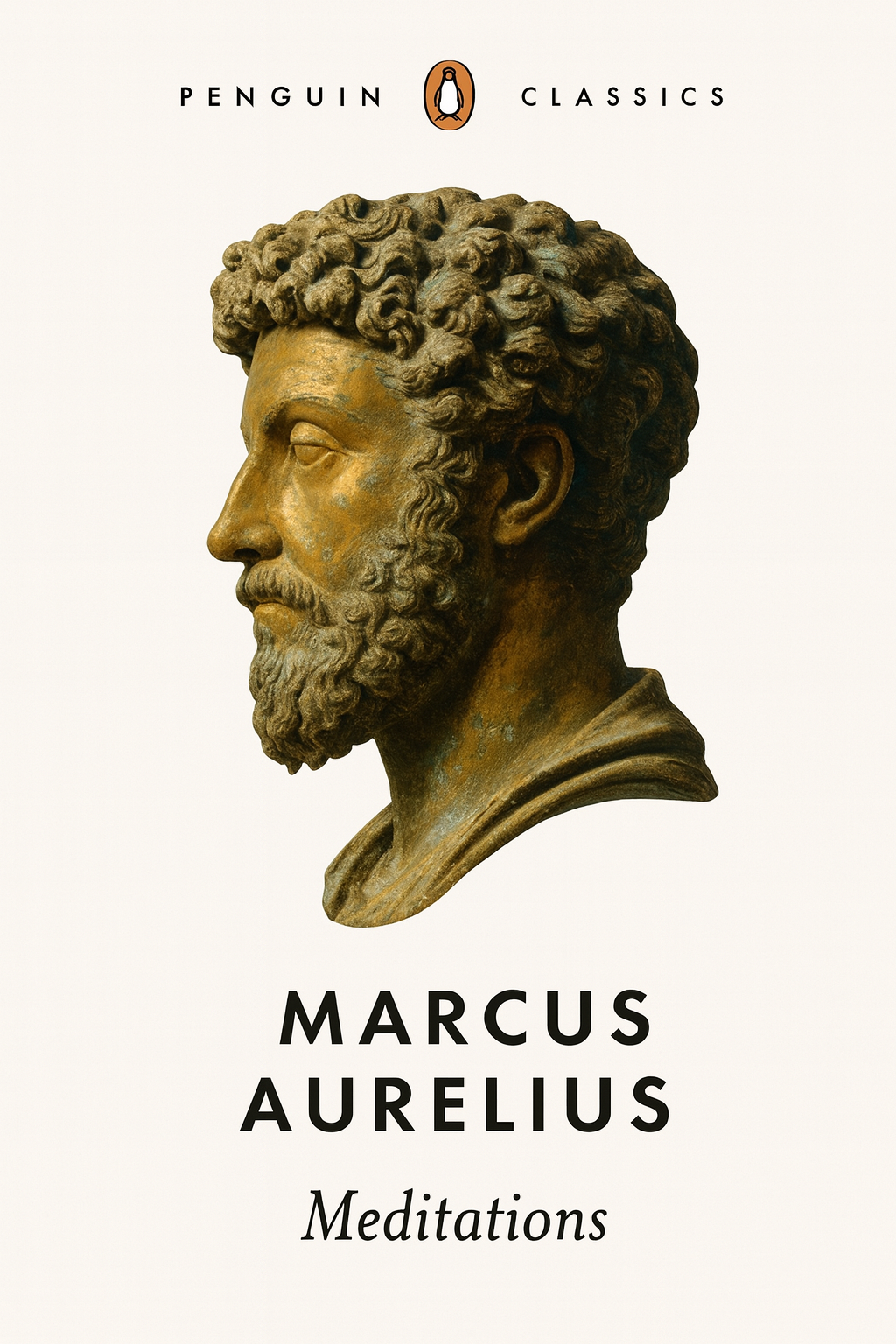
Meditations by Marcus Aurelius
This six-lecture audio course examines Marcus Aurelius’s Meditations in Gregory Hays’s translation. Lecture 1 traces Marcus’s path from bilingual education and adoption by Antoninus Pius through co-rule with Lucius Verus, frontier wars, plague, and succession concerns, showing how an emperor in training turned Stoic philosophy into daily practice. Lecture 2 explains the three disciplines of perception, action, and will, clarifying why Marcus records judgments rather than events and how the notebook’s fragments served as personal exercises. Lecture 3 reviews the people Marcus credits for his character and applies their lessons at the River Gran and in Carnuntum, where he rehearses meeting difficult colleagues without enmity and acting while time remains. Lecture 4 covers the inward retreat, the brevity of fame, rising each morning, treating obstacles as workable material, and refusing to answer harm with harm, testing when perspective supports engagement and when it risks withdrawal. Lecture 5 addresses ambition, the image of the severed limb restored to the body, the harm of inaction, and the demand to embody virtue, including guidance on correcting others versus tolerating faults without contempt. Lecture 6 follows Marcus’s final reflections on the rational soul, tragedy and comedy, Epictetus’s sayings, and death as a natural exit, then directs listeners to Hays’s Notes and Index of Persons for further reference.
The Emperor Behind the Notebook
The Emperor Behind the Notebook
Welcome to Meditations by Marcus Aurelius — the private notebook of a man who held more power than almost anyone in human history, yet wrote obsessively about why power means nothing. Most people assume that philosophy is for detached scholars, but this book asks something far more unsettling: what does it look like when the most powerful person alive genuinely tries, and fails, and tries again, to be good? Marcus Aurelius, a Roman emperor who commanded legions and governed millions, wrote these words in Greek — secretly, for no one but himself.
The Meditations is, at its core, an accidental document. Marcus never intended anyone to read this — it belongs to a Greek tradition called hypomnemata, personal notebooks used for moral self-examination. What we're reading is, the, the internal conversation of a man holding himself accountable to principles he found genuinely hard to live by.
The text came to us through centuries of translation, each version reflecting different choices about tone. But across every rendering, the essential nature stays the same: one person's sustained, often struggling effort to apply Stoic philosophy to actual life. Gregory Hays, whose introduction shapes our understanding here, is careful to frame Marcus not as a theorist, but as a practitioner.
Marcus absorbed Stoic teaching largely through Epictetus — a former slave whose Discourses profoundly shaped his thinking. The repetitive quality of the Meditations isn't carelessness; it's the method itself. Repeated self-exhortation was a legitimate Stoic tool, a way of making internalized principles actually operative in daily behavior.
The philosophical core rests on a few sharp commitments. The Stoics argued that virtue alone is a genuine good — everything else, health, wealth, reputation, is what they called 'indifferent.' What matters is not what happens to us, but how we respond. And according to Marcus, that response is always within our control.
What Hays identifies as the Meditations' enduring power is not philosophical novelty — it's psychological honesty. Marcus records his failures and frustrations with a candor that is, honestly, rare anywhere in ancient writing. He was not a serene sage above the difficulties; he was a man who found those difficulties genuinely exhausting.
That combination — enormous historical authority paired with unflinching private self-scrutiny — gives the Meditations a quality unlike almost any other ancient text. It is simultaneously a document of Roman imperial history, a primary source for Stoic philosophy, and an intimate portrait of someone trying, imperfectly, to live according to his beliefs. The notebook was never meant to survive.
Marcus also drew on Plato, Heraclitus, and earlier Stoics like Chrysippus and Zeno, but his version carries its own distinctive texture. He returns, again and again, to the brevity of human life and the vastness of historical time. Fame dissolves. Achievement dissolves. What remains, he insists, is only how well you used your reason.
The Stoic framework underlying all of this rests on what the author calls the distinction between what is within our control and what is not. Our judgments, desires, and responses — those belong to us. Everything else, including the behavior of others, reputation, even bodily health, is what Stoics called 'indifferent.' And Marcus believed that virtue — not success, not comfort — is the only genuine good.
What Hays keeps returning to is Marcus's psychological honesty, and that's, that's what makes this text feel modern in a way that surprises most readers. He was not writing to impress anyone; there was no audience. He was simply a man, trying to hold himself to a standard he kept falling short of — and writing it all down anyway.
Three Disciplines and a Notebook Written for One
There's a question that follows naturally from where we left off: if Marcus Aurelius never intended anyone to read the Meditations, what kind of document is it, exactly? The last lecture established that he was no detached theorist — he was a practitioner, writing under real pressure, failing in real ways. That honesty is the whole texture of the work.
The author makes a foundational point early on: Marcus composed these notes in Greek, not Latin, and that choice was deliberate. Greek was the language of philosophy and high culture in the Roman world, the, the register you chose when the work was serious and inward. The manuscript tradition itself refers to it by a title closer to 'To Himself,' and that phrase captures everything — no audience, no argument shaped for a reader, no rhetorical performance.
What we have instead is something stranger and more intimate: reminders, exhortations, and self-admonishments Marcus wrote to reinforce principles he already accepted. He wasn't discovering new truths; he was fighting to actually live the ones he knew. The prose is often compressed and elliptical — the shorthand of a man with no need to explain himself — which creates real, real challenges for anyone trying to translate it.
The repetitions that run through the Meditations have puzzled readers for centuries — the same themes, again and again: life's brevity, the indifference of external circumstances, the smallness of human fame. The author argues those repetitions are not a literary flaw. They are, in fact, the whole point.
The scholar Pierre Hadot described this kind of writing as a 'spiritual exercise,' and the author draws on that idea directly. For the Stoics, philosophy wasn't an academic discipline — it was a practice, and the lessons faded under daily pressure unless you kept reinforcing them. What Marcus was doing, entry by entry, was what you might call moral maintenance, working to keep internalized truths actually operative in behavior. The author identifies three interconnected disciplines organizing Marcus's practice: the discipline of perception, the discipline of action, and the discipline of will. These correspond roughly to Stoic logic, ethics, and physics — the, the three pillars of the school's whole system.
Central to all of it is the hegemonikon, the 'ruling faculty,' the governing part of the self that must be kept uncorrupted by whatever the world throws at it. Marcus drew especially heavily on Epictetus, the freed slave whose Discourses he clearly knew well and frequently paraphrases. But unlike Epictetus, who was a teacher, Marcus was a ruling emperor, and that tension is palpable throughout. He was trying to maintain philosophical composure while leading military campaigns and governing millions.
What gives the Meditations its, its lasting power, the author contends, is not philosophical novelty but psychological honesty. Marcus chastises himself repeatedly for irritability, distraction, and susceptibility to vanity — no sage serenity here. The apparent pessimism isn't despair; it's discipline, a clear-eyed acknowledgment of impermanence used as the very foundation for living well.
There's a question that follows naturally from where we left off: if Marcus Aurelius never intended anyone to read the Meditations, what kind of document is it, exactly? The last lecture established that he was no detached theorist — he was a practitioner, writing under real pressure, failing in real ways. That honesty is the whole texture of the work.
The author makes a foundational point early on: Marcus composed these notes in Greek, not Latin, and that choice was deliberate. Greek was the language of philosophy and high culture in the Roman world, the, the register you chose when the work was serious and inward. The manuscript tradition itself refers to it by a title closer to 'To Himself,' and that phrase captures everything — no audience, no argument shaped for a reader, no rhetorical performance.
What we have instead is something stranger and more intimate: reminders, exhortations, and self-admonishments Marcus wrote to reinforce principles he already accepted. He wasn't discovering new truths; he was fighting to actually live the ones he knew. The prose is often compressed and elliptical — the shorthand of a man with no need to explain himself — which creates real challenges for anyone trying to translate it.
The repetitions that run through the Meditations have puzzled readers for centuries — the same themes, again and again: life's brevity, the indifference of external circumstances, the smallness of human fame. The author argues those repetitions are not a literary flaw. They are, in fact, the whole point.
The scholar Pierre Hadot described this kind of writing as a 'spiritual exercise,' and the author draws on that idea directly. For the Stoics, philosophy wasn't an academic discipline — it was a practice, and the lessons faded under daily pressure unless you kept reinforcing them. What Marcus was doing, entry by entry, was what you might call moral maintenance — working to keep internalized truths actually operative in behavior. The author identifies three interconnected disciplines organizing Marcus's practice: the discipline of perception, the discipline of action, and the discipline of will. These correspond roughly to Stoic logic, ethics, and physics — the, the three pillars of the school's whole system.
Central to all of it is the hegemonikon, the 'ruling faculty,' the governing part of the self that must be kept uncorrupted by whatever the world throws at it. Marcus drew especially heavily on Epictetus, the freed slave whose Discourses he clearly knew and frequently paraphrases. But unlike Epictetus, who was a teacher, Marcus was a ruling emperor, and that tension is palpable throughout. He was trying to maintain philosophical composure while leading military campaigns and governing millions.
What gives the Meditations its, its lasting power, the author contends, is not philosophical novelty but psychological honesty. Marcus chastises himself repeatedly for irritability, distraction, and susceptibility to vanity — no sage serenity here. The apparent pessimism isn't despair; it's discipline, a clear-eyed acknowledgment of impermanence used as the very foundation for living well.
The People Who Taught Marcus How to Live
Marcus Aurelius wrote the Meditations not in a palace but in military camps along Rome's northern frontier — among the Quadi on the River Gran, later at Carnuntum on the Danube. These were not comfortable circumstances for philosophy; they were urgent ones. That urgency is, the, the whole point.
Last time, we saw that Marcus used his private notebook as moral maintenance — not to discover new truths but to keep the ones he already knew actually working in daily behavior. The author argues that Books 2, 3, and 8 share a coherent practical architecture, a, a manual for Stoic self-governance under real pressure. They cover how to begin the day, how to respond to wrongdoing, and how to think clearly about death.
Marcus opens one section with something that sounds almost confrontational: before leaving your tent each morning, remind yourself you will meet ungrateful, dishonest, and petty people. The point isn't pessimism — it's inoculation. According to the author, because all rational beings share in a common logos, those who act badly do so out of ignorance, not malice, and anger toward them violates our own nature.
A second theme running through all three books is the relentless contemplation of mortality. Marcus lists the greatest emperors, physicians, and generals of antiquity — Augustus, Hadrian, Hippocrates, Caesar — and notes they are simply gone. The author contends he uses this not to generate nihilism but as a clarifying lens: if fame is fleeting, then anxiety about reputation is, well, irrational. There's also a distinctive analytical tool Marcus applies repeatedly: stripping things down to bare physical components. Expensive wine becomes fermented grape juice; imperial purple robes become shellfish dye. The author argues this reductive method is a cognitive discipline — it, it prevents the mind from being manipulated by false impressions of grandeur or value. Underlying all of it is a principle traceable to Epictetus: it is not events themselves but our judgments about events that cause emotional disturbance. The author sees this as the core of what Marcus's teachers and influences — Epictetus above all — taught him about how to live.
Virtue is self-sufficient; a short life fully lived in accordance with reason is complete.
What, what does it actually mean to live well under impossible pressure? Marcus Aurelius wrote the Meditations not in a palace but in military camps along Rome's northern frontier — among the Quadi on the River Gran, later at Carnuntum on the Danube. That context matters: these were urgent circumstances, not comfortable ones.
Last time, we saw that Marcus used his private notebook as moral maintenance — keeping principles he already knew actually working in daily behavior. The author argues that the books we're covering share a coherent practical architecture, a, a manual for Stoic self-governance under real pressure. They cover how to begin the day, how to respond to wrongdoing, and how to think clearly about death.
Marcus opens one section with something almost confrontational: before leaving your tent each morning, remind yourself you will meet ungrateful, dishonest, and petty people. The point isn't pessimism — it's inoculation. Because all rational beings share in a common logos, the author argues those who act badly do so out of ignorance, not malice, and anger toward them violates our own nature.
A second theme running through these books is the relentless contemplation of mortality. Marcus lists the greatest emperors, physicians, and generals of antiquity — Augustus, Hadrian, Hippocrates, Caesar — and notes they are simply gone. The author contends he uses this not to generate nihilism but as a clarifying lens: if fame is fleeting, then anxiety about reputation is, well, irrational. There's also a distinctive analytical tool Marcus applies repeatedly: stripping things down to bare physical components. Expensive wine becomes fermented grape juice; imperial purple robes become shellfish dye. The author argues this reductive method is a cognitive discipline — it, it prevents the mind from being manipulated by false impressions of grandeur. Underlying all of it is a principle traceable to Epictetus: it is not events themselves but our judgments about events that cause emotional disturbance. The author sees this as the core of what Marcus's teachers — Epictetus above all — taught him about how to live.
Virtue is self-sufficient; a short life fully lived in accordance with reason is complete.
The Work of the Day in a World That Won't Stand Still
Marcus Aurelius kept returning to one unsettling question: if the world will not hold still, what exactly can a person rely on? Books 4 through 7 of the Meditations answer that question with a sustained, specific argument. The answer, the author contends, is not a quieter city or a country estate — it is the mind itself.
Last time, we saw that it is not events but our judgments about events that cause emotional disturbance — and that insight is, that's the engine driving everything in these books too. The author argues that the Stoics called the governing intelligence the hegemonikon, the ruling faculty, and Marcus believed it was essentially untouchable. Illness, insult, poverty — none of it damages reason unless reason consents.
This is not, the author is careful to say, a denial of pain. It is a precise philosophical diagnosis: strip away the evaluative layer you place on any impression, and most of what passes for hardship dissolves. The interruption point is always the judgment, not the event itself — and that judgment belongs entirely to you.
Marcus also catalogs the forgotten dead across these books — Alexander, Caesar, Pompey, Heraclitus, Pythagoras — not, the author argues, to induce despair. The rhetorical purpose is clarification: if the most celebrated figures in history are now dust, then reputation and legacy cannot be genuine goods worth compromising your integrity to pursue. It follows, the author contends, that the only sensible investment is in character and in the quality of the present action.
There is also what you might call Marcus's deflationary method, and it is, well, bracingly unglamorous. A banquet reduced to dead animals and fermented grain; a purple robe to dyed wool; a celebrated career to a briefly lit flame already extinguished. The author argues this is a cognitive discipline — it, it removes the false glamour that bends the will toward things that simply do not deserve it.
But what about the people who make daily life actually difficult? Marcus draws on Socratic ethics here: no one does wrong willingly, because harmful behavior comes from ignorance about what constitutes a genuine good. The author argues this doesn't excuse wrongdoers — it redirects the appropriate response from anger to patient, principled correction.
Anger, Marcus insists, is self-harm. It is a failure of the very rationality that defines a human being, and withdrawal from society — however attractive it feels when people behave badly — is a failure of both duty and reason. Human beings, like parts of a single body, exist to cooperate.
The final formulation running through all four books is the one that best captures the whole practical orientation. Obstacles are not impediments to the work of the rational soul — they are, the author contends, its material. Fire spreads by consuming what resists it; the rational will grows through adversity. What stands in the way becomes the path.
That formulation — what stands in the way becomes the path — is, the author contends, the practical heart of everything Marcus argued across these four books. It is not a motivational slogan; it is a philosophical claim about where the rational will actually finds its material. Adversity isn't the obstacle to the work — it is the work.
What We Owe One Another
Last time, we saw that obstacles are not interruptions to the work of the rational soul — they are, the author contends, its very material. Marcus Aurelius kept pressing that logic further, and the books we turn to now ask a harder question. What, exactly, do we owe the people around us — and why does that debt flow from the same source as our duty to ourselves?
The author argues that Marcus builds his answer on a Stoic foundation most readers underestimate: human beings are, the, the constitutionally made for one another. Cooperation and mutual benefit are not social conventions we choose to honor when convenient. According to the author, they are expressions of the rational order woven into the universe itself — which means withdrawing from them is a violation of your own nature.
One passage the author singles out is striking in its bluntness: injustice is a form of impiety. Marcus argues this because the cosmos is designed so that rational creatures serve one another's flourishing, so to harm another person is, in effect, to act against the structure of reality. Lying falls under the same indictment — truth, the author contends, is built into the Logos, the rational principle that governs all things.
From that foundation comes a conclusion that shifts the whole moral weight of daily life. Because those who act badly do so from ignorance rather than genuine malice, resentment becomes irrational and patience becomes obligatory. The author argues Marcus draws this directly from Socrates: no one does wrong willingly, so the right goal is correction, not punishment.
But acceptance, the author is careful to say, is not the, the same as resignation — and that distinction matters enormously. Marcus insists that each action should be performed with full intention, in conformity with reason, and then released without clinging to outcomes or demanding recognition. He also reminds himself that he, too, makes errors — a move that keeps the whole ethics from tipping into self-righteousness.
The final movement the author traces across these books is, well, quietly remarkable. Inner integrity and obligation to others point in exactly the same direction. The rational soul, properly disciplined, finds that what it owes itself — honesty, patience, reason kept uncorrupted — is identical to what it owes every person it encounters. What we owe one another, it turns out, was never separate from what we owe ourselves.
So what, exactly, does the cosmos demand of us when we encounter someone who has acted badly? Marcus's answer, the author argues, is both precise and uncomfortable. Correction replaces punishment as the only rational goal.
The author contends that this Socratic conviction — no one does wrong willingly — runs through all three books and shifts the moral burden dramatically. Resentment becomes a failure of reason, not a natural response. Patience isn't passive; it's the, the only intelligent move.
Book ten, the author argues, presses hardest on the active quality of Stoic virtue. Accepting what cannot be changed is not the same as indifference — Marcus draws that line carefully. Each action is performed with full intention and then released.
There is also a moment the author singles out as quietly essential: Marcus reminds himself that he, he too makes errors. That self-correction keeps the whole framework from becoming a tool for judging others. It is, the author contends, the move that keeps Stoic ethics honest.
The deepest claim these books make is, well, one Marcus seems almost surprised to arrive at himself. Inner integrity and obligation to others aren't competing demands — they are, the author argues, identical in their source. What we owe one another was never separate from what we owe ourselves.
Leaving With Grace
Last time, the author argued that inner integrity and obligation to others are, the, the same thing at their source — what we owe ourselves turns out to be identical to what we owe every person we meet. The final books of the Meditations carry that logic to its natural conclusion. They ask what it means to end well.
The rational soul, the author contends, is unique among all living things precisely because it can observe, analyze, and correct itself at any moment — regardless of age or circumstance. That self-correcting quality is the foundation of Marcus's whole ethical project, and it never expires. There is no final deadline on becoming better.
From that foundation, the author argues, Marcus deploys what might be called his deflationary method with particular force in these closing pages. Purple robes become dyed wool; sexual desire becomes, well, friction of membranes — the phrasing is deliberately unglamorous. By naming things accurately and stripping social glamour away, the mind keeps its freedom from prestige and appearance.
A substantial portion of these final books addresses other people, and the author treats this not as a secondary concern but as central to rational life. Marcus lays out a systematic method: recognize that the offender acts from ignorance, not malice; remember that you too act inconsistently; and understand that anger harms its host far more than its target. That framework, the author contends, follows the Socratic conviction that no one errs willingly.
The author argues that the closing synthesis returns to present-moment focus with particular urgency — the only time genuinely available is now. Marcus reflects on Alexander, Caesar, and other celebrated figures who have been largely forgotten, not, not to induce nihilism, but to liberate the reader from anxiety about reputation. Since honor and disgrace are equally meaningless in the long run, one is free to act from virtue alone.
The philosophical life, the author concludes, requires no special circumstances. It is available in every situation — including, Marcus insists, the very last one.
Reason, properly exercised, is sufficient for a good life, and that practice is never too late to begin and never finally complete.
The scholarly apparatus surrounding these final pages, the author contends, deepens everything Marcus wrote. Notes and references trace his debts to Epictetus, Heraclitus, and Plato, situating him within a living intellectual lineage. He was not inventing a philosophy — he was practicing one already centuries old.
So what does the author argue ties all of this together across these closing pages? The hegemonikon — the ruling faculty — is the, the single thread. Tranquility depends entirely on its orientation, not on any external condition, and Marcus insists that is always within reach.
The author contends that Marcus's reflections on Alexander and Caesar carry a specific, precise purpose. Since reputation dissolves regardless, anxiety about legacy is, well, simply irrational. Freedom from that anxiety is what finally makes virtue the only worthwhile pursuit.
The author contends that these closing pages carry a final, clarifying argument about time itself. The only moment genuinely available is now — not reputation, not legacy, not what comes after. Tranquility depends entirely on how the ruling faculty is oriented, not on any external condition.
Marcus asks, well, what does it mean that Alexander and Caesar are largely forgotten? The author argues the answer is liberating, not bleak: since honor and disgrace dissolve equally, one is, one is simply freed to act from virtue alone. The anxiety about legacy evaporates once you see that clearly.
That freedom, the author contends, is what makes the philosophical life available in every situation — even the last. No special circumstances are required. Reason, properly exercised, is always sufficient.
The scholarly apparatus surrounding these final pages deepens everything, tracing Marcus's debts to Epictetus, Heraclitus, and Plato. He was not inventing a philosophy — he was practicing one already centuries old. That lineage, the author argues, is itself part of the point.
The, the core conviction running through every page of the Meditations is this: the rational soul can correct itself at any moment, regardless of age or circumstance. That self-correcting quality never expires. There is no final deadline on becoming better.