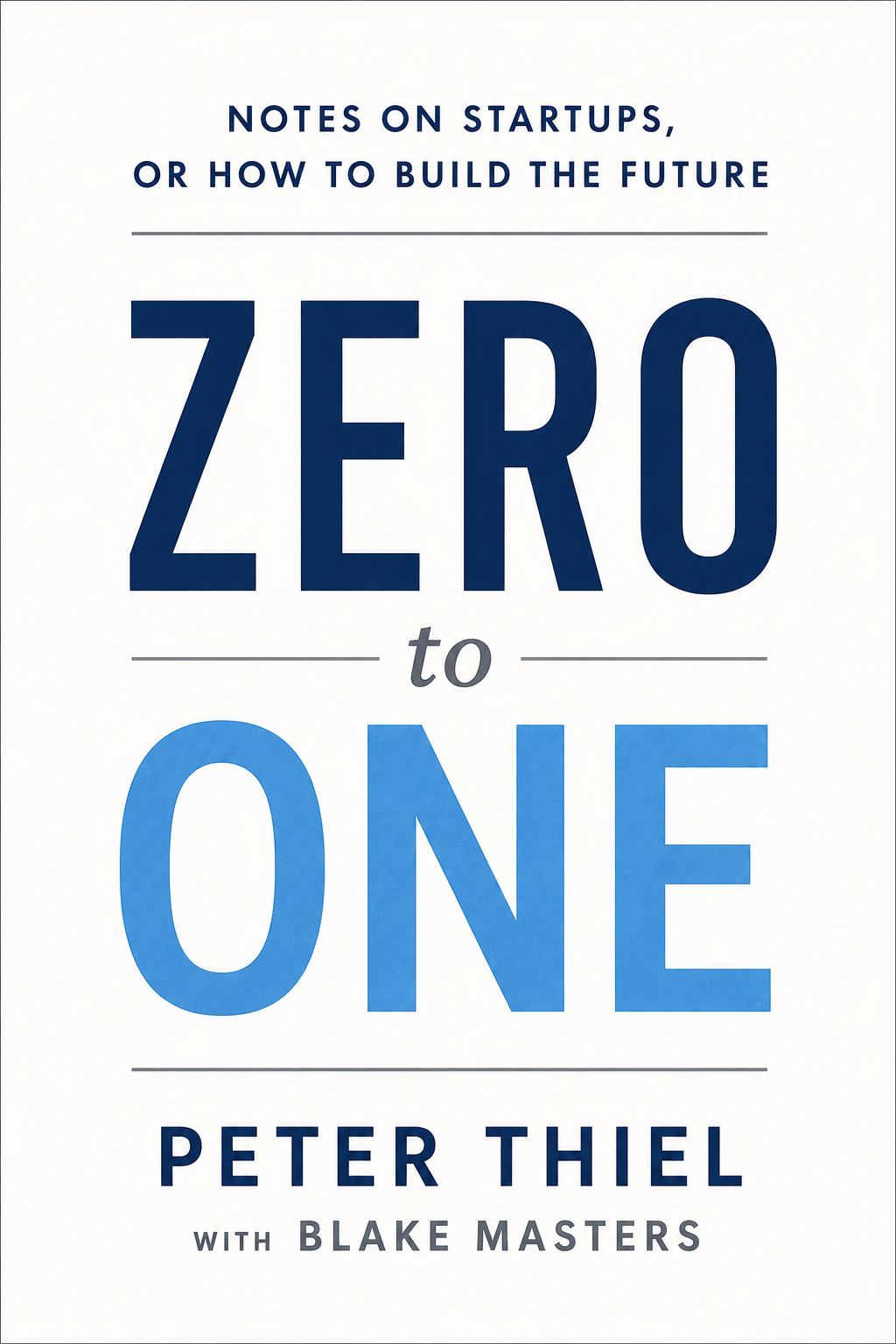
From Contrarian Insight to Building the Future
Zero to One: Notes on Startups, or How to Build the Future by Peter Thiel & Blake Masters

Transcript
SPEAKER_1: Welcome to the course. Today we're getting into *Zero to One: Notes on Startups, or How to Build the Future by Peter Thiel & Blake Masters* — and if you think this is just another startup playbook, the book is going to challenge that assumption hard. SPEAKER_2: It really will. The most surprising idea in here is that competition — the thing most people treat as proof a market is healthy — is actually a trap. The author argues that truly valuable companies escape competition entirely. That's worth sitting with. SPEAKER_1: Before we get into that, who actually wrote this? SPEAKER_2: Peter Thiel is a German-American entrepreneur and venture capitalist born in Frankfurt. And Blake Masters is an American venture capitalist widely described as Thiel's protégé — he co-wrote the book from notes he took in Thiel's Stanford course. SPEAKER_1: Alright, so the book opens with this distinction — vertical progress versus horizontal progress. Zero to one versus one to n. Our listener might think, isn't that just a fancy way of saying innovation versus imitation? SPEAKER_2: That's a fair read on the surface. But Thiel is making a sharper claim. Horizontal progress — one to n — is globalization: taking what works and spreading it. Vertical progress is technology: creating something the world has never seen. The typewriter example makes it concrete. Build one typewriter, that's zero to one. Build a hundred, that's one to n. SPEAKER_1: Mm. So globalization gets framed as the lesser path? SPEAKER_2: Not lesser — just insufficient on its own. The author's point is that zero-to-one progress is both rarer and more consequential. A world that only copies and distributes isn't actually moving forward. It's just spreading the same ceiling wider. SPEAKER_1: But here's where someone reading along might push back. The digital world has seen enormous vertical progress — computing, the internet, mobile. Isn't Thiel overstating the stagnation problem? SPEAKER_2: He anticipates that. The book draws a sharp line between the digital world and the physical one. Extraordinary advances in software have coexisted with striking stagnation in energy, transportation, and manufacturing. That's the tension behind the line everyone quotes: 'We wanted flying cars, instead we got 140 characters.' SPEAKER_1: Wait — is that just nostalgia? Our listener might hear 'flying cars' and think Thiel is romanticizing a future that was never realistic. SPEAKER_2: That's exactly the misread the book guards against. [emphasis] The flying car isn't the point. It's a stand-in for a diagnosis — that society has grown comfortable with incremental, horizontal gains and has quietly lost the drive to pursue genuine breakthroughs. The ambition shrank. That's what he's naming. SPEAKER_1: So where does the startup fit in? That sounds good on paper, but large companies have R&D budgets that dwarf any startup. Why is the startup the vehicle for zero-to-one thinking? SPEAKER_2: Because size is the constraint, not the resource. Large organizations are structurally oriented toward optimizing what already works. Their incentives push against radical questioning. Startups are small enough to challenge received wisdom. Thiel frames the startup not as a business structure but as an epistemic unit — a group committed to the premise that something important and new can actually be built. SPEAKER_1: Epistemic unit — that's a strong phrase. Isn't that a bit of a stretch by the author? Most startups are just people trying to make money. SPEAKER_2: [chuckle] That's a fair critique. But the book's case is that founding a company is closer to an intellectual and moral commitment than a business decision. The founding team has to believe something the market doesn't yet believe. That belief — held against consensus — is what makes the zero-to-one move possible. SPEAKER_1: Which brings us to the question the book closes this section with. 'What important truth do very few people agree with you on?' For our listener, that might sound like a thought experiment. How does the book make it actionable? SPEAKER_2: By treating it as a filter. The author argues that genuine contrarianism is rare. Most people who think they hold unconventional views are just restating familiar heterodoxies — edgy-sounding ideas that are actually consensus in disguise. A true contrarian insight reveals an opportunity invisible to everyone operating inside conventional assumptions. SPEAKER_1: But how does someone actually know if their contrarian belief is real insight versus just being wrong? SPEAKER_2: The book doesn't hand you a test. [short pause] What it does is frame the capacity to identify and act on a true contrarian insight as the foundational skill of the entrepreneur. The discomfort of the question is the point — if the answer comes easily, it probably isn't contrarian enough. SPEAKER_1: Alright. So for our listener, the core argument here isn't really about startups as a career move. It's about a particular kind of thinking — original, uncomfortable, non-consensus — as the prerequisite for building anything genuinely new. SPEAKER_2: That's exactly it. Thiel's argument is that real value requires original thinking, the courage to hold unpopular beliefs, and the willingness to build something that has never existed — rather than competing inside markets others have already made. The zero-to-one move starts in the mind before it ever starts in a company. SPEAKER_1: So let's push on that contrarian insight question a bit more. The book frames it as the foundational skill of the entrepreneur. But isn't that just a romanticized way of saying 'be different'? Our listener might feel like that's advice they've heard a hundred times. SPEAKER_2: That's a fair critique — and it's exactly the trap Thiel is warning against. The book's case is that most people who think they're being contrarian are just restating familiar heterodoxies. Edgy-sounding positions that are actually consensus in disguise. Real contrarianism is rarer and more uncomfortable than that. SPEAKER_1: Right — but how does someone actually tell the difference? Between a genuine insight and just being wrong? SPEAKER_2: The book doesn't hand you a clean test. [short pause] What it does is frame the discomfort of the question as the signal. If the answer comes easily, it probably isn't contrarian enough. A true insight reveals an opportunity invisible to everyone operating inside conventional assumptions — and that kind of belief is almost always lonely to hold. SPEAKER_1: Lonely to hold. That's an interesting phrase. So the book is essentially saying that the founding act — starting a company — is downstream of a belief most people would reject? SPEAKER_2: That's exactly Thiel's framing. The founding team has to believe something the market doesn't yet believe. That non-consensus belief is what makes the zero-to-one move possible in the first place. Without it, you're just entering a market someone else already defined. SPEAKER_1: Wait — but doesn't that logic apply to any bold decision, not just startups? Someone reading this might say Thiel is dressing up ordinary risk-taking in philosophical language. SPEAKER_2: [inhale] The distinction the book draws is structural, not just philosophical. Large organizations are incentivized to optimize what already works. A startup's founding commitment — the shared belief that something new can be built — is what keeps it oriented toward zero-to-one. That's not ordinary risk-taking. That's a different epistemic posture entirely. SPEAKER_1: Mm. So the whole framework — vertical versus horizontal, zero to one versus one to n — it's really a diagnosis before it's a prescription. SPEAKER_2: Exactly. Thiel argues that the default assumption most people carry is that tomorrow will look like today, only bigger and more connected. That assumption treats foundational technologies as essentially complete. The book's case is that this is a failure of imagination — and that the stagnation in energy, transportation, and manufacturing is the evidence. SPEAKER_1: And that's where the flying cars line lands. Not as nostalgia — as a measure of how much ambition has quietly contracted. SPEAKER_2: Right. The author isn't mourning flying cars specifically. He's naming a pattern: that society got comfortable with horizontal gains — faster phones, more apps — and stopped pushing on the harder physical problems. The ambition shrank, and most people didn't notice because the digital wins felt so large. SPEAKER_1: So for our listener, the book's opening move is essentially a reframe. Progress isn't one thing — it's two very different things, and we've been celebrating the easier one. SPEAKER_2: That's the core of it. Thiel argues that globalization — spreading what works — is valuable but insufficient. Technology — creating what didn't exist — is what actually moves the ceiling. And the future depends on our collective ability to produce more of the latter, not just distribute more of the former. SPEAKER_1: Alright. So if someone walks away from this opening section with one thing, what does the book actually want them to sit with? SPEAKER_2: The question. 'What important truth do very few people agree with you on?' Thiel's argument is that real value — the kind that creates something genuinely new — starts there. Not with a market analysis. Not with a competitor audit. With a belief held against consensus. [emphasis] That's where zero to one begins. SPEAKER_1: But here's what I keep coming back to. The book says the contrarian question is the foundational skill. Yet Thiel built PayPal in a very specific moment — the late nineties internet boom. Isn't someone reading this right to wonder whether that insight is portable, or whether it's just a founder retrofitting a story? SPEAKER_2: That's the sharpest version of the critique. And the book doesn't fully escape it. But Thiel's argument isn't 'do what I did.' It's structural. The contrarian question works because markets are built on consensus assumptions. Wherever consensus is wrong, there's a gap. That gap exists in every era, not just 1998. SPEAKER_1: So the book is saying the question travels even if the specific answer doesn't. SPEAKER_2: Exactly. The author contends that large organizations are structurally oriented toward optimizing what already works. Their incentives push against radical questioning. A startup's founding commitment — the shared belief that something new can be built — is what keeps it pointed toward zero-to-one. That posture is repeatable. The specific bet isn't. SPEAKER_1: Wait — but the book's own evidence cuts against that. Thiel points to stagnation in energy, transportation, manufacturing. If the contrarian question is so portable, why haven't more founders aimed at those harder physical problems? SPEAKER_2: [sigh] That's precisely the diagnosis the book is making. Thiel argues that the digital wins — computing, mobile, the internet — felt so large that ambition quietly contracted around them. Founders kept asking contrarian questions, but inside a narrowing frame. The flying cars line isn't nostalgia. It's a measure of how much the frame shrank. SPEAKER_1: So the problem isn't a shortage of contrarian thinkers. It's that contrarian thinking got captured by horizontal progress. SPEAKER_2: That's a sharp way to put it. The book's case is that globalization — spreading what works — is valuable but insufficient. Technology — creating what didn't exist — is what actually moves the ceiling. And the author argues we've been celebrating the easier one while calling it progress. SPEAKER_1: Mm. So for our listener who's not a founder — someone in a large organization, say — does the book have anything to offer them, or is this really just a founder's manifesto? SPEAKER_2: The book is written from a founder's vantage point, no question. But the epistemic argument underneath it applies more broadly. Thiel frames the startup as a unit of people who believe something the market doesn't yet believe. That belief structure — holding a non-consensus view and acting on it — isn't exclusive to company founders. SPEAKER_1: Though the book doesn't really develop that broader application. It stays pretty tightly focused on startups. SPEAKER_2: It does. And that's a real limitation if our listener is looking for a general theory of innovation. What the book offers instead is a very precise argument: that the zero-to-one move starts in the mind before it starts in a company. The institutional form is secondary to the quality of the underlying belief. SPEAKER_1: Alright. So pulling back — what does this opening section actually accomplish? Because it's a lot of framework before the book gets to anything concrete. SPEAKER_2: It's doing something specific. Thiel is establishing that the rest of the book's advice only makes sense if you accept the diagnosis first. If you think progress is basically on track — more apps, more connectivity, more distribution — then none of what follows is necessary. The framework is the argument for why the question matters at all. SPEAKER_1: So for our listener, the honest summary of this opening is: before you can build something new, you have to believe something uncomfortable. And most people — including most people who think they're being bold — haven't actually done that. SPEAKER_2: That's exactly where the book lands. [emphasis] Real value — the kind that creates something genuinely new — starts with a belief held against consensus. Not a market analysis. Not a competitor audit. A belief most people would reject. That's where zero to one begins. And according to Thiel, almost everything else in building a company flows from whether you got that first step right. SPEAKER_1: So the book's whole opening section is essentially a setup — a diagnosis before a prescription. But here's what I want to push on. Thiel argues that the contrarian question is foundational. Yet the book also admits most people who think they're being contrarian are just restating familiar heterodoxies. How does someone actually tell the difference? SPEAKER_2: That's the tension the book lives in. Thiel doesn't give a clean test. What he offers instead is a structural clue: a genuine contrarian insight reveals an opportunity that's invisible to everyone operating inside conventional assumptions. If the market already sees it, it's not contrarian — it's just late. SPEAKER_1: But that's almost circular. You know it was a real contrarian insight only after it worked. SPEAKER_2: The book doesn't fully escape that. But Thiel's point is that the discomfort is the signal. If holding the belief feels genuinely uncomfortable — if most people around you would reject it — that's at least a necessary condition. It's not sufficient, but it's the starting filter. SPEAKER_1: Wait — so the book is saying discomfort is a feature, not a bug? SPEAKER_2: Exactly. The author frames the startup as a group of people who've chosen to act on a shared belief the market doesn't yet hold. That shared commitment is what keeps the organization pointed toward zero-to-one. The discomfort of the belief is what keeps it non-consensus — and therefore potentially valuable. SPEAKER_1: That's a clean framing. But it raises a harder question. If startups are the primary vehicle for zero-to-one thinking, what does the book say about why large organizations can't do it? Because plenty of large companies have produced genuine breakthroughs. SPEAKER_2: The book's case isn't that large organizations never produce breakthroughs. It's structural: their incentives push toward optimizing what already works. The bigger the organization, the more it has to lose by questioning its own foundations. A startup has no existing model to protect — that's the asymmetry Thiel is pointing at. SPEAKER_1: Mm. Though someone reading this could fairly say that's a convenient story for a venture capitalist to tell. SPEAKER_2: [chuckle] That's a fair shot. And the book doesn't pretend to be neutral. But the structural argument holds independent of who's making it. Large organizations reward people for scaling proven models. Startups, at founding, reward people for questioning whether the model should exist at all. Those are genuinely different epistemic environments. SPEAKER_1: Alright. So the book's opening section has done a lot of work. It's separated vertical from horizontal progress, diagnosed stagnation in the physical world, introduced the startup as the institutional vehicle for zero-to-one thinking, and landed on the contrarian question as the foundational skill. That's a dense opening for what's supposed to be a practical book. SPEAKER_2: It is dense. But Thiel is deliberate about it. The author's argument is that the rest of the book's advice — on monopoly, on team building, on sales — only makes sense if you've accepted the diagnosis first. If you think progress is basically on track, none of what follows is necessary. The framework earns its length. SPEAKER_1: So for our listener who picks this up expecting a startup playbook — they're going to hit a philosophy lecture first. SPEAKER_2: They are. And that's intentional. Thiel's position is that most startup advice fails because it skips the prior question: do you actually believe something the market doesn't? Without that, the tactics are just noise. The philosophy isn't decoration — it's the load-bearing wall. SPEAKER_1: That's a strong claim. And honestly, it's the one that's hardest to argue with — because if it's wrong, the whole book collapses. If it's right, it reframes what building anything actually requires. SPEAKER_2: [short pause] That's exactly where the book wants our listener to land. According to Thiel, the zero-to-one move starts in the mind before it starts in a company. The institutional form is secondary. What matters first is the quality of the underlying belief — and whether you have the courage to hold it against the consensus long enough to act. SPEAKER_1: So the book has landed on this idea that the zero-to-one move starts in the mind. But here's what I keep circling back to — Thiel is essentially asking founders to bet their careers on a belief most people reject. That's not a framework. That's a leap of faith. SPEAKER_2: That's a fair tension to name. But the author's argument isn't that the belief is enough on its own. It's that without the belief, everything else — the product, the team, the market strategy — is just optimization inside someone else's frame. The leap is the prerequisite, not the whole plan. SPEAKER_1: But most people who take that leap are wrong. The book even admits that genuine contrarianism is rare — that most people restating unconventional views are just recycling familiar heterodoxies. So what separates the real insight from the delusion? SPEAKER_2: The book doesn't hand you a clean test. What Thiel offers is a structural clue: if the market already sees the opportunity, it isn't contrarian — it's just late. The discomfort of the belief is the starting filter. Not sufficient, but necessary. SPEAKER_1: Wait — so discomfort is the diagnostic? That seems like it could justify almost anything. SPEAKER_2: It could, if you stopped there. But the author pairs it with a second condition: the belief has to reveal an opportunity invisible to everyone operating inside conventional assumptions. Discomfort alone is just stubbornness. Discomfort plus hidden opportunity — that's the combination the book is pointing at. SPEAKER_1: Mm. And the flying cars line is doing real work here, isn't it? It's not just a quip — it's the evidence for why that hidden opportunity space exists at all. SPEAKER_2: Exactly. The author uses it as a diagnosis, not nostalgia. The argument is that we've had extraordinary vertical progress in the digital world and striking stagnation in the physical one — energy, transportation, manufacturing. That gap is where the invisible opportunities live. SPEAKER_1: Though someone reading this could say that digital progress has been genuinely transformative. Isn't Thiel underselling what horizontal progress has actually delivered? SPEAKER_2: The book doesn't dismiss horizontal progress. Spreading what works to new geographies has lifted enormous numbers of people. The author's point is narrower: horizontal progress alone can't solve problems that require capabilities the world has never had. For those, you need zero to one. SPEAKER_1: So the startup isn't just a business structure in this framing — it's the institutional form that keeps the zero-to-one belief alive long enough to act on it. SPEAKER_2: [short pause] That's precisely how the author frames it. A startup is a group of people who've chosen to act on a shared belief the market doesn't yet hold. The small size isn't a weakness — it's what allows the organization to keep questioning its own foundations instead of protecting an existing model. SPEAKER_1: But the book's case against large organizations doing this — isn't that a little convenient coming from a venture capitalist? SPEAKER_2: [chuckle] That's a fair shot. And the author doesn't pretend to be neutral. But the structural argument holds independent of who's making it. Large organizations reward scaling proven models. Startups, at founding, reward questioning whether the model should exist at all. Those are genuinely different epistemic environments. SPEAKER_1: Alright. So for our listener who came in expecting a startup playbook — what they've actually gotten in this opening is a philosophy lecture. Is that a feature or a bug? SPEAKER_2: According to Thiel, it's the load-bearing wall. The author's position is that most startup advice fails because it skips the prior question: do you actually believe something the market doesn't? Without that, the tactics are noise. The philosophy isn't decoration — it earns its place. SPEAKER_1: So the honest summary for someone finishing this opening section is: before you can build something new, you have to believe something uncomfortable. And most people — even the ones who think they're being bold — haven't actually done that. SPEAKER_2: [emphasis] That's exactly where the book lands. Real value — the kind that creates something genuinely new — starts with a belief held against consensus. Not a market analysis. Not a competitor audit. A belief most people would reject. And according to Thiel, almost everything else in building a company flows from whether you got that first step right.