
Transcript
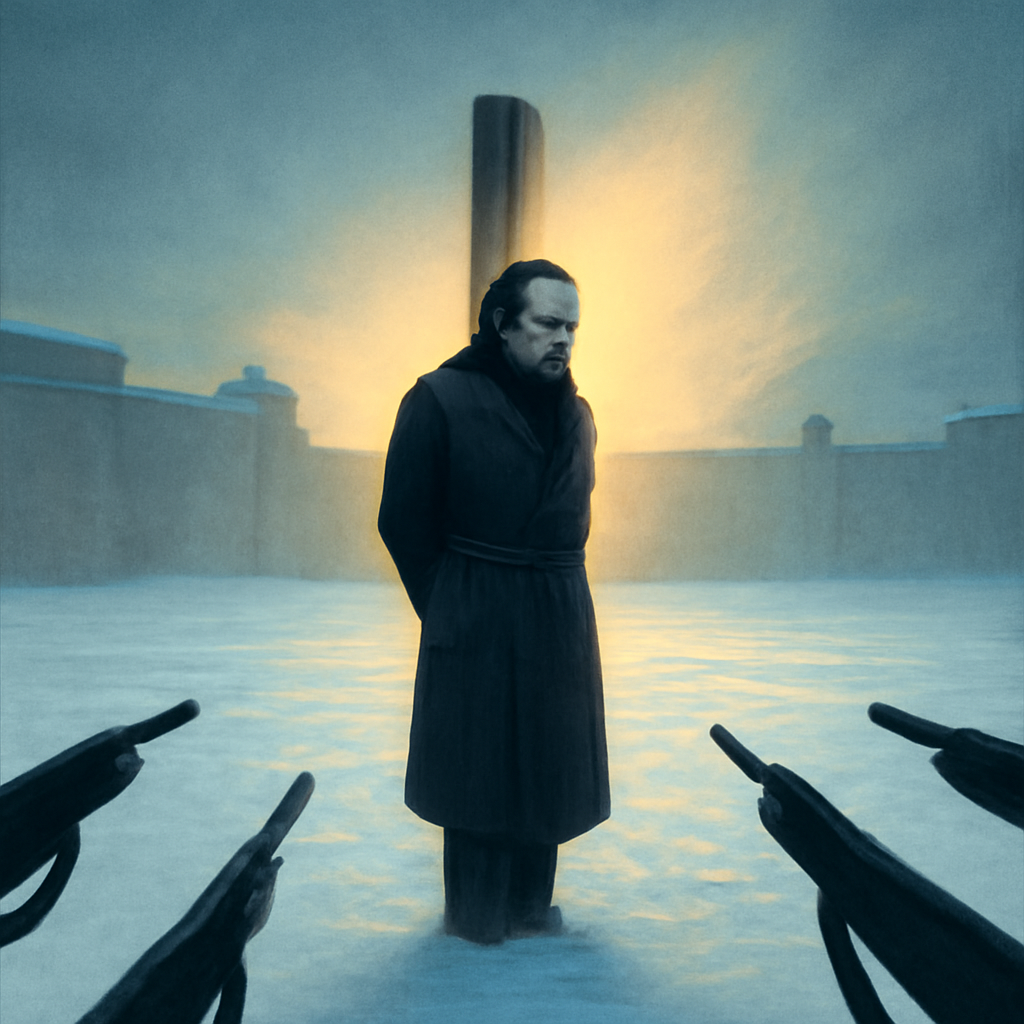
On December 22, 1849, Fyodor Dostoyevsky stood in Semyonovsky Square in St. Petersburg, wearing a white execution shroud, waiting to be shot. He was twenty-eight years old. The firing squad was ready. Last rites had been administered. And then — nothing. A rider arrived with a reprieve. The execution was a deliberate psychological torture, staged by order of Tsar Nicholas I. Dostoyevsky had spent several minutes in the absolute conviction that he was about to die. That experience did not leave him. It became the engine of everything he would ever write. The crime that brought him to that square was, by the standards of violent revolution, remarkably mild. Dostoyevsky had joined the Petrashevsky Circle, a discussion group that met to debate political reform, censorship, the abolition of serfdom, and banned literature. Think of it as a reading salon with dangerous ideas. The tsarist secret police saw it differently. In April 1849, they arrested Dostoyevsky and his fellow members, holding them in the Peter and Paul Fortress in St. Petersburg for approximately eight months before the staged execution was carried out. The circle had not launched a coup. They had talked. And talking, under autocracy, was enough. Now, James, here is where the story shifts from political biography to something far more interior. After the mock execution, Dostoyevsky was sentenced to four years of hard labor at the prison camp in Omsk, Siberia, followed by compulsory military service in the town of Semipalatinsk. The conditions at Omsk were brutal — overcrowding, severe cold, poor sanitation, relentless physical labor. He lived and worked alongside convicted murderers and thieves. The key idea is what this proximity produced. Dostoyevsky was forced to see the full spectrum of human suffering and human cruelty up close, not as an abstraction debated in a salon, but as daily, grinding reality. The only book he was reportedly permitted to possess was the New Testament. He read it repeatedly. By the time his shackles were removed at the end of his four-year term, his worldview had been fundamentally remade. The Siberian years did something specific to his writing. Before arrest, Dostoyevsky had been a promising young author interested in social conditions. After Omsk, punishment was no longer a legal question for him. It became a psychological and spiritual crisis. That shift is visible in his autobiographical prison work, The House of the Dead, serialized between 1860 and 1862 in the journal Time, edited by his brother Mikhail. The book is literary rather than a literal transcript, but its basis is unmistakably his own experience. And the mock execution itself kept surfacing in his fiction. Remember this: the consciousness of a condemned person facing death became one of his most recurring fictional preoccupations. For example, in The Idiot, Prince Myshkin delivers a harrowing, precise account of what a man thinks and feels in the final minutes before execution — a passage so specific, so psychologically exact, that it reads less like invention and more like memory. It almost certainly was. James, the takeaway from this first chapter of Dostoyevsky's life is not simply that suffering made him a better writer. That framing is too easy. What the gallows and the gulag actually did was redirect his entire philosophical compass. The young man who had gathered in drawing rooms to discuss utopian socialism emerged from Siberia convinced that external political systems could not redeem human beings. Redemption, if it existed at all, had to be fought for internally — through freedom, moral choice, and responsibility. His profound psychological insight was not a gift. It was extracted from him by trauma. The mock execution made the value of continued existence an intense, almost unbearable philosophical concern. Every character he would later create who stands at a moral precipice — Raskolnikov, Myshkin, the Grand Inquisitor — carries some fragment of that man in the white shroud, standing in the snow, counting his last seconds. Dostoyevsky survived the firing squad. Russian literature survived because of it.