
Transcript
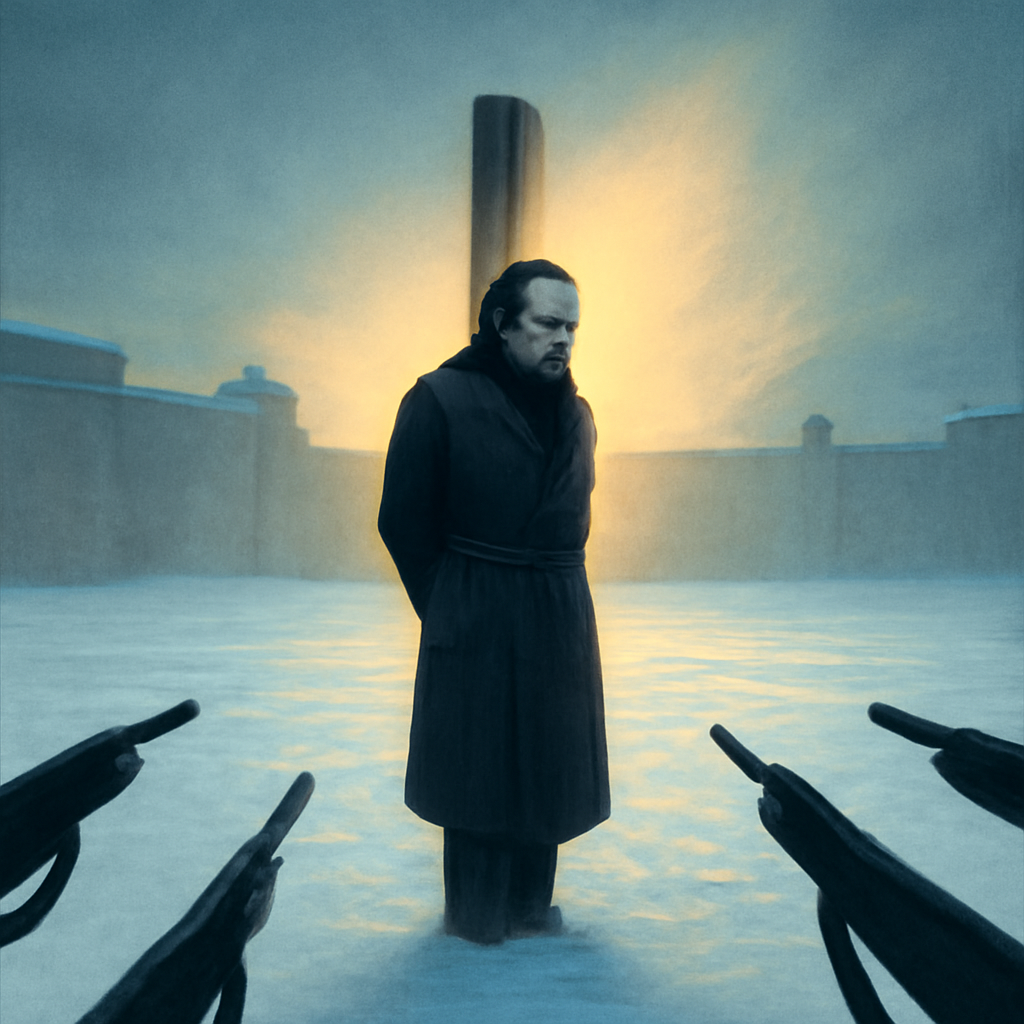
SPEAKER_1: Last time we traced how the mock execution and Siberia completely remade Dostoyevsky's philosophical compass — away from utopian politics and toward something far more interior. Now I want to follow that thread into his actual fiction, because that's where the argument gets sharp. SPEAKER_2: Right, and the sharpest early example is Notes from Underground, published in 1864. Dostoyevsky wrote it as a direct provocation aimed at a novel called What Is to Be Done? by Nikolai Chernyshevsky. That book had become a kind of manifesto for Russian radical intellectuals — the idea being that if you scientifically explain self-interest to people, they'll behave rationally and society will improve. SPEAKER_1: So Chernyshevsky was essentially arguing that human beings are rational calculators, and the right social engineering fixes everything? SPEAKER_2: Exactly. And Chernyshevsky used the Crystal Palace — the enormous iron-and-glass exhibition hall built in London in 1851 — as his symbol of that rational utopia. A perfect, transparent structure. Dostoyevsky seized on that image and turned it into a target. SPEAKER_1: How so? SPEAKER_2: The Underground Man — Dostoyevsky's narrator — says he would rather smash the Crystal Palace than live inside it. His core objection is this: even if someone proves to you, mathematically, what serves your best interest, you might still choose against it. Just to prove you can. Human beings, he insists, are not piano keys. They don't produce predictable notes when pressed. SPEAKER_1: [short pause] That's a genuinely strange argument. He's saying the desire to act irrationally is itself a fundamental human drive? SPEAKER_2: Precisely. And that's why the book is often called one of the earliest works of existentialist fiction — it insists that freedom, including the freedom to be self-destructive, is more essential to human identity than any rational plan. The Underground Man doesn't want to be optimized. He wants to be real. SPEAKER_1: So that's the philosophical setup. Then Crime and Punishment, serialized in 1866, takes that same argument and puts it under enormous pressure — through a character who actually acts on a theory. SPEAKER_2: Yes. Raskolnikov. His very name comes from the Russian word raskol, meaning schism or split — a name that signals his divided identity from the start. He's an impoverished former student in Saint Petersburg, and he's constructed what he calls the extraordinary man theory. SPEAKER_1: Walk our listener through that theory, because it's easy to misread it as simple arrogance. SPEAKER_2: It's more structured than arrogance. Raskolnikov divides humanity into two types: ordinary people, who must obey the law, and extraordinary people — think Solon, Caesar, Napoleon — who may transgress ordinary moral or legal limits when doing so serves a supposedly greater historical purpose. The key idea is that he sees this as a historical observation, not just personal vanity. SPEAKER_1: And he tests it. SPEAKER_2: He does. He decides to murder Alyona Ivanovna, an elderly pawnbroker he regards as exploitative and socially harmful. The utilitarian logic: her death frees resources and removes a parasite. But here's what Dostoyevsky does that's so devastating — Raskolnikov's motives are deliberately contradictory. He invokes utilitarian reasoning, yes, but also intellectual pride, resentment, and a raw desire to discover whether he himself is extraordinary. SPEAKER_1: So not X, but Y? It's not really about the pawnbroker at all. SPEAKER_2: Exactly. The murder is a self-experiment. He kills Alyona with an axe. Then her half-sister Lizaveta arrives unexpectedly, and he kills her too — an innocent woman his theory never accounted for. He takes almost nothing from the apartment. The utilitarian justification collapses immediately in practice. SPEAKER_1: And then the novel doesn't even make us wait to find out who did it. SPEAKER_2: That's the structural masterstroke. The reader knows the murderer from the first pages. The suspense is entirely psychological — what happens inside Raskolnikov after. He suffers illness, delirium, isolation. He cannot reduce the crime to one stable motive. His intellectual justification keeps colliding with his conscience, his compassion, his fear. The theory doesn't fail because someone out-argues him. It fails because he can't live inside it. SPEAKER_1: [sigh] That's the real argument Dostoyevsky is making, isn't it? Not a philosophical rebuttal — a psychological one. SPEAKER_2: Yes. And the axe is central to that. Think of it this way: the axe is the moment where Raskolnikov's abstract intellectual rebellion becomes embodied, irreversible violence. You can revise a theory. You cannot un-swing an axe. That's where the destroy-and-build dynamic scholars have noted in the novel becomes visceral — he destroys a life hoping to build a new moral order, and instead destroys himself. SPEAKER_1: So where does Sonya Marmeladova come in? Because she seems to represent something completely opposite to Raskolnikov's framework. SPEAKER_2: She's his moral counterpart. Sonya has entered prostitution to support her family — she's suffered enormously — yet she embodies compassion, sacrifice, and Christian faith. She urges him to confess. She reads him the Gospel story of Lazarus raised from the dead. And eventually, Raskolnikov does confess and is sentenced to eight years of hard labor in Siberia. SPEAKER_1: Though the confession isn't quite full repentance yet. SPEAKER_2: Not immediately. He still clings to aspects of his theory. The epilogue frames redemption as gradual — connected to suffering, to Sonya following him to Siberia, to a slow spiritual awakening. And there's a moment where Raskolnikov bows in the street and kisses the earth. That act is the opposite of everything his theory stood for — no calculation, no pride, no utilitarian logic. Just humility before existence itself. SPEAKER_1: The takeaway, then, is that Dostoyevsky isn't just critiquing a bad idea. He's showing that a certain kind of rationalism — one that treats human beings as means to an end — carries a violence inside it that eventually turns on the person who holds it. SPEAKER_2: That's it exactly. For everyone following this arc, the key thing to carry forward is this: Dostoyevsky's argument against rational egoism isn't made in a lecture hall. It's made through a man with an axe who can't sleep, can't eat, and can't explain to himself why he did what he did. The infinite value of a single human soul — even a pawnbroker's — is what his theory couldn't hold. And that failure is the novel.