The Triple Threat: Why Forests Are Our Most Critical Infrastructure
The Rain Pump We Keep Cutting Down

Transcript
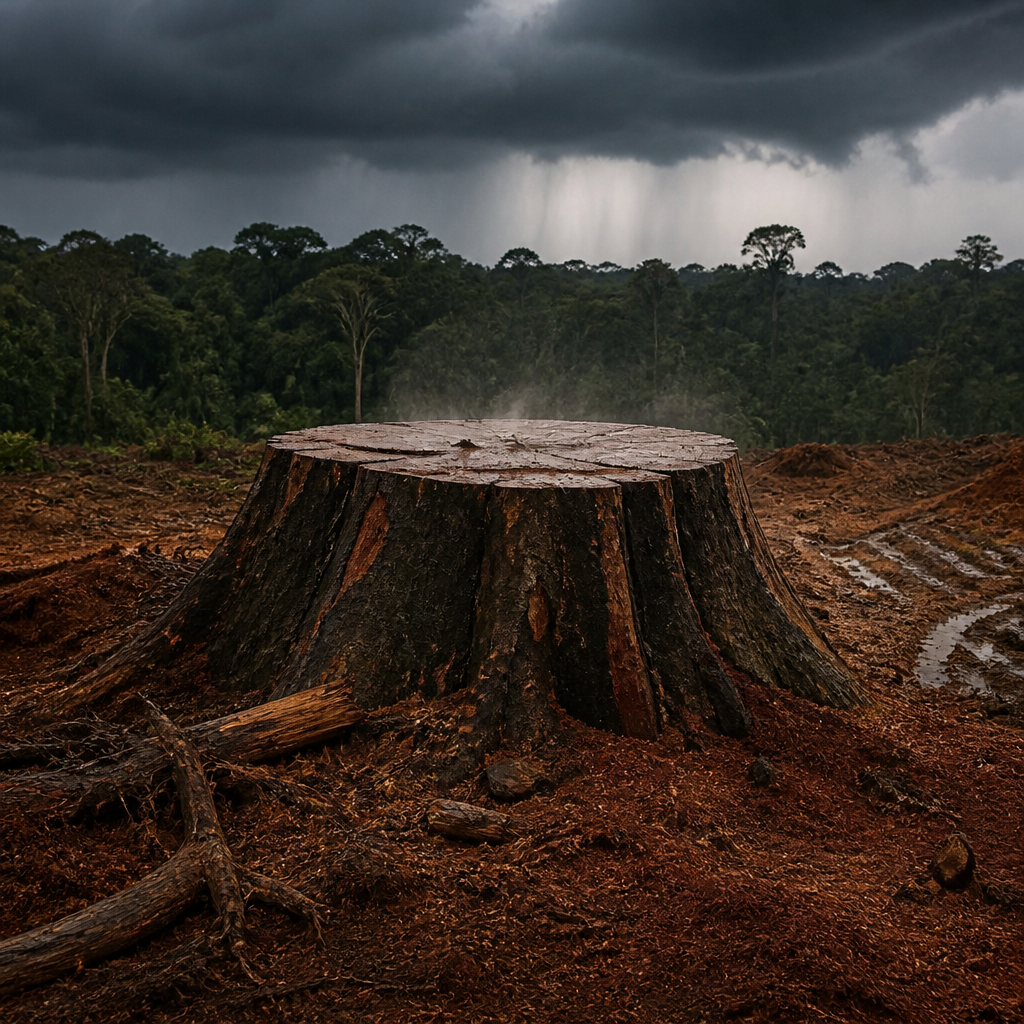
Forest soils hold more carbon than all the trees standing above them. That single fact — confirmed by the IPCC — reframes everything. We tend to think of forests as green lungs, a poetic but dangerously narrow metaphor. The Food and Agriculture Organization's Global Forest Resources Assessment 2020 puts the numbers in stark relief: forests cover approximately 4.06 billion hectares, about 31% of the world's land area, and they store carbon not just in trunks and canopies but in dead wood, litter, and the soil beneath your feet. Disturb that soil, and you release a carbon debt that took centuries to accumulate. That is not a lung. That is planetary infrastructure. Now, here is where the scale of the problem becomes visceral. Between 1990 and 2020, the world lost approximately 178 million hectares of forest — an area roughly the size of Libya — according to the FAO. The rate has slowed: from around 16 million hectares per year in the 1990s down to about 10 million hectares per year during 2015 to 2020. Slower is not stopped. Think of it like a hemorrhage that has gone from catastrophic to serious. The primary driver, the IPCC confirms, is agricultural expansion. Farms replace forests. And when that happens, the carbon stored across decades gets released as CO2 in a matter of months. The climate system absorbs that hit immediately. The forest takes a century to grow back — if it grows back at all. The key idea here is what researchers call the Nexus: the interlocking relationship between deforestation, climate change, and biodiversity loss. These are not three separate problems. They are one system failing in three directions at once. Tropical forests are the clearest example. They contain some of the highest carbon stocks on Earth and support intense biological activity. But here is the counterintuitive part: a tropical forest can flip from carbon sink to carbon source. Drought, fire, disease, or land-use change can push emissions above absorption. That means the very forests we count on to buffer warming can, under stress, accelerate it. And forest fragmentation makes this worse. Research published in scientific literature shows that even when some tree cover remains, fragmentation disrupts pollination, seed dispersal, and reproduction. The ecosystem unravels from the inside. That unraveling has direct economic consequences, Alina, and this is where the biodiversity angle hits hardest. Biodiversity loss weakens nutrient cycling, decomposition, soil formation, pest regulation, and pollination — the invisible services that underpin agriculture globally. More than one billion people depend directly on forests for food, livelihoods, shelter, energy, or income, according to the FAO. Forests also regulate water flows, reduce soil erosion, and filter pollutants. And here is a fact that surprises most people: tropical forests generate rainfall downwind. Forest loss in one region can reduce water availability in distant agricultural zones — zones that may have no trees left to lose. Remember, this is not a local problem wearing a global costume. It is a genuinely global system, and local tree loss is a master switch inside it. Indigenous Peoples and local communities, the IPCC notes, play a critical role in managing and protecting these systems — their knowledge is not peripheral, it is load-bearing. The takeaway from everything you have just heard, Alina, is this: deforestation is a threat multiplier. It is not an isolated event somewhere far away. It is a single action that simultaneously accelerates global warming, collapses biodiversity, disrupts water cycles, and destabilizes the agricultural systems that feed billions of people. A plantation of trees is not a forest — the science is clear on that. Plantations may store some carbon, but they support far fewer native species and far simpler ecological interactions than intact natural forest. What we lose when a forest disappears is not just timber or scenery. We lose a self-regulating, carbon-storing, rainfall-generating, species-sustaining system that took millennia to build. The reinforcing feedback loop is already running: warming stresses forests, stressed forests emit more carbon, more carbon drives more warming. Understanding that loop — and why forests sit at its center — is the foundation for everything that follows in this course.