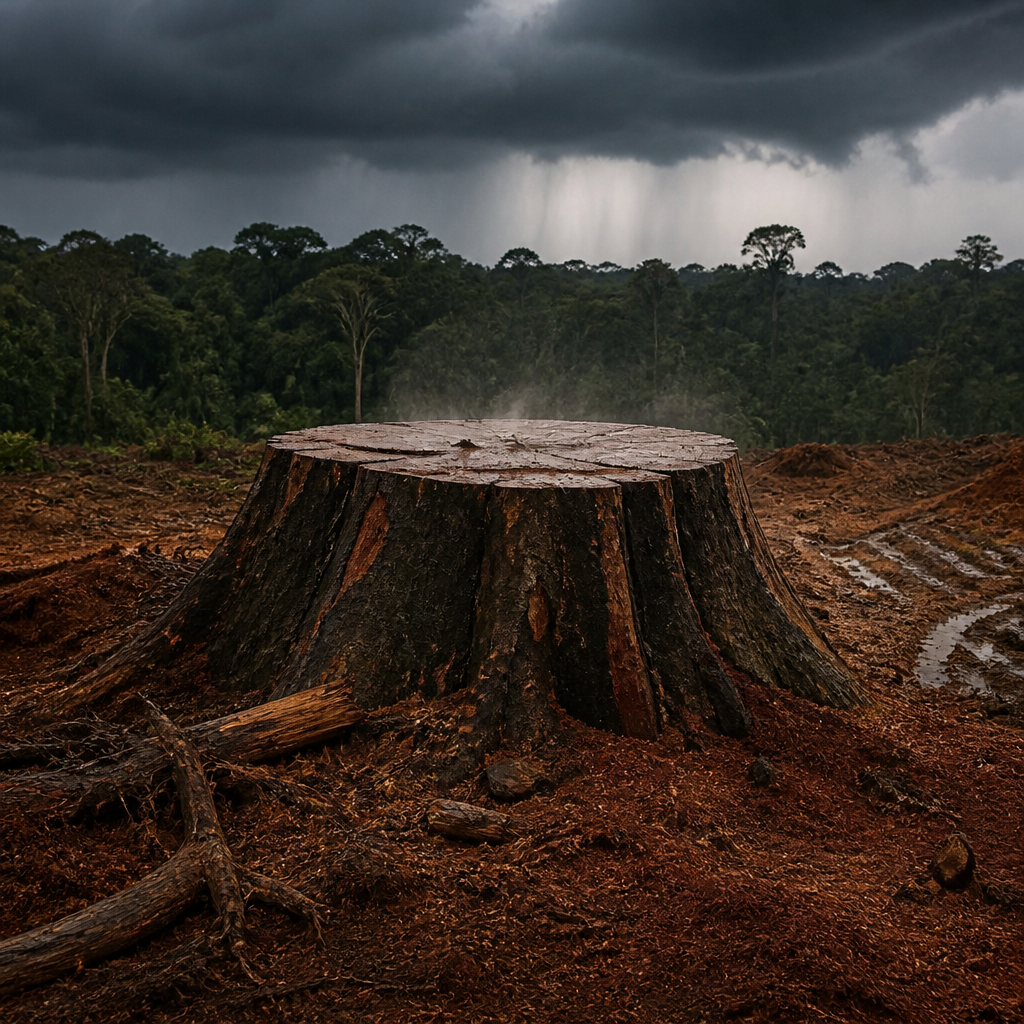

Transcript
A company clears a thousand hectares of forest. Its balance sheet shows a profit. The timber is sold. The land is converted to soy. Shareholders are happy. But here is what conventional accounting can fail to record: the emissions released, the water systems stressed, and the biodiversity put at risk. The profit was real. The destruction was also real. The accounting system simply could not see it. That is the core problem. And it is not a niche environmental issue, Alina. It is a structural flaw in how modern economies measure value. While forests are crucial for climate regulation, the economic systems driving deforestation are equally significant. The focus now shifts to understanding these economic drivers and exploring sustainable alternatives. Now the question is: why does this keep happening? The answer is economic. The dominant economic model prioritizes short-term gains over long-term sustainability, often ignoring the environmental costs of resource extraction. And the scale of that extraction is staggering. Global material extraction grew from roughly 30 billion tonnes in 1970 to about 106 billion tonnes in 2024. Without major changes, it could be nearly 60% higher in the future than it is today. Here is a number that reframes everything. In 2022, global investment in nature-based solutions was approximately 200 billion US dollars. That sounds significant. But finance flows directly harming nature exceeded it by more than thirty times. Private finance flowing into activities that damage nature was estimated at roughly 5 trillion dollars annually. That is about 140 times larger than private investment in nature-based solutions. Think of it this way: for every dollar going toward restoration, 140 dollars were actively funding destruction. This imbalance highlights the urgent need for economic models that prioritize ecological health and sustainability. Now, here is the counterintuitive part. Most people assume fossil fuels and mining are the primary drivers of biodiversity loss. They are not. Biomass production and harvesting — agricultural crops and forestry products — contribute more than 90% of land-related biodiversity loss and water stress. Agriculture alone accounts for almost 75% of land-related biodiversity impacts. Forestry adds roughly 23%. The extraction and processing of all material resources together account for more than half of global greenhouse-gas emissions. The food and materials system, not just the energy system, is the dominant pressure on living ecosystems. So what does a different model look like? Regenerative production aims not merely to reduce damage but to actively improve ecological functioning within existing land uses. For example, agroforestry integrates trees into farmland, supporting soil biodiversity, carbon storage, and water quality simultaneously. Managed grazing, crop rotation, and greater crop diversity can restore soil health rather than deplete it. Estimates suggest that agriculture, forestry, and other land-use measures could provide a significant portion of the global mitigation needed in pathways limiting warming to 1.5 or 2 degrees Celsius. Restoration also creates economic value. One modelling study found that restoring agricultural land increased gross value added by up to 5.4% and employment by up to 6.7%. Transitioning to sustainable practices requires significant investment. UNEP estimates that funding for restoration must increase substantially to meet future needs. Public policy plays a crucial role, but private investment must also scale up to meet the demands of sustainable development. [emphasis] That gap is the central challenge of the next decade. And closing it requires more than green investment funds. It requires redesigning the incentives that currently make destruction profitable and restoration optional. The takeaway from this entire course, Alina, is this. Forests are infrastructure. They regulate climate, generate rainfall, and sustain the biodiversity that underpins agriculture and human survival. Deforestation is a threat multiplier that accelerates warming, collapses water systems, and destroys value that no balance sheet currently captures. Changing that requires a fundamental shift: from valuing trees mainly as extracted products, to valuing the ecosystem services they provide while standing. Remember, the IPCC confirms that protecting and restoring forests, peatlands, and wetlands can reduce emissions and remove carbon from the atmosphere. The science is clear. The economics are catching up. The question now is whether the transition happens fast enough to matter.