
Transcript
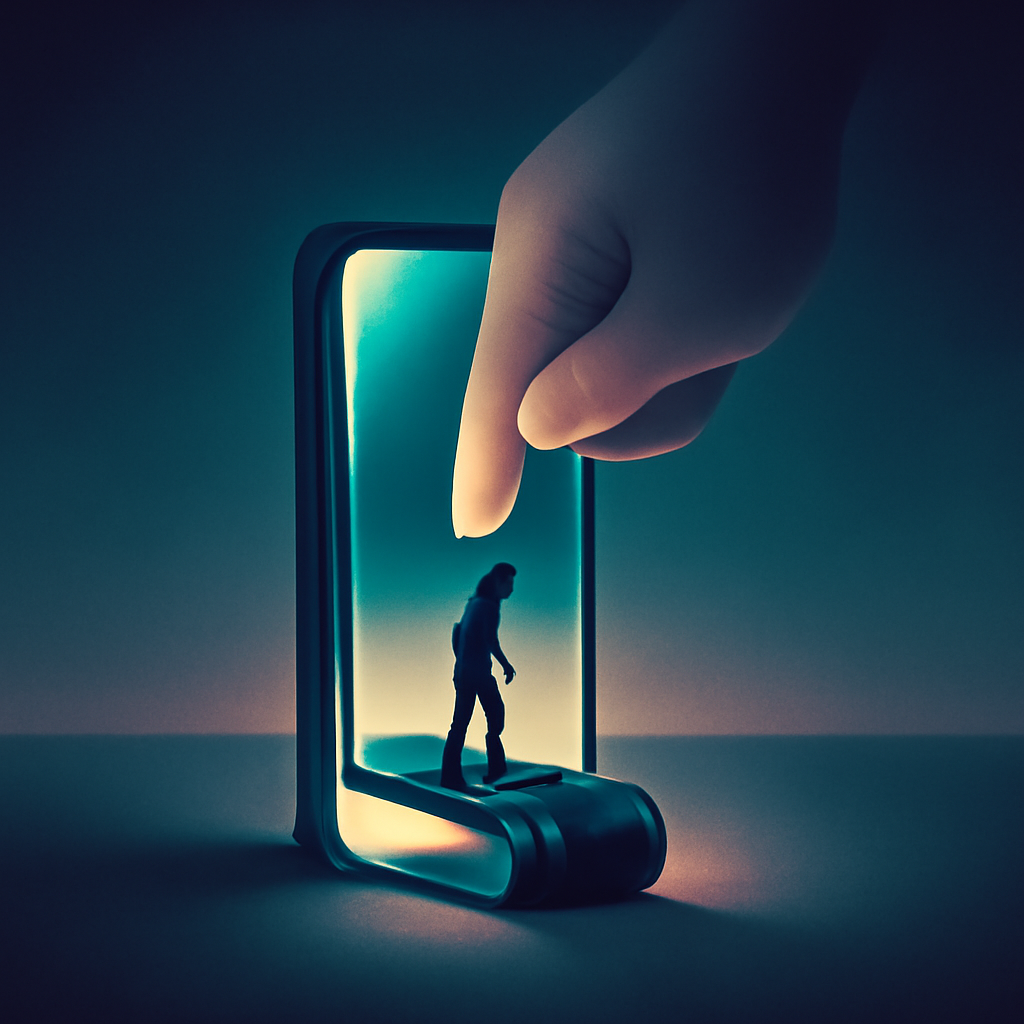
The stuckness starts before any comparison or guilt arrives. It starts earlier than that — with an app that almost never gives the brain a clean ending. Think of reaching for the phone to check one thing. A message, maybe, or a quick look at what is happening. You find the thing. And then the feed offers the next item. And the next. Not because you asked for more, but because the app was built so that more is always already there, waiting just below your thumb. You did not decide to read fifty posts. The app just kept presenting the next almost-choice, and your hand kept moving. This is not a coincidence of design. The feed behaves less like a list and more like a slot machine for attention. Each swipe might deliver something useful, something funny, something that feels personally relevant, something alarming, something that validates exactly what you were already thinking. Or it might deliver nothing much at all. The point is that you cannot know in advance. And that uncertainty — that maybe the next one will be the one — is precisely what keeps the finger moving. Psychologists call this intermittent reinforcement. When rewards arrive unpredictably, the brain does not relax and wait. It leans in. It searches harder. Predictable rewards are satisfying and then done. Unpredictable ones keep the loop open. Dopamine is part of this, but not in the simple way it is often described. It is not just a pleasure signal. It is more accurately a signal of anticipation — of learning, of seeking, of the possibility that something worth having is close. The brain releases it not only when a reward arrives, but when a reward might arrive. The scroll is not delivering pleasure on every swipe. It is delivering the feeling that the next swipe could. That is a harder thing to put down. Aza Raskin, who is often credited with inventing infinite scroll back in 2006, has said publicly that he deeply regrets it. His original idea was simply to make browsing cleaner — no more clicking a button to load the next page. But what he did not anticipate was what happens when you remove the page entirely. The page break was not just a technical inconvenience. It was a natural stopping point. It was the moment the brain could ask: do I want to keep going? Infinite scroll quietly removed that question. There is no unit to complete, no chapter to finish, no bottom of the page that says, you have arrived somewhere. There is only more. And so the notebook sits open on the desk. The sentence is still waiting. But the feed has no edge, no page break, no natural moment that surfaces and says: now return to the draft. The app was not designed to release you. It was designed to keep offering the next almost-choice until something else pulls you away — a sound, a notification, a sudden awareness that twenty minutes have passed and you are not sure where they went. That is why closing the app does not feel like finishing something. It feels more like interrupting it. And that interruption, it turns out, leaves something behind.