Training the Imagination to Invent Better Futures
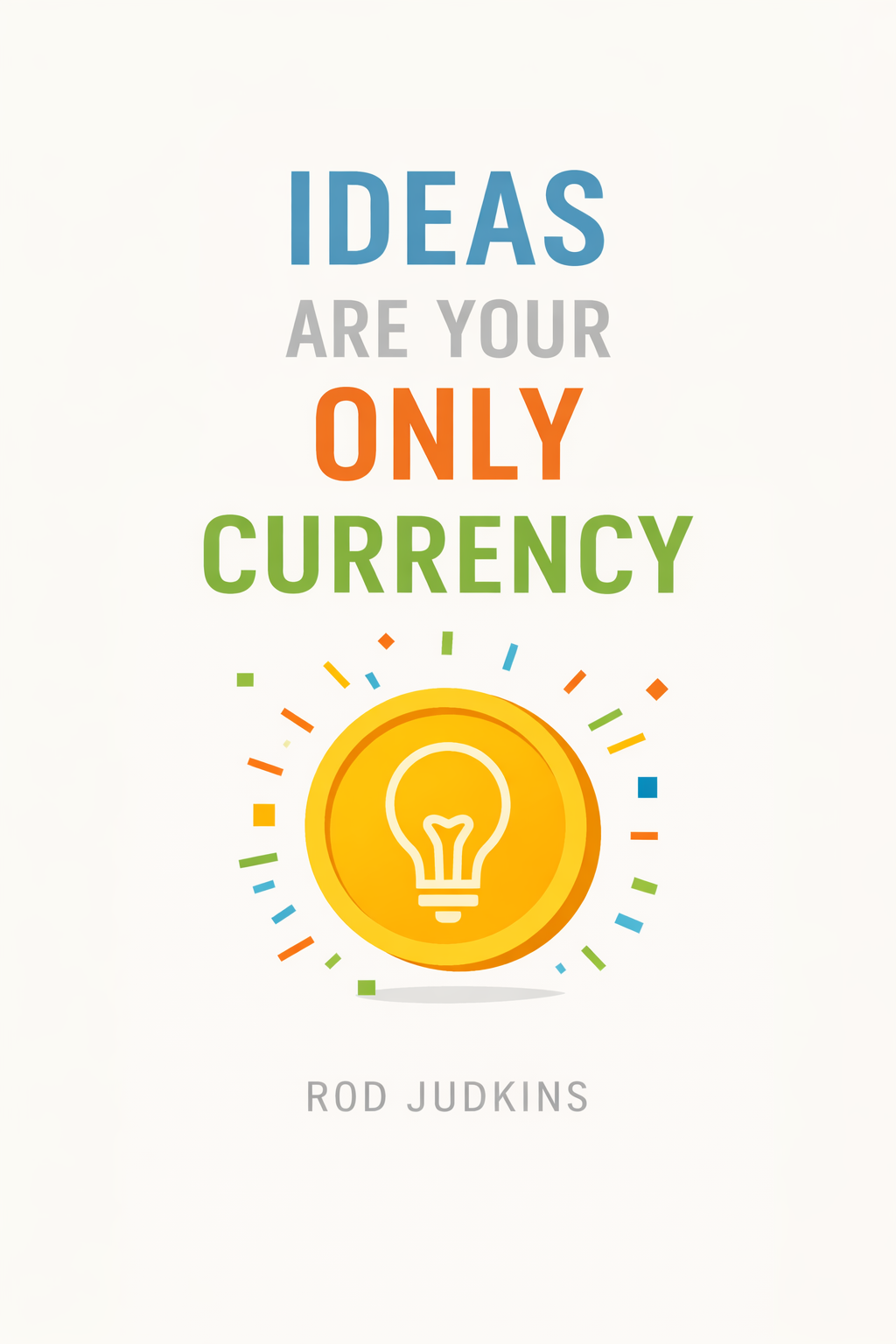
Ideas Are Your Only Currency by Rod Judkins

Transcript
In the modern world, the author argues, ideas are the most valuable currency available to individuals and organizations. Automation is displacing routine work, and information is now universally accessible. What remains scarce — and decisive — is the capacity to generate original, unconventional thinking. The previous lecture established that creative capacity is a practiced skill, not a fixed trait reserved for the exceptional. Building on that, the author sharpens the argument: whoever generates the best ideas holds the decisive advantage in any field. The evidence comes from direct observation at the Royal College of Art, where the students who went on to succeed were rarely the most technically polished. Those students shared one quality: they could produce a steady, reliable stream of fresh thinking. The author uses this observation to ground a central claim — creativity is not a mysterious gift distributed unevenly at birth. It is a learnable discipline, developed through deliberate practice and a conscious shift in mindset. The methodology the author proposes is practical rather than theoretical. It draws on the lives and working methods of artists, scientists, entrepreneurs, and historical thinkers. Each principle is designed to interrupt habitual thinking and push toward more generative approaches. At the core of this approach is a tension the author identifies as the primary obstacle to creative growth. Most people default to safe, familiar thinking — not because it works best, but because it feels least risky. The author argues this conservatism is precisely what kills creative potential, citing companies and institutions that collapsed by clinging to established formulas. Perhaps the most important barrier the author addresses is the fear of failure. Figures like Pablo Picasso and Thomas Edison were prolific precisely because they treated failure as essential data. In the author's view, this reframing is central to what the book calls the creative mindset — an orientation that prioritizes curiosity, experimentation, and the willingness to be wrong. The creative mindset, in the author's view, is not a personality type but a set of practiced behaviors. It prioritizes curiosity, experimentation, and the willingness to be wrong. Those three qualities, consistently applied, are what separate generative thinkers from those who stagnate. The author structures the book as a toolkit rather than a linear argument. Each principle is short and actionable, drawn from real working methods across art, science, and business. This design allows readers to apply specific ideas directly to real creative challenges as they arise. Central to the toolkit is the claim that most people default to incremental thinking not because it works best, but because it feels safest. The author cites companies and cultural institutions that collapsed by clinging to established formulas. Conservatism, in the book's view, is not caution — it is the primary killer of creative potential. Figures like Pablo Picasso and Thomas Edison appear as evidence that prolific output depends on reframing failure. The author argues they succeeded precisely because they treated failure as essential data, not as evidence of inadequacy. Every failed attempt, in this view, narrows the distance to a breakthrough. The author's conclusion is both practical and urgent. Imagination is not a fixed trait — it is a faculty that can be trained, stretched, and deliberately put to work. Anyone willing to shift their mindset and practice these principles can develop the capacity to invent genuinely better futures. What this means practically is that the book functions as a toolkit, not a manifesto. Each principle is short, actionable, and drawn from real working methods across art, science, and business. Readers can apply specific ideas directly to real creative challenges as they arise. The author argues that conservatism is not caution — it is the primary killer of creative potential. Companies and cultural institutions that collapsed by clinging to established formulas serve as the book's cautionary evidence. Safe thinking, in the author's view, is the most dangerous choice available. Figures like Pablo Picasso and Thomas Edison appear throughout as proof that prolific output depends on reframing failure. The author contends they succeeded precisely because they treated failure as essential data, not evidence of inadequacy. Every failed attempt, in this view, narrows the distance to a breakthrough. The creative mindset the author describes is not a personality type but a set of practiced behaviors. It prioritizes curiosity, experimentation, and the willingness to be wrong — three qualities that separate generative thinkers from those who stagnate. Applied consistently, they are what the book calls the path to genuinely original thinking. Imagination, the author concludes, is not a fixed trait. It is a faculty that can be trained, stretched, and deliberately put to work. Anyone willing to shift their mindset and practice these principles can develop the capacity to invent better futures.