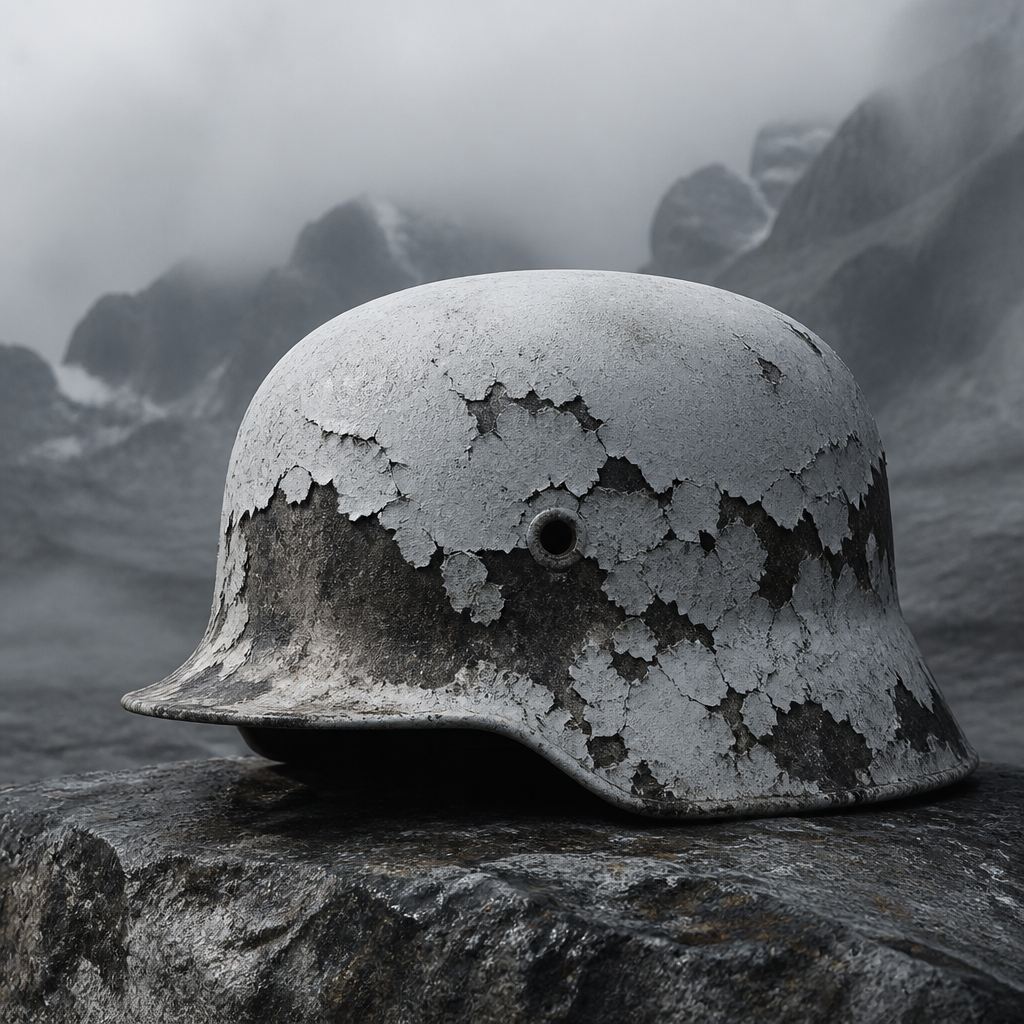
The Mechanism of the Shadow: Defining the SS
The Blueprints of Power: SS-Hauptämter
The Guard's Genesis: From Bodyguards to State-Within-a-State
The Paperwork of Terror: The WVHA
The Purity Filter: The RuSHA and Ideology
The Evolution of Combat: From Verfugungstruppe to Waffen-Ss
The Dual Hat: Himmler's Policing Synergy
Performance vs. Propaganda: The 'Elite' Question
The European Crusade: Foreign Volunteers and Forced Conscripts
The Revolving Door: Personnel Exchanges
The Bloodlands Intersection: The Einsatzgruppen
Evidence of Atrocity: Oradour and Malmedy
The Slavery Machine: SS Industries
The Skull's Shadow: The Totenkopfverbände
The Verdict of Nuremberg: A Criminal Organization
The Rehabilitation Campaign: The HIAG Myth
Cold War Amnesia: Geopolitics and Memory
Disciplining Imagination: The Synthesis of Evidence

Transcript
Eight men. That is where this story begins. In April 1925, the SS was established as a tiny sub-unit of the SA — eight men assigned to protect Adolf Hitler. Eight. Hold that number in your mind, James, because what grew from it became one of the most complex and lethal bureaucratic organisms in modern history. Now, the temptation is to treat the SS as a single, uniform thing — a monolithic block of black uniforms and ideology. That temptation is precisely the error we must correct. The International Military Tribunal at Nuremberg in 1946 designated the entire SS a criminal organization. Not part of it. Not one branch. The entire SS. That verdict was not rhetorical. It was a legal finding built on documented evidence, and it explicitly included the Waffen-SS. Start there. That is the foundation. Think of the SS as a tree with two major branches growing from one root. The root is ideology — a racial-political doctrine that Himmler treated as sacred science. One branch is the Allgemeine-SS, the General SS. This was the administrative, policing, and bureaucratic arm. It ran the concentration camp system, enforced racial laws, and managed the vast internal security apparatus. The other branch is the Waffen-SS, the Armed SS — the military formations that fought alongside the Wehrmacht on every major front. Different functions, yes. Different uniforms, different chains of operational command. But the same root. The key idea is that this bifurcation was organizational, never ideological. Both branches drew from the same recruitment pool, swore the same oath, and answered ultimately to Himmler's vision of a Staatsschutzkorps — a state protection corps designed to function as a parallel government embedded inside the Nazi state. Now, the myth. The persistent, carefully constructed myth of the "Clean Waffen-SS" — the idea that the military branch was simply a fighting force, soldiers doing soldier things, separate from the atrocities committed by their administrative cousins. Where does this come from? The evidence points clearly to the HIAG, the Mutual Help Association of Former Waffen-SS Members. Post-war, the HIAG worked deliberately to sanitize the Waffen-SS reputation. They succeeded in shaping early Cold War historiography. That is a documented historical outcome, not a conspiracy theory. The Cold War context mattered — West Germany needed rehabilitated soldiers, and the HIAG provided a convenient narrative. But the evidence does not support the narrative. For example, by 1944, thousands of wounded Waffen-SS soldiers were reassigned to guard duties within the concentration camp system. Personnel rotation between the military formations and the KL — the Konzentrationslager — was not exceptional. It was common. That single documented fact collapses the wall the HIAG tried to build between the two branches. The United States Holocaust Memorial Museum and the National World War II Museum have both documented the Waffen-SS's direct participation in massacres, deportations, and the operational machinery of the Holocaust. The Nuremberg tribunal reviewed this evidence and reached its conclusion accordingly. Remember, the tribunal's designation was not based on guilt by association. It was based on the documented conduct of the organization's members across both branches. Himmler's Staatsschutzkorps concept is essential here. He did not want a simple police force or a simple army. He wanted an ideological elite that could govern, police, fight, and administer simultaneously — a state within a state, loyal to racial doctrine above all other law. That ambition required both branches to remain ideologically unified even when operationally separated. The shared oath, the shared recruitment standards, the shared SS-Junkerschulen officer schools — these were the mechanisms of that unity. James, here is the takeaway that this entire course will keep returning to. The SS was not a single, uniform entity. It was a bifurcated organization — the administrative Allgemeine-SS and the military Waffen-SS — but both branches were held together by one ideological core. The myth of separation was manufactured after the fact, and the evidence from Nuremberg, from personnel records, from documented rotation between combat units and camp guard duties, dismantles that myth systematically. Eight men in 1925 became a sprawling empire of bureaucracy, violence, and ideology. Understanding how that happened — and why the two branches were never truly separate — is the precise question this course is built to answer. We have the evidence. Now we examine it carefully.