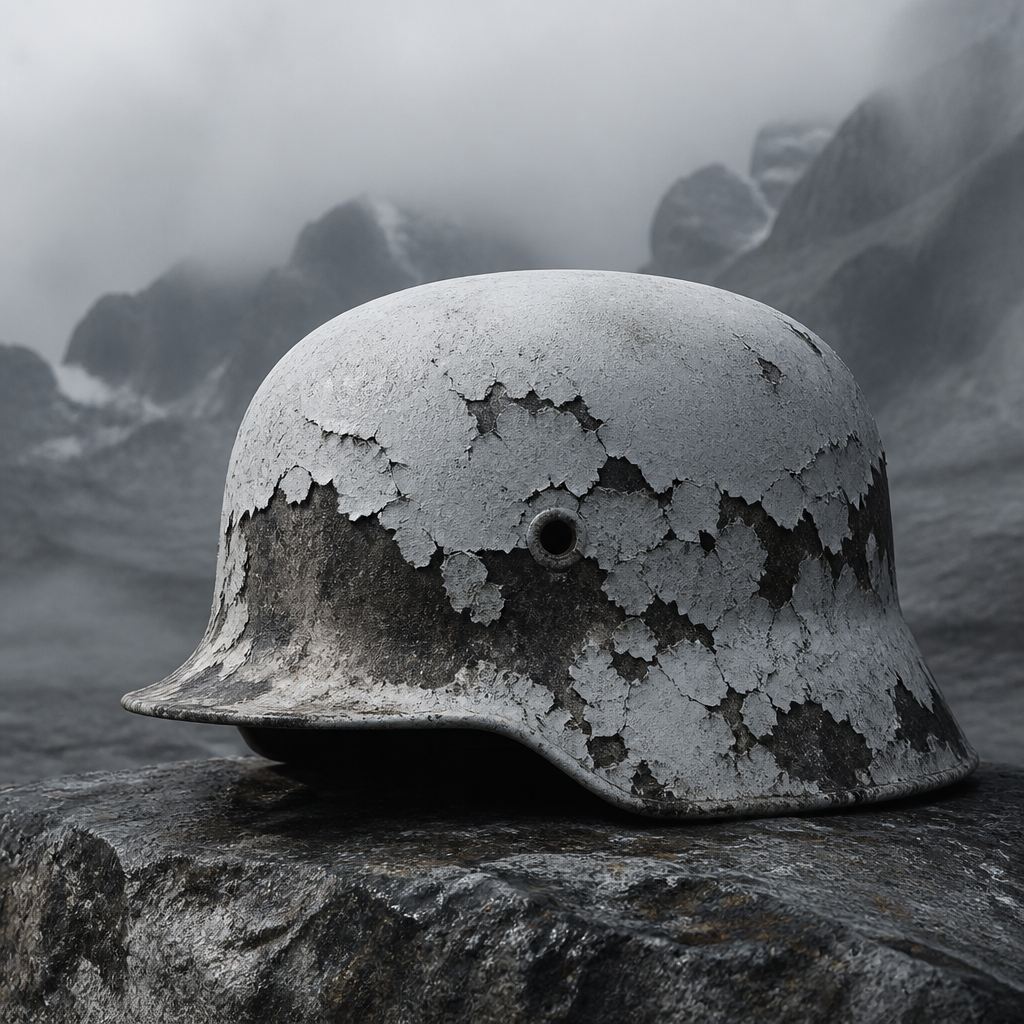
The Evolution of Combat: From Verfugungstruppe to Waffen-Ss
The SS Paper Trail Behind the Myth
The Mechanism of the Shadow: Defining the SS
The Blueprints of Power: SS-Hauptämter
The Guard's Genesis: From Bodyguards to State-Within-a-State
The Paperwork of Terror: The WVHA
The Purity Filter: The RuSHA and Ideology
The Evolution of Combat: From Verfugungstruppe to Waffen-Ss
The Dual Hat: Himmler's Policing Synergy
Performance vs. Propaganda: The 'Elite' Question
The European Crusade: Foreign Volunteers and Forced Conscripts
The Revolving Door: Personnel Exchanges
The Bloodlands Intersection: The Einsatzgruppen
Evidence of Atrocity: Oradour and Malmedy
The Slavery Machine: SS Industries
The Skull's Shadow: The Totenkopfverbände
The Verdict of Nuremberg: A Criminal Organization
The Rehabilitation Campaign: The HIAG Myth
Cold War Amnesia: Geopolitics and Memory
Disciplining Imagination: The Synthesis of Evidence

Transcript
Imagine a parade ground. On it stands roughly one infantry regiment — perhaps three thousand men. That is the entire armed SS in June 1934. Now hold that image. Ask yourself: what does five hundred thousand look like? That is what the same institution became by 1945. The question worth examining carefully is not simply that it grew. The question is: what mechanism drove that transformation? And here is the puzzle I want you to sit with before we examine the evidence — was this growth planned from the beginning, or was it improvised under pressure? The documentary record gives us a precise, and somewhat surprising, answer. Let me separate what the record shows from what historians infer. The observation: on 24 September 1934, the SS-Verfügungstruppe — the SS-VT — was formally constituted from earlier guard detachments and special SS units. It was explicitly placed at Hitler's personal disposal, not under the army, not under the police. Think of it as a clock spring wound for a specific owner. On 17 August 1938, Hitler decreed in writing that the SS-VT was neither Wehrmacht nor Ordnungspolizei — it occupied a deliberately ambiguous legal space. That ambiguity was not an accident. It was a design feature. The SS-VT was publicly announced in March 1935 as a military-trained formation at the Führer's disposal. Three infantry regiments, each modeled closely on Heer structure — battalions, motorcycle company, mortar company. The model was the army. The owner was the party. Here is a bounded analogy that may help, and I will name exactly where it stops fitting. Picture a rail line that splits into two tracks. One track carries the SS-Verfügungstruppe — combat-oriented, increasingly army-trained. The other carries the SS-Totenkopfverbände — the camp-guard formations. Both tracks run from the same station: Himmler's SS. By late 1938, Paul Hausser combined SS-VT regiments — Deutschland, Germania, Der Führer — into the SS-Verfügungsdivision. The analogy's limit: unlike rail tracks, these two institutional lines were never truly separate. Personnel, ideology, and command authority remained shared. The tracks merged back together repeatedly. That is where the analogy stops matching the historical system, and where the evidence becomes most important. Now the inference layer — what historians conclude from the operational record. In September 1939, SS-VT units entered Poland attached to regular army formations. Early assessments by German military observers rated their combat performance as mediocre. That is the observation. The inference: they were retained, retrained, and redeployed in France in 1940. After France, the SS-Verfügungs-Division was renamed Reich. Around 1940, the designation Waffen-SS became official. The SS-VT, the Leibstandarte, and the Totenkopf formations became its three founding streams. The SS-VT formally ceased to exist as a separate entity at this point, absorbed entirely into the new structure. What the record shows is a deliberate institutional consolidation. What remains uncertain is how much of this was strategic vision versus reactive improvisation under wartime pressure. Here is the part that surprises many people. Despite the eventual scale, Hitler initially capped the force at a small number of divisions. An institution advertised as elite began with uneven training, weak staff work, and dependence on Army logistical structures. The SS-VT's legal status remained genuinely ambiguous — trained as frontline troops, placed under army command in wartime, but institutionally part of the Nazi Party. In 1939, Gottlob Berger's SS-Ergänzungsamt formalized recruitment, providing the mechanism that would eventually scale the force past five hundred thousand. The clock spring, wound tightly in 1934, was not released all at once. It was released incrementally, under pressure, with consequences that the next lectures will examine in detail. So what does the evidence actually establish? Observation: the SS-VT was a small, legally ambiguous, party-owned military formation created in 1934. Model: it was designed to be deployable alongside the army while remaining institutionally separate from it. Inference: the transition to Waffen-SS around 1940 was not a sudden invention but the consolidation of three pre-existing streams under one command. What the prior lecture established — that the SS was never truly bifurcated at its ideological root — holds here too. The Waffen-SS inherited that shared root from the moment of its formation. The parade ground with three thousand men in 1934 became five hundred thousand by 1945. The mechanism was not mystery. It was documented, step by step, in orders, decrees, and reorganization records. That paper trail is precisely what we continue to follow.