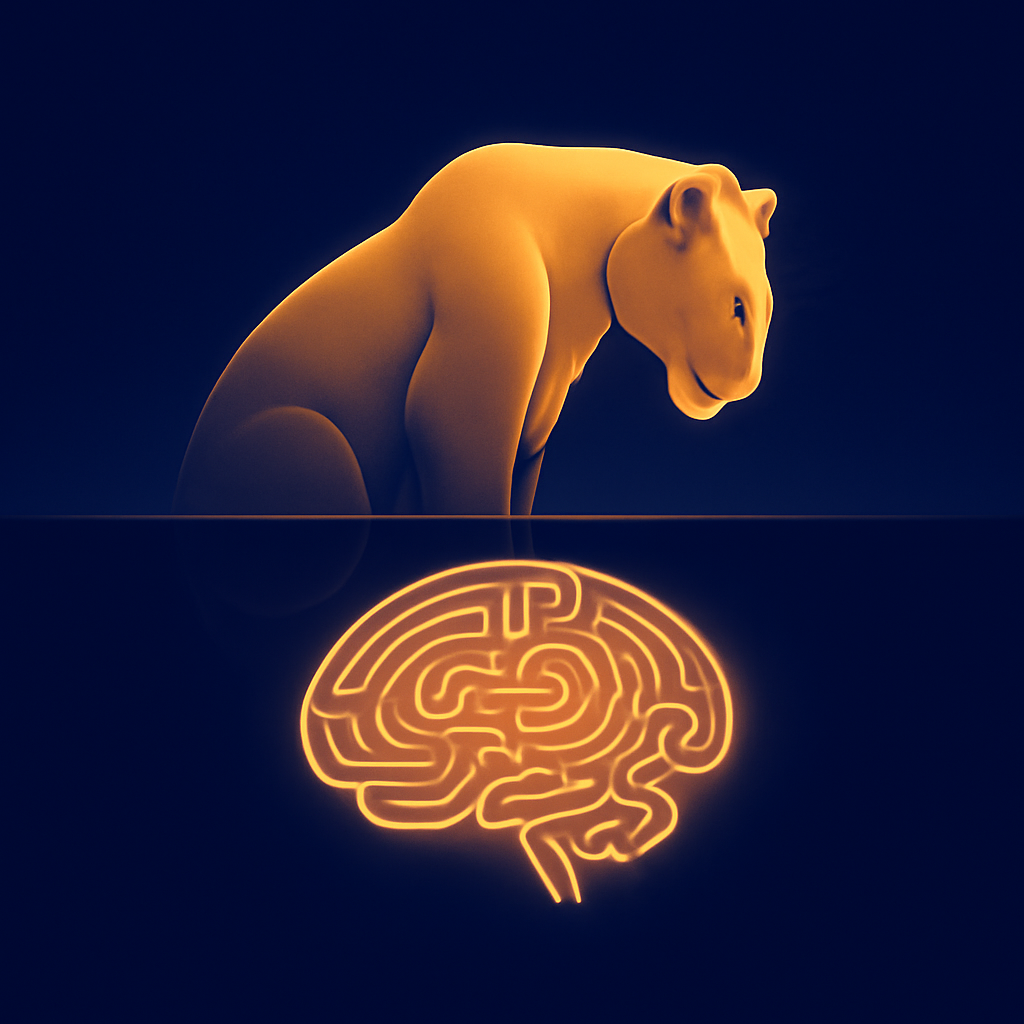
Into the Dark Corners: The Internet's Collective Id
The Nala Phenomenon: A Psychological Deep Dive
The Nala Phenomenon: Decoding the 'Come-Hither' Look
Quadrupeds vs. Anthros: The Architecture of Fantasy
Into the Dark Corners: The Internet's Collective Id
The Psychology of the Fictional Crush
Silicon Claws: The Rise of AI Furry Art
Beyond the Taboo: Validation and Reality

Transcript
SPEAKER_1: Today, let's shift our focus to the historical development of online communities and how anonymity played a role in exploring complex feelings about characters like Nala. SPEAKER_2: where did all of this actually go? Like, the 1994 film comes out, a generation of kids has these complicated feelings about a fictional lioness — and then what? The internet happens. SPEAKER_1: And not the internet we have now. We're talking scattered online fandom spaces where people could connect around interests they might have assumed were solitary. SPEAKER_2: That's the key idea here. Research on internet fandoms is clear that these spaces make unusual interests more visible by connecting people who would otherwise believe they were completely alone. Visibility doesn't mean the interest became more common — it means people could realize they weren't alone. SPEAKER_1: So someone who had a complicated reaction to Nala's design, voice, or role in the story — they might not have been searching for a community. They stumbled into one. SPEAKER_2: Exactly. And that stumbling-in dynamic is actually psychologically significant. Research on furry communities consistently identifies belonging and identity-making as core functions of participation — not just the art or the fantasy, but the social recognition. Someone finally saying, 'I get it, me too.' SPEAKER_1: Mm-hmm. Let's explore how these online spaces evolved, leading to platforms like FurAffinity, which became significant for anthropomorphic art. SPEAKER_2: No, they didn't. Think of it as a slow migration. Early fan art and discussion lived in Usenet groups and personal web pages — very decentralized. Over time, larger online art spaces made artists and audiences easier to connect. FurAffinity came later and became one of the primary homes for anthropomorphic fan art specifically, including adult-tagged content behind age gates. SPEAKER_1: Age-gating and community norms are crucial in understanding how these platforms manage content visibility and maintain boundaries. SPEAKER_2: Community norms and platform moderation. Most established furry art platforms use content rating systems — general, mature, explicit — and require users to opt into adult content. That's not perfect, but it reflects a genuine community norm: protect the general space, flag the adult space clearly. It's a boundary that the communities themselves often enforce. SPEAKER_1: Which brings us to Rule 34. We can't do this episode without it. SPEAKER_2: [short pause] Right. So Rule 34 is an internet adage — if something exists, there is adult fan content of it somewhere online. It's not a law, it's an observation about the breadth of human imagination applied to any cultural artifact. Nala is absolutely not exempt from that. SPEAKER_1: But — and this is important — acknowledging that content exists is not the same as describing it, linking to it, or endorsing it. SPEAKER_2: Exactly. For everyone following along, we can discuss this phenomenon analytically without reproducing any of it. The point isn't the content itself — it's what the existence of that content tells us about how people process a character like Nala. SPEAKER_1: So what does it tell us? Because I think this is where the idea of a 'foundational character' becomes really useful. SPEAKER_2: For some fans, Nala was a fictional character who triggered something they didn't have language for yet. Think of it like an emotional imprint — not universal, but for some people who encountered her at a formative moment, she could become an anchor point for understanding their own responses to fictional characters. SPEAKER_1: Wait — so it's less about Nala specifically and more about timing? SPEAKER_2: Both, actually. The timing matters — she arrived at a formative moment. But the design choices matter too. The animated signals we talked about in lecture one — the expressive eyes, the confident posture — those aren't accidental. They're doing real psychological work on the viewer. SPEAKER_1: And the internet gave people a place to process that work without shame. That's the anonymity piece. SPEAKER_2: Right. Pseudonymous and anonymous spaces can actually support more honest emotional disclosure than real-name environments. Someone exploring a stigmatized or confusing feeling is more likely to articulate it, examine it, and find community around it when they're not risking their real-world identity. That's not inherently dangerous — it can be genuinely clarifying. SPEAKER_1: As long as the ethical line holds. And that line — fiction stays fiction, real animals cannot consent — has to be stated clearly. SPEAKER_2: animal welfare means physical and mental wellbeing, and real-world sexual contact with animals is incompatible with any responsible consent framework. The fantasy and the real world are not the same space, and that distinction is non-negotiable. The takeaway from today is this — Nala's presence in adult internet spaces isn't a scandal. It's a case study in how a fictional character can become a shared reference point for people making sense of fictional attraction.