The Secret Begins as a Burning Idea
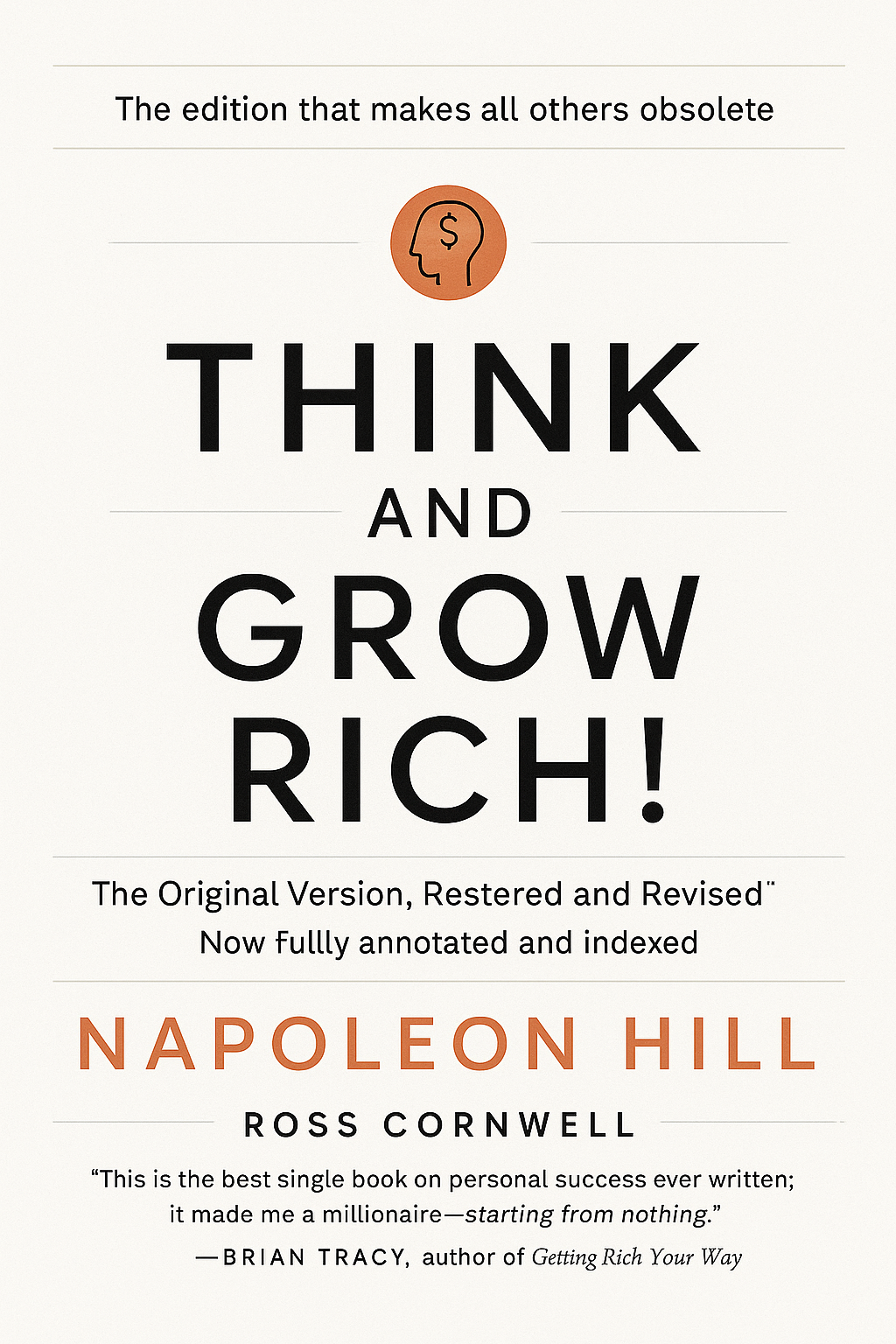
Think and Grow Rich! By Napoleon Hill & Rosa Lee Beeland

Transcript
Welcome to one of the most studied books on success ever written — Think and Grow Rich, by Napoleon Hill and Rosa Lee Beeland — a book that promises a hidden formula powerful enough to transform any life. Here is the surprising part: the central secret is never directly stated anywhere in the text. Napoleon Hill, born Oliver Napoleon Hill on October 26, 1883, in Pound, Virginia, co-authored this work with Rosa Lee Beeland, born December 16, 1905, in Harriman, Tennessee. Bob Proctor's foreword opens with a striking personal testimony. In 1961, Proctor was earning roughly $4,000 a year when a mentor handed him this book. Within a year of studying and applying its principles, his income had surpassed $175,000 — a result he attributes entirely to a deliberate reprogramming of his thinking. Proctor is careful to frame this transformation as a replacement of limiting mental habits with focused, purposeful thought patterns. He urges readers to treat the book as a manual to be studied repeatedly, not read once. According to Proctor, each pass through the material reveals layers that earlier readings missed. The editorial forewords establish the intellectual foundation for Hill's methodology. The editors explain that Hill spent over twenty years interviewing more than five hundred of America's most successful individuals — among them Andrew Carnegie, Henry Ford, and Thomas Edison. The book, in their view, is a distillation of observed patterns, not invented theory. Carnegie himself originally commissioned this work, challenging Hill to organize the philosophy of achievement that had made Carnegie one of the wealthiest men alive. Crucially, this was not a paid assignment — Carnegie challenged Hill to undertake it on faith alone. The editors argue that the principles Hill uncovered are universally applicable regardless of background, education, or starting circumstances. Hill's own preface deepens the philosophical foundation while deliberately withholding the central secret. He frames the book around a definite, learnable formula — one Carnegie disclosed during a three-day interview — that Hill spent two decades verifying. Rather than stating the secret outright, the author embeds it throughout the text, arguing it only reveals itself to readers who are genuinely prepared and hungry for it. Hill illustrates the principle's reach through a personal story about his son, born without ears and predicted by doctors to be permanently deaf. By applying principles he later codified — particularly burning desire and unwavering belief — Hill contends he helped his son develop functional hearing, defying medical expectations. This example extends the book's promise well beyond financial ambition to every area of human achievement. Running through both preface sections is Hill's insistence on the power of thought charged with emotion and purpose. He argues that thoughts mixed with strong desire begin to attract the people, resources, and circumstances needed for their realization — not as mysticism, but as practical observation drawn from hundreds of documented lives. The author also warns that closed-mindedness is the single greatest barrier to applying these principles, and that every adversity carries within it the seed of an equivalent or greater benefit. Taken together, the forewords and prefaces function as a unified psychological primer. They establish credibility, build anticipation, and place the reader in the mental state necessary to act. Hill argues this preparation is not optional — it is the condition under which the secret becomes visible. The gap between knowing a principle and actually applying it is, in the book's view, the primary reason most people fail. Hill contends that passive reading produces no transformation; only deliberate, repeated study does. The book positions itself as the bridge across that gap. Hill also introduces a reframing of failure that runs throughout his entire philosophy. Every adversity, he argues, carries within it the seed of an equivalent or greater benefit. This single idea reorients how a reader interprets setbacks — not as endpoints, but as redirections. The subconscious mind, according to Hill, is the mechanism through which desire becomes reality. Thoughts charged with emotion and definiteness of purpose begin attracting the people and resources needed for their realization. The author is careful to frame this not as mysticism, but as a pattern observed across hundreds of documented lives. Closed-mindedness, Hill warns, is the single greatest barrier to applying these principles. The book's opening sections exist precisely to dismantle that barrier before instruction begins. What follows is not a story about wealth — it is a manual for reprogramming the mind itself.