
Transcript
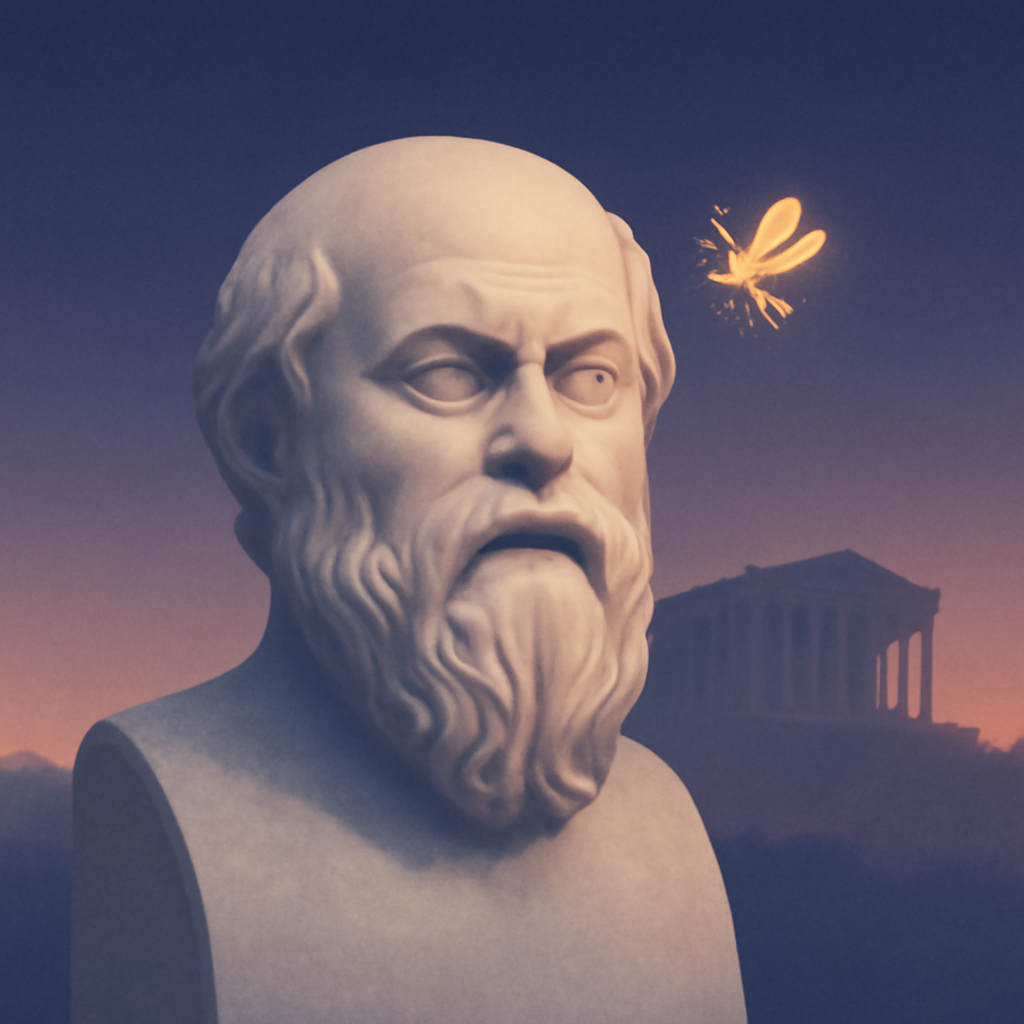
A man who never wrote a single word changed the entire direction of Western thought. That is not a small irony — it is the central fact of Socrates. Everything we know about his ideas comes filtered through his students, primarily Plato and Xenophon, who recorded his conversations after his death. He left no books, no treatises, no manuscripts. And yet the questions he asked in the dusty agora of Athens still cut to the bone today. Before philosophy consumed him, Hugo, Socrates was a soldier. He served as a hoplite — a heavily armed infantry fighter — in the Athenian army during the Peloponnesian War. His fellow soldiers reportedly marveled at his physical endurance. He could march barefoot through snow. He could stand motionless in thought for hours. This was not a fragile academic. This was a man who had stared down death on a battlefield, and that experience shaped how seriously he took the question of how to live. Now, that background matters because it explains something crucial: Socrates did not philosophize from comfort. He philosophized from conviction. The key idea that launched his public mission came from an unexpected source. His friend Chaerephon traveled to the Oracle at Delphi and asked the Pythia — the sacred prophetess — whether anyone was wiser than Socrates. The Oracle said no. Socrates, rather than accepting the compliment, was baffled. He knew he was not wise. So he did what any genuinely curious person would do: he went looking for someone wiser than himself to prove the Oracle wrong. Think of it like a man told he is the best chess player in the city, who immediately goes to challenge every grandmaster he can find. He interviewed politicians, poets, and craftsmen — the recognized experts of Athens. Every time, he found the same thing. They believed they knew things they did not actually know. He, at least, knew that he did not know. That gap — between assumed knowledge and real knowledge — became the engine of his entire philosophy. The method he used to expose that gap is called the Elenchus, or the Socratic Method. It is not a standard argument where one person lectures and another listens. The Elenchus is a cooperative dialogue. Socrates would ask a person to define something they claimed to understand — justice, courage, piety. Then, through a careful sequence of questions, he would draw out the hidden contradictions in their answers. He was not trying to humiliate anyone. He was trying to strip away false certainty so that genuine inquiry could begin. That means the Elenchus is less a debate tool and more a diagnostic one. It reveals what you do not know by testing what you think you do. For example, a general who claims to know what courage is might define it as standing firm in battle — and Socrates would gently show that this definition fails the moment you consider a reckless soldier versus a strategic retreat. The definition collapses. And in that collapse, real thinking starts. This is why Socrates called himself a gadfly. Athens, he said, was a great but sluggish horse. He was the small, irritating insect that kept stinging it awake. Remember, Hugo, a gadfly does not destroy the horse — it prevents the horse from falling into a dangerous sleep. Socrates believed that a city, like a person, could become dangerously comfortable with its own assumptions. His role was to sting, to provoke, to force discomfort in service of clarity. And the takeaway from his entire approach is this: wisdom does not begin with knowing more. It begins with the honest recognition of how much you do not know. That recognition, uncomfortable as it is, is the only real starting point for thinking clearly. The unexamined assumption is the one that will eventually betray you. Socrates made it his life's work to examine every assumption he could find — and he paid for that work with his life. But the questions he asked, Hugo, are still alive. They are still doing their job.