
Transcript
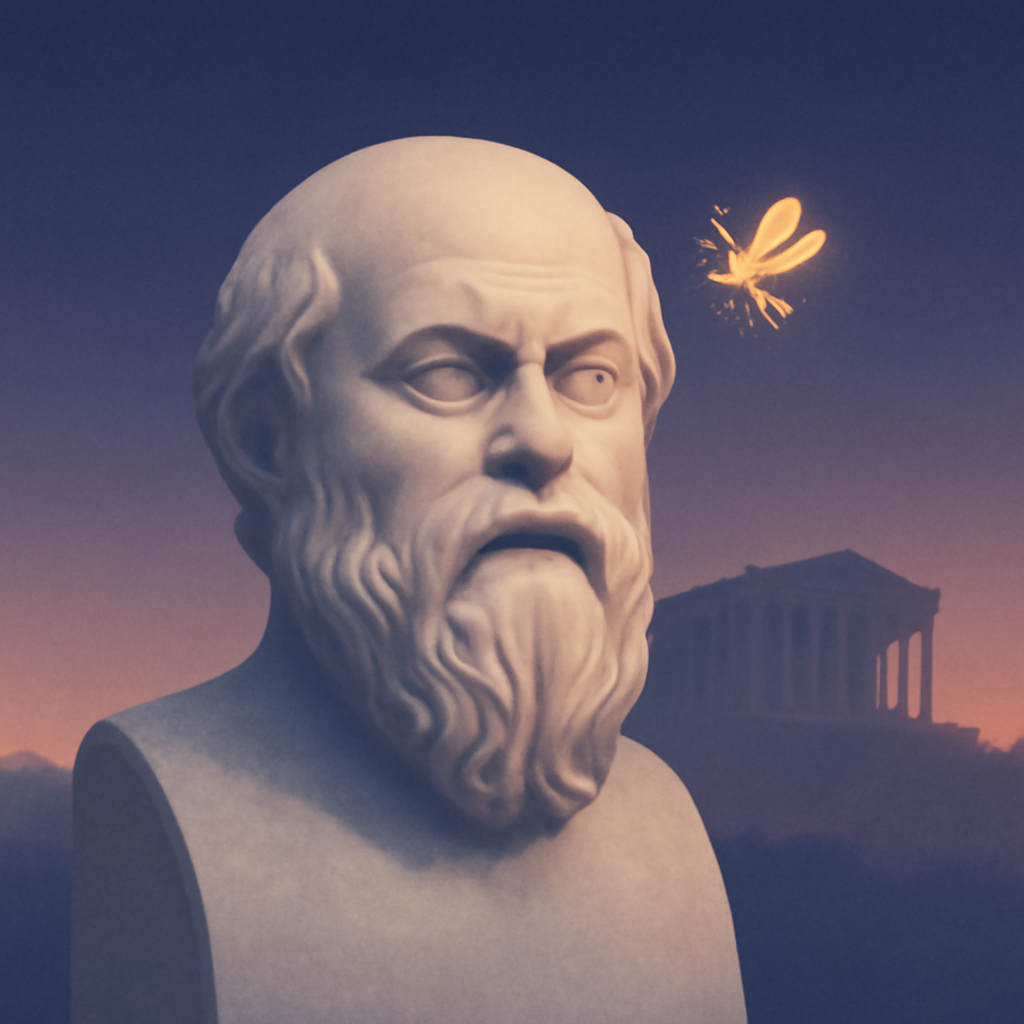
SPEAKER_1: Alright, so last time we established that Socrates saw himself as a gadfly — stinging Athens awake through relentless questioning. Now I want to get into what happens when Athens finally swats back. SPEAKER_2: Right, and that swat came in 399 BCE, when Socrates stood trial at roughly age seventy. The charges were formal and specific: corrupting the young, and failing to recognize the gods the city recognized — while introducing new divine beings. SPEAKER_1: So who actually brought these charges? Was this the government acting against him? SPEAKER_2: That's the key thing to understand about Athenian law. Athens had no public prosecutor. Any citizen could initiate a case. Here, a young poet named Meletus filed the indictment. Anytus and Lycon were associated with the prosecution and supported it. SPEAKER_1: Meletus — a poet. That's an unusual choice to lead a prosecution against a philosopher. SPEAKER_2: It is. And Socrates essentially dismantled him in court. He cross-examined Meletus directly and showed that Meletus couldn't coherently explain how Socrates had supposedly corrupted anyone. The argument collapsed under its own weight. SPEAKER_1: But why was there so much hostility toward Socrates in the first place? He'd been doing this for decades. SPEAKER_2: The political climate matters enormously here. Athens had just lost the Peloponnesian War — defeated by Sparta in 404 BCE. That's only five years before the trial. The city was traumatized. And some men associated with Socrates had been connected to oligarchic movements and the brutal rule of the Thirty Tyrants. So suspicion had been building. SPEAKER_1: So the charges weren't purely philosophical. There was a political wound underneath. SPEAKER_2: Exactly. And Socrates himself acknowledged that older prejudices were working against him — including Aristophanes' comedy Clouds, which had portrayed a fictionalized Socrates as a natural philosopher who made weaker arguments appear stronger. That caricature had been circulating for decades before the trial. SPEAKER_1: [short pause] So the jury was already primed against a version of him that wasn't even accurate. SPEAKER_2: Precisely. And the charge of impiety — expressed through the Greek concept asebeia — carried real weight in a city trying to restore civic order. Socrates pushed back hard. He argued that someone who genuinely engaged with divine matters couldn't consistently be accused of denying all gods. The accusation was internally incoherent. SPEAKER_1: What about the corruption charge? How did he answer that? SPEAKER_2: He posed a logical dilemma to Meletus. If he harmed young people unintentionally, then the appropriate response would be instruction — not prosecution. You don't take someone to court for an accident; you correct them. Meletus had no good answer. SPEAKER_1: And through all of this, Socrates kept framing his whole life as a divine mission — connected back to the Oracle at Delphi. SPEAKER_2: He did. He presented philosophy itself as a calling. The oracle had said no one was wiser than he was, and he interpreted that as a charge to keep questioning — to expose false certainty wherever he found it. He told the jury he would not stop philosophizing even if they offered acquittal on that condition. SPEAKER_1: Wait — he said that directly to the jury deciding his fate? SPEAKER_2: He did. And he refused to beg. No weeping, no bringing in his family, no theatrical appeals for mercy. He argued that a defendant should persuade the court through reason, not manipulate it through emotion. Think of it as a man who believed the method of his life had to match the content of his defense. SPEAKER_1: That must have landed badly with a jury already on edge. SPEAKER_2: The numbers tell the story. The jury was composed of male Athenian citizens selected by lot — a large popular body, not professional judges. They found him guilty by what appears to have been a relatively narrow margin: roughly 280 votes for conviction, around 220 for acquittal. Thirty votes the other way and he walks free. SPEAKER_1: So then comes the sentencing phase. And this is where things get almost deliberately provocative. SPEAKER_2: [chuckle] Deliberately is the right word. Athenian procedure required both sides to propose penalties, and the jury chose between them. Socrates initially proposed that he deserved free maintenance in the Prytaneum — the honor given to Olympic victors and great benefactors of the city. He was essentially saying: I've served Athens. Reward me. SPEAKER_1: Mm-hmm. And the jury's response to that was decisive. SPEAKER_2: Far more decisive than the guilt vote. He eventually agreed to a monetary fine, with friends offering to back a larger amount — but the posture was never a conventional plea for mercy. The punishment vote was reportedly much more lopsided than the conviction itself. His refusal to perform contrition seems to have cost him more votes than the original charge. SPEAKER_1: So the takeaway here isn't just that Athens silenced a philosopher. It's that Socrates understood exactly what he was doing and chose it anyway. SPEAKER_2: That's the core of it. He believed that fear of death should never determine whether an action is right. Moral judgment comes first. And for everyone following this story, the real tension isn't between guilt and innocence — it's between a city desperate for stability and a man who insisted that questioning was the only honest form of loyalty to that city. The sentence was death. And with the guilty verdict now handed down, we turn to the final act of this philosophical drama.