
Transcript
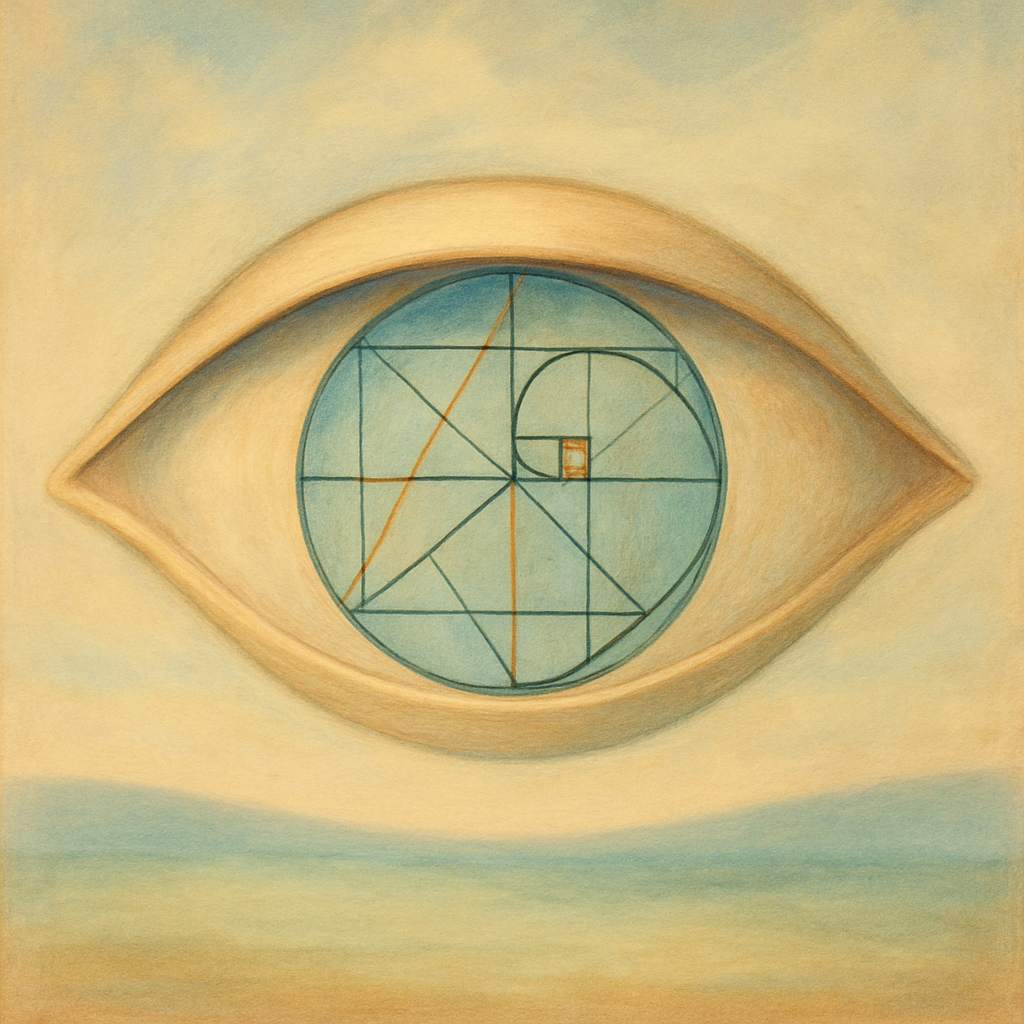
You walk past a beehive and see wax. A bee sees a geometry problem — and solves it perfectly every time. Here is the counter-intuitive part: bees did not learn hexagons. They arrived at them through pressure. Bees use hexagonal cells because it is the most efficient shape for tessellation, requiring the least wax to provide the maximum storage volume. No other shape does that job better. Not circles, not squares. Hexagons. That is not a coincidence, J. That is mathematics operating as a survival mechanism, hiding in a structure most people walk past without a second glance. Now, the reason we miss this is not a failure of intelligence. It is a failure of framing. Our brains are wired to see objects, not relationships. You see a sunflower. Your brain files it under "flower" and moves on. But the Smithsonian has reported on research showing that the spiral patterns in sunflower seed heads typically follow the Fibonacci sequence, allowing for the most compact packing of seeds without overlapping. Think of it this way: the sunflower is not decorative. It is a packing algorithm. Each seed needs light and space. The Fibonacci arrangement solves both problems simultaneously, with zero wasted area. The math is not applied to the sunflower from the outside. It grows from within the biological logic of survival itself. The key idea here is that mathematics is not a human invention imposed on nature. It is the operating system nature already runs. For example, look at a tree. Not the whole tree — just the branching. A large branch splits into smaller branches. Those split again. Each split follows the same proportional rules as the one before it. Yale researchers found that fractal patterns in trees, where the same mathematical branching rules repeat at different scales, are an evolutionary solution for maximizing surface area for sunlight and nutrient transport. That means a single tree is running the same equation at every level of its structure simultaneously. The trunk does not know what the twig is doing. Yet they follow the same rule. That is a mathematical function expressed in wood and bark. So how do you start seeing this? A one-percent shift in perception is enough. Your commute is a geometry lesson. The tiles on a subway floor are a tessellation problem. The curve of a highway ramp is a parabola under load. The shadow a lamppost casts at noon is a right angle proof. You do not need to calculate anything. You just need to ask one question differently. Instead of "what is that," ask "what shape is that, and why that shape." That single reframe is the perceptual lever. It costs nothing. It takes a fraction of a second. And over time, J, it rewires how your brain categorizes the physical world — from a collection of objects into a living map of mathematical relationships. Remember this: the world is not decorated with math. It is built from it. The bee, the sunflower, the tree — none of them studied geometry. They were shaped by it, because mathematical order is not an exception in nature. It is the default. Our world is built on mathematical foundations we often overlook, but by shifting perspective just slightly, we can begin to see the geometry of existence. That shift is what this course is about. Not memorizing formulas. Not solving equations. Seeing the invisible architecture that was always there, waiting for the right kind of attention. One percent at a time, that attention compounds — and the world stops looking ordinary.