
Transcript
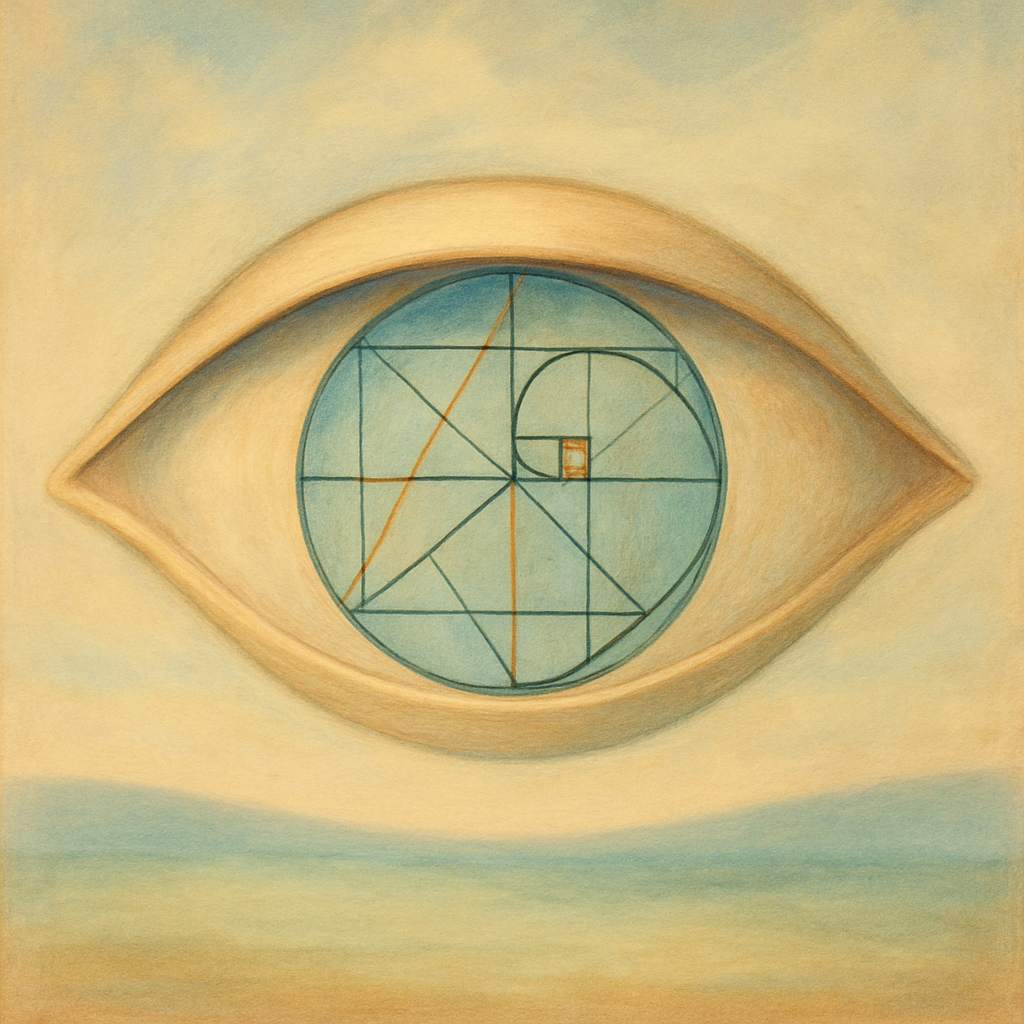
Pick up a nautilus shell. Run your finger along the curve. It widens, smoothly, without a single sharp edge. That curve is not random. It follows a logarithmic spiral — and in many biological forms like this one, the growth factor sits numerically close to one specific number. One point six one eight. That number has a name. Phi. The golden ratio. And J, once you see what it actually is, you will find it almost everywhere you look. The golden ratio, phi, is a mathematical constant that appears in various forms of nature and art. It is closely related to the Fibonacci sequence, where the ratio of consecutive Fibonacci numbers converges toward phi as the sequence grows. This connection highlights the universality and elegance of phi, transcending simple numerical patterns to influence natural and artistic forms. So what is phi, precisely? It is the number that satisfies one elegant equation: phi squared equals phi plus one. Solve that, and you get one point six one eight, repeating forever without pattern. It is irrational. Its decimal expansion does not terminate or repeat. Here is the key idea: two quantities are in the golden ratio when the ratio of the whole to the larger part equals the ratio of the larger part to the smaller. The whole reflects the part. The part reflects the smaller part. Self-similarity, all the way down. Think of it as a fraction that contains itself — phi can be written as one plus one divided by one plus one divided by one, repeating infinitely. For example, consider how a sunflower packs its seeds. Each new seed is placed at roughly one hundred thirty-seven point five degrees from the last. That specific angle — the golden angle — comes directly from phi. Mathematical models show this arrangement minimizes overlap and maximizes packing efficiency under simple growth rules. In sunflower seed heads, the visible spirals typically come in pairs of consecutive Fibonacci numbers, like thirty-four and fifty-five, or fifty-five and eighty-nine. Research sampling hundreds of sunflower specimens confirmed most followed this pattern. Real plants do deviate — genetics, noise, and environment all push the angle slightly off. But they cluster around that golden angle. Nature aims at phi, even when it does not land perfectly. The golden ratio is not limited to biology. In geometry, the diagonal of a regular pentagon is exactly phi times its side length. Penrose tilings — quasiperiodic patterns that do not repeat periodically — use two shapes whose edge lengths and frequencies are governed by powers of phi. Now, that matters beyond pure math. Quasicrystals, real solid materials discovered in the lab, show atomic arrangements whose diffraction patterns carry fivefold rotational symmetry. The peak spacings in those X-ray patterns match phi. That means this ratio appears not just in living things, J, but in the atomic structure of matter itself. The golden ratio has inspired countless artists and architects throughout history. From the Parthenon in Greece to the works of Leonardo da Vinci, phi has been a guiding principle in design. While some claims about its role in beauty are exaggerated, its influence on creativity and innovation is undeniable. Recognizing its true impact requires a discerning mathematical eye. The takeaway, J, is this. The golden ratio and the Fibonacci sequence are not decorations nature chose for aesthetic reasons. They are solutions. Dynamical models show that Fibonacci spiral counts and golden-angle arrangements emerge from growth processes that minimize crowding and local interaction energy. Nature did not read a geometry textbook. It arrived at phi through pressure — the same way bees arrived at hexagons. [short pause] That means in many sunflower heads and pinecones — and in some shell curves — phi is not magic; it is a clue to growth, packing, and self-similar form. One number. One ratio. Hiding in plain sight, one percent at a time.