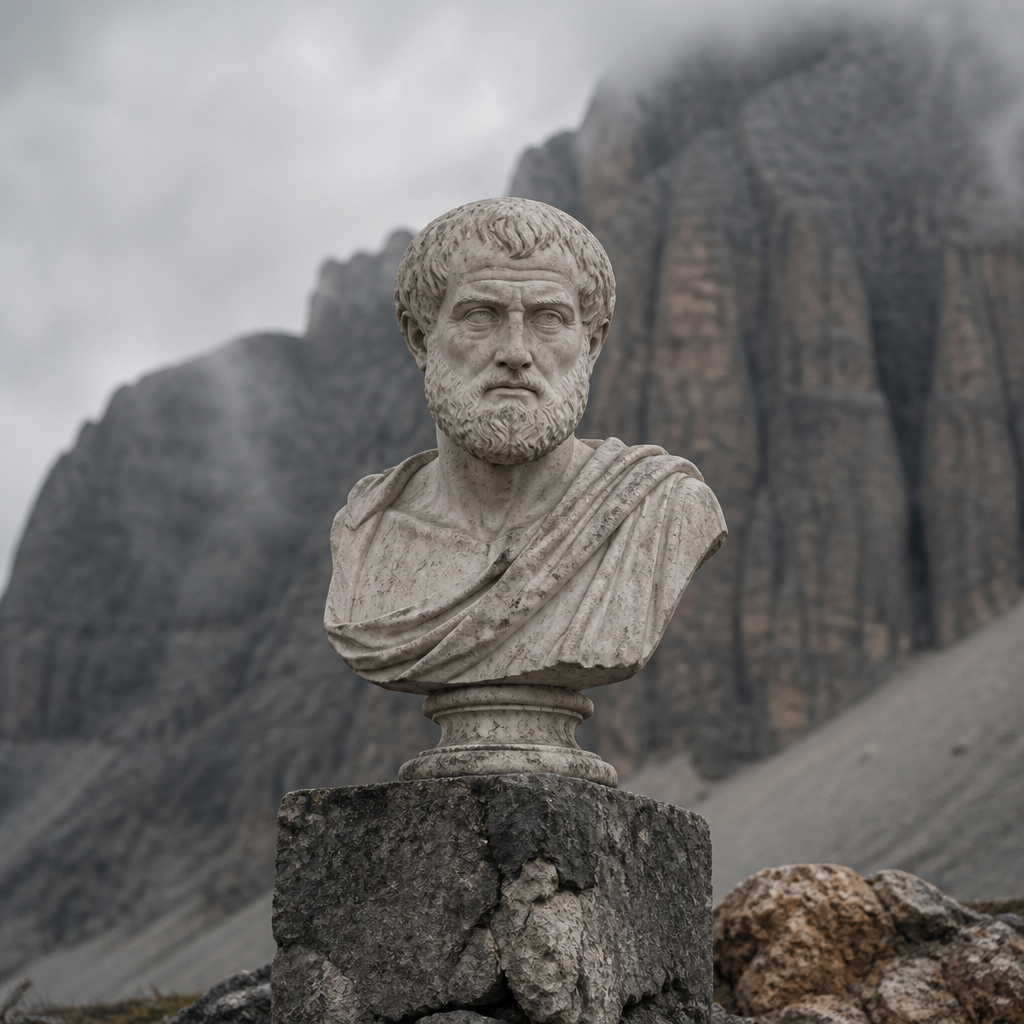
The Master of Those Who Know: Logic and the Structure of Reality
Aristotle: The Architect of Western Thought

Transcript
Dante called him simply "the master of those who know." No other name needed. That single phrase, borrowed from the medieval world, tells you something remarkable: for over a thousand years, one man's framework for thinking was treated as the framework for thinking itself. That man was Aristotle, and the tool he built — a collection of logical works the ancient world would call the Organon, meaning instrument — became the operating system of Western intellectual life. The Organon includes six texts: the Categories, On Interpretation, Prior Analytics, Posterior Analytics, Topics, and Sophistical Refutations. Together, they do something audacious. They argue that logic is not one subject among many. It is the prerequisite for every other subject. You cannot do science, ethics, or politics rigorously until you can reason correctly. That claim alone reshaped civilization. Now, to understand why Aristotle's project was so radical, you need to see what he was pushing against. His teacher, Plato, believed that the truest reality was not the world you can touch and observe. It was a realm of perfect, abstract Forms — the ideal Form of a horse, the ideal Form of justice — and the physical world was just a dim shadow of those Forms. Aristotle looked at that and essentially said: no. Reality is right here. Think of a sculptor and a block of marble. For Aristotle, the marble is matter — raw potential. The finished statue is form. Neither exists in some separate heavenly realm. They are inseparable, present in the actual object in front of you. This is the core of what scholars call hylomorphism, from the Greek words for matter and form. Aristotle's metaphysics investigates being itself — being considered in general — and it grounds that investigation in the observable, categorizable world. That shift from Plato's heaven to Aristotle's earth is one of the most consequential pivots in the history of thought. The key idea behind Aristotle's logic is the syllogism — what he called a sullogismos, a deduction. Here is how it works. Every basic syllogism contains exactly two premises and a conclusion. The premises share one term, called the middle term. That middle term is the hinge. It connects the two outer terms, which Aristotle calls the extremes. The predicate of the conclusion is the major term; the subject of the conclusion is the minor term. For example: all humans are mortal — that is the major premise. Socrates is human — that is the minor premise. Therefore, Socrates is mortal. The conclusion follows necessarily. Not probably. Not usually. Necessarily. Aristotle was explicit: a deduction must produce a conclusion that differs from the premises. If you simply repeat a premise, you have not deduced anything. That distinction matters enormously. It means valid reasoning is not just assertion — it is structured movement from what you already know to what you did not yet know. His non-modal syllogistic, laid out in the Prior Analytics, is considered by scholars the pinnacle of his logical achievement. He also extended the system into modal syllogistic, examining deductions involving possibility and necessity — a level of sophistication that would not be surpassed for centuries. Remember, Aristotle did not stop at logic. He used that logical framework to build a system of categories — a map of reality itself. In the Categories, he identifies ten fundamental ways anything can be described: substance, quantity, quality, relation, place, time, position, state, action, and being acted upon. Substance is primary. An individual person, a specific horse — these are primary substances, existing independently. Species and genera are secondary substances, more abstract groupings. Everything else — qualities, quantities, relations — exists in or is predicated of a substance. That means you cannot have redness floating free in the universe. Redness exists in something red. This obsession with classification, with sorting the world into its proper bins, is where Aristotle's fingerprints are most visible in modern life. The university system — with its distinct faculties of biology, physics, ethics, rhetoric, and politics — reflects Aristotle's conviction that knowledge has a structure, and that structure can be mapped. In the Posterior Analytics, he goes further: genuine scientific knowledge requires demonstration from explanatory principles, not just true conclusions. Knowing that something is true is not enough. You must know why. The takeaway from all of this is precise and powerful. Aristotle did not simply add to Plato's philosophy — he redirected the entire enterprise. He pulled philosophy down from the realm of abstract ideals and planted it firmly in the observable, categorizable, logically analyzable world. That move — from pure abstraction to rigorous empirical structure — is the seed of the modern scientific method. So when you encounter a biologist classifying species, a lawyer constructing an argument, or a scientist demanding explanatory principles rather than mere correlation, you are watching Aristotle's ghost at work. The shape of knowing, as he designed it, is still the shape we use today.