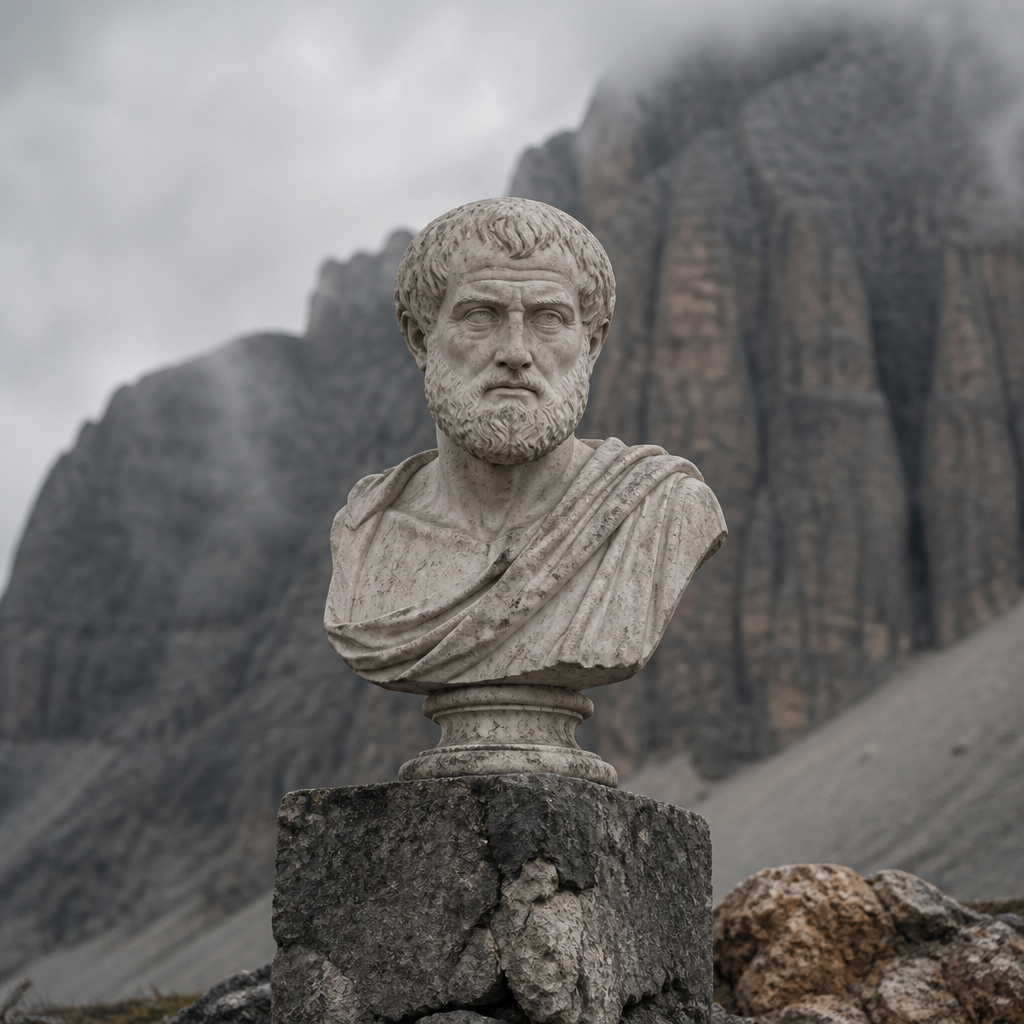
The Flourishing Life: Virtue and the Golden Mean
Aristotle: The Architect of Western Thought

Transcript
Think of someone you genuinely admire. Not because they won a prize or made a fortune. Because they seem to handle life well. They stay calm under pressure. They're generous without being a pushover. They know when to speak and when to stay quiet. Aristotle had a name for what that person has built. He called it eudaimonia. And it is the destination his entire philosophy was pointing toward. Now, let's transition from natural ends to human ends. While natural things like acorns have built-in ends, humans pursue a unique end: eudaimonia. Aristotle's Nicomachean Ethics explores this human pursuit. Eudaimonia is often translated as happiness, but it's more profound. It's the activity of the soul aligned with virtue throughout a complete life. Key elements are activity, virtue, and completeness. Flourishing requires exercising virtues, much like a musician must play to truly flourish. A single moment doesn't define a life; the entire journey does. Aristotle divides virtue into two categories. Intellectual virtues concern reasoning, the capacity to think clearly and deliberate well. Ethical virtues concern character and emotion. They govern how you feel and act in the world. Here is the key idea: ethical virtues are not gifts you are born with. They are skills you build. You become just by performing just actions. You become courageous by performing courageous actions. Repeated practice shapes a stable disposition Aristotle calls hexis. That disposition, once formed, makes virtuous action feel natural rather than forced. Now, how do you know which action is virtuous? This is where Aristotle's most famous idea enters. Each virtue sits at a mean between two vices. Take courage. Too little produces cowardice. Too much produces rashness. Courage is the appropriate response to fear and confidence, positioned between those two extremes. But here is what most people miss, joealanis1961. The mean is not a mathematical midpoint. It is relative to the person and the circumstances. Consider a trained athlete and someone else. The appropriate training load for one would destroy the other. Virtue works the same way. That means no rulebook can do the work for you. Aristotle is explicit: the right response depends on the right time, object, person, purpose, manner, and intensity. What guides you through that complexity is phronesis, practical wisdom. It is not theoretical knowledge. It is the cultivated ability to deliberate well in concrete situations and then act on that deliberation. [short pause] A person can know ethical principles and still fail to apply them wisely. Practical wisdom is what closes that gap. Aristotle goes further: genuine practical wisdom is incompatible with akrasia, the failure of self-control, because real wisdom requires both correct reasoning and the emotional mastery to follow through. The takeaway is this. Aristotle's ethics is not a list of rules. It is a training program. Virtue is a practical skill, built through habit, calibrated to the person and the moment, and guided by practical wisdom. Eudaimonia, the flourishing life, is the result of that long practice. Not a reward handed to you. Not a feeling that arrives. An achievement, earned action by action, across an entire life. That, joealanis1961, is Aristotle's final answer to the question his whole system was built to ask: what is the best way for a human being to live?