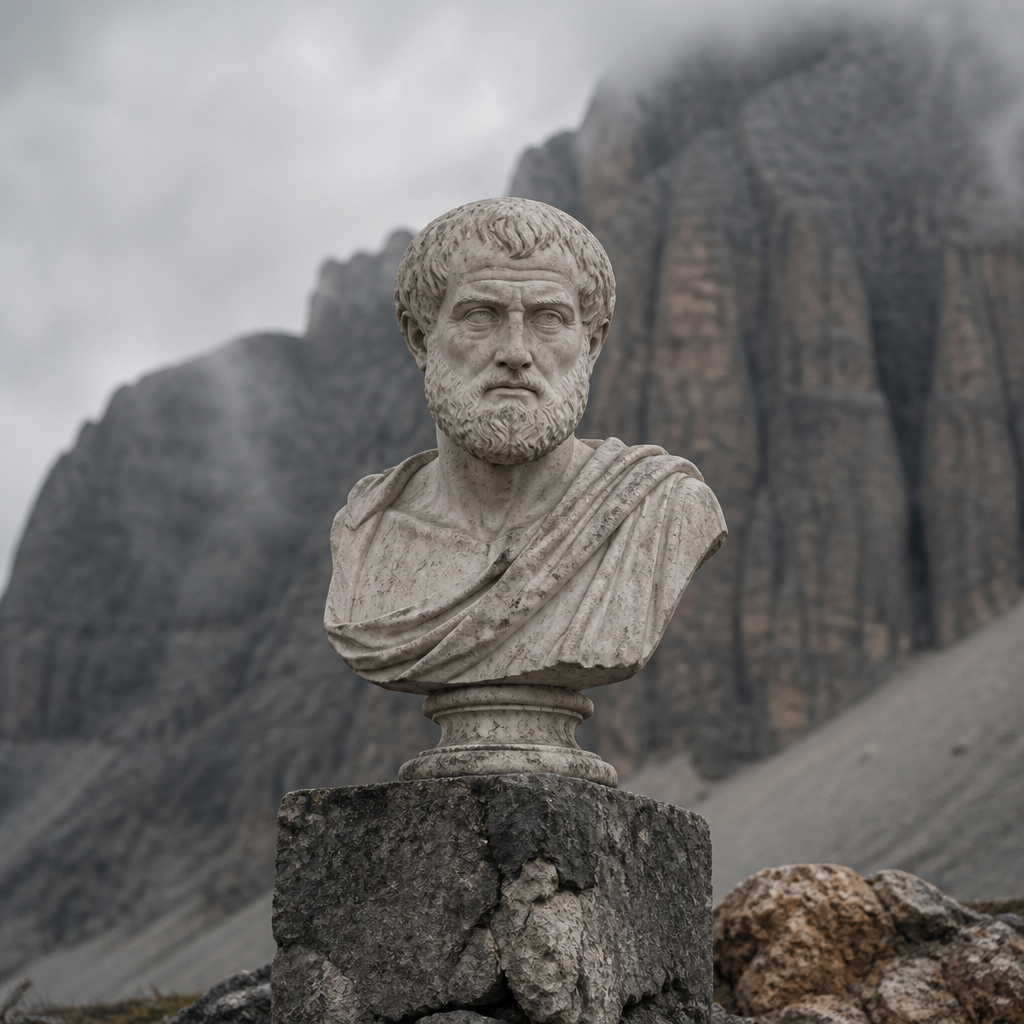
The Four Causes: Decoding the Blueprint of Existence
Aristotle: The Architect of Western Thought

Transcript
SPEAKER_1: So last time we set up Aristotle's habit of asking why things are the way they are. Now I want to see how he actually explains that world. Because he doesn't just say 'things exist.' He asks why they exist. SPEAKER_2: Exactly, and that word — why — is the whole engine here. Aristotle's Greek term is aitia, usually translated as 'cause,' but it really means something closer to explanation or responsibility. A cause, for him, is fundamentally an answer to a why question, not just a prior event that triggers an effect. SPEAKER_1: So not cause in the modern billiard-ball sense — one thing hits another and produces a result. SPEAKER_2: Right. His account is broader than that. Aristotle identifies four distinct explanatory roles, four ways something can be responsible for a thing's existence. He calls them the material, formal, efficient, and final causes. And he lays this out chiefly in the Physics and the Metaphysics. SPEAKER_1: Can we ground that with a concrete example? Something our listener can actually picture? SPEAKER_2: Think of a bronze statue. The material cause is the bronze itself — what the thing is made from, what persists through its production. The formal cause is the statue's shape, its defining structure — what makes it this statue rather than a lump of metal. The efficient cause is the sculptor, the primary source from which the change originates. And the final cause is the purpose — why the statue was made at all, perhaps to honor a general or adorn a temple. SPEAKER_1: what's it made of, what is it, who or what made it, and what's it for. SPEAKER_2: Precisely. And Aristotle insists that a genuinely adequate explanation normally requires identifying all four. You can't just say 'the sculptor made it' and call that understanding. That's one dimension of the explanation. SPEAKER_1: Now, the efficient cause — I assumed that meant a human maker. But does it have to be a human maker? SPEAKER_2: No, and this is where it gets richer. Aristotle explicitly broadens it. A parent generating a child, a healer restoring health, even an adviser prompting a decision — all of these count as efficient causes. The key is that they are the primary source from which a change or motion originates. SPEAKER_1: And the final cause — that one feels almost controversial. Because it implies everything has a purpose. SPEAKER_2: [inhale] It does, and that's exactly where Aristotle's teleology comes in. The Greek word is telos — end or goal. He argues that natural processes are organized toward ends, even without conscious intention. Take health. Walking, dieting, surgery — these may all be undertaken for the sake of health. Health is the final cause. It doesn't require anyone to consciously plan it at every step. SPEAKER_1: So not X, but Y — not 'someone intended this,' but 'this process is structured toward an outcome.' SPEAKER_2: Exactly. And this applies to natural things, not just artifacts. An acorn is potentially an oak tree — not potentially any random object — because its form, its essence, already orients it toward that specific end. That's what distinguishes it. The form and the final cause are often deeply connected in natural generation. SPEAKER_1: Mm. So form isn't just visible shape — it's more like the defining account of what something is. SPEAKER_2: Right. The formal cause can be the essence, the intelligible structure that makes a thing the kind of thing it is. And here's where Aristotle parts ways with Plato. The Aristotelian point is that form belongs in the explanation of the concrete thing itself. For Aristotle, it's intrinsic to the actual object — matter and form are inseparable aspects of the same thing. SPEAKER_1: Which of the four causes became the most contested later on? Because I suspect it wasn't the material one. SPEAKER_2: [chuckle] No. The final cause took the hardest hit. When mechanistic thinkers in the scientific revolution built their physics around efficient causes alone — matter in motion, forces, collisions — they rejected teleology as unscientific. Why would nature have purposes? But Aristotle's framework dominated scientific and philosophical thought for roughly two thousand years before that challenge arrived. SPEAKER_1: Two thousand years is a long time to hold a framework together. What keeps it coherent internally? SPEAKER_2: Causal pluralism. That's the key idea. Aristotle's system is built on the premise that different, irreducible kinds of explanation may be required for one and the same thing. The four causes aren't four separate objects — they're four ways something can be explanatory. And final-cause chains can't regress forever. One end may be pursued for the sake of another, but explanation must ultimately terminate in an end that isn't pursued for anything further. SPEAKER_1: The takeaway for everyone following along, then, is that Aristotle's 'why' is genuinely plural — material, formal, efficient, final — and that nature itself, not just human craft, operates with purpose built in. SPEAKER_2: That's it. And now that we understand why things exist in Aristotle's framework, the next question becomes unavoidable: how should human beings live within this purposeful universe? That's where his ethics enters, and it's where the whole system becomes personal.