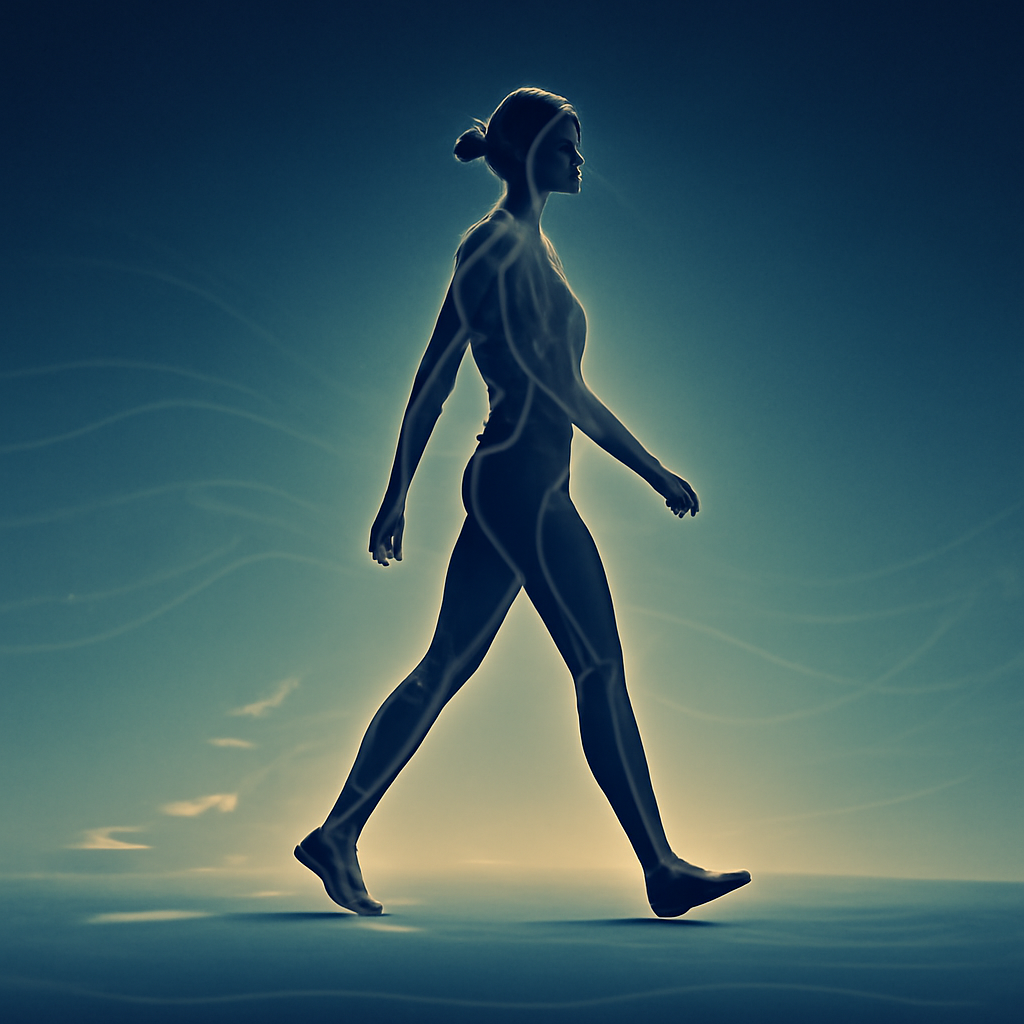
The Signature of Your Stride
The Biomechanics of the 'Controlled Fall'
Phases of the Gait Cycle
Spatiotemporal Features: The Metrics of Motion
The Posture Signature
Computer Vision: Seeing the Silhouette
Model-Based Approaches: The Digital Skeleton
Wearable Sensing: Identity in the Pocket
The Clinical Intersection
Machine Learning: From Pixels to Patterns
Temporal Modeling: The Flow of Time
The 'In the Wild' Challenge
The Covariate Problem: Clothes, Coats, and Carry-Ons
Affective Gait: The Walk of Emotion
Multi-Modal Fusion
Privacy by Design
The Ethical Limits of Recognition
Conclusion: The Future of Embodied Identity

Transcript
A security camera captures a figure crossing a parking lot, two hundred feet away. The face is a blur. Iris recognition is useless at that range. Yet a gait recognition system flags the individual with high confidence — because the way that person walks is, in a very real sense, who they are. That is not science fiction. Research confirms that gait recognition systems can identify individuals from distances exceeding fifty meters, a range where facial recognition typically fails due to low image resolution. The body, moving through space, broadcasts a signal that cameras can read long before any face becomes visible. Now, the science behind that signal is older than you might expect. Aristotle's fourth-century BCE treatise "On the Motion of Animals" is historically recognized as one of the earliest scientific attempts to categorize the biomechanics of movement and gait. He was asking, in essence, what makes a body move the way it does. The answer, we now know, involves over two hundred bones and more than six hundred muscles working in coordinated sequence. That mechanical complexity is precisely what makes gait so individual. Think of it like a musical instrument: the same song played on two different violins sounds subtly different because of the instrument's physical construction. Your skeleton and musculature are your instrument. No two are tuned identically, and that means no two people walk identically. The key idea here is the gait cycle itself, because it is the fundamental unit of measurement for everything that follows. A standard human gait cycle divides into two primary phases. The stance phase, when your foot contacts the ground, accounts for approximately sixty percent of the cycle. The swing phase, when your foot travels through the air, accounts for the remaining forty percent. That sixty-forty split is the biological clock of walking. Within those phases, researchers extract spatiotemporal features — stride length, cadence, step width, double-support time — and kinematic features like joint angles at the hip, knee, and ankle. Each of those measurements carries your individual signature. Injury, posture habits, leg-length asymmetry, and neurological timing all leave their marks in those numbers. That means the data is rich, layered, and deeply personal. This is where gait recognition separates itself from static biometrics, Jordan. A fingerprint does not change when you are tired. An iris does not shift when you are carrying a heavy bag. But gait is a behavioral biometric — it is the product of both your fixed anatomy and your dynamic neurology. Your central pattern generators, the spinal circuits that automate walking rhythm, interact with your skeletal geometry in real time. For example, a person recovering from a knee injury will show measurable asymmetry in their stance-phase duration, even after the pain resolves, because the nervous system has partially adapted its timing. That behavioral layer is what makes gait simultaneously harder to forge and more sensitive to context. It is also, Jordan, what makes it genuinely fascinating from a biometric standpoint — it captures not just structure, but the living rhythm of a person in motion. Remember this: natural biological gait recognition is not simply a surveillance tool. It is a window into the body's most honest self-expression. Unlike voice recognition, which requires acoustic capture and cooperation, or radio-frequency sensing, which requires specialized hardware and signal processing infrastructure, camera-based gait recognition works at a distance, passively, without the subject's active participation. That non-cooperative quality is a double-edged reality — it enables clinical monitoring of patients who cannot cooperate, and it enables identification without consent. The takeaway from this first lecture is the one that anchors everything ahead: natural biological gait is a behavioral biometric that captures the unique harmony between skeletal structure and neurological timing. Your walk is not just locomotion. It is a signature written in motion, legible to machines from across a parking lot, and shaped by every bone, muscle, and neural circuit that makes you, specifically, you.