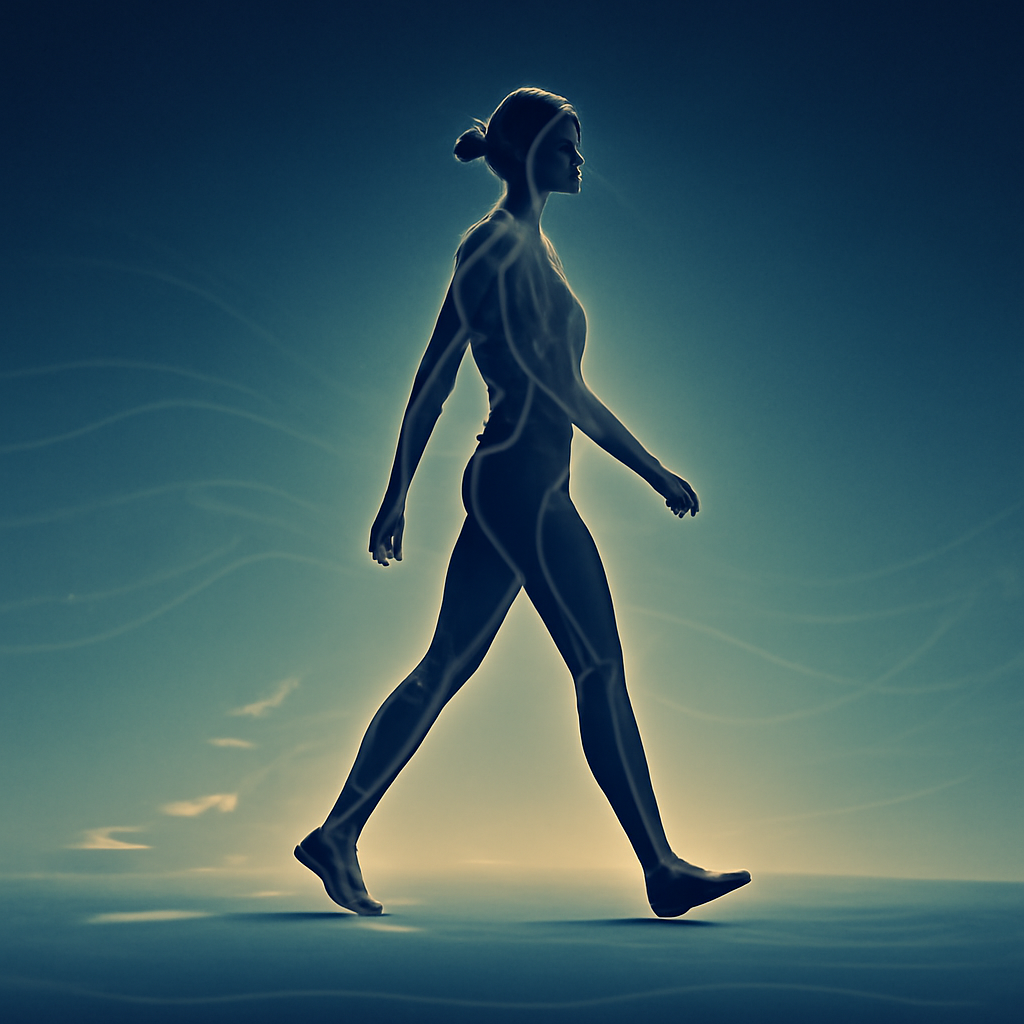
The Signature of Your Stride
The Biomechanics of the 'Controlled Fall'
Phases of the Gait Cycle
Spatiotemporal Features: The Metrics of Motion
The Posture Signature
Computer Vision: Seeing the Silhouette
Model-Based Approaches: The Digital Skeleton
Wearable Sensing: Identity in the Pocket
The Clinical Intersection
Machine Learning: From Pixels to Patterns
Temporal Modeling: The Flow of Time
The 'In the Wild' Challenge
The Covariate Problem: Clothes, Coats, and Carry-Ons
Affective Gait: The Walk of Emotion
Multi-Modal Fusion
Privacy by Design
The Ethical Limits of Recognition
Conclusion: The Future of Embodied Identity

Transcript
A detective spots someone across a crowded train station. No face visible. The figure is moving away, partially blocked by other passengers. Yet the detective says: I know that person. Not from the legs. From the way the shoulders carry forward. From the slight rightward tilt of the trunk. From the arms that barely swing. That recognition is real, and it is not magic. It is posture reading. Posture in gait recognition is not just about the physical configuration of body segments like the head, trunk, and limbs. It also conveys emotional and physical states, making it a rich source of information. Now, last time we established that small timing differences in spatiotemporal features often outperform large visible leg movements as identity signals. That insight carries directly into this lecture. Because the legs are not the only source of those signals. The upper body is broadcasting identity information simultaneously, and in some camera conditions it is actually the more reliable channel. Think of the walking body as a kinetic chain. Foot placement drives pelvic rotation. Pelvic rotation demands trunk counter-rotation. Trunk counter-rotation coordinates with shoulder motion and arm swing. Each link in that chain is mechanically coupled to the others. Trunk, pelvis, and head motions are tied directly to balance control, which means a gait-recognition system can extract identity information from upper-body stabilization — not just from the legs. The key idea is that the upper body is not a passenger. It is an active co-author of the gait signature. Researchers track features like trunk inclination and lateral trunk lean, which can reveal information about a person's health or mood, emphasizing the ethical implications of using such data. That is a rich vocabulary. And some of those features are surprisingly stable. For example, lateral trunk lean and toe-out angle can remain consistent across prolonged treadmill walking. One study reported intraclass correlation coefficients of 0.90 to 0.95 for maximum toe-out angle — strong test-retest reliability. Lateral trunk lean scored lower, between 0.61 and 0.72, but still useful. Stability is what makes a feature biometrically valuable. Here is where it gets interesting for you, Jordan. Trunk posture is not passive. Changing trunk orientation actively reshapes the entire gait pattern. When someone walks with increased trunk flexion — a forward lean — the body adopts a crouched configuration: sustained knee flexion, increased ankle dorsiflexion, increased hip flexion. The pelvis and trunk shift backward to offset the displaced mass. And the step-to-step transition strategy changes: the leading limb takes on more of the center-of-mass redirection after ground contact, rather than the trailing leg doing it anticipatorily. Posture is not merely a consequence of walking speed. It is a cause of downstream mechanical choices. That means the posture signature is not perfectly fixed. Neuromuscular fatigue can alter trunk and hip kinematics and muscle-activation patterns. After exertion, the lumbo-pelvic-hip complex tends to stiffen — increased muscle activation alongside reduced movement — as the body protects the trunk. A posture signature recorded after a long run may differ measurably from one recorded at rest. Mood, pain, and confidence also alter trunk carriage. A person in pain guards their posture. A person walking with social confidence opens their shoulders. These shifts are ethically significant, as systems reading posture can inadvertently reveal sensitive information like emotional state or medical condition, raising privacy concerns. Camera-based systems represent posture through detected body landmarks or skeleton sequences. A practical pipeline runs person detection, tracking, pose extraction, temporal alignment, feature normalization, sequence modeling, and identity scoring. But view angle, clothing, and carried objects reduce accuracy by altering the visible relationship between body, joints, and silhouette. In one evaluation using CASIA data, reported accuracy was substantially higher for subjects carrying bags than for subjects wearing coats. The coat hides the trunk. The trunk is the signal. That gap is not a minor calibration issue. It is a fundamental challenge for any posture-based system deployed in real-world conditions. The takeaway is this: upper-body carriage and trunk rotation are as vital to gait recognition as the movement of the legs — and in some camera conditions, more reliable. The posture signature is a time-varying record of how your skeleton manages balance, momentum, and identity simultaneously. It encodes your habitual motor control, your structural geometry, and your momentary state. [short pause] And because it can reveal fatigue, pain, age, and emotional condition, any system that reads it carries a serious ethical responsibility alongside its technical capability.