Conclusion: The Future of Embodied Identity
The Rhythm of Identity: Natural Biological Gait Recognition
The Signature of Your Stride
The Biomechanics of the 'Controlled Fall'
Phases of the Gait Cycle
Spatiotemporal Features: The Metrics of Motion
The Posture Signature
Computer Vision: Seeing the Silhouette
Model-Based Approaches: The Digital Skeleton
Wearable Sensing: Identity in the Pocket
The Clinical Intersection
Machine Learning: From Pixels to Patterns
Temporal Modeling: The Flow of Time
The 'In the Wild' Challenge
The Covariate Problem: Clothes, Coats, and Carry-Ons
Affective Gait: The Walk of Emotion
Multi-Modal Fusion
Privacy by Design
The Ethical Limits of Recognition
Conclusion: The Future of Embodied Identity

Transcript
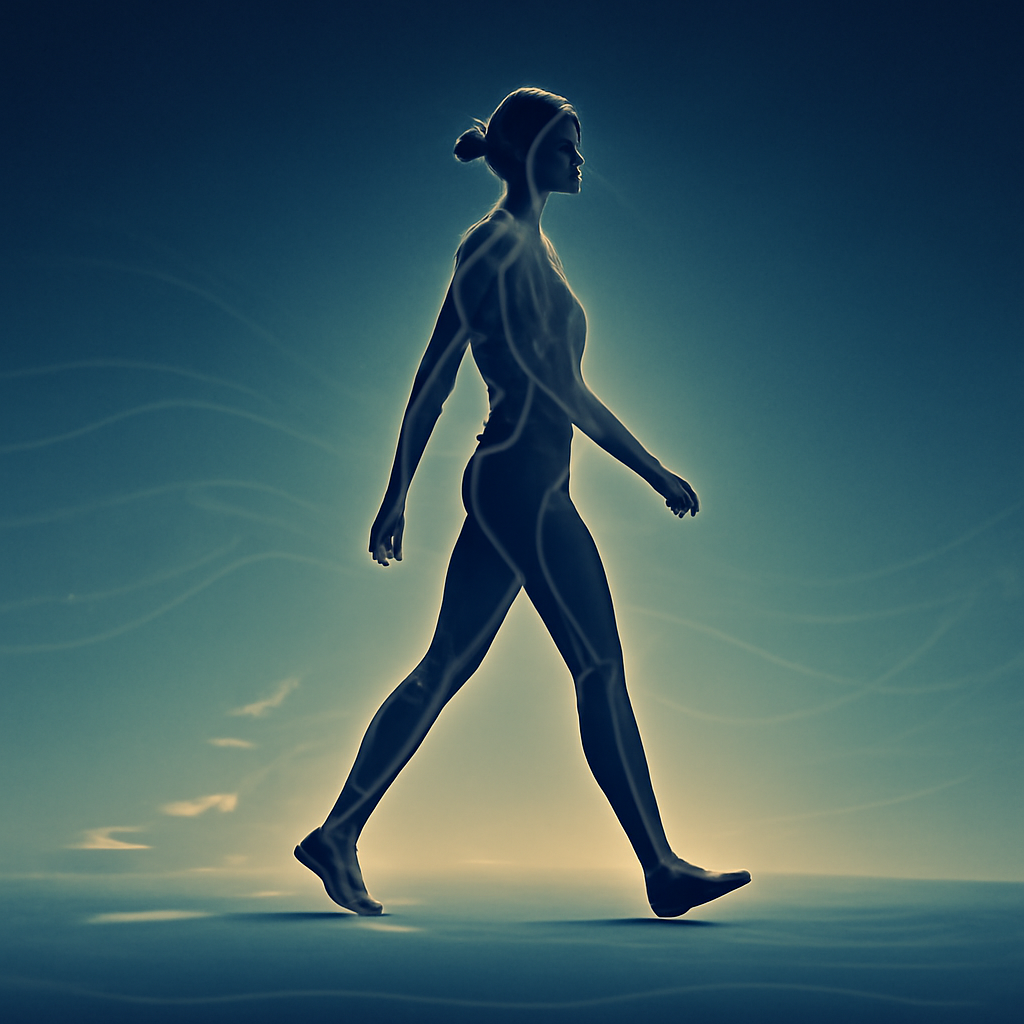
A single heel strikes pavement. That contact lasts a fraction of a second. Yet inside that fraction lives a biological signature no two people share in exactly the same way. Earlier in the course, we started with a parking-lot camera and a blurred face. Now we know what the camera was actually reading. Not the face. The rhythm underneath it. The key idea running through this entire course is deceptively simple. Gait is a behavioral biometric. Identity can be inferred from characteristic patterns of walking rather than from a face, fingerprint, or voice. That one sentence contains multitudes. The gait cycle begins at heel strike and ends at the next heel strike of the same foot. Stance takes roughly sixty percent. Swing takes forty. Inside that loop sit eight precisely timed checkpoints, each one a biometric timestamp. Speed, cadence, step length, stride length, stance time, swing time, double-support time. Those are the vocabulary. The body writes the sentence. Think of it this way. Skeletal geometry sets the instrument. Neural timing plays it. Kinematic analysis describes joint angles and ranges of motion at the hip, knee, and ankle. Kinetic analysis describes the forces and power behind those angles. Gait variability measures stride-to-stride fluctuation, not average speed. That variability is its own signal. It can provide information about stability and motor control that a single average number may not capture. Asymmetry between limbs adds another layer. Step time, stance time, single-support time. Each difference between left and right is a quiet fingerprint. Camera systems detect a person, isolate a silhouette or skeleton, normalize the sequence, extract features, and compare against enrolled identities. Wearable inertial systems use accelerometers and gyroscopes to measure body motion outside a laboratory. Heel strike and toe-off are among the most commonly detected events. Machine learning shifted the field from handcrafted features to learned representations. Now, the critical rule: a pipeline must separate enrollment and evaluation data by person. Randomly splitting sequences from the same individual produces misleadingly optimistic results. Here is where honesty matters most. Viewpoint, clothing, carried objects, lighting, and walking surface can substantially reduce recognition accuracy. For example, one reported CASIA experiment found ninety percent accuracy for subjects carrying bags but only fifty-eight percent for subjects wearing coats. Same system. Same people. Different covariate. Age compounds the problem further. Reduced walking speed, altered stride length, wider steps, and increased variability mean a model trained on young adults may fail older walkers. Mental fatigue increases step variability during dual-task walking without necessarily changing ordinary walking the same way physical fatigue does. [short pause] The gap between benchmark and real world is real. The most defensible uses of gait recognition are clinical. Wearable research has examined movement disorders, surgical outcomes, walking stability, and fall-risk assessment. A single lower-posterior-trunk inertial sensor has been reported as sufficient to derive multiple fall-risk-related measures in older adults. That is remarkable. Rehabilitation feedback, accessibility support, opt-in device security. These are contexts where the person benefits directly and consents fully. Now, the counterintuitive principle: the best future of gait recognition may involve using it less often, in narrower contexts, with stronger boundaries. Restraint is not weakness. It is precision. Gait can be captured at a distance without active participation. That non-cooperative quality is the field's sharpest ethical edge. Pose-preserving anonymization can hide a face while leaving motion identity intact. Blurring appearance alone is not gait privacy protection. Biometric governance guidance explicitly treats gait as biometric information and recommends privacy-risk assessment, clear disclosure, protection measures, and documented deletion practices. Jordan, that means consent, edge processing, template protection, and narrow purpose are not optional additions. They are the architecture. Remember this. Natural biological gait recognition is a testament to the uniqueness of the human experience. The walk encodes skeletal geometry, neural timing, emotional state, age, fatigue, and adaptation. It is the most honest self-expression the body produces, and it is legible to machines from across a parking lot. The field's obligation is to recognize the pattern without reducing the person to the pattern. Presence, privacy, elegance, and respect are not values in tension with good science. They are the conditions that make good science worth doing. The heel strikes. The cycle completes. The signature was there.