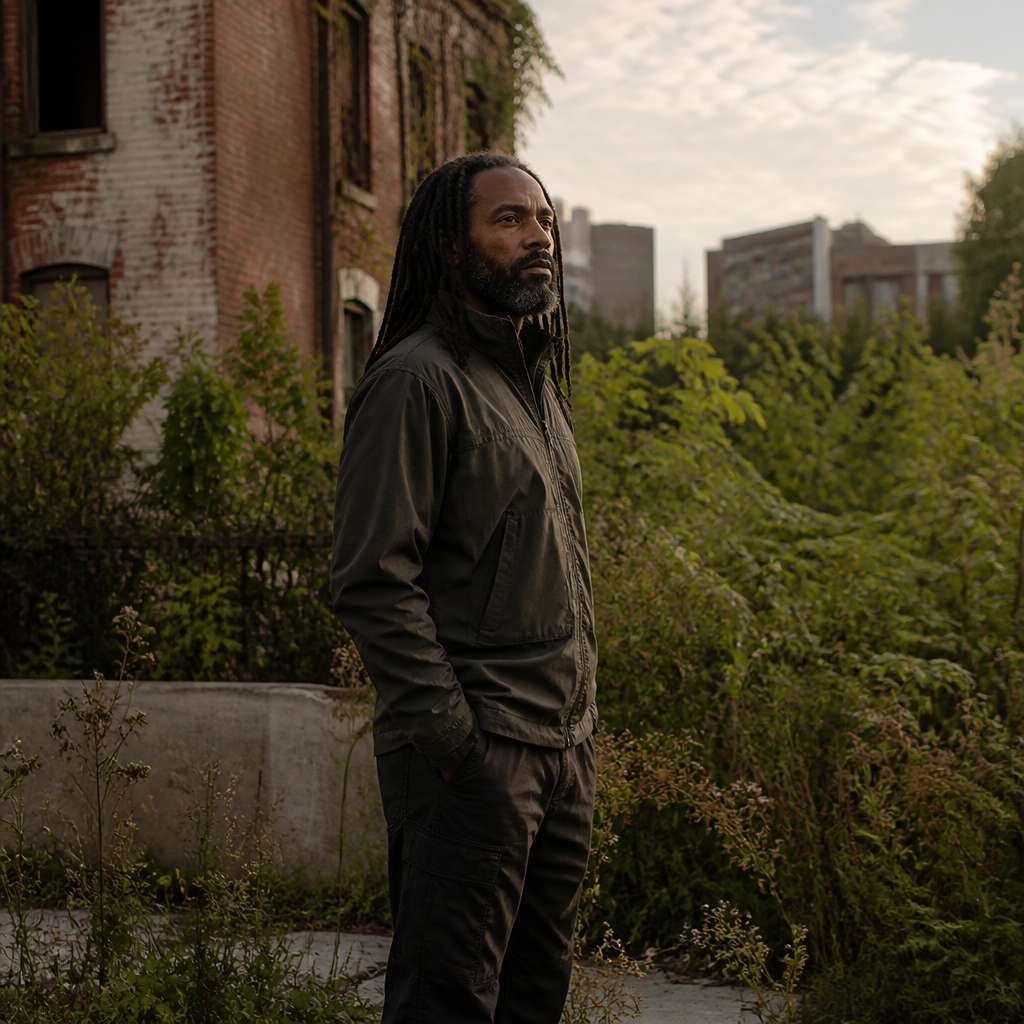
The Seed of Resistance: Who Was John Africa?
The Teachings of John Africa: Life, System, and Resistance
The Seed of Resistance: Who Was John Africa?
The Core Dichotomy: 'Life' vs. 'The System'
The Guidelines: The Written Blueprint
Radical Equality: Species and Hierarchy
The Name Africa: Identity and Unity
Natural Discipline: The MOVE Lifestyle
Education and the Un-Learning Process
The Rejection of Modern Medicine
The Critique of Institutional Racism
Anti-Capitalism and Shared Resources
Animal Liberation: Kinship Beyond Human Limits
The Power of the Collective Voice
The Technology Trap
State Conflict: 1978 and 1985
The Philosophy of Resistance
Absolutism and the Risks of Belief
Anarcho-Primitivism and Global Context
The Legacy of 'Life' Today

Transcript
On May 13, 1985, a Philadelphia police helicopter dropped a military-grade explosive device onto a residential rowhouse. The fire that followed killed eleven people, including children, and destroyed or damaged roughly sixty neighboring homes. The city of Philadelphia had just bombed its own citizens. That event is the endpoint of a story that begins forty-four years earlier, in a neighborhood called Mantua, in West Philadelphia, where a boy named Vincent Leaphart was born on July 26, 1931. That boy would become John Africa. And the philosophy he built would force one of the most powerful cities in America into a confrontation that still has no clean resolution. Vincent Leaphart grew up poor and Black in a city where those two facts carried enormous weight. He served in the Korean War, and like many veterans before and after him, he returned home profoundly disillusioned. The America he had fought for did not match the America he came back to. That gap — between the promise and the reality — became the engine of his thinking. Now, here is the key idea: John Africa did not frame his critique as politics alone. He framed it as a spiritual emergency. He looked at racism, police brutality, prisons, schools, war, and animal cruelty and concluded they were not separate problems. They were symptoms of one disease. He called that disease the System. And he believed the only cure was a complete return to what he called Life — a living, breathing force connecting humans, animals, plants, water, air, and soil into one interdependent whole. That vision needed a document. John Africa was functionally illiterate, so he worked with a social worker named Donald Glassey to produce a written text. The result was roughly three hundred pages long. It was first called The Book of Guidelines and later known as The Teachings of John Africa. Think of it as the philosophical constitution of everything MOVE would become. MOVE itself was founded in 1972, originally under the name the Christian Movement for Life. The name MOVE is not an acronym. John Africa chose it deliberately, to express constant motion, constant action. Members gathered first in the Powelton Village neighborhood of Philadelphia, living communally under his guidance. They rejected electricity, processed food, drugs, alcohol, and most modern medicine. They ate raw and natural foods. They opposed zoos, staged protests at group homes, and challenged the city's social norms at every turn. Scholars often describe this framework as radical naturalism or anarcho-primitivism — a structured rejection of industrial civilization rooted in a religious reverence for nature. The surname Africa was central to all of it, IZ. Every member adopted it. That shared name was not a branding exercise. It was a declaration. It rejected individual family lineage as a product of a system built on slavery and disconnection. It replaced that lineage with a collective identity rooted in the African continent — the origin point, in John Africa's view, of humanity's deepest connection to the natural world. He also insisted, according to some accounts, that MOVE members see themselves as their own leaders. That means the structure was deliberately non-hierarchical, at least in principle. The claim that "everything is level" ran through the teachings. Every person, every animal, every plant held equal standing in the order of Life. That is a radical position. It is also, IZ, one worth sitting with critically — because a community that claims to have no hierarchy while organized around one man's three-hundred-page document presents a genuine tension worth examining. The MOVE Archive holds more than seventy-five linear feet of records, including unpublished writings by John Africa, which suggests the scope of his output was vast and still not fully studied. The takeaway from this first lecture is foundational. John Africa's philosophy was not a collection of lifestyle preferences. It was a total worldview. He argued that modern society is an artificial system — one that manufactures suffering by severing human beings from the natural order of Life. That argument drew from his own experience of poverty, military service, and racial injustice. It produced a community, a document, a set of practices, and ultimately a confrontation with state power that ended in fire. Remember this: understanding MOVE requires holding two things at once. The teachings contain genuine insight about ecological interdependence and the violence of systemic power. They also carried real risks — for health, for safety, and for the people who lived inside them. Both things are true. That tension is exactly where this course lives.