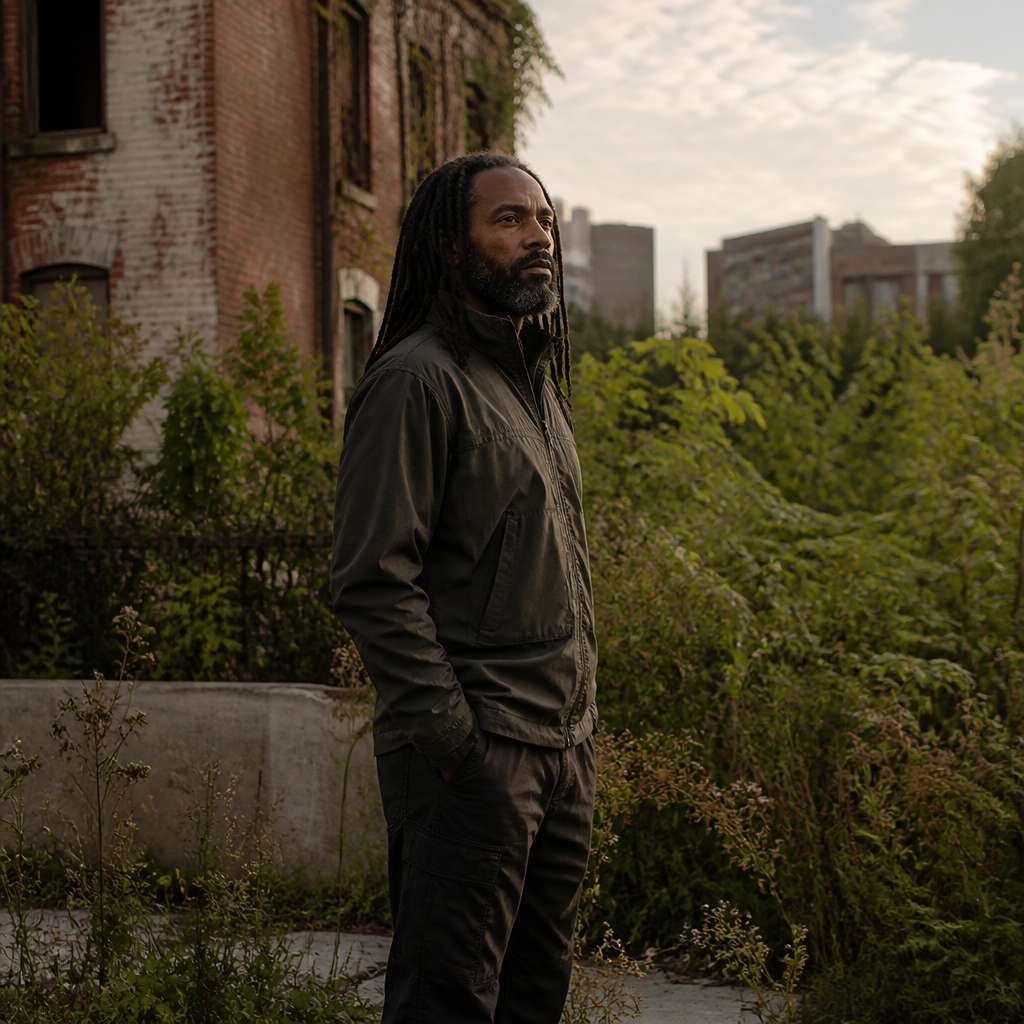
The Critique of Institutional Racism
The Teachings of John Africa: Life, System, and Resistance
The Seed of Resistance: Who Was John Africa?
The Core Dichotomy: 'Life' vs. 'The System'
The Guidelines: The Written Blueprint
Radical Equality: Species and Hierarchy
The Name Africa: Identity and Unity
Natural Discipline: The MOVE Lifestyle
Education and the Un-Learning Process
The Rejection of Modern Medicine
The Critique of Institutional Racism
Anti-Capitalism and Shared Resources
Animal Liberation: Kinship Beyond Human Limits
The Power of the Collective Voice
The Technology Trap
State Conflict: 1978 and 1985
The Philosophy of Resistance
Absolutism and the Risks of Belief
Anarcho-Primitivism and Global Context
The Legacy of 'Life' Today

Transcript
SPEAKER_1: Last lecture we sat with something uncomfortable — that MOVE's rejection of medicine carried real risk, especially for children. And now I want to push into something equally charged: how MOVE connected all of that philosophy to race. To the repeated confrontations over housing, public order, and enforcement in Philadelphia. SPEAKER_2: Right — and the key idea here is that MOVE didn't treat racism as a separate issue. John Africa's teachings framed racism as structural. Embedded in law enforcement, courts, schools, prisons. Not individual prejudice. The whole architecture. SPEAKER_1: So not 'bad cops' as individuals. The institution itself. SPEAKER_2: Exactly. MOVE argued that what society called legality could still be morally wrong if it upheld racism or violence. That was central to the group's anti-system critique. The law's claim to order didn't make it just. And in 1970s Philadelphia, that argument had a very specific face attached to it. SPEAKER_1: Frank Rizzo. SPEAKER_2: Frank Rizzo. He built his political identity on aggressive policing — particularly in Black neighborhoods. In MOVE's critique, that kind of policing wasn't an aberration. He was the System made visible. The confrontations with MOVE escalated steadily through his tenure. SPEAKER_1: And those confrontations came to a head in 1978. SPEAKER_2: August 8, 1978. Police moved on MOVE's Powelton Village compound, leading to a violent clash. The circumstances of the officer's death remain disputed, yet nine MOVE members were convicted and sentenced to thirty to one hundred years, becoming known as the MOVE 9. SPEAKER_1: Thirty to one hundred years. For a conviction where the circumstances of the shooting were disputed. SPEAKER_2: [inhale] And scholars who've examined the case argue that reflects exactly the double standard MOVE was naming. Police violence against Black residents was treated differently from violations attributed to MOVE. That asymmetry — that's what MOVE's critique was built around. The 1978 confrontation became a central example in later scholarship on institutional racism in the city. SPEAKER_1: Now, MOVE was predominantly Black. So someone listening might assume this was essentially a Black nationalist movement — one defined by race alone. But that's not quite right, is it? SPEAKER_2: That's the counterintuitive part. MOVE's membership was predominantly Black, and its critique centered racial oppression. But John Africa explicitly rejected racial separatism. The framework was Life versus the System — and the System harmed everyone, regardless of race. Think of it this way: MOVE also linked racism to animal cruelty, environmental destruction, capitalism, war. Race was one expression of a single dominating force, not the organizing category on its own. SPEAKER_1: So not Black nationalism. Something stranger and broader simultaneously. SPEAKER_2: Scholars describe it as both political and religious — which helps explain why the critique of racism was also a sacred critique. Resistance to racist institutions wasn't just politics for MOVE. It was a moral and spiritual obligation. The sanctity of Life placed above state authority. SPEAKER_1: Mm. And the prison critique fits directly into that. SPEAKER_2: Directly. MOVE's anti-prison stance wasn't just advocacy for the MOVE 9, though that was constant. It was a structural argument — prisons as an institution of racial domination, part of the same interlocking system as schools, courts, and police. That argument overlaps with what scholars now call the prison-industrial complex critique, though MOVE arrived there through a religious naturalist framework rather than a political-economic one. SPEAKER_1: But the group's radical image also made it easier for authorities to portray repression as justified. That's a real tension. SPEAKER_2: [short pause] It is. The 1985 bombing exemplifies how MOVE's radical image was used to justify state violence. Public sympathy often focused more on the tragic loss of children than on the broader structural violence at play. The group's radical image made it easier to frame repression as justified, even when eleven people died and a neighborhood burned. SPEAKER_1: The takeaway for everyone following this course — the group's critique of racism was structural, not just about individual prejudice. But its radicalism also became the mechanism by which the state neutralized public outrage. SPEAKER_2: That's the lasting lesson the Philadelphia case offers. MOVE named real mechanisms — policing, courts, prisons as interlocking racial domination. Scholars still use the 1985 bombing as a case study in how urban governance, racial hierarchy, and policing converge in violent outcomes. The critique had weight. And the state's response confirmed much of what the critique claimed.