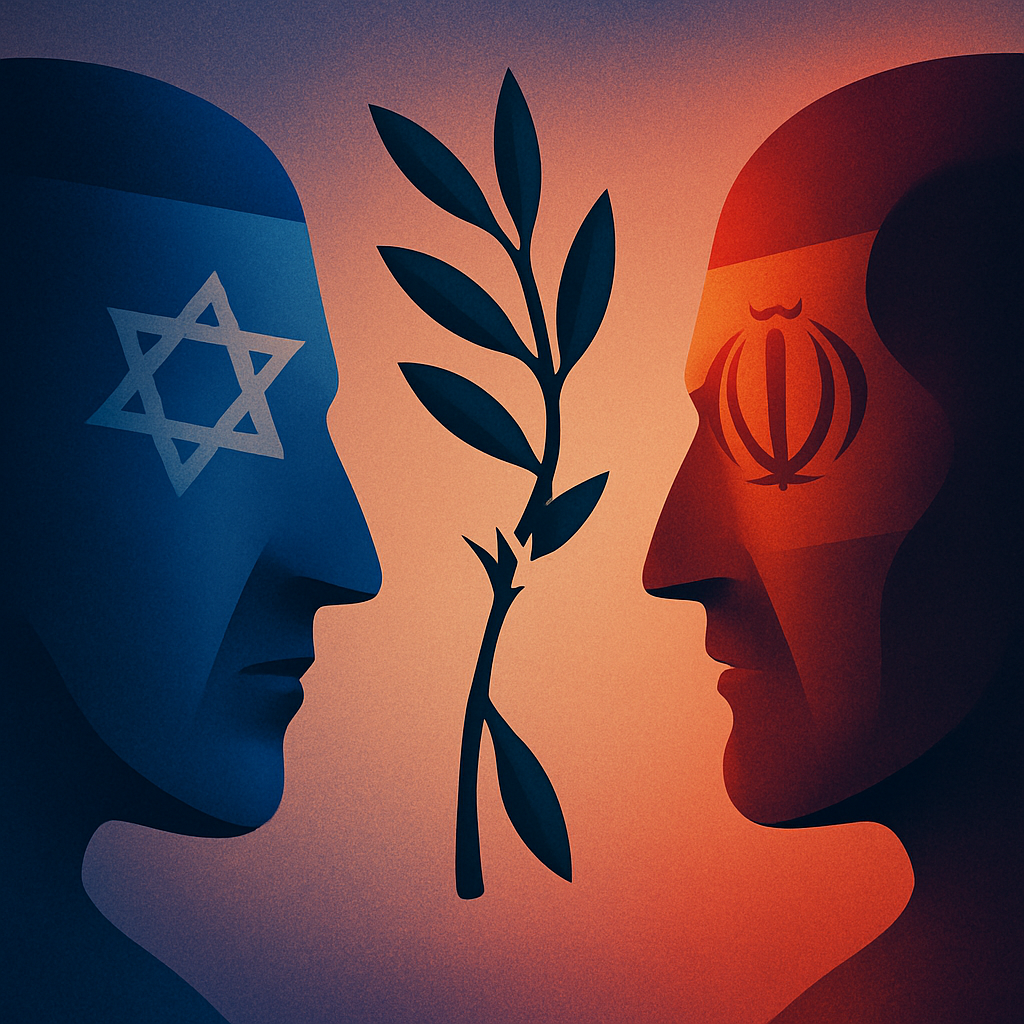
Out of the Shadows: The Great Regional Rivalry
The Axis of Resistance: Beyond the Proxies
Iron Dome vs. Hypersonic Hope: The Arms Race
The Nuclear Threshold: Red Lines and Deadlines
The Invisible Front: Cyber Warfare and Intelligence
Global Shockwaves: Oil, Trade, and Superpowers
Domestic Pressures: The Home Fronts
The Road Ahead: Escalation or New Equilibrium?

Transcript
SPEAKER_1: Alright, so last time we established that domestic pressure — protests under missile alerts, suspended battalions, a judiciary limiting emergency powers — is actively shaping military timing on both sides. And now we're at week six. The Times of Israel confirmed it: six weeks in, no end in sight. So where does this actually go? SPEAKER_2: That's the right question to end the series on. And the honest answer is: strategists have mapped three distinct futures for this conflict, and right now all three are simultaneously plausible, which is itself a sign of how unstable the situation is. SPEAKER_1: Walk everyone through those three scenarios. SPEAKER_2: The first is a negotiated pause — not peace, a pause. The 45-day ceasefire framework that Axios confirmed is still technically on the table, though the Wall Street Journal called US-Iran negotiations a dead end as of April 5th. The second is what analysts call a 'new normal' — periodic strikes, degraded but ongoing, neither side able to finish the other. The third is uncontrolled escalation into a full regional war pulling in the US directly. SPEAKER_1: So why would a 'new normal' of periodic strikes actually be more sustainable than full-scale war? That sounds almost counterintuitive. SPEAKER_2: It's counterintuitive but strategically coherent. Full-scale war requires sustained logistics, political will, and economic tolerance that neither side can maintain indefinitely. Iran still has over a thousand missiles left — Deutsche Welle confirmed that — but its industrial base is burning. The IDF struck Iran's largest petrochemical plant on April 6th, causing fires. Three Tehran airports, including Mehrabad, were hit the same day, destroying dozens of fighter jets. Iran is degraded but not broken. A 'new normal' lets both sides claim deterrence without triggering the catastrophic endgame. SPEAKER_1: And yet Trump's rhetoric doesn't sound like someone settling for a new normal. He said Iran could be 'taken out in one night, and that might be tomorrow night.' He's threatened Power Plant Day and Bridge Day on Tuesday, April 8th. Reuters confirmed he has thousands of ground troops ready for a Strait of Hormuz operation. SPEAKER_2: Right, and that's where the third scenario becomes genuinely frightening. The key factors that could trigger uncontrollable regional war are: a miscalculation near a nuclear facility — the IAEA warned a recent strike landed 75 meters from Bushehr, a radiological event would collapse all diplomatic frameworks instantly — or US ground forces entering the Strait, which transforms this from an air campaign into a direct US-Iran war. SPEAKER_1: On the nuclear dimension — Iran fired Fattah hypersonic missiles again in what's being called Operation True Promise 4. And AP News confirmed a fourth casualty in Haifa from a building collapse caused by Iranian attacks on April 6th. An elderly couple, their son. AFP confirmed it. So the human cost is still climbing even as we're talking about strategic scenarios. SPEAKER_2: That's the tension that gets lost in the scenario analysis. Four dead in Haifa. Fifty-six injured across Israel in 24 hours. And Iron Dome is proving ineffective against the Fattah — we covered that last lecture. Home Front Command extended siren warning windows to 15 to 30 seconds across 22 Golan Heights locations. That's not a defense posture. That's a managed retreat from the idea of full protection. SPEAKER_1: Let's delve into the strategic implications of potential miscalculations, particularly near nuclear facilities, and the role of international diplomacy in preventing escalation. SPEAKER_2: Exhaustion is historically the most reliable path to negotiation, but it cuts unevenly here. Israel killed IRGC intelligence chief Majid Khademi on April 6th — Time magazine confirmed it. But an Iranian analyst noted the same day that his killing may not weaken regime suppression. And BBC intelligence assessments say the Iranian regime is actually stable, with the IRGC gaining more internal control as external pressure mounts. Regimes under siege often consolidate, not collapse. SPEAKER_1: That's a striking inversion. So the strikes meant to degrade Iran's leadership are potentially strengthening the IRGC's grip internally? SPEAKER_2: Exactly. Iran's negotiating posture reflects its strategic confidence. Tehran's rejection of ceasefire proposals on April 6th underscores its focus on military strategy over economic leverage, highlighting the potential for miscalculations to escalate the conflict. SPEAKER_1: Some analysts argue this is heading toward a transformative clash — not just a bilateral conflict but a restructuring of the entire regional order. How seriously should that framing be taken? SPEAKER_2: Seriously, but carefully. The Asia Times framed this as the end of the unipolar moment — the US as sole guarantor of regional stability is visibly strained. The UNDP flagged that escalation has already reversed more than a year of economic growth across Arab states. If the Strait stays closed and US ground forces enter, you're not looking at an Israel-Iran war anymore. You're looking at a systemic rupture. SPEAKER_1: So for Artin and everyone who's followed this entire series — what's the single thing they should carry forward from today? SPEAKER_2: This: the future of this conflict hinges on whether a new deterrence equilibrium can be established before the cycle of retaliation becomes self-sustaining. Both sides have demonstrated they can absorb enormous punishment. Neither has demonstrated they can deliver a decisive blow. That gap — between the ability to hurt and the inability to finish — is where wars either freeze into cold standoffs or spiral into catastrophes. The next 48 hours, with Trump's Tuesday deadline and Iran's rejection of every ceasefire on the table, will tell our listener which direction this is heading.