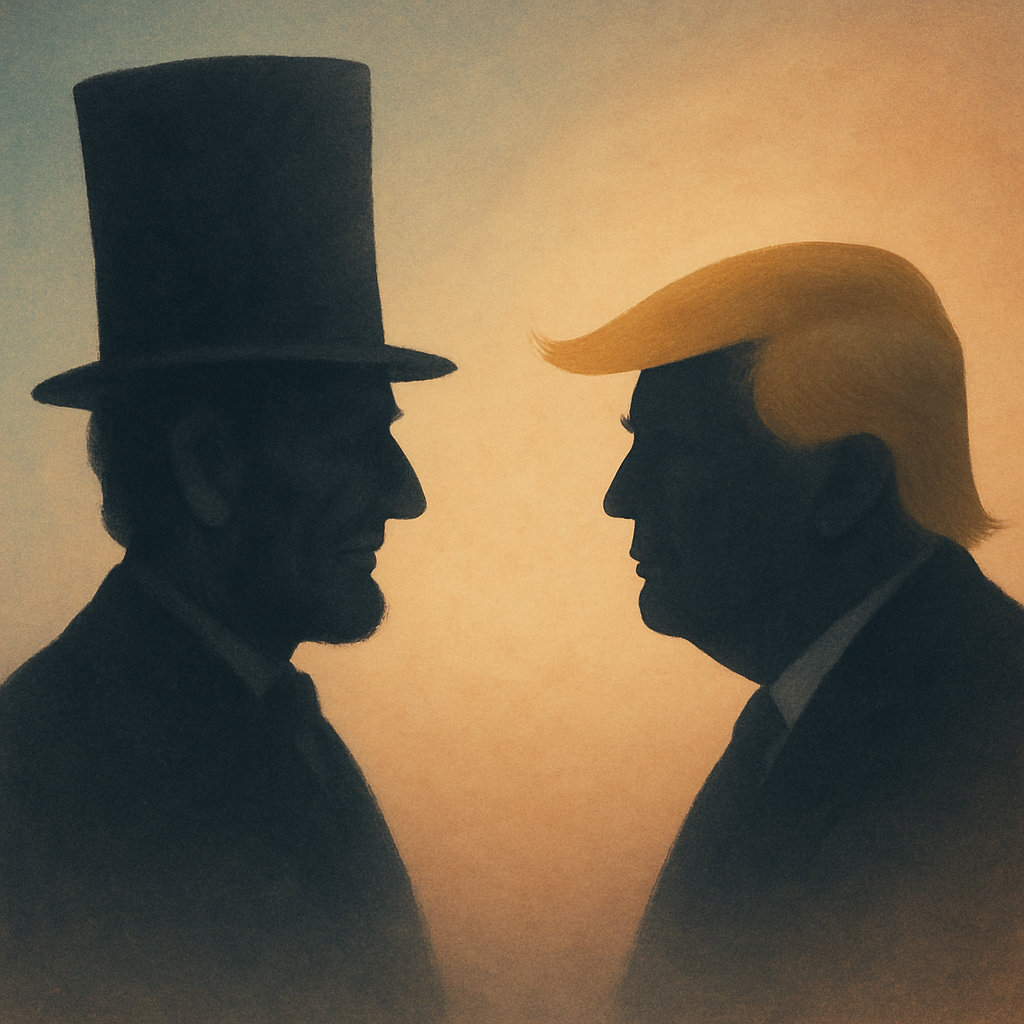
The First Question of Rule: Power, Consent, and the Common Good
Ruling a Nation: Lincoln and Trump in Dialogue

Transcript
SPEAKER_1: So here's the question — what actually makes a ruler legitimate? Not popular, not powerful. Legitimate. SPEAKER_2: That's the right place to start. Because those three things — popularity, power, and legitimacy — get collapsed together constantly, and they're not the same thing at all. SPEAKER_1: So walk me through the distinction. Why can't a ruler just point to strength or a winning election and call it done? SPEAKER_2: Because legitimacy has two layers. There's the normative question — whether power ought to be obeyed — and the empirical one — whether people actually accept the authority as rightful. Winning an election touches the second layer. It doesn't automatically satisfy the first. SPEAKER_1: And that's where the philosophers come in. Aristotle and Locke are the two anchors here, and they pull in different directions. SPEAKER_2: They do. Aristotle's anchor is the common good — the idea that a just regime aims at conditions that allow all citizens to flourish, not just the rulers or a favored faction. Locke's anchor is consent. Legitimate government protects natural rights to life, liberty, and property, and it loses that legitimacy the moment it systematically violates them. SPEAKER_1: So Aristotle asks what the government is for, and Locke asks who authorized it. Those are genuinely different questions. SPEAKER_2: Exactly. And the tension between them is real. Think of a ruler who has full popular consent but uses it to crush a minority. Locke's consent is satisfied. Aristotle's common good is not. SPEAKER_1: Now, where does Lincoln fit into this? Because his framing of 'government of the people, by the people, for the people' sounds like it's trying to hold both ideas at once. SPEAKER_2: That's precisely what it does. The 'by the people' is Lockean consent. The 'for the people' is Aristotelian common good. Lincoln was deliberate about that fusion. His political rhetoric was plainspoken but philosophically layered — designed to appeal to constitutional ideals of union and liberty simultaneously. SPEAKER_1: And his 'house divided' argument is a good example of that moral framing in action, right? SPEAKER_2: A strong one. He argued that a nation cannot endure permanently half slave and half free — not just as a political prediction, but as a moral claim. The nation's survival was tied to resolving a fundamental contradiction. That's the common good operating as a constitutional obligation, not just a preference. SPEAKER_1: Now contrast that with Trump's framework. Because the vocabulary is completely different — strength, winning, deal-making, America First. SPEAKER_2: Right, and that vocabulary isn't random. Studies of Trump's communication style show that repetition, superlatives, and direct address to audiences function as a form of populist performance — reinforcing an image of personal strength and authenticity. The key idea is that leadership is demonstrated, not argued. SPEAKER_1: So where Locke and Aristotle ask 'what justifies power,' that framework asks 'what projects power.' Those are almost opposite starting points. SPEAKER_2: And that maps onto what Max Weber called charismatic authority — the belief in a leader's exceptional personal qualities that mobilizes followers beyond ordinary institutional routines. Both Lincoln and Trump drew on this, but toward very different ends. Lincoln used it to reinforce constitutional constraints. The populist version can strain them. SPEAKER_1: There's also a difference in how each invokes 'the people.' That phrase does a lot of work. SPEAKER_2: A critical difference. Lincoln tied 'the people' to constitutional equality and union. Modern populist rhetoric often deploys it to separate a so-called real people from elites or perceived enemies. Same phrase, radically different political logic. SPEAKER_1: So what does this mean for someone trying to understand legitimate rule? What's the actual test a ruler has to pass? SPEAKER_2: Research suggests citizens judge legitimacy by more than outcomes: perceived fairness, procedural integrity, and whether a leader appears to act for the common good rather than narrow self-interest. The takeaway is this: a ruler must persuade people that power serves something higher than the ruler himself. Popularity and force can both fail that test. SPEAKER_1: And that's the unresolved tension that makes this dialogue worth having. Lincoln and Trump aren't just two styles — they represent two genuinely different answers to the first question of rule. SPEAKER_2: Exactly. And for everyone listening, that first question — what makes authority legitimate — is the thread that runs through everything else we'll examine in this course. Consent, common good, constitutional constraint, and the performance of strength. The challenge is understanding how they interact.