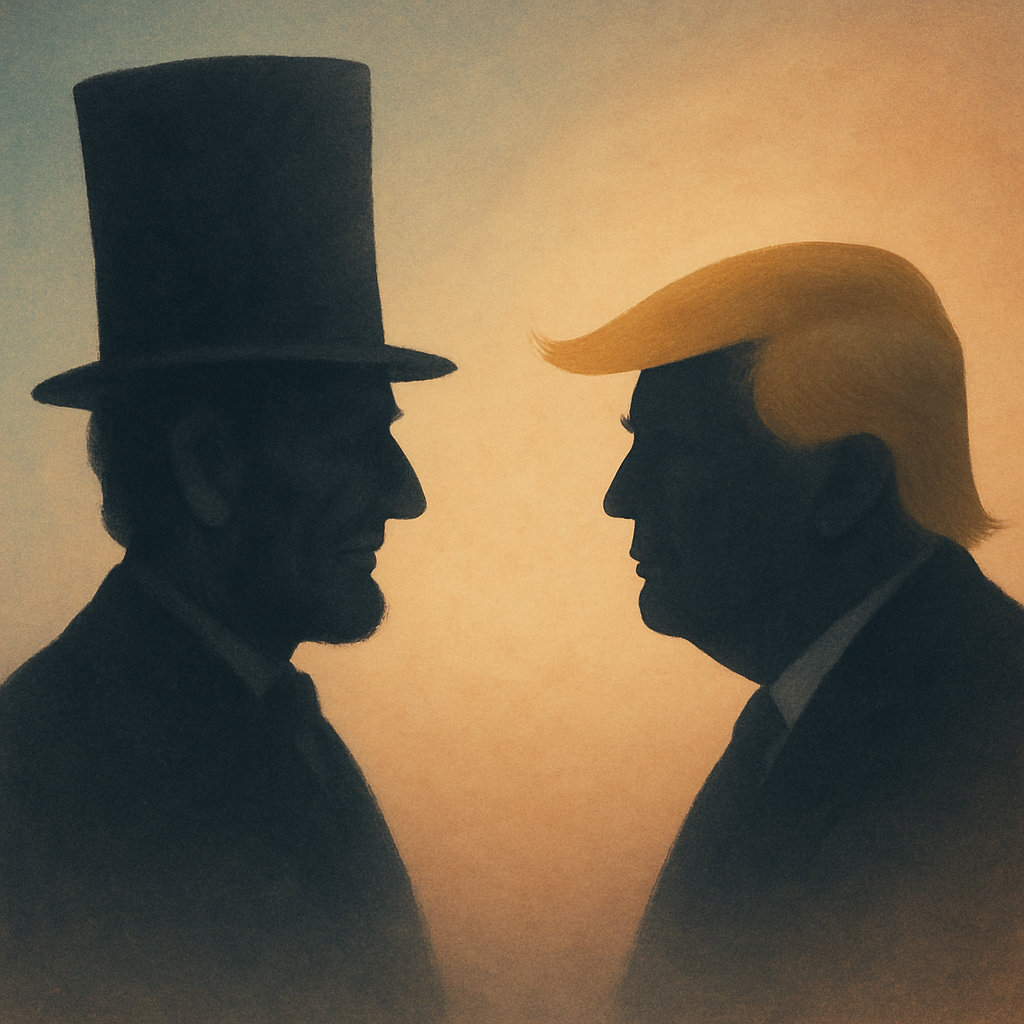
The Voice of Authority: Persuasion, Sacrifice, and the Burden of Consequences
Ruling a Nation: Lincoln and Trump in Dialogue

Transcript
SPEAKER_1: strength without legal grounding loses legitimacy over time. Now I want to push into the voice itself — how a leader actually persuades. SPEAKER_2: Weber's distinction between the ethic of conviction and the ethic of responsibility is crucial for understanding leadership. They sound compatible, but Weber argued they create a genuine tension at the heart of leadership. SPEAKER_1: Walk through the distinction. What does Weber actually mean? SPEAKER_2: act on your principles, full stop — consequences are not your burden. The ethic of responsibility says: you own the consequences, so principles must be weighed against outcomes. A leader who holds only conviction can cause enormous damage while feeling morally clean. SPEAKER_1: So the challenge isn't choosing one over the other — it's holding both simultaneously. SPEAKER_2: Exactly. Think of the Thirteenth Amendment. Lincoln held the conviction that slavery was wrong. But he pressed Congress for a constitutional amendment rather than relying solely on the Emancipation Proclamation — because a wartime executive order could be reversed. Conviction shaped the goal; responsibility shaped the method. SPEAKER_1: And his 1862 letter to Horace Greeley is the clearest statement of that responsibility logic — preserving the Union as the paramount objective, not personal moral satisfaction. SPEAKER_2: Historians point to that letter as evidence that Lincoln consistently framed the Civil War as a struggle to save the constitutional republic, not to advance personal power. He subordinated his own moral preferences to the institutional outcome he believed was necessary. That's the ethic of responsibility at full weight. SPEAKER_1: Now contrast that with Trump's rhetoric. The vocabulary of conviction is everywhere — 'America First,' winning, strength. But the relationship to consequences seems different. SPEAKER_2: Communication scholars who've studied Trump's rallies document a clear pattern: short, repetitive phrases, superlatives, direct address to the crowd. The persuasive strategy aims at emotional resonance and branding rather than formal argument. And analysts note his improvisational style actually reinforced a perception of authenticity among core supporters. SPEAKER_1: So does that style carry a Weberian ethic at all? That's what someone following this course might be wondering. SPEAKER_2: Trump's framing of leadership in terms of winning and leverage — drawn from his business background — maps onto a present-tense politics. The goal is the visible outcome now: the deal closed, the crowd energized. Weber's ethic of responsibility asks a leader to project consequences forward, sometimes accepting short-term unpopularity for long-term institutional health. SPEAKER_1: And Lincoln actually did accept serious unpopularity — even within his own party. SPEAKER_2: Historians emphasize this repeatedly. That's a long time-horizon for political responsibility. The sacrifice wasn't rhetorical; it was structural. He constrained his own power to preserve the system that made power legitimate. SPEAKER_1: Now, let's explore how Lincoln and Trump navigated these ethics in their decision-making processes. SPEAKER_2: Lincoln's decision-making was guided by a balance of conviction and responsibility, as seen in his approach to the Thirteenth Amendment. Literary scholars describe the Second Inaugural as unusually theologically dense for a political speech, framing the war as divine judgment and tempering triumphalism even at the edge of Union victory. SPEAKER_1: And in private or semi-public settings he was completely different — frontier humor, anecdotes, plainspoken storytelling. SPEAKER_2: That flexibility was strategic. Scholars note he also used deliberate ambiguity early in the war — carefully calibrated language about slavery and Union aims — to hold a fragile political coalition together. Conviction and responsibility working simultaneously through language itself. SPEAKER_1: Trump's decision-making often emphasized conviction, focusing on immediate outcomes and public perception. Rhetorical analysts have documented that pattern specifically. SPEAKER_2: And his reality television background reinforced it — dramatic moments, conflict, constant media visibility as tools for maintaining political authority. Communication research shows both leaders blend appeals to shared values with strong narrative frames. But Lincoln's values pointed toward shared sacrifice and constitutional durability. Trump's pointed toward personal strength and movement identity. SPEAKER_1: So Weber's framework gives us the clearest lens. Performance without responsibility becomes vanity. Principle without judgment becomes disaster. SPEAKER_2: That's the key idea for everyone following this course. Lincoln's rhetoric carried the weight of consequences — sacrifice, legal constraint, long time-horizons. Trump's rhetoric carried the weight of conviction — strength, authenticity, present-tense urgency. What makes authority durable is whether the voice persuades people that the leader is bearing real costs for something larger than themselves.