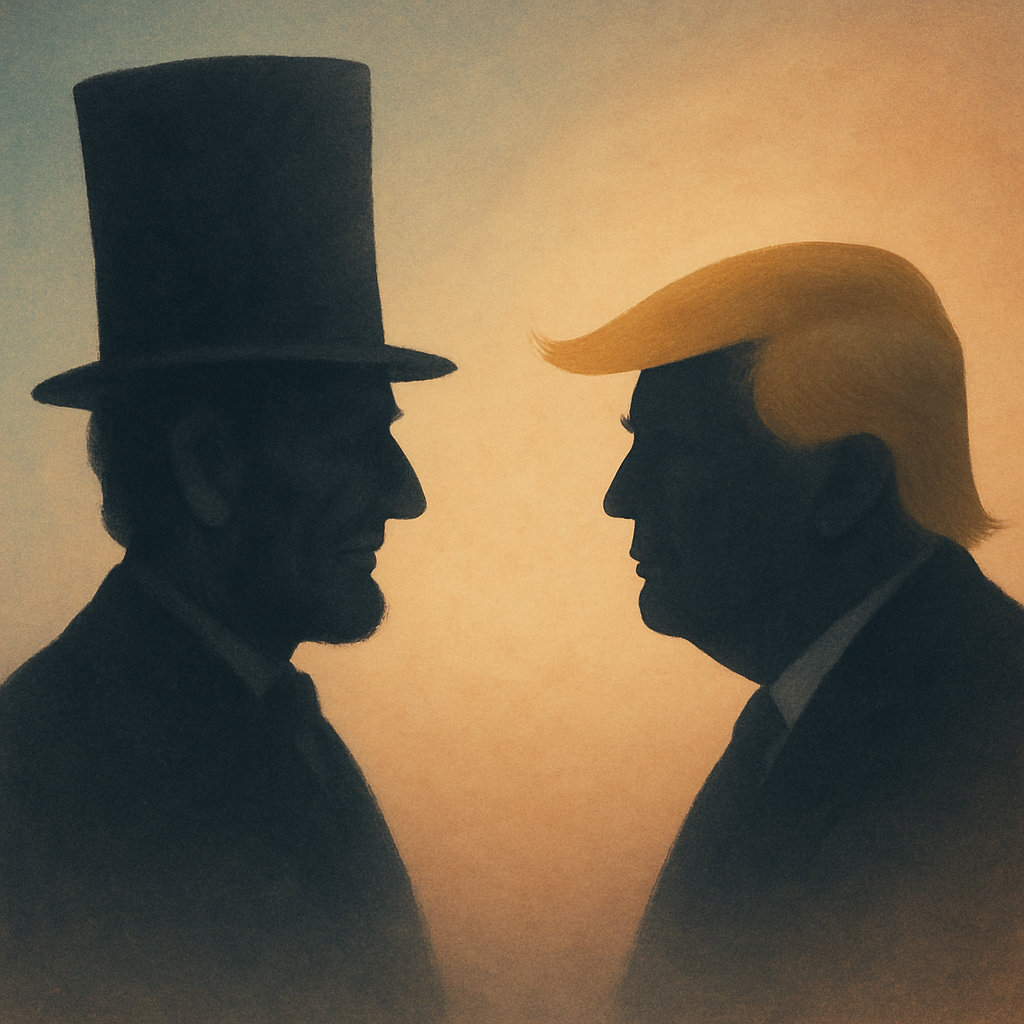
Strength Versus Law: A Dialogue on How to Govern a Divided Nation
Ruling a Nation: Lincoln and Trump in Dialogue

Transcript
SPEAKER_1: legitimacy requires persuading people that power serves something higher than the ruler himself. Now I want to push that further — what happens when the nation is actually breaking apart? SPEAKER_2: That's exactly when the gap between rule of law and rule by strength stops being theoretical. It becomes a governing crisis. And that's where Machiavelli becomes unavoidable. SPEAKER_1: So put Machiavelli on the table. Because his argument isn't simply 'be brutal,' is it? SPEAKER_2: Much more precise than that. The core claim is that a ruler must combine force and law — lion and fox together. Fear, used correctly, is more reliable than love. And appearances matter as much as reality. A leader who seems strong can hold a fractured state together even when underlying conditions are terrible. SPEAKER_1: Trump's public persona maps onto that framework. Think of how he consistently uses words like 'strong,' 'tough,' 'winners' — and frames compromise as weakness unless it produces a visible win. SPEAKER_2: Right, and his 2017 National Security Strategy made that explicit at the policy level — national sovereignty, economic strength, and military power as core governing tools. His branding background reinforced it: public office became partly a stage where projecting success was itself a governing instrument. SPEAKER_1: So where does Lincoln sit in contrast? Because Lincoln also used coercive strength — total war, massive armies. He wasn't a pacifist. SPEAKER_2: No, and the key idea is that Lincoln's argument wasn't 'avoid force.' It was 'force must be justified within a legal framework.' For example, when he ordered blockades and called up the militia in 1861 — before Congress had even convened — he still framed those actions as necessary to preserve the constitutional structure of the Union, not as expressions of personal will. SPEAKER_1: The Emancipation Proclamation is the clearest case of that logic. Morally, Lincoln clearly believed slavery was wrong — but he issued it as a war measure under his Commander in Chief powers. SPEAKER_2: Exactly. Even a morally driven action had to be anchored in a recognizable legal basis. He wasn't willing to let moral urgency override the constitutional architecture — because that architecture was what made the moral outcome durable. SPEAKER_1: What about habeas corpus? Suspending it looks like a strongman move on the surface. SPEAKER_2: It does — and that's where things get genuinely complicated. Lincoln suspended the writ, but Congress later addressed it through the Habeas Corpus Suspension Act of 1863. So even his most aggressive use of executive power was eventually brought back under statutory grounding. He stretched the law; he didn't simply discard it. SPEAKER_1: Now here's the counterintuitive piece. Why would a strong leader — someone with military force at their disposal — still choose to bind themselves to law? SPEAKER_2: Because legitimacy is what makes strength sustainable. Lincoln said it plainly in an 1864 letter: he did not control events — events controlled him. A leader governing through personal will alone has no institutional anchor when things go wrong. That's why he allowed the 1864 election to proceed even when he believed he might lose — military strength could have justified postponement, but it would have destroyed the very thing he was fighting to preserve. SPEAKER_1: And Lincoln had warned about this exact danger decades earlier — in the 1838 Lyceum Address. Reverence for the laws must become the political religion of the nation. SPEAKER_2: Some scholars have connected that warning to broader worries about charismatic, norm-breaking leaders in any era. Lincoln was diagnosing a democratic vulnerability: the same charisma that builds popular support can, in different hands, erode the institutions that make popular support meaningful. SPEAKER_1: So for someone listening to this — say, someone trying to understand why these two leadership styles feel so fundamentally different — the takeaway isn't just stylistic. SPEAKER_2: Not at all. Lincoln's 1865 Second Inaugural emphasized humility, shared guilt, and reconciliation — the call to act 'with malice toward none, with charity for all.' Some scholars read that as moral strength, not macho or purely coercive strength. Trump's rhetoric, by contrast, often equates national success with his own personal success and brand. Same word — strength — but pointing in completely opposite directions. A ruler who governs through law accepts constraints on personal power. A ruler who governs through projected strength gains flexibility but risks losing the institutional legitimacy that makes authority last.