A second collection of aphorisms sharpens the experimental style of Human, All Too Human. Brief observations take the place of a continuous philosophical system.
“A good aphorism is too hard for the tooth of time”
Assorted Opinions and Maxims is a set of 408 aphorisms that Nietzsche published in 1879 as a supplement to Human, All Too Human, and later made the first part of its second volume. Written in the free-spirit years, it tests common opinions about truth, morality, religion, art, friendship and politics by asking what motives, habits and histories lie behind them.
The aphorisms loosely follow the topics of the earlier book, moving from metaphysics and moral feeling to art, culture, society and the solitary thinker. Along the way Nietzsche argues that art should first embellish life, that Wagner’s music belongs to a passing age, and that a thinker grows through conversation with a few great minds of the past.
The intellectual conscience grows from pride and habit, yet that humble origin does not discredit the love of truth.
2
Vanity behind virtue
Pity, sympathy and moral indignation often conceal vanity and envy, which grow stronger every time they are wounded.
3
Art embellishes life
Art’s first task is to make people bearable to one another, and works of art are only the overflow of that power.
4
Possession possesses
Property, parties and national pride free people only up to a point, and then they quietly make them servants.
5
Conversing with the dead
A thinker comes to terms with a few great predecessors, such as Montaigne and Spinoza, rather than following a single master.
Summary by chapter
Assorted Opinions and Maxims in 9 chapters, in our own words.
Chapter 1
Philosophy Without Illusions (§1–33)
Assorted Opinions and Maxims has no chapters of its own. Its 408 numbered aphorisms run without headings, but the topics loosely follow the order Nietzsche had used in Human, All Too Human the year before: first things and knowledge, then morality, religion, art, culture, society, the sexes, the state, and finally the individual alone. The opening stretch is about what remains of philosophy once its old comforts have gone. The very first aphorism speaks to readers who once believed in the highest value of life and now feel disillusioned, and asks whether they must therefore get rid of life at the lowest possible price. Nietzsche’s answer, implied throughout, is no. Losing a metaphysical faith is a reason to look more closely, not a reason to despair.
“
The belief in truth begins with the doubt of all truths in which one has previously believed.
Friedrich Nietzsche
Much of this section is a quarrel with metaphysicians and with Schopenhauer in particular. In §5 Nietzsche accuses philosophers of a hereditary sin: they take the rough rules of thumb of moralists and inflate them into necessary truths. Schopenhauer’s supremacy of the will over the intellect, his doctrine of unchangeable character and his view of pleasure as merely negative all came, Nietzsche says, from popular wisdom dressed up as a system. Worse, the word “will” became a poetic metaphor applied to all of nature, until fashionable thinkers could say that everything is One Will. Nietzsche compares this to trying to have the stupid Devil for one’s God. In §9 he gives the same treatment to the phrase “natural law,” which smuggles either moral obedience or a divine watchmaker into a description of what simply happens.
The psychology of knowing gets equal attention. In §7 Nietzsche notices that people are delighted to hear that they can speak only of probability, never of truth, and he suspects that most of them hate truth for its definiteness. The long §26 describes how a thinker treats ideas like persons: he fights a defiant new thought by attaching a “perhaps,” nurses a weak one until it grows strong, crowns a convincing one as a prince and later deposes it. From this private drama of pride and shame, he argues, grows the “intellectual conscience,” something of the highest moral kind that has bloomed from a black root. The search for truth, in other words, has all-too-human origins and is not thereby discredited.
The section ends with §33, one of the longest and most important entries. Schopenhauer once wrote that insight into the strict necessity of human actions separates philosophical minds from the rest, yet he still insisted that the world must have an ethical meaning. Nietzsche says the two cannot be held together. If no one is free and responsible in the old sense, then the urge to find a culprit, whether the individual, history or God, must go too. He describes, with some horror, the Christian move of making God the sinner and man the redeemer. His conclusion is that the philosopher, like Christ, should say “Judge not.” Philosophical minds wish to be just; the others wish to be judges.
Chapter 2
The Psychology of Moral Feeling (§34–92)
The second group of aphorisms turns from metaphysics to the moral emotions, in the manner of the French moralists La Rochefoucauld and Chamfort whom Nietzsche admired. Vanity is the recurring suspect. In §46 he calls it the human “thing in itself,” the most vulnerable and yet most unconquerable of things, which grows stronger every time it is wounded. In §38 he notes that the man who denies his own vanity usually has it in so brutal a form that he shuts his eyes to avoid seeing it. In §50 he observes that the strongest piece of knowledge, the complete unfreedom of the human will, has always had the mightiest opponent in human vanity, which is why it has produced so few results.
“
Good conscience has bad conscience for its stepping-stone, not for its opposite.
Friedrich Nietzsche
Pity and sympathy receive a skeptical reading. Sympathy, §68 says, comes with a peculiar impudence: wanting to help at all costs, it never doubts its diagnosis and keeps administering its quack medicines. In §377 he will add that the dagger of envy is sometimes hidden in the gilded sheath of pity. Against this Nietzsche sets a rarer capacity. The snake that stings us can picture our pain, he writes in §62, but to picture the joy of others and rejoice in it is the privilege of the highest animals, a rare “human thing.” His definition of love in §75 points the same way: love means understanding and rejoicing that another person lives and feels in a way different from and even opposite to our own.
Several entries ask where morality comes from and whom it serves. In §89 Nietzsche traces it to two ideas: the community is worth more than the individual, and the lasting interest is to be preferred to the passing one. From these follows the sacrifice of the individual to the permanent interest of the group. But this way of thinking, he points out, is held by those who are not the victims. The philosophy of the sacrificed person, who might claim that one individual or one moment in paradise is worth more than a tame succession of comfortable days, always finds its voice too late.
The most hopeful aphorism in the section is §90. People assume that good things have always had a good conscience, but science, which is certainly good, came into the world like a smuggler, by roundabout ways and with a masked face. Everything good was once new, strange and therefore immoral, and gnawed like a worm at the heart of its discoverer. The bad conscience, on this view, is a stage on the way to the good one. Shorter maxims scattered through the section make the same point at a smaller scale: §78 says that all complaint is accusation, and §77 that not joy but joylessness is the mother of debauchery.
Chapter 3
Christianity and Its Future (§93–98)
A short run of aphorisms takes up religion, the subject that had filled a whole chapter of Human, All Too Human. Nietzsche writes here as a historian and psychologist of belief rather than as the open polemicist of his later books. In §95 he calls love Christianity’s finest artistic conception, the word that made it the “lyric religion.” Even the coldest heart and the meanest intelligence feel some glimmer of its meaning, and people who missed love from parents, children or sweethearts found what they longed for in it. In §96 he describes an Epicurean strand in Christianity: if one sincerely believes one loves one’s enemies, that belief alone gives real happiness, so that error can make Christ’s promise come true.
“
If Christ really intended to redeem the world, may he not be said to have failed?
Friedrich Nietzsche
His forecast for the faith in §97 is economic as much as spiritual. Protestantism spread quickly in the North because it promised to do more cheaply what the old Church had done, without costly masses and pilgrimages. Where Christianity broke with an older paganism it became more thoughtful and, in times of danger, more fanatical; where the senses had gone over to it, as in the South, it would bend but not break. The senses, he adds slyly, plead against a dechristianised world because there would be too much work in it and too little leisure. They prefer to let God do the work.
The long §98 is a frank piece of self-examination by an unbeliever. Nietzsche admits that free spirits defending themselves against believers adopt a certain theatricality, presenting science as a religion of self-denial. Between themselves they should be more honest: if knowledge brought no pleasure and no use, who would care for it? To a purely knowing being, he writes, knowledge would be indifferent. He then turns to the believers and tells them that their faces have done more harm to their faith than any argument. If the glad tidings were written in their faces, they would not need to insist so stiffly on the authority of the Bible. The section closes on a question about two thousand years of history: whether Christ, if he meant to redeem the world, has failed.
Elsewhere in the book Nietzsche returns to the theme from a historical angle. In §224 he calls Christianity the religion of antiquity grown old, a balm for exhausted cultures, and he imagines how Juvenal’s Rome must have looked to the silent early Christians. He even says one can be grateful that they stifled the Greco-Roman Empire. This historical respect, mixed with a firm denial of the faith’s truth, is typical of the free-spirit books, and it marks a real difference from the fury of The Antichrist a decade later. In §225 he imagines a Christian on forbidden paths of thought asking whether God and the Lamb need to exist at all, if faith in them alone produces the same effects.
Chapter 4
The Poet as Guide to the Future (§99–126 and §169–178)
Art is the largest single subject of the book, and Nietzsche approaches it as someone recovering from his own youthful devotion to Wagner. In §99 he asks that the surplus poetic force of modern humanity be spent neither on depicting the present nor on reviving the past but on pointing the way to the future. The poet should do what earlier poets did for the gods: portray fair images of human beings, showing where a great and noble soul is still possible in modern conditions. Such poetry would be calm, free of the old shattering tragedy and mocking comedy, with science and art welded into a new unity. Many roads to it start from Goethe, he says, but modern poets lack the strength and mistake mere intemperance for power.
“
Art is above all and first of all meant to embellish life, to make us ourselves endurable and if possible agreeable in the eyes of others.
Friedrich Nietzsche
The most striking idea about art comes in §174. Art, Nietzsche says, is first of all meant to embellish life: to make us bearable to one another, to create manners, decency and well-timed speech and silence, and to conceal or transfigure what is ugly and painful in human nature. Works of art, the paintings and operas in museums and theaters, are only a by-product of this larger task, the overflow of people who have more power of transfiguration than daily life can use. Modern culture gets this backwards, beginning with works of art and hoping they will improve life. He compares it to starting dinner with dessert and ruining one’s appetite for the nourishing meal.
History sharpens his sense that art is always tied to its time. In §171 he argues that music is the last plant to grow in any culture, coming up in its autumn. The Flemish masters gave voice to the Gothic Middle Ages, Handel to the spirit of Luther, Mozart to the age of Louis XIV and Racine, Beethoven and Rossini to the eighteenth century. Music is not a universal language; Palestrina would be unintelligible to a Greek. Wagner’s music, born of the reaction and restoration that followed the Napoleonic era, may therefore soon become incomprehensible too. In §134 he describes Wagner’s “endless melody” as the feeling of wading into the sea until one loses the ground and must swim, where older music made the listener dance and so kept him in measure.
Nietzsche is not simply nostalgic. In §126 he defends performers who animate old works with modern feeling, imagining Beethoven hearing a modern performance of his music and saying at last that it is neither he nor not-he but a third thing, and perhaps right. In §172 he regrets that the poet is no longer a teacher of grown men, as the Greeks demanded, but often an unchainer of the will, a ruin overgrown with flowers and nettles. The thread running through all these entries is a demand that art serve life and help shape better human beings, a demand that later grows into his claim that we need art in order not to perish of the truth.
Chapter 5
Writers, Readers and the Aphorism (§127–168)
A cluster of aphorisms reflects on the craft Nietzsche was practicing as he wrote them. He defends his form directly. Against those who disparage brevity, §127 says that a brief saying may be the harvest of long reflection. Against the short-sighted, §128 asks whether a work is piecework just because it is offered in pieces. In §129 he warns that the worst readers of aphorisms are the author’s own friends, who keep tracing a general thought back to the particular occasion that prompted it. And in §168 he praises the aphorism as the great paradox of literature: imperishable in the midst of change, food for every age, like salt that never loses its savor.
“
A good aphorism is too hard for the tooth of time, and is not worn away by all the centuries, although it serves as food for every epoch.
Friedrich Nietzsche
He is equally precise about bad writing and bad reading. Good writers, §138 says, prefer being understood to being admired. The worst readers, according to §137, behave like plundering soldiers who take what they can use and throw the rest into confusion. In §144 he gives a sympathetic account of the baroque style, which arises when an art is in decline and a writer or artist lacking dialectical training reaches for rhetoric, drama and sheer mass. Michelangelo is his example of the father of the Italian baroque. The style, he says, should be observed with melancholy, as a forerunner of night, but also with admiration for its compensating arts.
The longest portrait in this section is of Laurence Sterne in §113, whom Nietzsche calls the freest writer of all time. Sterne’s digressions are continuations of his story, his maxims satirize everything sententious, and he can be serious and smiling with one wrinkle of the face. Reading him gives a sensation like floating in the air. Nietzsche adds that Sterne is the worst model for anyone else, the inimitable author, and that even Diderot paid for imitating him in Jacques the Fatalist. The admiration is revealing, because Nietzsche’s own aphorisms aim at something similar: a mobility of viewpoint that refuses to let the reader settle comfortably on one answer.
Other entries treat writing as a moral discipline. Writing, §152 says, should always record a victory over oneself that is then shared with others. Every good book tastes bitter at first because of its newness (§153), and the most cutting criticism of a person or a book is to state its ideal (§157). The section as a whole works as a manual for readers of Nietzsche himself: read slowly, take nothing as merely biographical, and let a short thought do its work over time. As §153 puts it, a book is made better by good readers and clearer by good opponents.
Chapter 6
Culture, Education and the Greeks (§179–228)
The aphorisms that follow ask what a higher culture could look like. Nietzsche is unusually hopeful in §179, which calls the age happy in two respects: it can enjoy the cultures of every past period, and for the first time a vision of human and economic purposes encircling the whole globe lies open, with no need of supernatural aid. Humanity, he writes, can henceforth do with itself what it will. In §180 he sketches a vision of hours of instruction and meditation for adults, held in churches, where the ideal teacher would blend the clergyman, the artist, the physician, the scientist and the sage. Yet §181 describes present education as so haphazard that every adult says his only teacher was chance.
“
We need history, for the past continues to flow through us in a hundred channels.
Friedrich Nietzsche
Nietzsche also thinks hard about how individual minds grow. Original minds, §200 says, are not those who see something new first but those who see the old and familiar as if it were new. In §223 he insists that self-observation is not enough to know oneself; we need history, since the past flows through us, and we should travel as Herodotus did to peoples who preserve older stages of culture. In §228 he ranks travelers in five grades, from those who are merely seen to those who must work out everything they have experienced in their lives and works. All of humanity, he adds, goes through life in one of these grades.
The Greeks occupy a central place. In §218 Nietzsche notes that when moderns talk about the Greeks they are really talking about themselves, using them as a blank mirror. In §219 he denies that Greek clarity was a natural gift: the history of prose from Gorgias to Demosthenes was a long struggle out of obscurity, and Homer’s achievement was to free the Greeks from Asiatic pomp and gloom. They kept relapsing and resurfacing, he writes, like good swimmers and divers, fellow-countrymen of Odysseus. In §220 he praises the pagan habit of granting festivals even to evil and animal impulses, regulating rather than condemning them, which Christianity never understood.
The section also contains two sobering pieces about great men. In §189 Nietzsche quotes Homer’s thought that the gods doomed men to perish so that there might be songs for later generations, and calls it a winter sun shining over human destiny. In §227 he argues that Goethe twice mistook his calling, first believing himself meant to be a painter, which drove him to Italy, and later believing himself a great scientific discoverer. Even the greatest, Nietzsche suggests, misunderstand themselves, and a free spirit should hold genius in reverence without idolizing it.
Chapter 7
In Company: Friends, Followers and the Sexes (§229–292)
This group of aphorisms deals with life among other people, and much of it is written from the point of view of someone who has outgrown old companions. In §229 Nietzsche observes that as soon as we climb higher than those who once admired us, we look to them as if we had sunk. In §237, titled “The Wanderer in the Mountains to Himself,” the signs of progress are a freer prospect, cooler and milder air, and a firmer step, together with a journey that is lonelier and more dangerous than before. These lines read like a preview of the Wanderer who gives the next collection its name.
“
If we change ourselves vitally, our friends, who have not changed, become ghosts of our own past
Friedrich Nietzsche
Friendship is described without sentimentality. A good friendship, §241 says, arises when one respects the other more than oneself and loves him, though not as much as oneself, and wisely refrains from a real intimacy that confuses mine and thine. When we change deeply, §242 adds, friends who have not changed become ghosts of our past, speaking in our own younger and harder voice. In §231 he praises the sentiment of Abraham to Lot, “if thou wilt take the left hand, then I will go to the right,” as the hallmark of humanity in close relationships. Without that willingness to part, every friendship and every band of disciples becomes a fraud. In §251 he writes that he recognizes kinship between souls not by how they approach one another but by how they separate.
Teachers and pupils come in for the same honesty. In §268 a good teacher is proud when a pupil stays true to himself in opposition to him, and §357 later says that every master has only one pupil, who becomes disloyal because he too is destined for mastery. In §270 Nietzsche rejects the idea that fairy tales and games belong only to childhood: at every age we live by them, just in different words. In §271 he says every philosophy reflects the period of life in which it was found, so that Schopenhauer’s remains a mirror of a hot and melancholy youth, while Plato’s recalls the middle thirties, when warm and cold currents meet and produce rainbows.
Scattered through the 270s and 280s are aphorisms on women and the sexes, which a modern reader will find mixed. Some are generalizations that repeat the prejudices of his time, such as §286 on women’s supposed disgust with truth. Others are sharper observations about love and pride, as in §280, where every great love is said to contain the cruel fancy of killing its object to remove it once and for all from the play of change, because love fears change more than destruction. Nietzsche writes these as a psychologist rather than a theorist, and they are best read as part of the book’s running experiment of testing common opinions, his own included.
Chapter 8
Parties, Property and the Nation (§293–325)
The political aphorisms are cool, ironic and often surprisingly modern. Nietzsche is interested less in which side is right than in how partisanship works on the mind. The true partisan, §301 says, learns nothing more; he only experiences and judges. Every party that can wear an air of martyrdom wins good-natured souls to its side (§294), and an assertion moves most people more than an argument, because arguments provoke mistrust (§295). In §309 he notes that our followers never forgive us for taking sides against ourselves, and in §313 that one will not get the crowd to cry “Hosanna!” until one rides into the city upon an ass.
“
Only up to a certain point does possession make men feel freer and more independent; one step farther, and possession becomes lord, the possessor a slave.
Friedrich Nietzsche
On wealth and socialism he addresses the comfortable classes directly. In §304 he tells rich liberals that the only remedy against socialism still in their power is to live moderately, avoid lavish display and support taxation of luxuries. If they dislike this remedy, it is because the appetite they fear in socialists is their own; possession alone separates them. Only a man of intellect should hold property, §310 argues, because others use leisure only to pile up more wealth, and their gilded coarseness provokes envy and revolution. Possession, §317 adds, frees a person up to a point and then enslaves him, nailing him to a place and to the state.
Nietzsche’s remarks on the modern state are just as pointed. In §320 he says that great governments keep people dependent through two instruments, the army for the coarser and the school for the more refined, and that by controlling teaching posts they turn teachers into a court looking anxiously upward. The daily press, in §321, is an everlasting false alarm that deafens and excites while real political events glide past unseen. In §318 he sketches, half in jest, a legislature chosen by experts recognizing the best experts, so that on each question only the most specialized judgment would decide.
Nationalism is treated as a passing condition rather than a destiny. In §323, titled “To be a Good German means to de-Germanise Oneself,” Nietzsche argues that national differences are mostly differences in levels of culture and are rarely permanent. A growing nation bursts the girdle of its national outlook; a declining one hardens it into a prison. The good German, therefore, answers the question “What is German?” by overcoming his German traits. In the same spirit §324 records a foreign traveler’s jokes about Germans, including the advice that they drop their beer and newspapers for tea and pamphlets.
Chapter 9
Alone with Oneself: The Journey to Hades (§326–408)
The final and longest stretch returns to the individual and the conduct of an inner life. Many of these aphorisms read like notes from convalescence, which suits Nietzsche’s circumstances: he was seriously ill through these years and would soon give up his professorship in Basel. In §349 he describes the invalid’s longing for a golden cloud of painlessness, and observes that when it comes, enjoyment soon gives way to boredom, which is the thaw of a frozen will. Desire, he concludes, is a sign of recovery. In §356 he lists the uses of being often ill, among them a greater pleasure in health and a keen sense of what is healthy or sickly in one’s own and others’ achievements. Nearly all great writers, he adds, were of uncertain health, and that is why their writings sound so healthy.
“
There were four pairs who responded to me in my sacrifice: Epicurus and Montaigne, Goethe and Spinoza, Plato and Rousseau, Pascal and Schopenhauer.
Friedrich Nietzsche
Several maxims offer a hard, practical wisdom. Do you find the burden of life too heavy, asks §401? Then increase it. In §366 active natures are said to follow not “Know thyself” but the command “Will a self, so you will become a self.” In §382 Nietzsche dismisses the wish to have lived in another age: anyone who seriously studied a past era would cry, “Anything but a return to that!” We can bear our own time only because its spirit is in us as well as upon us. In §407 he says the glory of great men is to make themselves superfluous, by giving those who revere them such freedom of feeling that they no longer need genius.
Other entries describe the social discipline of an independent thinker. Opinions should either be hidden or used to hide behind (§338). In §348 the lonely man is said to be eaten up by himself in solitude and by the many in crowds. In §397 a noble soul is not the one capable of the highest flights but the one that rises little and falls little, living always in a free and bright atmosphere. A short aphorism, §405, offers a prayer to mankind: “Forgive us our virtues.” These maxims share a tone of chastened cheerfulness, closer to Montaigne than to the prophet Nietzsche would later become.
The book ends with §408, “The Journey to Hades,” one of the most quoted passages in the free-spirit writings. Nietzsche writes that, like Odysseus, he has gone down to the underworld and will go again, sacrificing not only sheep but his own blood in order to speak with the dead. Four pairs answered him: Epicurus and Montaigne, Goethe and Spinoza, Plato and Rousseau, Pascal and Schopenhauer. With these he must come to terms, and to them he will listen as they prove one another right or wrong. The living, by comparison, sometimes seem to him like pale and restless shadows. The image sums up the book’s method: a solitary conversation with a few great minds, carried on in public, in which agreement matters less than the vigor of the exchange.
Who it’s for
Readers who enjoy La Rochefoucauld style maxims on vanity, envy and pride
Music and art lovers curious about Nietzsche’s cooling view of Wagner
Writers interested in the aphorism as a form and in how good readers read
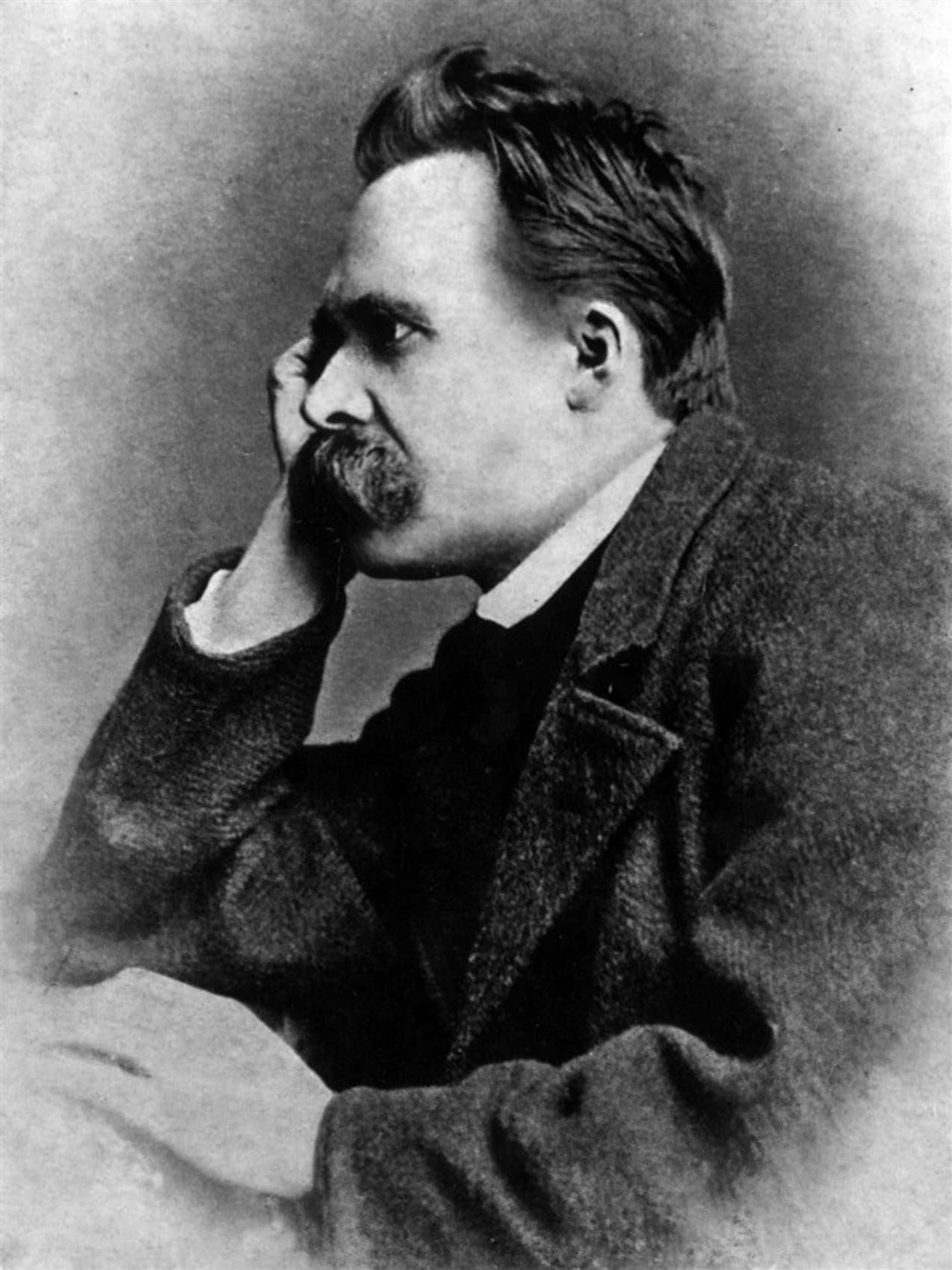
Friedrich Nietzsche was born on 15 October 1844 in Röcken, a village near Leipzig in Prussian Saxony, the son of a Lutheran pastor who died when Friedrich was four. He studied theology and then classical philology at Bonn and Leipzig, and in 1869, at just 24 and before he had formally completed his doctorate, he was appointed professor of classical philology at the University of Basel. There he became a close friend of Richard Wagner, whose music and cultural ambitions shaped his first book, The Birth of Tragedy, in 1872.
Chronic illness forced Nietzsche to give up his professorship in 1879. For the next decade he lived on a small pension, moving between the Swiss Alps, the Italian Riviera and Turin, and wrote the books for which he is best known: Daybreak, The Gay Science, Thus Spoke Zarathustra, Beyond Good and Evil, On the Genealogy of Morality and the works of 1888. In January 1889 he suffered a mental collapse in Turin from which he never recovered, and he died in Weimar on 25 August 1900.
After his collapse his sister, Elisabeth Förster-Nietzsche, took control of his papers and published selections from his notebooks, most famously The Will to Power, shaping his reputation in ways later scholars rejected. The critical edition by Giorgio Colli and Mazzino Montinari restored his texts. His ideas about the death of God, the will to power, eternal recurrence, the Übermensch and the genealogy of values went on to influence existentialism, psychoanalysis, modern literature and much of twentieth-century philosophy.
Assorted Opinions and Maxims is a collection of 408 numbered aphorisms that Nietzsche published in 1879 as a supplement to Human, All Too Human. It ranges over philosophy and truth, the psychology of moral feelings, Christianity, art and music, writing and reading, culture and the Greeks, friendship, politics and the solitary life of a thinker. There is no continuous argument. Instead each entry tests a common opinion, often by asking what motives lie behind it. The book continues the turn Nietzsche had made away from Schopenhauer and Wagner toward a cooler, more historical and psychological way of thinking, written from the standpoint of what he called the free spirit.
What is the main idea of Assorted Opinions and Maxims?
If one idea unites the book, it is that our highest values have human, and often unflattering, origins, and that seeing this need not lead to despair. Nietzsche traces the intellectual conscience to pride, morality to the interests of the community over the individual, and Christian consolation to the needs of tired cultures. Yet he insists that good things often begin with a bad conscience, as science did, and that a free spirit can live cheerfully without metaphysical comfort. Alongside this runs a demand that art serve life by embellishing it and by offering images of better human beings, rather than simply intoxicating its audience.
What are the key takeaways from Assorted Opinions and Maxims?
First, philosophers often inflate popular moral wisdom into false necessities, as Nietzsche claims Schopenhauer did with the will. Second, the love of truth has roots in pride and habit, but it is still worth having. Third, vanity and envy hide inside feelings like pity and sympathy. Fourth, art’s main task is to make life and people bearable, and works of art are only its overflow. Fifth, every culture, including its music, belongs to a time and fades with it. Sixth, partisanship and possessions can make people less free. Finally, a thinker grows by conversing with a few great minds and by being willing to part from old friends and teachers.
Why does Nietzsche write in aphorisms?
Nietzsche defends the form inside the book itself. In §127 he says a brief saying may be the harvest of long reflection, and in §128 he asks whether a work is piecework just because it comes in pieces. In §168 he calls a good aphorism too hard for the tooth of time, a paradox that feeds every age without wearing out. Practically, the aphorism suited his poor health, since he could compose short passages on long walks. It also suited his method. An aphorism invites the reader to test it rather than accept it, and a series of them lets a subject be seen from many angles without forcing them into one system.
What does Nietzsche say about art and Wagner in this book?
The book treats art at length and often has Wagner in view, though it criticizes him far more gently than Nietzsche’s later polemics. In §134 Nietzsche describes Wagner’s endless melody as a sensation of losing one’s footing in the sea and having to swim, where older music made listeners dance and so kept them in measure. In §171 he argues that music is always the last art to flower in a culture and that Wagner’s music, born of a period of reaction, may soon become unintelligible. More broadly he asks art to calm and shape people rather than inflame them, and in §99 he hopes for a poet who will portray noble human beings and so guide the future.
What is “The Journey to Hades” at the end of the book?
The final aphorism, §408, borrows the scene from the Odyssey in which Odysseus offers blood so that the dead can speak to him. Nietzsche says he too has gone to the underworld, sacrificing his own blood, and that four pairs answered him: Epicurus and Montaigne, Goethe and Spinoza, Plato and Rousseau, Pascal and Schopenhauer. With these eight he must come to terms, and he looks to them to judge him and one another. The passage is often read as a list of Nietzsche’s most important interlocutors, and it shows his idea of philosophy as an ongoing argument with the great dead rather than allegiance to a single master.
Is Assorted Opinions and Maxims worth reading?
It is worth reading for anyone who already enjoys Nietzsche’s middle period or the French moralist tradition of La Rochefoucauld and Chamfort. Many entries are sharp, funny and still apt, especially those on vanity, partisanship, the press and the habits of readers and writers. The aphorisms on art and music are among his most thoughtful, and the closing Journey to Hades is a memorable self-portrait. It is less essential than Human, All Too Human or The Gay Science, and some passages on women and nations show the prejudices of his time. Readers who browse rather than read straight through usually get the most from it.
Who should read Assorted Opinions and Maxims?
The book suits readers who like short, self-contained observations they can take one at a time, and who are curious how Nietzsche thought between his early Wagnerian period and Zarathustra. Students of Nietzsche will find early versions of later themes: the critique of pity, the origins of the intellectual conscience, the idea of becoming oneself. Writers and critics will enjoy the many passages on style, reading and the aphorism form. Those who want a single sustained argument, or a first introduction to his best-known ideas such as the death of God or the will to power, would do better to start elsewhere.
How long does it take to read Assorted Opinions and Maxims?
The English translation runs to about 36,000 words, so at an average pace of around 250 words per minute it takes roughly two and a half hours to read straight through. Few readers do it that way. Because the 408 aphorisms are self-contained and range from a single line to a page or two, the book is easier to read in short sittings of twenty or thirty entries. The denser passages on Schopenhauer, Wagner and Christianity reward slower reading. A summary like this one takes about twenty minutes and can serve as a map for returning to the sections that interest you most.
How does Assorted Opinions and Maxims relate to Human, All Too Human and The Wanderer and His Shadow?
Nietzsche first published Assorted Opinions and Maxims in 1879 as an appendix to Human, All Too Human, which had appeared in 1878. The Wanderer and His Shadow followed, dated 1880. In 1886 he reissued the two supplements together as the second volume of Human, All Too Human with a new preface. All three share the free-spirit outlook and the aphoristic form. Assorted Opinions and Maxims roughly retraces the topics of the first volume in the same order, while The Wanderer and His Shadow is framed as a dialogue and pays more attention to everyday life, custom and the small things that shape a person.