Summary by chapter
The Dionysian Worldview in 5 chapters, in our own words.
Chapter 1
Two Gods of Art: Dream and Intoxication
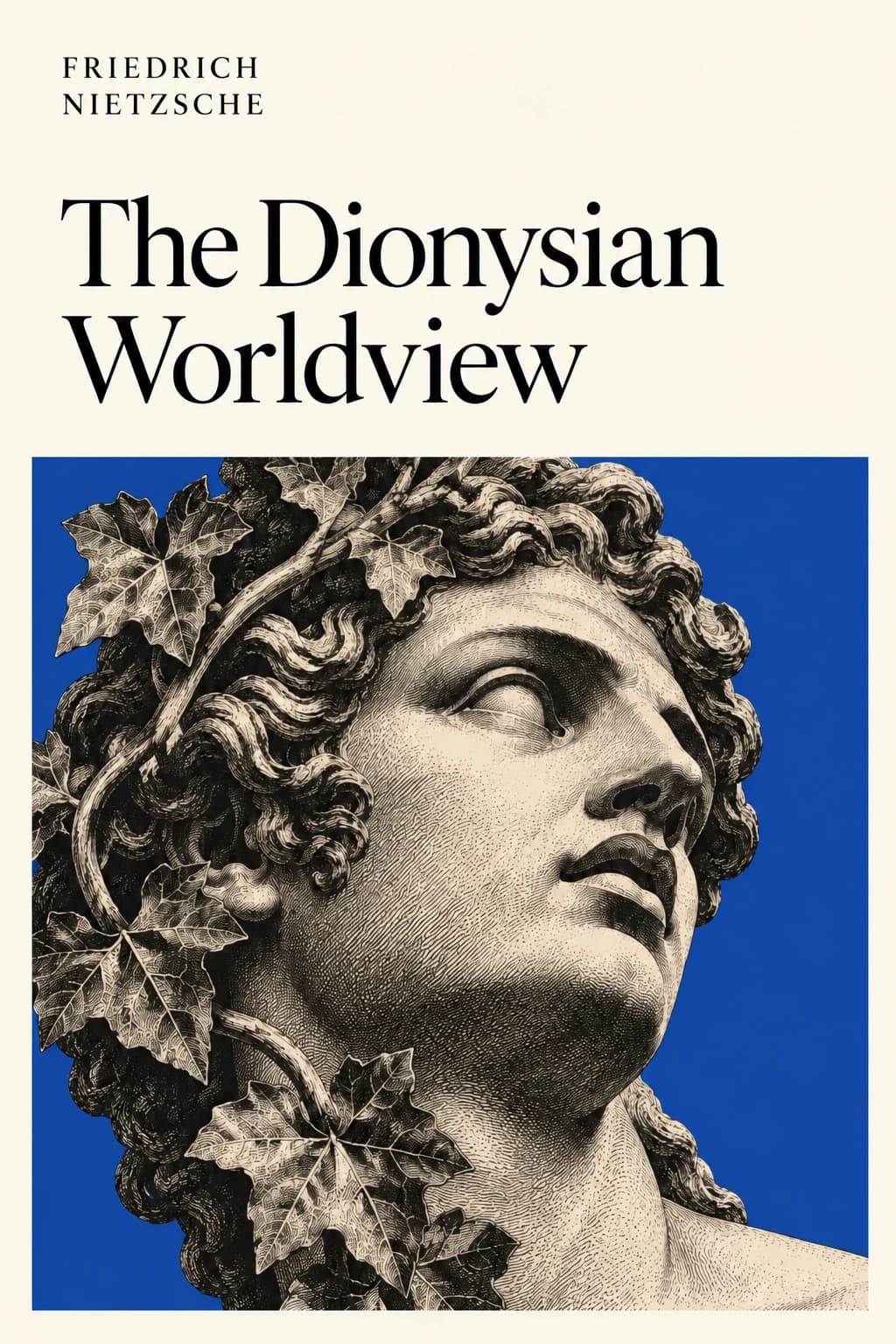
Nietzsche wrote The Dionysian Worldview in the summer of 1870, while he was a young professor of classical philology at Basel and a frequent guest of Richard and Cosima Wagner. It is a short essay in four numbered sections, never published in his lifetime, and it works out the ideas that would become the opening of The Birth of Tragedy two years later. Its starting claim is that the Greeks expressed the hidden doctrine of their view of the world through their gods, and that they set up two deities as the double source of their art: Apollo and Dionysus.
To make the two gods intelligible, Nietzsche ties each to a familiar human state. Apollo belongs to the dream. In dreams everyone is an artist, producing vivid images that we enjoy even while we half know they are appearances. Apollo is the god of light and of beautiful appearance, and also the god of measure and limits: his images are clear, calm and bounded, and they never forget that they are images. The pleasure we take in such images, together with our half-awareness that they are only images, is exactly what Apollonian art cultivates in sculpture and in epic poetry.
Dionysus belongs to intoxication. Nietzsche names two routes into it: narcotic drink and the surge of spring, when nature seems to awaken and people are carried out of themselves. In this state the sense of being a separate individual weakens. People sing and dance together, feel at one with each other and with nature, and lose the boundaries that ordinary life keeps in place. Nietzsche presents this not as mere drunkenness but as a powerful natural force that seizes whole communities, which the Greeks recognised in the festivals of their god. In this state the self is not so much destroyed as absorbed into something larger.
The essay’s most famous formula describes this change. In the Dionysian state, Nietzsche says, the human being is no longer an artist but has become a work of art. Under the dream, a person makes images and looks at them. Under intoxication, a person becomes the material through which a larger creative power expresses itself. The contrast between making and being made, between looking and taking part, runs through the rest of the essay. The image anticipates a theme Nietzsche never abandoned: that art is not only something humans make but a power that works through them.
Chapter 2
From Barbarian Orgy to Greek Festival
Nietzsche does not present the Dionysian as something purely Greek. Ecstatic festivals of a god of wine and nature were widespread in the ancient world, and among many peoples, he suggests, they released the wildest impulses, mixing sexual licence and cruelty. What interests him is what the Greeks did with this force when it reached them. He insists on the difference between this raw ecstasy and the form it later took in Greece, since the contrast reveals what was distinctive about Greek culture. For Nietzsche, the question is not whether a people feels the Dionysian, but how it shapes that force.
His answer is that Apollonian Greek culture first stood against it like a dam. Its sense of form, proportion and restraint resisted the flood of ecstasy. But resistance did not last, and Nietzsche describes a historical turn: instead of crushing the newcomer, the Greeks made peace with it. Apollo and Dionysus were reconciled, and at Delphi, Apollo’s own sanctuary, Dionysus came to be honoured too. In Nietzsche’s telling, Apollo did not abolish his rival but set limits to him, and the two gods came to share the Greek world between them.
This reconciliation changed the meaning of the Dionysian festival. In Greek hands it became less an outburst of brute appetite and more a festival of release and redemption, a celebration in which the breaking of individual limits took on an almost religious and artistic sense. Nietzsche presents this as one of the decisive moments of Greek culture: the point at which an impulse that destroyed other societies was turned into a source of art. The same ecstasy that elsewhere returned people to something brutish became, among the Greeks, a source of song, dance and eventually drama.
The same contrast appears in music. Nietzsche associates Apollonian music with rhythm and clear structure, a measured art of shaping time, while the Dionysian brings the overwhelming power of tone and harmony that seizes the listener’s feelings directly. Tragedy, the essay suggests, could only emerge once both kinds of power were allowed to work together rather than against each other. This contrast between measured and overwhelming music prepares the essay’s later reflections on how sound expresses feeling more directly than images do. Here, as elsewhere, the essay sketches rather than proves.
Chapter 3
The Olympian Gods and the Terror of Existence
Why did the Greeks need such radiant gods at all? Nietzsche’s answer overturns the image of the Greeks as serene and untroubled. They knew the terrors and horrors of existence very well, he argues, and their bright Olympian world was a response to that knowledge. He recalls the old legend of King Midas, who captured Silenus, the companion of Dionysus, and asked him what was best for human beings. Silenus answered that the best thing is never to have been born, and the second best is to die soon. The story is the essay’s starkest image of Greek pessimism.
The Olympian gods, in Nietzsche’s reading, were the Greeks’ way of living with this wisdom. They placed between themselves and the abyss a shining world of beautiful figures who lived the same life as humans, only greater and more glorious. By making the gods live human lives, they justified human life itself. Existence under such gods became something worth desiring rather than something to escape. Homer’s heroes, on this view, cling to life precisely because their gods have made it shine. The Olympian world is not a moral order but a mirror of beauty in which the Greeks could see their own existence glorified.
This gives Nietzsche his view of Apollonian beauty. It is not a naive delight in harmony but a veil, a necessary appearance created by a people that saw too clearly. The Greek “cheerfulness” that later admirers praised was, on this account, a hard-won achievement, an artistic answer to suffering rather than a sign that suffering was unknown. This reverses the image of a serene, untroubled Greece that German classicism had made famous. Beauty, for Nietzsche, is not the opposite of suffering but one of the ways a people responds to it.
The Dionysian threatens this arrangement because it tears the veil. In ecstasy the individual glimpses the truth that the Apollonian world covers up: that the separateness and stability of things are appearances, and that beneath them lies a single restless life full of pain and contradiction. The essay asks how a culture can bear such a glimpse without being destroyed by it. The Apollonian answer had been to cover the abyss with beauty. The Dionysian experience made that cover harder to maintain, and the rest of the essay explores what art did in response.
Chapter 4
The Sublime and the Comic
Nietzsche describes what happens after the Dionysian state passes. A person who has known ecstasy and then returns to ordinary reality may feel disgust at it. Everyday life now seems absurd or horrible, and action seems pointless. This mood, in which the will to act is paralysed by a glimpse of the truth, is the real danger the Dionysian poses. Its natural end would be a denial of life. Nietzsche’s point is that insight into the truth of things does not automatically make life easier; it can make ordinary activity seem trivial or absurd.
Art, Nietzsche argues, is what saves the Greeks from this outcome. It turns the thoughts of disgust at the horror and absurdity of existence into images that one can live with. He names two such transformations. The sublime is the artistic taming of the horrible: terror is given form so that it can be contemplated and even admired. The comic is the artistic release from disgust at the absurd: what is meaningless is turned into laughter. Both depend on keeping some distance from the horror or absurdity they portray. Neither denies what has been seen.
These two forms, he suggests, make up a kind of middle world between beauty and truth. The purely Apollonian world of beautiful appearance is not enough once the Dionysian truth has been seen, but the bare truth cannot be lived with either. Sublime and comic art acknowledge what ecstasy has revealed while keeping a protective distance from it. Nietzsche presents this middle world as one of the great inventions of Greek culture, a way of telling the truth without being destroyed by it. It lets a spectator acknowledge suffering while still affirming the life in which it occurs.
Here Nietzsche points toward the drama that grew out of the Dionysian festival, which he treats as the great Greek achievement of this middle world. In it, the Dionysian vision of suffering and the Apollonian gift of form meet. The essay does not yet give the full account of the tragic chorus that The Birth of Tragedy will offer, but it sets out the logic that account will follow: art exists so that a people that has looked into the abyss can go on living. This conviction that art serves life itself, rather than teaching or decorating it, becomes the backbone of Nietzsche’s first book.
Chapter 5
Gesture, Tone and the Language of Feeling
The final part of the essay turns from history to something closer to a theory of expression. If the Dionysian is an experience of losing oneself in a shared life, how can it be communicated at all? Nietzsche looks at the means available to humans for conveying inner states, and he distinguishes between the symbolism of gesture and the symbolism of sound. The question matters because the Dionysian state, as he has described it, is precisely the loss of the separate self that ordinary communication assumes. Some form of expression must exist that does not depend entirely on individual words and concepts.
Gesture and image, he suggests, can convey representations: they show something, and so they belong naturally to the Apollonian side. Tone works differently. In the rise and fall of the voice, in rhythm, loudness and harmony, feeling is expressed more directly, below the level of pictures and concepts. Drawing on Schopenhauer, whose philosophy shaped the whole essay, Nietzsche treats music as the art closest to the will, the restless striving that Schopenhauer saw at the root of the world. The distinction lets him explain why music seems to speak directly to feeling.
This allows Nietzsche to place the Dionysian dithyramb, the choral song and dance of Dionysus’ worshippers, at the origin of a new kind of art. In it, the whole body speaks at once: voice, movement and music combine to express a state that ordinary language cannot capture. Words alone, he suggests, can only point toward such feeling, while music can seize it. This places music, rather than spoken drama, at the root of Greek tragedy, a claim that becomes the central thesis of The Birth of Tragedy and is announced in its original full title, The Birth of Tragedy from the Spirit of Music.
The essay stops short of a finished argument, and it was not meant for publication. Its ideas reappear, reworked and expanded, in The Birth of Tragedy of 1872, where the paired gods, the wisdom of Silenus, the sublime and the comic, and the special status of music all return. Read on its own, The Dionysian Worldview shows Nietzsche thinking these ideas through for the first time, in a more compact and less polemical form, before Wagner and the attack on Socrates took centre stage. It remains one of the best short introductions to his early aesthetics.