Returning from Zarathustra’s poetic voice to argument and aphorism, Nietzsche challenges philosophers’ assumptions about truth, morality, and the human drives behind them.
“He who fights with monsters should be careful lest he thereby become a monster.”
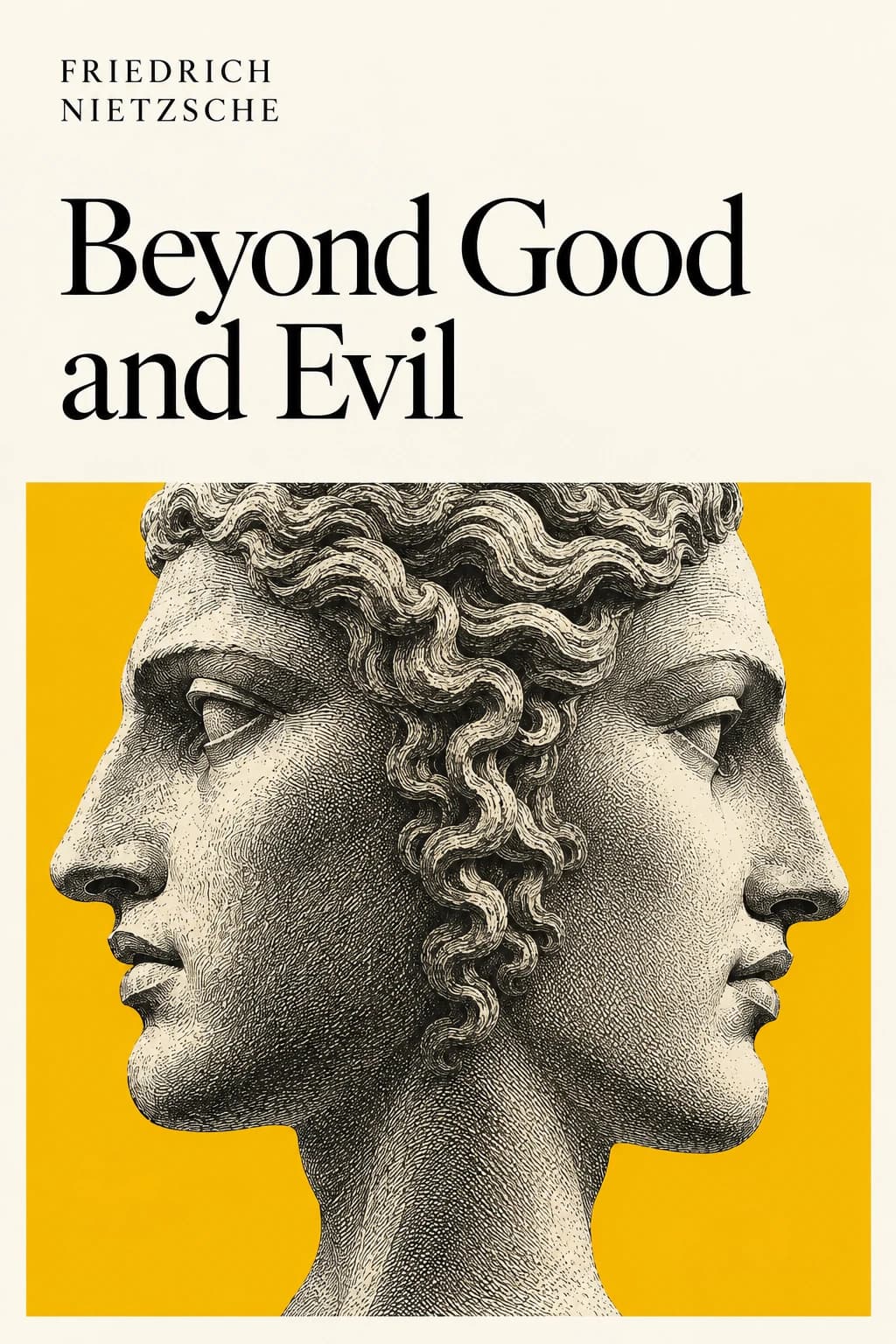
Subtitled Prelude to a Philosophy of the Future, this book of 296 numbered sections returns from Zarathustra’s poetry to argument and aphorism. Nietzsche asks why philosophers have trusted opposites like truth and error or good and evil, and suggests that every great philosophy is the unconscious confession of its author’s drives and moral aims.
From there he ranges over religion, scholarship, modern virtues, the nations of Europe and the meaning of nobility. He introduces the contrast between master morality and slave morality, calls modern European ethics a herd morality, and looks for new philosophers who will be commanders and legislators of value. It ends with a poem welcoming Zarathustra.
Every great philosophy is an involuntary memoir of its author, shaped by unexamined moral aims rather than pure reasoning.
2
Perspectives and drives
Thinking emerges from competing instincts, and even a false belief can be valuable if it furthers life.
3
Beyond inherited oppositions
Good and evil, truth and error may be degrees of one thing rather than fixed opposites, so they become objects of inquiry.
4
Master and slave morality
Noble morality affirms itself as good, while slave morality begins by fearing the powerful and calling them evil.
5
Philosophers as legislators
Genuine philosophers do not just catalogue existing values; they create new ones, and their will to truth is will to power.
Summary by chapter
Beyond Good and Evil in 11 chapters, in our own words.
Preface
The preface, dated Sils Maria, June 1885, opens with one of Nietzsche’s most famous questions: “Supposing that Truth is a woman, what then?” Philosophers who have been dogmatists, he suggests, courted truth with a terrible seriousness and clumsy insistence, and she never let herself be won. Today every dogma stands sad and discouraged, if it stands at all. The great metaphysical systems, he proposes, may have rested on very little: an old popular superstition such as the belief in the soul, a trick of grammar, or a bold generalization from a few personal, all-too-human facts.
“
the worst, the most tiresome, and the most dangerous of errors hitherto has been a dogmatist error—namely, Plato's invention of Pure Spirit and the Good in Itself.
Friedrich Nietzsche
Nietzsche does not simply sneer at dogmatic philosophy. Like astrology, it may have been a promise that took thousands of years to pay off, and great things often have to wander the earth first as enormous caricatures; he names the Vedanta in Asia and Platonism in Europe. But the most dangerous error so far was Plato’s invention of pure spirit and the good in itself, which denied perspective, the basic condition of all life. He wonders, as a physician might, how such a sickness could attack the finest product of antiquity, and whether Socrates really did corrupt the young. He then gives the provocative formula that Christianity is Platonism for the people.
The long struggle against Plato and against the Church, he argues, has produced in Europe a magnificent tension of spirit, like a tightly drawn bow that can now shoot at the farthest goals. Twice, attempts have been made to slacken the bow: first by the Jesuits, then by democratic enlightenment with its free press and newspaper reading. Nietzsche addresses his book to those who refuse both: “good Europeans” and very free spirits who still feel the whole distress of the spirit and the tension of its bow, and who may also have the arrow, the task and the target.
Chapter 1
Chapter I: Prejudices of Philosophers
The first part questions the will to truth itself. Granted that we want truth, Nietzsche asks in §1, why not rather untruth, uncertainty, even ignorance? The value of truth has never been seriously questioned. In §2 he exposes what he calls the typical prejudice of metaphysicians: the belief in opposites of value. They assume that things of the highest value cannot come from their opposites, that truth cannot grow from error or selflessness from selfishness, and so they must have a separate origin in Being, God or the thing in itself. Nietzsche suggests instead that good things may be secretly knotted to their apparent opposites, and that the usual valuations may be mere “frog perspectives,” views from a corner and from below.
“
It has gradually become clear to me what every great philosophy up till now has consisted of—namely, the confession of its originator, and a species of involuntary and unconscious auto-biography
Friedrich Nietzsche
If that is so, conscious thinking is mostly a function of instinct (§3). Behind every logic stand valuations, or more plainly physiological demands for the preservation of a certain kind of life. In §4 he states one of the book’s most startling claims: the falseness of a judgment is not in itself an objection to it. The question is whether it furthers life. Logical fictions, the comparison of reality with an invented world of the unconditioned, and the constant falsification of the world by numbers may be indispensable to us, so that one must recognize untruth as a condition of life.
Philosophers, he says in §5, pretend that their views come from cold, pure dialectic, when in fact they are advocates defending a prejudice, usually their heart’s desire, with reasons found afterwards. Kant’s stiff moral imperative and Spinoza’s mathematical armor are his examples. Hence §6: every great philosophy has been the confession of its author and a kind of involuntary memoir, and its moral aims have been the seed from which the whole plant grew. To understand a metaphysical claim, ask what morality it is aiming at. In §9 he mocks the Stoics, who claim to live “according to nature” while really imposing their own morality on a nature that is in truth extravagant, indifferent and without pity.
The following sections take apart several favorite philosophical certainties. Kant explained the possibility of synthetic judgments a priori by a “faculty,” which Nietzsche compares to the comic doctor in Molière who explains that opium makes us sleep by its sleep-inducing power (§11). Psychologists who make self-preservation the basic drive are wrong; a living thing above all wants to discharge its strength, and life itself is will to power (§13). Against Descartes, Nietzsche argues that “I think” is not an immediate certainty (§16). A thought comes when “it” wants, not when “I” want, and even the “it” is an interpretation borrowed from grammar (§17).
The will too is not simple (§19). Willing involves a plurality of feelings, a commanding thought and above all an emotion of command; we are at once the ones who command and the ones who obey, and we take credit for the success. Free will in the metaphysical sense is the wish to be causa sui, to pull oneself up into existence by one’s own hair (§21), but the opposite notion of “unfree will” is equally a mythology. Physicists’ “laws of nature” are an interpretation flattering democratic instincts, Nietzsche says (§22), and another interpreter might read the same facts as tyrannical assertions of power. If that too is only interpretation, so much the better. The part ends (§23) by calling for a psychology bold enough to become the morphology and development-doctrine of the will to power.
Chapter 2
Chapter II: The Free Spirit
The second part begins with wonder at how simplified and falsified human life is (§24). We have made everything around us clear and easy so that we can enjoy life, and knowledge has been built on a granite foundation of ignorance, the will to knowledge on a far stronger will to not-knowing. Even language keeps speaking of opposites where there are only degrees. Nietzsche warns philosophers against becoming martyrs for truth (§25), since suffering for the truth makes them theatrical and vengeful, and he says the select person instinctively seeks a citadel apart from the crowd, though he must sometimes go down among the many, and cynics who speak frankly of human baseness are a help to him (§26).
“
Everything that is profound loves the mask: the profoundest things have a hatred even of figure and likeness.
Friedrich Nietzsche
Several aphorisms concern style and tempo. It is hard to be understood, especially when one thinks at a tempo different from one’s listeners (§27), and the hardest thing to translate is the tempo of a style (§28). Independence is for very few, and the person who attempts it enters a labyrinth (§29). Deep insights must sound like follies or even crimes to those not made for them (§30). Section 32 offers a sketch of moral history in three phases: a pre-moral period that judged actions by consequences, a moral period that judged them by intentions, and a possible extra-moral period that may see the intention itself as a surface sign that hides more than it shows.
The philosophical core is in §34 to §36. The erroneousness of the world we live in, Nietzsche says, is the surest thing our eyes can see, yet it is only a moral prejudice that truth is worth more than appearance. There would be no life at all except on the basis of perspective valuations. Why might not the world that concerns us be a fiction? In §36 he proposes an experiment in thought: suppose that nothing is given except our world of desires and passions. Could this suffice to understand the so-called material world as well? If all efficient causation is will acting on will, then the world seen from within would be will to power and nothing else.
The part closes with portraits of the free spirit and of the philosophers to come. A thing could be true and still be harmful and dangerous; the strength of a spirit might be measured by how much truth it could bear (§39). Everything profound loves the mask, and every deep spirit needs one (§40). One must put oneself to the test: not cling to a person, a fatherland, pity, a science or even one’s own detachment (§41). A new kind of philosopher is coming, whom Nietzsche calls “tempters” (the German Versucher also means experimenters), who will not be dogmatists and will say “My opinion is MY opinion” (§42 to §43). These philosophers will be free spirits, but Nietzsche separates them sharply from the so-called free spirits of the day, whom he calls levellers and slaves of democratic taste (§44).
Chapter 3
Chapter III: The Religious Mood
Nietzsche treats religion here as a psychologist on a big hunt through the history of the human soul (§45). Early Christian faith, he says, was not the sincere, sturdy faith of a Luther or a Cromwell but resembled the faith of Pascal, a continuous suicide of reason, demanding the sacrifice of all freedom, pride and self-confidence (§46). Wherever religious neurosis has appeared it has come with three prescriptions: solitude, fasting and sexual abstinence (§47), and the sudden switch from wild sensuality to penitence has always fascinated observers. The saint, whom even the most powerful people have bowed before, is honored for his self-mastery, which they sense as a hidden power (§51).
“
To sacrifice God for nothingness—this paradoxical mystery of the ultimate cruelty has been reserved for the rising generation
Friedrich Nietzsche
He contrasts religious traditions. The Jewish Old Testament, the book of divine justice, contains people, things and sayings on so grand a scale that Greek and Indian literature has nothing to set beside it, while the New Testament he finds a kind of rococo of taste; binding them together as one Bible may be the greatest audacity and “sin against the Spirit” that literary Europe has on its conscience (§52). Why atheism today? Because God as father, judge and rewarder has been refuted, and above all because he seems unable to communicate clearly (§53). Modern philosophy since Descartes, he adds, has been an attack on the old concept of the soul, and so an anti-Christian one (§54).
Section 55 describes a ladder of religious cruelty with three main rungs. Once people sacrificed human beings to their god, often those they loved most. Then, in the moral epoch, they sacrificed their strongest instincts, their own nature. What remained to sacrifice? Finally, God himself, to worship stone, stupidity, gravity, fate and nothingness instead. Against this nihilistic end, §56 sketches the opposite ideal in a rare glimpse of eternal recurrence: a person so world-affirming that he wants everything again exactly as it was and is, for all eternity, calling “da capo” not only to himself but to the whole play.
The part ends with a cold-eyed account of religion as a tool. The philosopher as Nietzsche understands him, a person with responsibility for the whole development of humankind, will use religion for breeding and education, as he would use political and economic conditions (§61). For the strong it can be a means of overcoming resistance; for the ordinary majority it gives contentment and a transfigured meaning to everyday suffering. But when religions rule on their own account rather than as means, the cost is terrible (§62). Christianity, by preserving too much of what was sick and suffering, has worked to make man a sublime abortion, a sight at which an Epicurean god might never stop laughing.
Chapter 4
Chapter IV: Apophthegms and Interludes
The fourth part is an interlude of 123 short sayings (§63 to §185), a breathing space between the longer arguments. Many are only a line long, and they range from the epigrammatic to the confessional. Some compress the book’s philosophy into a sentence. “Knowledge for its own sake” is the last snare laid by morality (§64). There are no moral phenomena at all, only a moral interpretation of phenomena (§108). What is done out of love always takes place beyond good and evil (§153). Objection, evasion, cheerful mistrust and love of irony are signs of health; everything absolute belongs to pathology (§154).
“
He who fights with monsters should be careful lest he thereby become a monster. And if thou gaze long into an abyss, the abyss will also gaze into thee.
Friedrich Nietzsche
Others are miniature psychological studies. Memory says “I did that”; pride says “I could not have done that,” and in the end memory gives way (§68). Whoever despises himself still respects himself as a despiser (§78). It is not the strength but the duration of great feelings that makes great people (§72). Under peaceful conditions the warlike person attacks himself (§76). Not only our reason but also our conscience bows to our strongest drive, the tyrant in us (§158). We end up loving our desire, not what we desire (§175). The thought of suicide is a strong consolation that gets one through many a bad night (§157).
The interlude also contains the book’s most quoted line, §146: whoever fights monsters should take care not to become one, and when you gaze long into an abyss, the abyss also gazes into you. Many sayings concern religion: Christianity gave Eros poison to drink, and he did not die of it but degenerated into vice (§168); the devil has the widest perspectives on God, which is why he keeps so far away from him (§129). Maturity means regaining the seriousness one had as a child at play (§94). One should part from life as Ulysses parted from Nausicaa, blessing it rather than in love with it (§96).
A number of sayings about women and love appear here too, and they are among the passages readers find hardest to accept. Taken together, the interlude shows Nietzsche at his most aphoristic, working in the tradition of French moralists like La Rochefoucauld. It also shows his method in small: a common assumption is turned around in a few words to expose the motive beneath it, and the reader is left to work out how far the reversal holds. Several of these sayings return, expanded, in the longer arguments of the parts that follow, so the interlude also works as a preview of the book’s second half.
Chapter 5
Chapter V: The Natural History of Morals
Nietzsche opens his central part on ethics by mocking the very phrase “science of morals.” Moral feeling in Europe is subtle and refined, but the science of it is young, clumsy and coarse-fingered (§186). What is needed first is modest work: collecting material and comparing many moralities, a typology of morals. Philosophers who tried to “give a foundation” to morality only expressed their faith in the morality of their own time; the problem of morality itself was never seen. Schopenhauer’s formula “Injure no one; rather help everyone as much as you can” is his example of a principle stated without suspicion. In §187 he adds that moralities are above all a sign language of the emotions.
“
The essential thing "in heaven and in earth" is, apparently (to repeat it once more), that there should be long OBEDIENCE in the same direction
Friedrich Nietzsche
Every morality, Nietzsche argues in §188, is a kind of tyranny against nature and against reason, and that is no objection. What is essential and invaluable in a morality is that it is a long constraint. He compares it to the metrical rules that forced poets and orators to make language strong and free. Everything of value, virtue, art, music, dance, reason, spirituality, has grown from long obedience in one direction. In §190 and §191 he turns to Socrates, whose claim that no one does wrong willingly he calls plebeian. Plato, too noble for it, reinterpreted his teacher, and the ancient quarrel between instinct and reason has run through moral philosophy ever since.
Section 195 introduces an idea developed fully in the Genealogy. The Jews, Nietzsche writes, accomplished an inversion of values: their prophets fused “rich,” “godless,” “wicked,” “violent” and “sensual” into one, and used “world” as a term of reproach; with them begins the slave revolt in morals. Moralists misunderstand the beast of prey and the man of prey, like Cesare Borgia, when they look for sickness or an inner hell in them (§197), and their morality of the temperate zones amounts to a chapter on morals as timidity. The type who contains warring drives may become weary and long for peace, or, rarely, become an enigmatic, magical figure like Alcibiades, Caesar or Leonardo (§200).
The part ends with the analysis of herd morality. Since human beings have always lived in herds and obedience has been practiced most, the need to obey is now innate as a kind of formal conscience that says “Thou shalt” (§199). In early communities, what counted as moral was what served the group, and fear is the mother of morality (§201). As long as the community is under threat, harsh and dangerous drives are praised; once it is safe, they are branded immoral. Today, Nietzsche says in §202, morality in Europe is herd-animal morality, which claims to be the only morality. The democratic movement is its heir. His hope lies in new philosophers strong enough to revalue values and to prepare great experiments in human discipline (§203).
Chapter 6
Chapter VI: We Scholars
This part is about the relation between science and philosophy, and Nietzsche begins by protesting against a reversal of rank. Science has declared its independence from philosophy and now wants to lay down the law to it (§204). The scholar who sneers at philosophy usually knows it only through recent, impoverished philosophers. The dangers facing a would-be philosopher are many, Nietzsche says in §205, and the greatest is that the range of what he must know has become so vast that he may tire, settle down as a specialist or arrive too late. In §206 he offers a mocking portrait of the scholar, a respectable average type with industry, modesty and a need for recognition, but no capacity to beget or create.
“
Their "knowing" is CREATING, their creating is a law-giving, their will to truth is—WILL TO POWER.
Friedrich Nietzsche
The objective spirit deserves gratitude and also caution (§207). The ideal scholar is a mirror, an exquisite measuring instrument that waits for something to reflect. He no longer knows how to affirm or to deny, commands nothing and destroys nothing. He is a tool, valuable in the hands of someone more powerful, but not a goal. Nietzsche then turns to skepticism (§208). Europe suffers from a sickness of the will, and its fashionable skepticism is a symptom of paralysis. He contrasts it with a stronger, masculine skepticism, which he associates with Frederick the Great and the German critical spirit, a skepticism that despises and yet seizes, that undermines and takes possession (§209).
The new philosophers will be critics and experimenters, but more than critics (§210). In §211 Nietzsche draws his famous distinction between philosophical laborers, such as Kant and Hegel, who fix and formalize existing valuations, and genuine philosophers, who are commanders and legislators. They say “thus it shall be,” and determine the whither and the why of humanity. For them knowing is creating, creating is legislating, and their will to truth is will to power. Kant and Hegel, in this picture, did indispensable work in compressing the past, but the real task begins after them. Have there ever been such philosophers? Must there not be?
Philosophers, he adds in §212, have always been in contradiction to their own age; their enemy is the ideal of the day, and they have been the bad conscience of their time, applying the knife to its virtues. In an age that praises specialization and equality, greatness would mean breadth, many-sidedness and the ability to be different and to stand alone. The part ends by noting that what a philosopher is cannot be taught but only known through experience (§213). Real philosophy unites a bold, rapid spirituality with rigorous necessity, and one has to be born for it, and bred for it through generations.
Chapter 7
Chapter VII: Our Virtues
What virtues can “we Europeans of the day after tomorrow” still have? Nietzsche’s answer is ironic and serious at once. Our virtues will be ones that agree with our most secret inclinations (§214). Among them he counts the historical sense, the ability to taste and appreciate the values of every age and people (§224). He traces it to Europe’s democratic mixing of classes and races, and observes that it makes us connoisseurs of everything half-barbarous and unfinished, like Homer or Shakespeare, while making it hard for us to enjoy what is perfect and complete.
“
Almost everything that we call "higher culture" is based upon the spiritualising and intensifying of CRUELTY—this is my thesis
Friedrich Nietzsche
Section 225 contains one of the book’s central arguments. All ways of thinking that measure the value of things by pleasure and pain, whether hedonism, pessimism, utilitarianism or eudaemonism, are naive. Modern pity for social distress wants to abolish suffering. Nietzsche counters that the discipline of great suffering has produced every elevation of humanity so far: depth, mystery, spirit, cunning and greatness of soul. In man, he writes, creature and creator are united. Our pity is for the creator in man, who must be formed, broken and shaped. Against well-being as a goal he sets a different pity, and in §226 he calls his readers “immoralists.”
The one virtue left to free spirits, he says, is honesty, and they should work at it with all their love and malice so that it never becomes stupid or sanctimonious (§227). He mocks English utilitarians as dull moral plodders (§228). Then comes the thesis on cruelty (§229): almost everything we call higher culture is based on the spiritualizing and deepening of cruelty. The pleasure in tragedy, the bullfight, the auto-da-fé and the passion of the Wagnerian audience at Tristan all share this root. Even the seeker of knowledge practices cruelty on himself, since he forces his spirit to know against its own inclination.
Section 230 analyzes the basic will of the spirit. The spirit wants to master, simplify and appropriate, and also to be deceived, to wear masks and keep surfaces. Against it works the sublime tendency of the seeker of knowledge, who insists on taking things deeply. The task is to translate man back into nature, to read beneath the flattering moral glosses the terrible basic text “homo natura,” and to stand before man as science stands before the rest of nature. Learning changes us, he adds (§231), but deep down there is something unteachable, a granite of spiritual fate.
That admission introduces the part’s last sections (§232 to §239), Nietzsche’s “truths” about woman, which he concedes are only his own truths. He opposes the emancipation of women of his day and says women lose their power by imitating men. These pages are among the most criticized in his work. Readers have noted their conventionality, their tension with his attacks on prejudice elsewhere, and the hedge in §231, which frames them as personal convictions rather than knowledge. Nietzsche himself ends §239 by lamenting the “disenchantment” of woman under modern ideas, a reminder that his target here, as elsewhere, is the democratic levelling he sees everywhere in Europe.
Chapter 8
Chapter VIII: Peoples and Countries
The eighth part opens with Nietzsche hearing Wagner’s overture to The Mastersingers “once again for the first time” (§240). It is magnificent, heavy, late art, he says, an expression of the German soul: young and old, overripe and full of future at once. In §241 he overhears two old patriots arguing over whether a politician who makes his nation great but coarse is a great man. Then he widens his view. Behind what Europe calls civilization, humanization, progress or the democratic movement lies a vast physiological process, the growing similarity of Europeans and their detachment from any particular climate or class (§242). This will produce, on average, useful, adaptable, herd-like workers, and at the same time exceptional people of unprecedented strength. Democracy breeds tyrants, in every sense.
“
the democratising of Europe is at the same time an involuntary arrangement for the rearing of TYRANTS—taking the word in all its meanings, even in its most spiritual sense.
Friedrich Nietzsche
Much of the part is a psychology of nations, often satirical. The Germans are a people of the most extraordinary mixture of races, which makes them incomprehensible, and they love what is cloudy, becoming and evolving (§244). German music from Mozart and Beethoven to Schumann is surveyed in §245, ending with Schumann as a merely German, no longer European event. German prose, he complains, is written for the eye, not the ear (§246 to §247). There are two kinds of genius, one that begets and one that conceives, and peoples can be sorted the same way (§248).
Section 251 is an important text in the history of how Nietzsche was later misused. He lists the “follies” current among Germans: anti-French, anti-Semitic, anti-Polish, Christian-romantic, Wagnerian, Teutonic, Prussian. He calls the Jews the strongest, toughest and purest race in Europe, says they want to be absorbed by Europe and finally settled and respected, and suggests that it might be useful and fair to banish the “anti-Semitic bawlers” from the country. Some of his language reflects the racial vocabulary of his day, but the passage plainly attacks political anti-Semitism. Section 250 also credits the Jews with the grand style in morality.
Nietzsche is harsh on the English (§252 to §253). They are not a philosophical race, he says, and he names Darwin, Mill and Spencer as respectable but mediocre minds whose ideas suit middle-class taste. France remains the seat of Europe’s most spiritual and refined culture, though one must know how to find it (§254). The part ends with a vision (§256). Behind the nationalist craze, Europe wants to become one. Its great spirits, Napoleon, Goethe, Beethoven, Stendhal, Heinrich Heine and Schopenhauer, were good Europeans in their deepest aims, and even Wagner belongs among the late French romantics more than to German nationalism.
Chapter 9
Chapter IX: What Is Noble?
The last and longest part asks what nobility can mean now. It begins with a hard claim (§257): every elevation of the type “man” has been the work of an aristocratic society, one that believes in a long ladder of rank and differences in worth. Out of the pathos of distance between castes grew another, more mysterious pathos: the longing to widen distances within the soul itself, to reach states that are higher, rarer and more comprehensive. Nietzsche insists that aristocracies began in violence, with barbarians who were more whole human beings and fell on gentler, more civilized peoples.
“
EVERY elevation of the type "man," has hitherto been the work of an aristocratic society and so it will always be
Friedrich Nietzsche
A healthy aristocracy, he says in §258, does not see itself as a function of the monarchy or the community but as their meaning and justification, and the French nobility at the Revolution, giving up its privileges in an excess of moral feeling, showed corruption. In §259 he denies that refraining from injury and exploitation can be the basic principle of society. Life itself, he writes, is essentially appropriation, injury, conquest of the strange and weaker, suppression, harshness, and at the least exploitation. Exploitation belongs to the essence of the living as a basic organic function; it is a consequence of the will to power, which is the will of life.
Section 260 introduces the distinction that the Genealogy will develop: master morality and slave morality. Both can exist in the same culture and even in the same soul. In master morality, the noble type determines values from its own sense of itself: “good” means noble, proud and powerful, and “bad” means contemptible, cowardly and petty. The noble person honors himself, has reverence for age and tradition, and owes duties only to his equals. Slave morality is a morality of utility. It is suspicious of the virtues of the powerful and honors pity, the helping hand, patience, humility and friendliness. In it the contrast is “good” and “evil,” and the evil one is the one who inspires fear.
The remaining aphorisms sketch the noble soul from many sides. Vanity is a slave’s habit of waiting for others’ opinions (§261). An instinct for rank is itself a sign of high rank (§263). Egoism belongs to the noble soul as a matter of justice (§265). Communication depends on shared experiences, and over long time the most common experiences win, which gives power to the ordinary (§268). Profound suffering ennobles and separates (§270). In §287 Nietzsche concludes that the noble person is known not by works but by a fundamental certainty about himself: the noble soul has reverence for itself. The hermit’s philosophy, he adds, is always a foreground philosophy, every word also a mask (§289).
The book ends with two of Nietzsche’s most personal pages. Section 295 praises the “genius of the heart,” a tempter and rat-catcher of consciences who makes people richer and newer, and it turns out to be the god Dionysus, of whom Nietzsche calls himself the last disciple and initiate. The god philosophizes too, and when Nietzsche suggests polite words for him, Dionysus replies that he loves man and finds him an agreeable, brave and inventive animal. In §296 Nietzsche addresses his own written thoughts, which were young and malicious when he had them and now on paper are already becoming truths, things that have grown tired and are about to stop living.
Chapter 10
Aftersong: From High Mountains
Beyond Good and Evil closes with a poem of fifteen stanzas, translated in this edition as “From the Heights.” It begins at the midday of life in a summer garden high in the mountains, where the speaker waits day and night for his friends. He has set his table for them near the stars and the abyss and asks who has tasted his honey. When the old friends finally arrive, they stop and stare. He has changed so much that they no longer recognize him: a wrestler who has too often wrestled himself, hampered and wounded by his own victories over himself.
“
The Guest of Guests, friend Zarathustra, came! The world now laughs, the grisly veil was torn, And Light and Dark were one that wedding-morn.
Friedrich Nietzsche
He has learned to live where no one lives, on lonely icy heights, and has unlearned man and god, curse and prayer. His old friends turn pale with love and fear and go. They could not live up here, where one must be a hunter, like the chamois. He lets them leave without anger. What once bound them is now like faded writing on dry parchment, and the friends who knock at his window at night are only ghosts saying “we were.” He longs instead for new friends, and the refrain of the midday of life returns.
In the last two stanzas the waiting is answered. The song of longing has ended because a magician, a friend at midday, arrived, and at noon one became two. The new friend is named: Zarathustra, the guest of guests. The world laughs, the dark curtain is torn, and light and darkness are joined in a wedding. The poem thus ties this book of hard prose arguments back to Thus Spoke Zarathustra, and it ends in celebration rather than in solitude. The noon setting matters too: in Nietzsche’s imagery, midday is the hour of the shortest shadow and of the great noontide promised in Zarathustra.
Who it’s for
Readers who want Nietzsche’s mature ideas in argument rather than parable
Anyone curious why moral certainties might rest on hidden motives
Students of Descartes, Kant or Schopenhauer looking for their sharpest critic
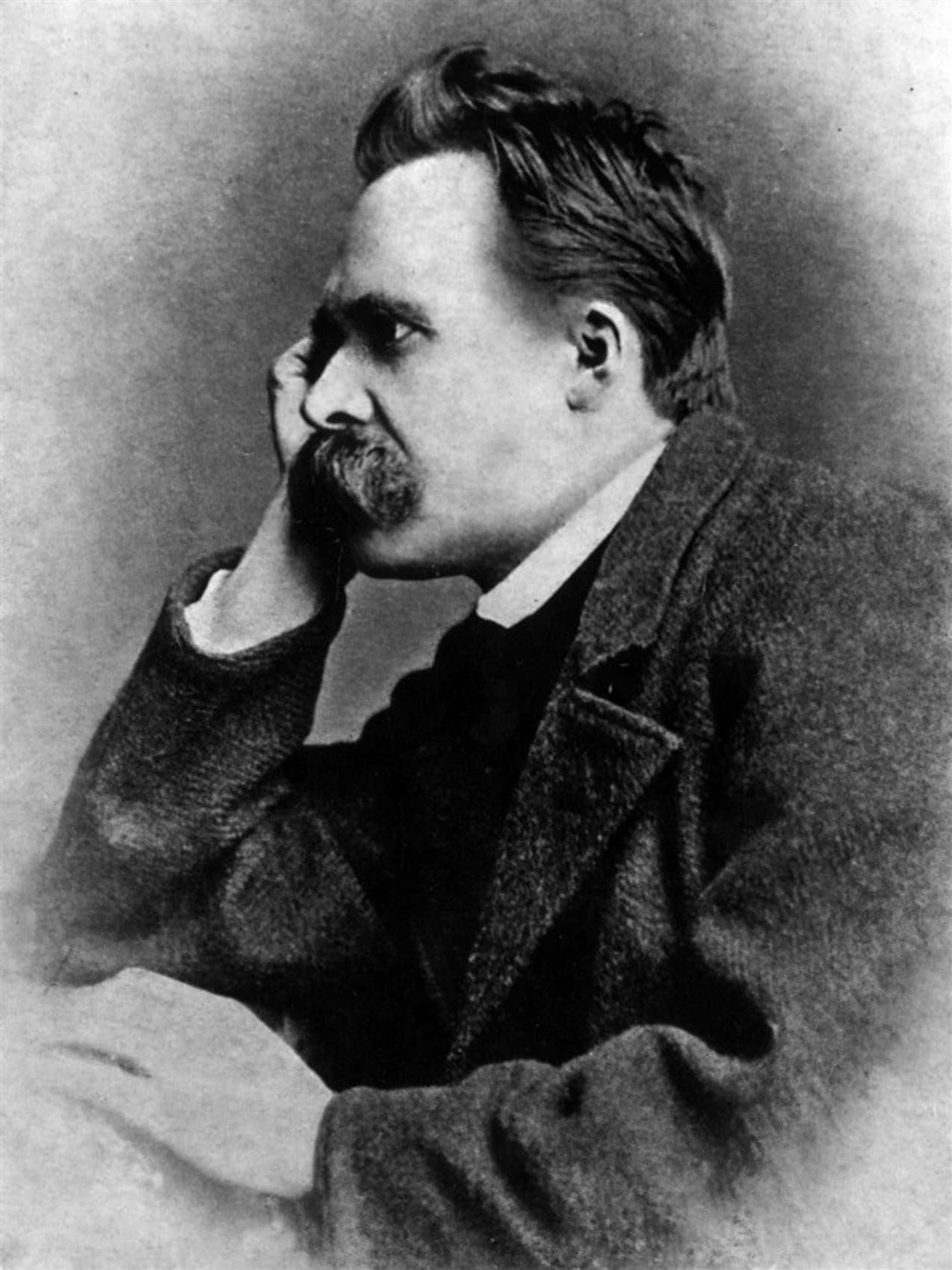
Friedrich Nietzsche was born on 15 October 1844 in Röcken, a village near Leipzig in Prussian Saxony, the son of a Lutheran pastor who died when Friedrich was four. He studied theology and then classical philology at Bonn and Leipzig, and in 1869, at just 24 and before he had formally completed his doctorate, he was appointed professor of classical philology at the University of Basel. There he became a close friend of Richard Wagner, whose music and cultural ambitions shaped his first book, The Birth of Tragedy, in 1872.
Chronic illness forced Nietzsche to give up his professorship in 1879. For the next decade he lived on a small pension, moving between the Swiss Alps, the Italian Riviera and Turin, and wrote the books for which he is best known: Daybreak, The Gay Science, Thus Spoke Zarathustra, Beyond Good and Evil, On the Genealogy of Morality and the works of 1888. In January 1889 he suffered a mental collapse in Turin from which he never recovered, and he died in Weimar on 25 August 1900.
After his collapse his sister, Elisabeth Förster-Nietzsche, took control of his papers and published selections from his notebooks, most famously The Will to Power, shaping his reputation in ways later scholars rejected. The critical edition by Giorgio Colli and Mazzino Montinari restored his texts. His ideas about the death of God, the will to power, eternal recurrence, the Übermensch and the genealogy of values went on to influence existentialism, psychoanalysis, modern literature and much of twentieth-century philosophy.
Beyond Good and Evil, subtitled Prelude to a Philosophy of the Future, is a book of 296 numbered sections in nine parts, plus a preface and a closing poem. Nietzsche attacks the hidden prejudices of philosophers, especially their faith in opposites like true and false or good and evil, and argues that philosophies express the drives and moral aims of the people who make them. He examines religion, scholarship, modern virtues, European nations and the meaning of nobility, and introduces his famous contrast between master morality and slave morality. Throughout, he calls for new philosophers who will create values rather than merely inherit them.
What is the main idea of Beyond Good and Evil?
The central idea is that our moral and philosophical certainties are not neutral truths but interpretations that serve particular forms of life. Philosophers have treated good and evil, truth and falsehood, as fixed opposites, when they may be degrees of the same thing, shaped by instinct and by the will to power. Nietzsche argues that European morality has become herd morality, which presents itself as the only possible morality. He wants free spirits and future philosophers to stand beyond this opposition of good and evil, not in the sense of anything goes, but in order to question and eventually create values.
What are the key takeaways from Beyond Good and Evil?
First, every great philosophy is a kind of unconscious autobiography of its author. Second, the falseness of a belief is not by itself an objection; the question is whether it furthers life. Third, the self, the will and free will are more complicated than philosophers assume. Fourth, life is will to power. Fifth, every morality is a long constraint, and that discipline has produced most human achievements. Sixth, European morality is herd morality, born partly of fear. Seventh, there are two basic types of morality, master and slave. Finally, real philosophers are commanders and legislators of value, not merely scholars.
What is the difference between master morality and slave morality?
Nietzsche sketches the distinction in §260 and develops it in On the Genealogy of Morality. Master morality begins with the self-affirmation of a noble type: “good” means proud, strong and noble, and “bad” is simply the contemptible opposite. Slave morality begins with suspicion of the powerful. It values pity, humility, patience and usefulness to the weak, and its key contrast is “good” versus “evil,” where evil names whoever inspires fear. Nietzsche stresses that the two often mix within one culture and even within one person, and he presents them as types for analysis rather than as descriptions of social classes alone.
What does Nietzsche mean by will to power in Beyond Good and Evil?
Nietzsche introduces the will to power as a hypothesis. Living things, he says in §13, seek above all to discharge their strength, and self-preservation is only one result of this. In §36 he experiments with the idea that the world seen from within, including the material world, might be will to power and nothing else. In §259 he applies it to society, calling exploitation a basic function of life. In §211 he says that the genuine philosopher’s will to truth is will to power. The concept is less a theory of domination than a way of explaining growth, interpretation and value-creation.
What does “Beyond Good and Evil” mean?
The title refers to standing outside the moral opposition of “good” and “evil” in order to examine it. Nietzsche argues that this pair belongs to slave morality, which judges by whether something is harmful or frightening to the herd, while noble morality works with “good” and “bad.” Going beyond good and evil does not mean rejecting all values. In the Genealogy, Nietzsche says explicitly that it does not mean beyond good and bad. It means questioning the absolute status of one morality, studying many moralities historically, and preparing to create new values.
Is Beyond Good and Evil worth reading?
Yes. It is one of Nietzsche’s most important books and probably the best single statement of his mature thought in prose. It contains many of his most famous ideas and sayings, from the confession hidden in every philosophy to the warning about fighting monsters. It is demanding: the sections jump between topics, the tone is ironic and sometimes deliberately offensive, and several passages, especially on women and on race, are troubling. Read slowly and with attention to its irony and hypotheses, it is one of the most stimulating books in modern philosophy and essential background for twentieth-century thought.
Who should read Beyond Good and Evil?
It suits readers who want to understand Nietzsche beyond his slogans and who enjoy philosophy that questions its own foundations. Students of philosophy will find sharp critiques of Descartes, Kant, Schopenhauer and the Stoics. Readers interested in psychology will find early theories of drives, self-deception and the hidden motives behind morality. Those curious about the origins of master and slave morality may want to read it alongside On the Genealogy of Morality, which expands its fifth and ninth parts. Readers new to Nietzsche might start with Part One, the aphorisms of Part Four and Part Nine.
How long does it take to read Beyond Good and Evil?
The Helen Zimmern translation runs to about 62,000 words, so at an average pace of 250 words per minute it takes roughly four hours. In practice, most readers need considerably longer, because the arguments are compressed, the references are many and the irony needs attention. The numbered sections make it easy to read in short sittings, and the interlude of short sayings in Part Four can be dipped into at any time. A summary like this one covers all nine parts and the closing poem in well under an hour.
How does Beyond Good and Evil relate to Thus Spoke Zarathustra and the Genealogy of Morality?
Nietzsche wrote Beyond Good and Evil in 1885–1886, after finishing Thus Spoke Zarathustra, and later described it as saying the same things in a different way. Where Zarathustra speaks in parables, this book argues, analyzes and provokes in prose. The closing poem even ends by welcoming Zarathustra as a guest. The Genealogy of Morality, published the next year, was presented as a supplement and clarification of Beyond Good and Evil. It expands the brief sketches here of master and slave morality, the slave revolt in morals and the role of cruelty and asceticism into three sustained essays.