
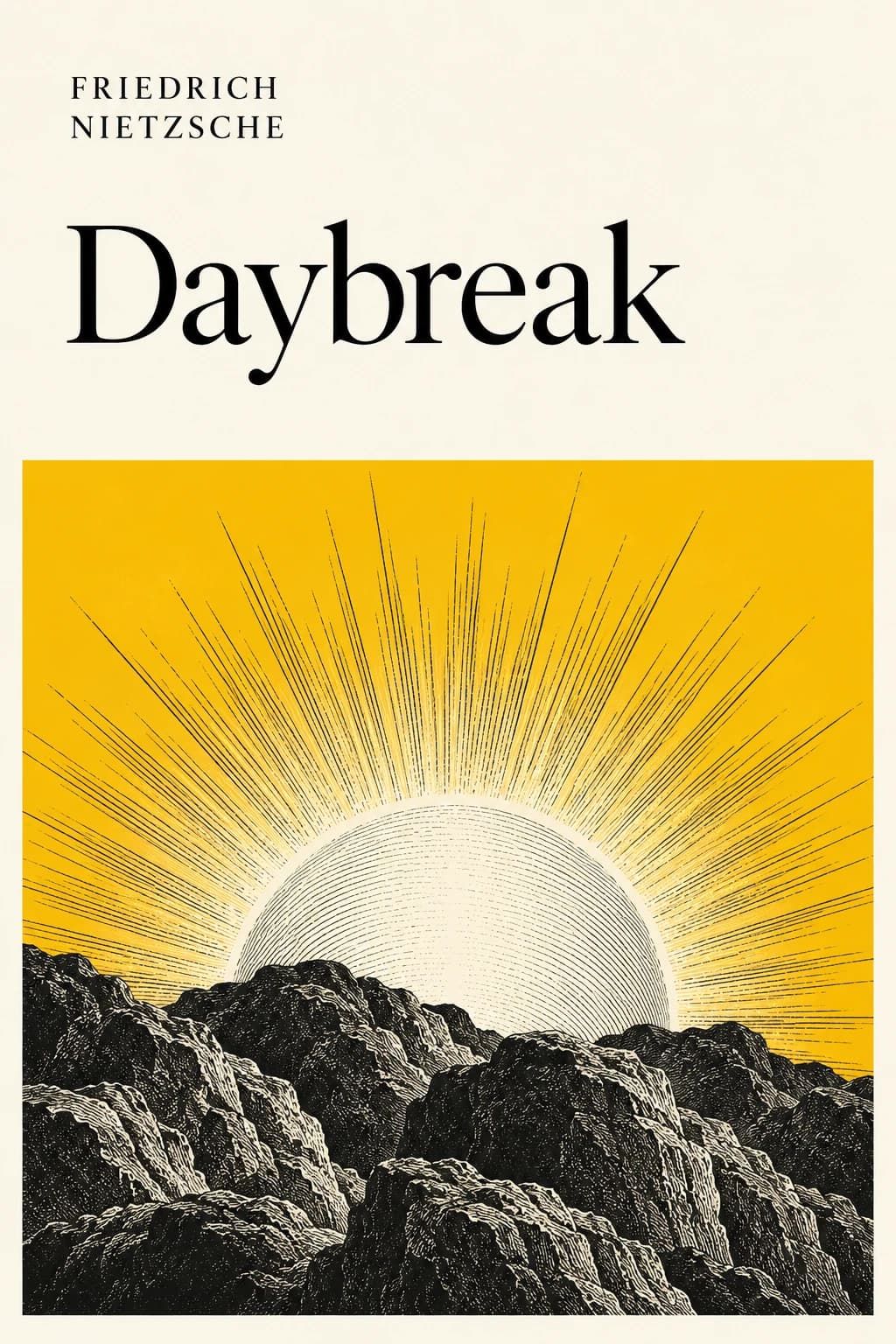
Daybreak
1881
A sustained investigation of the assumptions behind moral judgment.
Morgenröte
Listen your way
Create audio summary ↗Review your voice and settings in SUN before generating.
In Nietzsche’s life
When it was written
- Written
- 1880–1881
- Publication
- 1881; new preface, 1886
Nietzsche investigates the origins of moral feelings through small psychological experiments. Inherited duties become questions rather than unquestioned commands.
“We are experiments: if we want to be so!”
What it’s about
Daybreak examines how customs, feelings, and explanations become moral obligations. Nietzsche presents the investigation as an experiment that loosens the authority of inherited evaluations.
Key ideas
- 1
The morality of custom
Practices become authoritative through repetition and social pressure.
- 2
Motives and interpretation
The reasons we give for actions may misdescribe their causes.
- 3
Experiments in living
Questioning morality opens possibilities for different ways of life.
Who it’s for
- Readers exploring Nietzsche’s thought
- Anyone interested in philosophy, culture, and the history of values
Other books by Friedrich Nietzsche
View all 26 works →


If you liked this
Wrote a book? List it on SUN and get paid.
Earn from every summary, course and narration made from your book. Non-exclusive — you keep your rights.