Summary by chapter
Dionysian Dithyrambs in 4 chapters, in our own words.
Chapter 1
Only Fool! Only Poet! and Among Daughters of the Desert
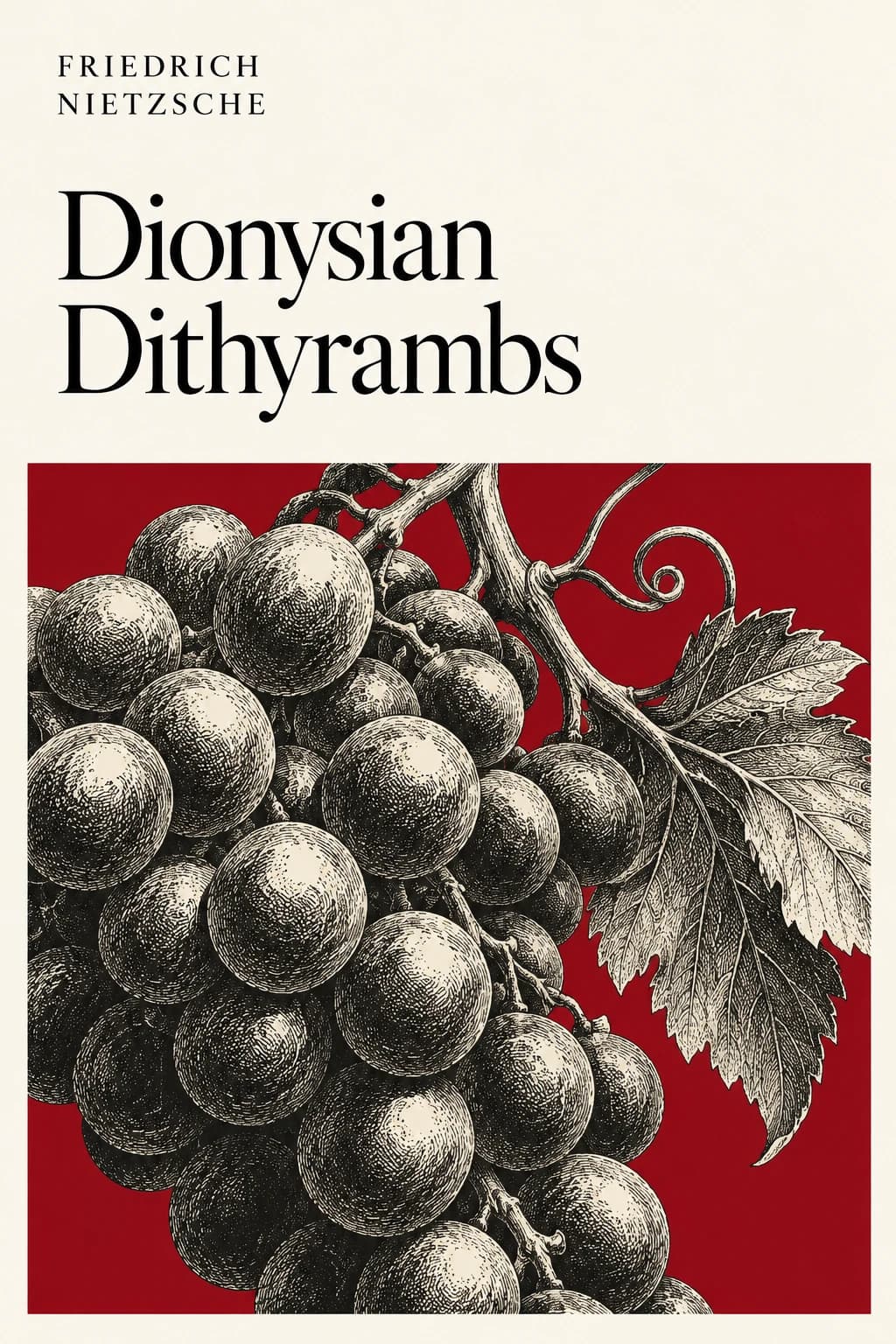
Dionysian Dithyrambs is a cycle of nine poems that Nietzsche put into final order in Turin at the end of 1888 and the very beginning of January 1889, shortly before his collapse. The dithyramb was the ancient Greek choral hymn to Dionysus, and in Ecce Homo Nietzsche claims to have reinvented the form in German. The poems are written in free, unrhymed verse with long, irregular lines and sudden changes of pace. Three of them rework songs from the fourth part of Thus Spoke Zarathustra, where they are sung by other characters; the other six are newer. Six poems appeared in print in 1892, and the complete nine-poem cycle only in 1898.
The cycle opens with Only Fool! Only Poet!, adapted from the Song of Melancholy that the old magician sings in Zarathustra. At evening, as the dew falls, the speaker recalls being mocked by the sun’s glances as a suitor of truth. He is no such thing, the mocking voice says, only a fool and only a poet, someone who speaks in many colours from behind masks, crosses false bridges of words, and roams through invented heavens. Against this it sets the image of a predator, an eagle or panther that falls on lambs, as the poet’s secret longing. The poem ends with the speaker exiled from all truth.
Among Daughters of the Desert comes from the chapter of the same name in Zarathustra, where Zarathustra’s shadow, the wanderer, sings it. A European finds himself in an oasis beside two girls, swallowed by the place as if by a whale, and describes a palm tree swaying like a dancer on one leg. The tone is comic and exotic, a parody of moralizing European pathos, yet the poem is framed by a grave refrain warning that the desert is growing and that woe comes to whoever carries deserts within. Read together, these first two poems set up the cycle’s central tension between mask and truth, and between play and the threat of inner emptiness.
Chapter 2
Last Will, Among Birds of Prey and The Beacon
Last Will is one of the shortest poems in the cycle. The speaker wishes to die as he once saw a friend die, a friend who cast lightning and looks into his dark youth, a warrior who was wanton and deep, dancing in battle and the most cheerful of fighters. That friend, the poem says, rejoiced in victory even while dying and commanded even as he destroyed. Commentators have proposed different real models for the figure, but the poem works on its own terms as a wish for a death that is itself an act of affirmation rather than resignation.
Among Birds of Prey is darker. Zarathustra appears on a cliff above an abyss, surrounded by birds of prey, hanging, as it were, from his own rope. The poem calls him a self-knower and his own executioner, a hunter who has hunted himself and now lies wounded, caught between two nothings, a question mark, a riddle for the birds that circle him. It is often read as the counterpart of the proud solitude celebrated elsewhere in Nietzsche’s work: the same isolation that frees the thinker also turns his insight against himself.
The Beacon, sometimes translated as The Fire Signal, is set on an island where a sacrificial stone rises from the sea. Zarathustra lights a fire there, a flame that rises toward ever purer heights, and the poem identifies this flame with his soul, restless and hungry for new heights. The fire is a signal and a question sent out to distant, solitary people, a line cast for those who might answer. The poem associates the moment with his seventh and last solitude, linking the cycle to the imagery of height, loneliness and calling that runs through Zarathustra.
These three middle poems share an image of the solitary figure at a height: on a battlefield, on a cliff above an abyss, on an island rock. Nietzsche had used such images since Zarathustra, where height stands for freedom from the crowd and also for danger. What changes here is the emphasis on cost. Last Will imagines a death that crowns a life of struggle; Among Birds of Prey shows the thinker wounded by his own insight; The Beacon sends a call outward in hope of an answer. Read in sequence, they suggest that solitude is neither simply heroic nor simply tragic, but a condition the poet must both endure and use.
Chapter 3
The Sun Sinks and Ariadne’s Lament
The Sun Sinks is the calmest and most lyrical poem in the collection. In three short sections the speaker addresses his own burning heart, which will not thirst much longer, and greets the evening of his life as the sun goes down. The mood moves from heat and exhaustion toward a golden serenity, with images of cool evening air, a quiet sea and a small boat drifting on it. Many readers hear in it a farewell, though it is a farewell without bitterness. The poem turns the ending of a day into an image of fulfilment, the closest the cycle comes to peace.
Ariadne’s Lament is the most famous of the nine and the most striking revision. In Zarathustra the same lament is sung by the old magician, a deceiver performing anguish. Here Nietzsche gives it to Ariadne, the Cretan princess of Greek myth who was abandoned by Theseus on Naxos and then found by Dionysus. Lying stretched out and shivering, she cries out to an unknown, cruel god, a hunter hidden behind clouds who torments her, and yet she begs him to come back, since even pain from him is better than his absence.
At the end of the poem Dionysus himself appears, in emerald beauty, and answers her. He tells her to be wise, remarks that she has small ears, and declares that he is her labyrinth. The ending transforms the poem from a lament into an encounter between the god and the soul that longs for him. Ariadne had come to matter greatly in Nietzsche’s late thought: in Ecce Homo he asks who but he knows who Ariadne is, and in his letters of January 1889 he signed himself Dionysus and addressed Cosima Wagner as Ariadne. Scholars read the figure both as a mythic image of the soul that affirms life and as a reflection of his private history.
The placement of the two poems is telling. The Sun Sinks offers a serenity reached alone, while Ariadne’s Lament suggests that the soul cannot complete itself alone and needs the god who wounds it. Nietzsche’s revision also reverses the lament’s meaning. In Zarathustra, Zarathustra stops the magician with blows of his stick and calls him an actor for staging his suffering; in the cycle, the same words become sincere and are answered. Critics often see in this change Nietzsche’s late view that the masks of art can carry genuine feeling, and that affirmation includes even the longing and pain a stern moralist would dismiss as theatre.
Chapter 4
Fame and Eternity and On the Poverty of the Richest
Fame and Eternity is in several parts and builds to the cycle’s most exalted vision. It begins with contempt for fame, which it treats as a common coin that the world pays and by which the crowd measures greatness, and for those who bow before it. Then the poem turns upward to a vision of the highest constellation of being, an eternal tablet of necessity that no wish can reach and no denial can stain. What this vision offers is an eternal Yes of being, and the speaker answers it with a declaration of love for eternity, echoing the refrain of The Seven Seals at the end of the third part of Zarathustra.
On the Poverty of the Richest closes the cycle and returns to Zarathustra. After ten years in which no rain has reached him, Zarathustra has grown rich in wisdom and light, but his wealth isolates him: no one can take what he has to give, and so he is poor because he is too rich. The poem turns this into a reflection on giving and receiving, a theme that runs through Zarathustra from its prologue onward, and it suggests that the overflowing giver must learn to become poorer if he is to be loved.
Taken as a whole, the cycle moves from masks and mockery through solitude, self-wounding and longing to visions of eternity and the problem of the giver. It gathers the main images of Nietzsche’s late work, Dionysus, Ariadne, the labyrinth, the growing desert, eternity and the overflowing soul, into lyrical form. Because it was completed in the final days before his breakdown, readers have often searched it for signs of illness. Most critics now read it instead as a deliberate, carefully revised work in which Nietzsche tried to give his philosophy of affirmation a voice that argument alone could not supply.
The cycle also has a publication history worth knowing. Nietzsche prepared a clean copy for the printer but the cycle was not published before his collapse in January 1889. Six of them appeared in 1892, and the full cycle in his intended order followed in 1898. In the critical edition of Giorgio Colli and Mazzino Montinari, the nine poems stand together with the other works of 1888, among them Twilight of the Idols, The Antichrist, Ecce Homo and Nietzsche contra Wagner. That is where they belong: among the last works Nietzsche finished, and the one in which he chose verse rather than prose as the final form for his thought.