Summary by chapter
Idylls from Messina in 4 chapters, in our own words.
Chapter 1
Messina, Spring 1882
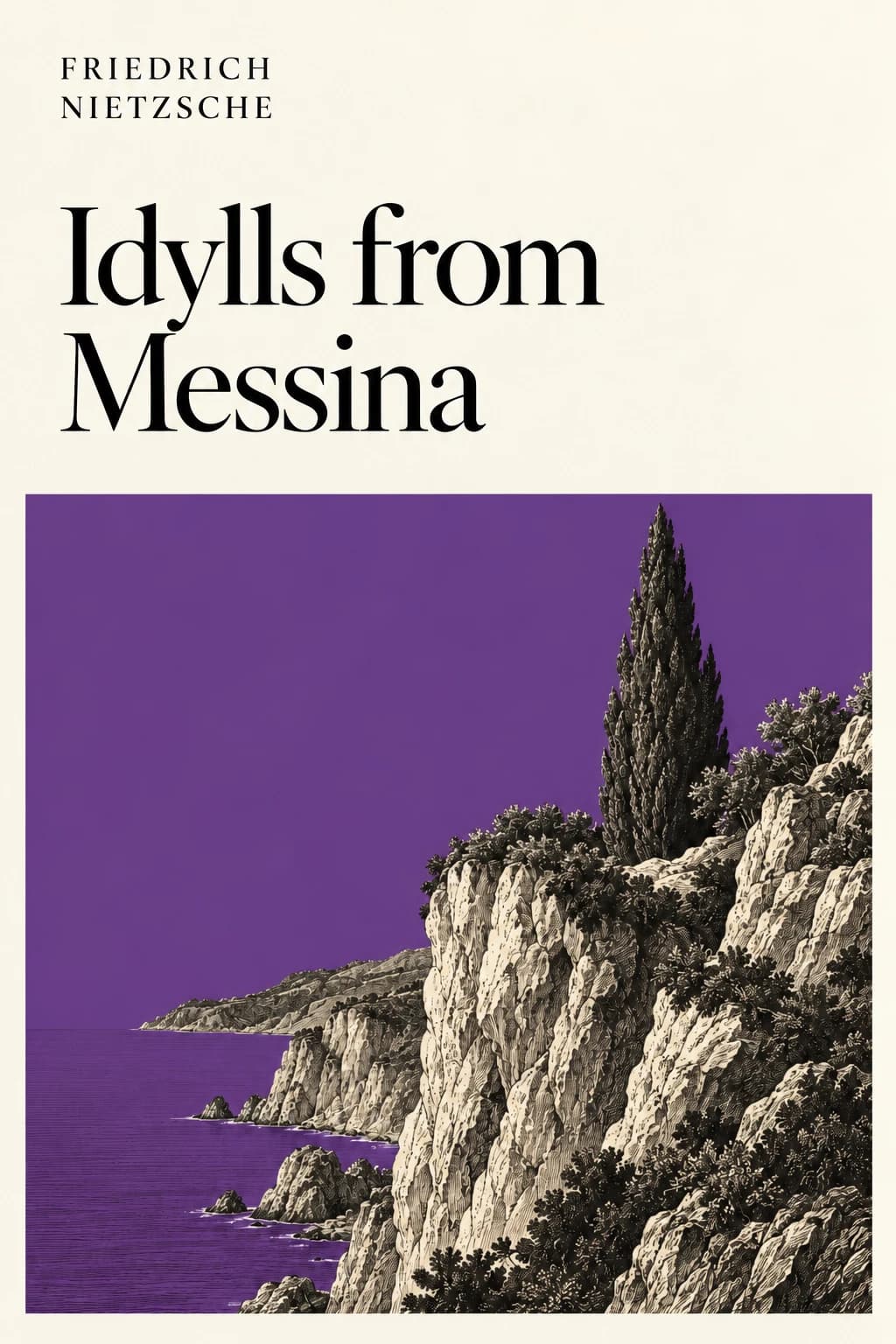
In the spring of 1882 Nietzsche did something unusual for a man of his fragile health: he sailed from Genoa to Sicily and spent a few weeks in Messina. He had recently finished the first version of The Gay Science, and the trip seems to have been partly an escape and partly an experiment in living further south, under brighter skies. The visit was short. Within weeks he left for Rome, where his life would soon take a very different turn. But from those weeks came a small cycle of eight poems, the Idylls from Messina.
The poems appeared in May 1882 in a literary periodical published by Ernst Schmeitzner, Nietzsche’s publisher at the time. They were not issued as a book, and they are easy to overlook in a body of work dominated by prose. Yet they matter. They show Nietzsche writing verse in a light, songlike manner, full of sea air, birds, boats, southern villages and playful voices, at the very moment when his philosophy was turning toward cheerfulness, affirmation and what he called the gay science. The same year, The Gay Science itself opened with a prelude of short rhymed verses, so the Idylls belong to a period when verse and philosophy were closely entwined in his work.
The title promises idylls, a word that recalls the pastoral poetry of ancient Sicily, above all Theocritus of Syracuse, the founder of the genre. Nietzsche plays with that inheritance rather than imitating it. His idylls are short, rhythmic and often ironic, and their speakers are masks: a bird-prince, a goatherd, a pious girl, a lover addressing an albatross. Reading them as straightforward confessions misses their point, which is to try on voices and moods with a lightness that his philosophical books were beginning to praise. The best way to approach them is as one would approach songs: for their tone, their turns of phrase and the scenes they briefly light up.
Chapter 2
Prince Free-as-a-Bird and the Birds
The cycle opens with “Prince Free-as-a-Bird” (Prinz Vogelfrei), and its title contains a pun that runs through the whole collection. In German, vogelfrei literally suggests being free as a bird, but in ordinary usage it meant outlawed, placed outside the protection of the law. The speaker is both at once: an outsider and a creature of flight. The poem celebrates leaving behind a cautious, step-by-step life for the open air of the south, trading plodding reason for song and movement. It is the cycle’s keynote, and it gave its name to the later group of poems Nietzsche added to The Gay Science.
Birds return elsewhere in the cycle. “Bird Albatross” (Vogel Albatross) turns the great seabird into the object of a declaration of love, admiring a creature that rides the wind without effort and seems never to tire. “Bird Judgment” (Vogel-Urtheil), as its title announces, brings a bird’s verdict into the cycle. Flight, height and lightness were becoming central images for Nietzsche in these years, and in the poems they take the form of play rather than argument. Where his aphorisms reason about freedom, these poems simply enact it, letting the reader feel the lift of a wing or a gust of wind instead of following a proof.
These bird poems also suggest a self-portrait in disguise. Nietzsche was living as a wanderer, without a post, often alone, moving between Italian and Swiss towns in search of a climate his body could bear. The figure of the outlaw who is also free, the bird who belongs nowhere and everywhere, fits that life closely. Still, the poems keep their distance through humor and rhythm, and the speaker is a role more than a diary. That combination of personal feeling and theatrical mask is typical of Nietzsche’s verse.
Chapter 3
Sea, Night and the South
The other poems turn to people and places of the Sicilian coast. “Song of the Goatherd,” addressed to Nietzsche’s “neighbor” Theocritus of Syracuse, takes up the classic pastoral figure of the lovesick herdsman and gives him a wry, modern twist. Its dedication makes the link to ancient Sicilian poetry explicit, as if Nietzsche were greeting the old idyllist across two thousand years from just up the coast. Syracuse lies on the same island as Messina, so the gesture is both literary and geographical: a modern visitor nodding to the poet who first made Sicilian shepherds into literature. The tone is affectionate rather than reverent, and the old form is bent to a new, more ironic voice.
Several poems belong to the harbor and the sea. “The Little Brig Called ‘Little Angel’” plays on the name of a small ship and on the charm of something light, quick and a little capricious. “The Nocturnal Secret” is set by the water at night, where the speaker, unable to sleep, glimpses a boat and a mystery he cannot resolve. In these poems the sea is not the stormy, tragic ocean of romanticism but a bright or moonlit stage for small, strange events. The mood is closer to a folk song or a sailor’s ballad than to grand lyric poetry, and the brevity of each piece is part of its charm.
Two poems take on religion with a light, teasing touch. “The Little Witch” presents a pretty young woman whose piety sits comfortably alongside her charms, and it teases the easy bargains of popular piety. Another poem, bearing an Italian title and set at a campo santo, a cemetery, brings the cycle near to death without dropping its lightness. Taken together, the eight poems sketch a southern world of sailors, girls, herdsmen, monks, birds and graves, seen with affection and irony by a visitor from the north.
Chapter 4
From Messina to The Gay Science
Nietzsche did not leave the Idylls as they were. When he prepared the expanded second edition of The Gay Science in 1887, he added an appendix of poems called the Songs of Prince Vogelfrei, and several of the Messina poems reappear there in revised form, with new titles and altered lines. The bird-prince’s flight south, the goatherd’s song, the pious girl and the night-time boat all found new life in that appendix, where they sit beside new poems and face the philosophical book they accompany. Comparing the two versions is one of the best ways to see Nietzsche at work as a craftsman of verse.
The revision tells us how Nietzsche valued the cycle. He did not treat it as juvenile verse to be forgotten, but as material worth reshaping for one of his central books. The Gay Science praises lightness, laughter, the south and the courage to treat life as an experiment, and it declares that seriousness need not be heavy. The Messina poems put that attitude into practice. They are less a statement of doctrine than a demonstration of a mood, an experiment in philosophical form carried out in rhyme. In that sense the poems belong to the same project as the aphorisms: finding forms that make thinking lighter, quicker and more alive.
For readers today, the Idylls from Messina are a small but revealing work. They are not a major achievement in German poetry, and they are best read alongside The Gay Science and Thus Spoke Zarathustra, where Nietzsche’s poetic gifts show more fully. But they capture a brief, bright moment in his life: a sick, solitary thinker at sea and in the south, trying on the voice of a free bird and finding that thought can dance. That image of dancing thought would return, far more grandly, in Zarathustra the following year.