Summary by chapter
Nachlass: Writings from the Late Notebooks in 7 chapters, in our own words.
Chapter 1
What the Nachlass Is
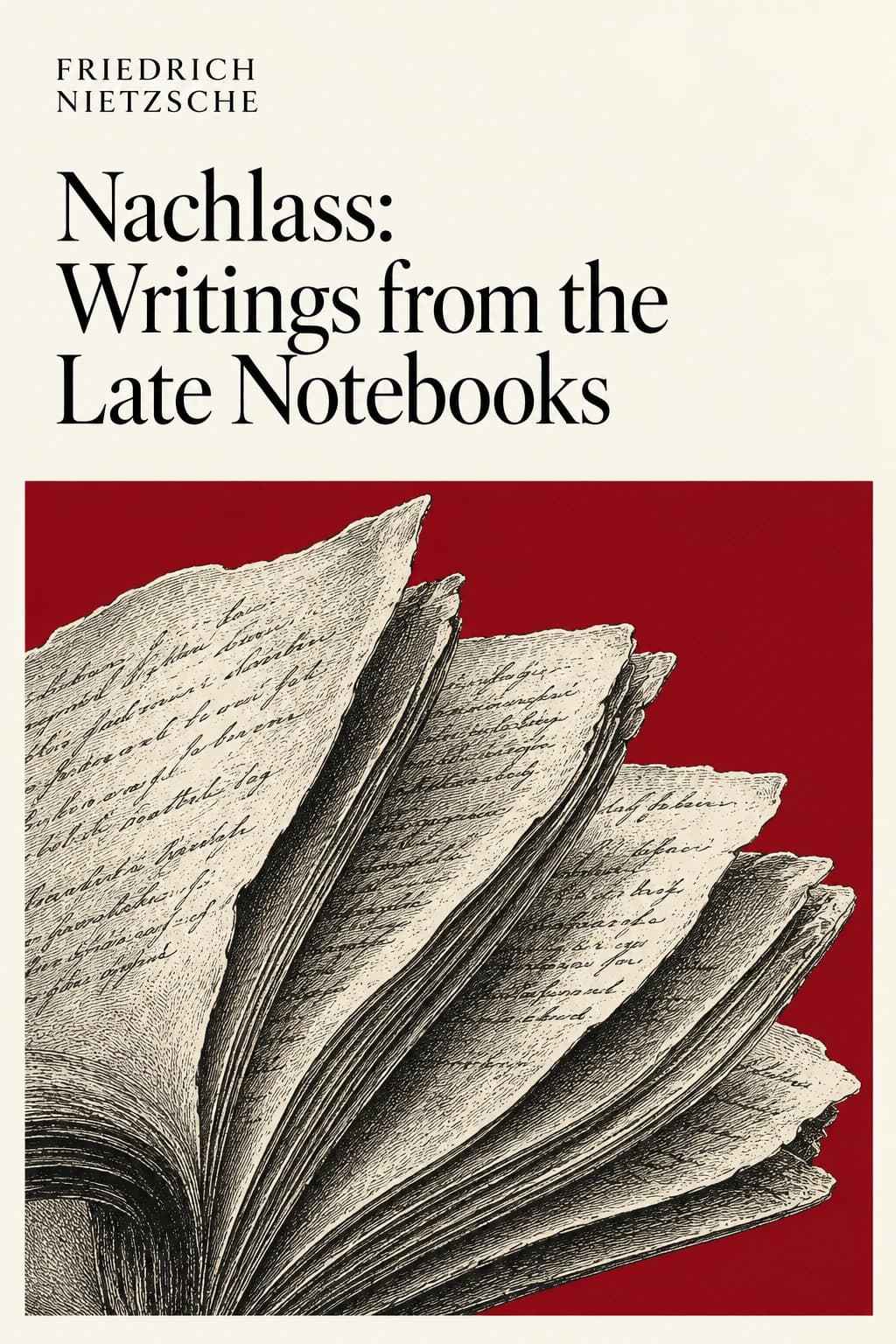
Nachlass is the German word for a person’s literary estate, everything left behind unpublished at death. In Nietzsche’s case it is enormous. From his student years to his collapse in January 1889 he kept notebooks, pocket books, loose sheets and folders, and in them he drafted aphorisms, sketched plans for books, copied passages from what he was reading, made lists, tried out titles, and wrote letters in draft. The material runs from about 1869 to 1889 and, in modern critical editions, fills several thousand printed pages, more than all the books he published in his lifetime.
This summary concentrates on the late notebooks of the 1880s, the period after Thus Spoke Zarathustra, when Nietzsche was working toward a major systematic work and produced the notes later used for the compilation known as The Will to Power. Earlier parts of the estate include unpublished essays now read as separate works, such as On Truth and Lies in a Nonmoral Sense and Philosophy in the Tragic Age of the Greeks, as well as his Basel lecture notes. The title Writings from the Late Notebooks is also used by a well-known English selection of notes from 1885 to 1888, printed in chronological order.
The most important thing to understand about the Nachlass is what kind of writing it is. A notebook entry can be a finished thought, a first draft of something later published, a hypothesis tried and dropped, a summary of another author, or a reminder to himself. Nietzsche often worked by writing notes on walks, copying and revising them in larger notebooks, and then reworking the best of them for print. The notebooks therefore show his workshop, and reading them well depends on knowing when a note was written, what surrounds it, and whether he later used, revised or abandoned it.
Chapter 2
From the Nietzsche Archive to The Will to Power
After Nietzsche’s breakdown in 1889, control of his manuscripts passed to his sister, Elisabeth Förster-Nietzsche, who returned in 1893 from the failed colony she had helped found in Paraguay with her late husband, the anti-Semitic agitator Bernhard Förster. She established the Nietzsche Archive, first in Naumburg and then in Weimar, and directed the publication of his works and papers. The Archive’s large collected edition, begun in the 1890s, printed much of the Nachlass, but selectively, often without dates, and arranged by the editors’ sense of theme. Nietzsche himself, cared for by his mother and then by his sister, was unable to take any part in these decisions.
The most consequential product of this work was The Will to Power. Nietzsche had planned a book with that title from the mid 1880s and drafted many outlines for it, but he abandoned the plan in late summer 1888, using material instead for Twilight of the Idols and The Antichrist. The Archive nonetheless published a compilation under that title in 1901, with 483 sections, and an expanded version of 1,067 sections in 1906, edited by Elisabeth and Nietzsche’s friend Peter Gast. Arranged into four books under headings Nietzsche never assigned, it presented his notebooks as the finished system he supposedly did not live to publish.
Elisabeth’s editorial control extended beyond selection. Later research showed that she suppressed passages, including parts of Ecce Homo critical of herself and their mother, and that she altered or fabricated some letters to make herself appear his closest confidante. She also promoted her brother to German nationalists and, in her last years, welcomed Nazi leaders to the Archive. These facts do not make every reading of the notebooks suspect, but they explain why scholars came to insist on returning to the manuscripts themselves. The question was no longer only what Nietzsche thought, but what he had actually written and when.
Chapter 3
Schlechta, Colli and Montinari
The first serious challenge to the Archive’s version came from Karl Schlechta, whose three-volume edition of Nietzsche’s works appeared between 1954 and 1956. Schlechta printed the notes used for The Will to Power not in the editors’ thematic order but in the order of the manuscripts, under the plain title From the Nachlass of the Eighteen-Eighties, and he documented Elisabeth’s forgeries of letters. His edition sparked fierce debate in Germany about how much of the received image of Nietzsche rested on editorial invention. Critics accused him of diminishing Nietzsche’s importance; defenders replied that he had simply let readers see the evidence.
The decisive work was done by two Italian scholars, Giorgio Colli and Mazzino Montinari. Beginning in the early 1960s, working in the Weimar archive in what was then East Germany, they set out to transcribe and date all of Nietzsche’s manuscripts. Their critical edition, the Kritische Gesamtausgabe, began appearing in 1967, and a fifteen-volume study edition followed in 1980. It prints the notebooks chronologically, in their original groups, using a reference system of notebook and fragment number, such as 7[60] for a note from late 1886 to spring 1887. Most scholarship now cites the notebooks this way rather than by Will to Power section numbers.
Montinari’s research showed in detail how the earlier compilation had cut, merged and reordered notes from different years, misread words, and in some cases printed Nietzsche’s excerpts from other writers as if they were his own thoughts. His verdict, often summarized as the claim that the book called The Will to Power does not exist as a work by Nietzsche, reshaped the field. More recently the Colli and Montinari edition has been supplemented by a section reproducing the late notebooks page by page in a more exact transcription, and by Nietzsche Source, a free digital edition launched in 2009 that makes the whole critical text searchable online.
Chapter 4
Nihilism and the Revaluation of All Values
The single most important theme of the late notebooks is nihilism. Nietzsche had used the word before, but from 1885 onward he analyses it repeatedly as the condition in which the highest values devalue themselves, so that there is no goal and no answer to the question of why. He traces it to Christian morality itself, which trained people in a truthfulness that finally exposes the morality’s own fictions. A long note written at Lenzer Heide in Switzerland on 10 June 1887 sets out this argument most fully and links it to the thought of eternal recurrence as nihilism’s most extreme form.
The notes distinguish forms of nihilism: active nihilism, a sign of strength that destroys values it has outgrown, and passive nihilism, a sign of exhaustion that longs for rest. They also criticize what Nietzsche calls incomplete nihilism, the attempt to keep Christian morality while dropping Christian belief. Out of this diagnosis grew his project of a revaluation of all values, a phrase that recurs in plans and title pages through 1887 and 1888. The notebooks show him trying out many arrangements: four books, then other sequences, first under the title The Will to Power and later under the title Revaluation of All Values.
In late summer 1888 the plans changed decisively. Nietzsche dropped The Will to Power as a title and turned his material toward two books he did complete, Twilight of the Idols and The Antichrist, which he came to regard as the first book, and then the whole, of the Revaluation. Comparing the notebooks with these books is instructive. Many of the published sections exist first as notes, sometimes almost word for word, while other notes on the same themes were left aside, which suggests that Nietzsche himself judged them unfinished or unconvincing.
Chapter 5
Perspectivism, Knowledge and the Body
A second major theme is knowledge. In a famous note from late 1886 to spring 1887, catalogued as 7[60], Nietzsche argues against positivism that there are no facts as such, only interpretations, and that even the claim that everything is subjective is itself an interpretation. It is our needs and drives, he suggests, that interpret the world, each with its own perspective and its own urge to dominate the others. This position, usually called perspectivism, appears in his published works too, but the notebooks explore it more freely and more radically.
Many notes take apart the basic categories of thought. Nietzsche argues that the idea of a thing is modelled on the idea of an ego, that belief in cause and effect projects our sense of doing onto events, and that logic depends on treating similar cases as identical. Truth, in several notes, is a kind of error without which a certain species could not live. He proposes taking the body as a guiding thread for philosophy, on the grounds that it is a richer and better-attested phenomenon than consciousness, and he imagines the self as a multiplicity of drives, a kind of commonwealth under a ruling power rather than a single soul.
These notes have been especially influential in twentieth-century philosophy, from existentialism to postmodern thought, and are often quoted out of context. Read in sequence, they show Nietzsche testing formulations against one another, sometimes contradicting himself, and moving between a sceptical view that all knowledge falsifies and a more moderate view that knowledge is always from a perspective but can be more or less honest and comprehensive. Scholars disagree about which view is his considered one, and the notebooks are the main evidence in that debate. What is clear is that the notebooks give no support to the popular idea that Nietzsche thought anything goes.
Chapter 6
Will to Power and Eternal Recurrence
The notebooks are also where Nietzsche worked out his two most famous doctrines. The first record of eternal recurrence, the thought that all things return eternally in the same sequence, comes from August 1881 in Sils-Maria, headed with the phrase that Ecce Homo later recalls: six thousand feet beyond man and time. Later notes try to give the idea a cosmological proof, arguing that if the world is a finite quantity of force in infinite time, every combination must already have recurred infinitely often. Nietzsche never published such a proof, and his books present recurrence mainly as a test: whether one could will one’s life again, forever.
The will to power grows in the notes from a psychological insight into a far broader hypothesis. Nietzsche suggests that living things seek not happiness or mere survival but an increase of power, that pleasure is the feeling of power growing, and in some notes that all force in nature should be understood as will to power. A note from 1885, revised more than once, describes the world as a monster of energy without beginning or end, a sea of forces eternally changing and returning, and ends by declaring that this world is the will to power and nothing besides, and that we ourselves are too.
How far Nietzsche held these ideas as doctrines is one of the central questions in Nietzsche scholarship. His published books state the will to power more cautiously, for instance in Beyond Good and Evil, where it is framed as an experiment in thought. Some interpreters, following Martin Heidegger, treat the notebooks as the place where Nietzsche’s real metaphysics appears. Others argue that what he chose not to publish should not outweigh what he did. The notebooks themselves support caution: the bold cosmological notes sit beside doubts, revisions and abandoned plans.
Chapter 7
Art, Christianity, Rank and the Last Notebooks
The late notebooks range widely beyond these central themes. Notes on art develop a physiological aesthetics in which intoxication, the feeling of heightened power, is the root of all art, and art is a stimulant to life rather than an escape from it. Notes on Christianity, especially from 1887 and 1888, prepare The Antichrist, with drafts on the psychology of Jesus, on Paul and on the priest. Notes on morality anticipate the Genealogy of Morality and explore the herd, resentment and the ascetic ideal. Many entries also record his reading: of French psychologists and novelists, of contemporary biology and physics, and of writers such as Tolstoy, from whom he copied passages.
Some notes on rank, breeding and the future of Europe are among the most troubling things Nietzsche wrote, speaking of a new ruling caste and of the destruction of the weak. They were seized on by Nazi-era propagandists, often through the Will to Power compilation. Read chronologically, they appear as scattered and sometimes contradictory experiments, alongside harsh criticism of German nationalism and anti-Semitism. Neither fact cancels the other, and responsible readers keep both in view. The chronological edition makes it possible to see each of these notes in its context, and to set it beside what Nietzsche actually published on the same subjects in the same months.
The final notebooks of autumn and winter 1888 show Nietzsche working at extraordinary speed on Ecce Homo, Nietzsche contra Wagner and the Dionysian Dithyrambs, alongside plans for the Revaluation and increasingly grandiose drafts. They end with his collapse in Turin in early January 1889. The story they tell is not of a hidden system waiting to be assembled, but of a writer constantly drafting, testing and discarding. That is the main lesson of the Nachlass: it is indispensable for understanding Nietzsche, provided it is read as a workshop, in chronological order and in conversation with the books he chose to publish.