This final dossier assembles and revises passages from earlier works to explain his growing distance from Wagner. It is a retrospective selection, not a new continuous treatise.
“My objections to Wagner's music are physiological objections.”
Nietzsche contra Wagner is a short dossier Nietzsche assembled in Turin at Christmas 1888 from passages about Richard Wagner in his earlier books. Lightly revised and set under new headings, the excerpts trace his path from admiring Wagner as the Orpheus of secret misery to rejecting him as an artist of exhausted, life-denying décadence.
Along the way Nietzsche judges music with his body, asking whether it lets him breathe, walk and dance, and distinguishes art born of overflowing life from art born of impoverished life. The book ends not with Wagner but with Nietzsche himself: his illness, his solitude after their break, and the lighter, healthier art he wanted instead.
Passages written from 1877 onward are rearranged into a single argument showing that Nietzsche and Wagner are antipodes.
2
Aesthetics as physiology
Music is judged by what it does to the body, and Wagner’s unending melody makes Nietzsche feel he must swim rather than dance.
3
Two kinds of sufferers
Some art springs from overflowing life and some from exhausted life, and Nietzsche places Wagner and Schopenhauer in the second camp.
4
Parsifal and chastity
Wagner’s last opera is read as a surrender to the ascetic ideal and a betrayal of his earlier praise of healthy sensuality.
5
Beyond Wagner
After great suffering Nietzsche asks for a mocking, light, cheerful art for artists, made by people superficial out of profundity.
Summary by chapter
Nietzsche contra Wagner in 6 chapters, in our own words.
Preface
Nietzsche contra Wagner, subtitled The Brief of a Psychologist, is one of the last things Nietzsche prepared before his collapse in January 1889. He dated its preface Turin, Christmas 1888. It is not a new treatise but a dossier: a selection of passages about Richard Wagner taken from books he had published since 1877, lightly revised and given new headings. Earlier in 1888 he had published The Case of Wagner, a mocking pamphlet, and this second Wagner book was meant to show that his opposition was not a sudden whim but a judgment he had been forming for more than a decade.
“
Read consecutively, they can leave no one in any doubt, either concerning myself, or concerning Wagner: we are antipodes.
Friedrich Nietzsche
The preface explains the method in a few lines. The chapters were chosen with care, Nietzsche says, made here and there a little more intelligible and above all more brief, and read in sequence they leave no doubt that he and Wagner are antipodes, standing at opposite ends of the earth. He calls it an essay for psychologists rather than for Germans, and boasts that he has readers in Vienna, St Petersburg, Copenhagen, Stockholm, Paris and New York but none in Germany, which he calls Europe’s flatland. A closing jab at the Italian prime minister Crispi and the Triple Alliance shows how much the political mood of 1888 was on his mind.
The book had an odd fate. A few copies were privately printed in 1889, but in early January Nietzsche asked for it to be held back in favour of Ecce Homo, and a public edition appeared only in 1895. Readers should keep its nature in view. Because almost every passage first appeared elsewhere, its interest lies less in new ideas than in arrangement. By setting old texts in a new order under titles such as Wagner as a Danger and How I Got Rid of Wagner, Nietzsche turns scattered remarks into a story of admiration, diagnosis and escape.
Chapter 1
Wherein I Admire Wagner; Wherein I Raise Objections
The book opens with praise, and it is real praise. Artists, Nietzsche says, often do not know what they do best, because they are too vain to be content with small perfections. Wagner is the greatest master of the tones of suffering, oppressed and tormented souls; he can give speech even to mute misery. No one equals him in the colours of late autumn, in the touching joy of a last and all too short happiness, or in the midnight hours of the soul when cause and effect seem to have come apart. He is, Nietzsche writes, the Orpheus of all secret misery and the master of everything very small.
“
My objections to Wagner's music are physiological objections. Why should I therefore begin by clothing them in æsthetic formulæ?
Friedrich Nietzsche
The trouble is that Wagner does not want to be a miniaturist. His taste runs to vast walls and daring frescoes, and he does not see that his real genius prefers to hide in the corners of half-ruined houses, where he paints his true masterpieces, all very short and often only a single bar long. The section ends with a line that sums up Nietzsche’s ambivalence: Wagner has suffered much, and that raises him above other musicians, and Nietzsche admires him wherever he sets himself to music. The praise is sincere, but it also prepares the attack: a master of the miniature who insists on the colossal is already, in Nietzsche’s eyes, at odds with himself.
The second section turns to objections, and Nietzsche insists they are physiological, since aesthetics is only applied physiology. His evidence is his own body. When Wagner’s music takes hold of him he can no longer breathe easily, his foot rebels because it wants time, march and dance, and his stomach, heart and circulation protest. Even the young Kaiser, he jokes, could not march to Wagner’s Imperial March. What the body wants from music is relief: light, bold rhythms that make heavy life lose its weight. Wagner, he says, makes one ill.
Behind the music Nietzsche sees the theatre. He calls himself anti-theatrical at heart and the stage a mob art. Wagner, alongside being the creator of the most unique music that ever existed, was above all an actor, a man for whom the attitude is the end and drama and music only means. Nietzsche recalls telling a devoted Wagnerite that in Bayreuth people are honest only in the mass: one leaves oneself at home, gives up one’s own taste and courage, and becomes herd, Pharisee, voting cattle, patron and, finally, Wagnerite.
Chapter 2
Wagner as a Danger; A Music Without a Future
Wagner as a Danger explains the technical heart of Nietzsche’s complaint through a vivid image. Older music, he says, made the listener dance. Its measured balance of time and energy kept the soul sober even while it warmed, and the charm of good music lay in that play of cool and warm currents. Wagner’s famous unending melody is like walking into the sea: gradually you lose your footing and must give yourself up to the elements and swim. Wagner, Nietzsche argues, overturned the physiological first principle of all earlier music. We no longer walk or dance; we hover.
“
It was no longer a matter of walking or dancing,—we must swim, we must hover
Friedrich Nietzsche
The danger, as he sees it, is the decay of the feeling for rhythm, chaos in place of rhythm, especially when music clings to naturalistic play-acting governed by no law of form. Expressiveness at any cost, with music as the slave of poses, is the end. The second part of the section attacks a fashion among performers for maximum dramatic relief in everything. Played that way, Mozart’s cheerful, loving and golden seriousness would be sinned against. Music that leaps out of the wall to shake the listener’s bowels works only on those a noble artist should never court: the mob, the immature, the jaded, the sick and the Wagnerites.
A Music Without a Future places Wagner in a theory of cultural history. Music, Nietzsche suggests, is the last art to grow from a culture, appearing in its autumn as the culture fades. The Dutch masters gave voice to medieval Christianity, Handel to the best of Luther’s Reformation, Mozart to the age of Louis XIV, Racine and Claude Lorrain, and Beethoven and Rossini sang out the eighteenth century. All real and original music is therefore a swan song. On this view, Wagner’s own music might be the farewell song of a culture rather than the dawn of a new one.
Wagner’s music grew from a culture already sinking. Its conditions were a certain Catholicism of feeling and a taste for old national ideals, and Nietzsche now laughs at the scholarly prejudice that saw something especially German in Wagner’s revived Scandinavian sagas and their mix of sensuality and spirituality. The present age of national wars and reaction may give such an art sudden glory, he warns, but that does not guarantee it a future. The section ends with a line typical of his late anger: the Germans themselves have no future.
Chapter 3
We Antipodes; Where Wagner Is at Home
We Antipodes, taken from The Gay Science, is the philosophical centre of the book. Nietzsche admits that he began his career with errors and exaggerations, but with hope. He took the pessimism of his century, Schopenhauer’s above all, as a sign of a richer power of thought, and he heard in Wagner’s music the earthquake of a long-imprisoned Dionysian life force. You see how I misunderstood, he says, and what I gave to Wagner and Schopenhauer: myself. The admiration of his youth, he now thinks, projected his own hopes onto them.
“
does the creative power in this case arise from a loathing of life, or from an excessive plenitude of life?
Friedrich Nietzsche
He then offers the distinction that governs his late thought about art. Every art and philosophy serves suffering and sufferers, but there are two kinds of sufferers. Some suffer from an overabundance of life and want Dionysian art and a tragic view of existence. Others suffer from an impoverishment of life and want rest, calm seas and redemption, or else intoxication, spasm and numbness. For the poor in vitality, revenge on life itself is the most voluptuous intoxication. Wagner and Schopenhauer answer both needs of these impoverished people, which is why they are his antipodes.
The richest nature, by contrast, can look at what is terrible and questionable and even take part in destruction, because its creative power can turn any desert into fertile land. Those poorest in life need mildness, goodness and a god of the sick. From here Nietzsche draws a method for judging any artist: ask whether the creative power springs from hatred of life or from overflowing life. In Goethe, he says, abundance was creative; in Flaubert, hatred. Flaubert tormented himself in writing as Pascal did in thinking, and disinterestedness, the will to nothingness, is the principle of décadence in art as in morals.
Where Wagner Is at Home, drawn from Beyond Good and Evil, argues that Wagner’s true home is Paris. France, Nietzsche says, remains the high school of taste in Europe, though its finest minds hide, and many are invalids and pessimists. Schopenhauer is more at home there than in Germany, and so is Heine. French Romanticism and Wagner belong together: writers and artists steeped in literature, fanatics of expression, discoverers of the sublime and the ugly, masters of effect, enemies of logic and straight lines, with talent greater than their genius. They taught their century what an artist was. But they were ill.
Chapter 4
Wagner as the Apostle of Chastity; How I Got Rid of Wagner
Wagner as the Apostle of Chastity is about Parsifal, Wagner’s last opera, with its Christian imagery and its ideal of the pure fool. It opens with a short poem from Beyond Good and Evil asking whether bowing, praying and ringing the Ave bell is truly the German way, and answering that what lures here is Rome, Rome’s faith sung without words. The prose that follows, adapted from the Genealogy of Morality, argues that sensuality and chastity need not be opposed at all. Every good marriage and every real love is above the contrast, and minds like Hafiz and Goethe found the tension between angel and little beast one more attraction of life.
“
Already in the summer of 1876, when the first festival at Bayreuth was at its height, I took leave of Wagner in my soul.
Friedrich Nietzsche
Nietzsche then asks whether Wagner could have been serious with Parsifal. He would like to believe it was a parody, a satyr play in which the tragedian took leave of tragedy by laughing at the ascetic ideal and at himself. If it was meant seriously, it was a return to sick Christian ideals and a curse on the senses and the mind, a betrayal of the young Wagner who had followed the philosopher Feuerbach in praising healthy sensuality. Nietzsche’s verdict is blunt: Parsifal is a work of rancour and revenge, a bad work, and preaching chastity is an incitement to unnaturalness.
How I Got Rid of Wagner comes from the preface Nietzsche added in 1886 to the second volume of Human, All Too Human. He says he took leave of Wagner in his soul during the first Bayreuth festival in the summer of 1876. Since returning to Germany, Wagner had stooped to everything Nietzsche despised, even anti-Semitism, and soon afterwards he fell on his knees before the Christian cross. Biographers note that this account compresses a gradual estrangement. Wagner’s Christian turn became clear to Nietzsche through Parsifal in the years after 1876, and their last meeting was in Sorrento that autumn.
The break left Nietzsche ill and exhausted, tired of the idealistic lies that had conquered even so brave a man, and alone, since he had had no one but Wagner. From that solitude he took sides against himself and for whatever hurt him, and found the road to what he calls a courageous pessimism, the opposite of idealistic falsehood and the road to his own mission. That hidden task, he says, takes revenge on us for every attempt to evade it, and illness is always the answer when we doubt our right to it.
Chapter 5
The Psychologist Speaks; Epilogue
The Psychologist Speaks, taken from Beyond Good and Evil, widens the focus from Wagner to the fate of exceptional people. A born psychologist who studies higher human beings is in danger of being suffocated by pity, because their ruin is the rule. He learns to keep silent while others praise, and he suspects that the crowd has often worshipped a god who was really a poor sacrificial animal. Success, Nietzsche says, is the greatest liar: the work invents the person thought to have made it, and great men as they are revered are little fictions composed afterwards.
“
I doubt whether such suffering improves a man; but I know that it makes him deeper
Friedrich Nietzsche
He gives examples of poets, Byron, Musset, Poe, Leopardi, Kleist and Gogol, men of the moment who often took revenge in their works for an inner flaw, and idealists out of nearness to the mud. In the context of this book the passage reads as a portrait of Wagner without his name. Nietzsche adds a reflection on suffering and rank: how deeply a person can suffer almost determines their rank, and profound suffering makes noble because it separates. Such people hide behind masks, cheerfulness, a scientific manner or insolent folly, as Hamlet did.
The Epilogue, adapted from the 1887 preface to The Gay Science, turns from Wagner to Nietzsche himself. He asks whether he does not owe more to the hardest years of his life than to any others, and answers with amor fati, the love of what is necessary, which he calls the core of his being. To his long illness he owes a higher health, one that grows stronger under whatever does not kill it, and even his philosophy. Great pain, he writes, is the ultimate liberator of the spirit, because it teaches deep suspicion and forces the philosopher down into his own depths.
Out of such abysses, Nietzsche says, one returns as if reborn, with a second and more dangerous innocence and a finer taste for joy. Convalescents need a different art from the loud, romantic, intoxicating art of the cultured crowd: a mocking, light, divinely untroubled art, an art for artists. He also renounces the youthful madness of wanting truth at any price. The Greeks knew how to stop at the surface and worship appearance, forms, tones and words, and were superficial out of profundity. The book that began as a case against Wagner thus ends by sketching the healthier art and life that Nietzsche wanted in its place.
Who it’s for
Music lovers curious why Wagner inspired both devotion and fierce rejection
Readers of The Birth of Tragedy who want to see how Nietzsche’s hopes for Wagner turned to disillusion
Anyone drawn to Nietzsche’s reflections on illness, recovery and loving one’s fate
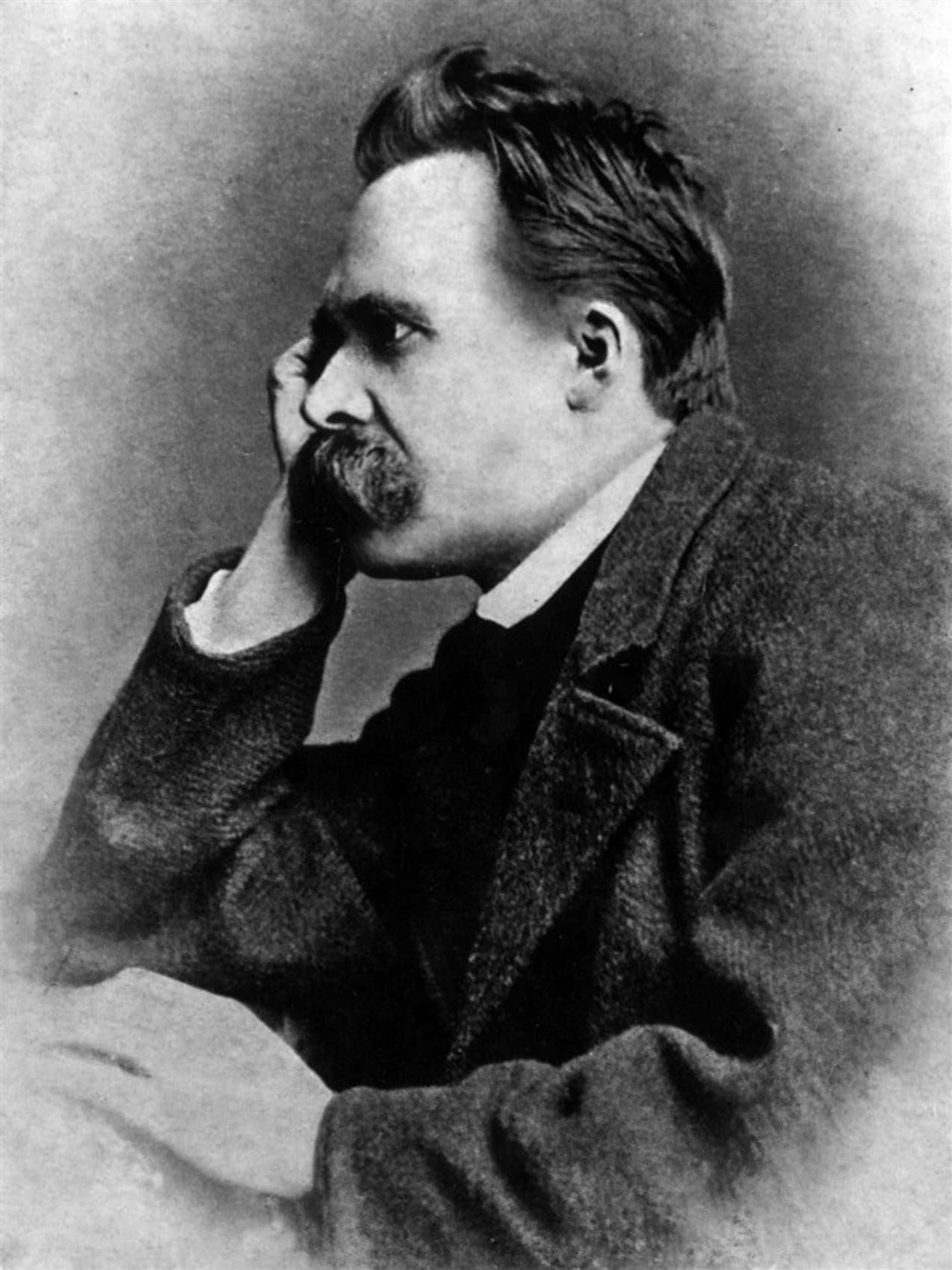
Friedrich Nietzsche was born on 15 October 1844 in Röcken, a village near Leipzig in Prussian Saxony, the son of a Lutheran pastor who died when Friedrich was four. He studied theology and then classical philology at Bonn and Leipzig, and in 1869, at just 24 and before he had formally completed his doctorate, he was appointed professor of classical philology at the University of Basel. There he became a close friend of Richard Wagner, whose music and cultural ambitions shaped his first book, The Birth of Tragedy, in 1872.
Chronic illness forced Nietzsche to give up his professorship in 1879. For the next decade he lived on a small pension, moving between the Swiss Alps, the Italian Riviera and Turin, and wrote the books for which he is best known: Daybreak, The Gay Science, Thus Spoke Zarathustra, Beyond Good and Evil, On the Genealogy of Morality and the works of 1888. In January 1889 he suffered a mental collapse in Turin from which he never recovered, and he died in Weimar on 25 August 1900.
After his collapse his sister, Elisabeth Förster-Nietzsche, took control of his papers and published selections from his notebooks, most famously The Will to Power, shaping his reputation in ways later scholars rejected. The critical edition by Giorgio Colli and Mazzino Montinari restored his texts. His ideas about the death of God, the will to power, eternal recurrence, the Übermensch and the genealogy of values went on to influence existentialism, psychoanalysis, modern literature and much of twentieth-century philosophy.
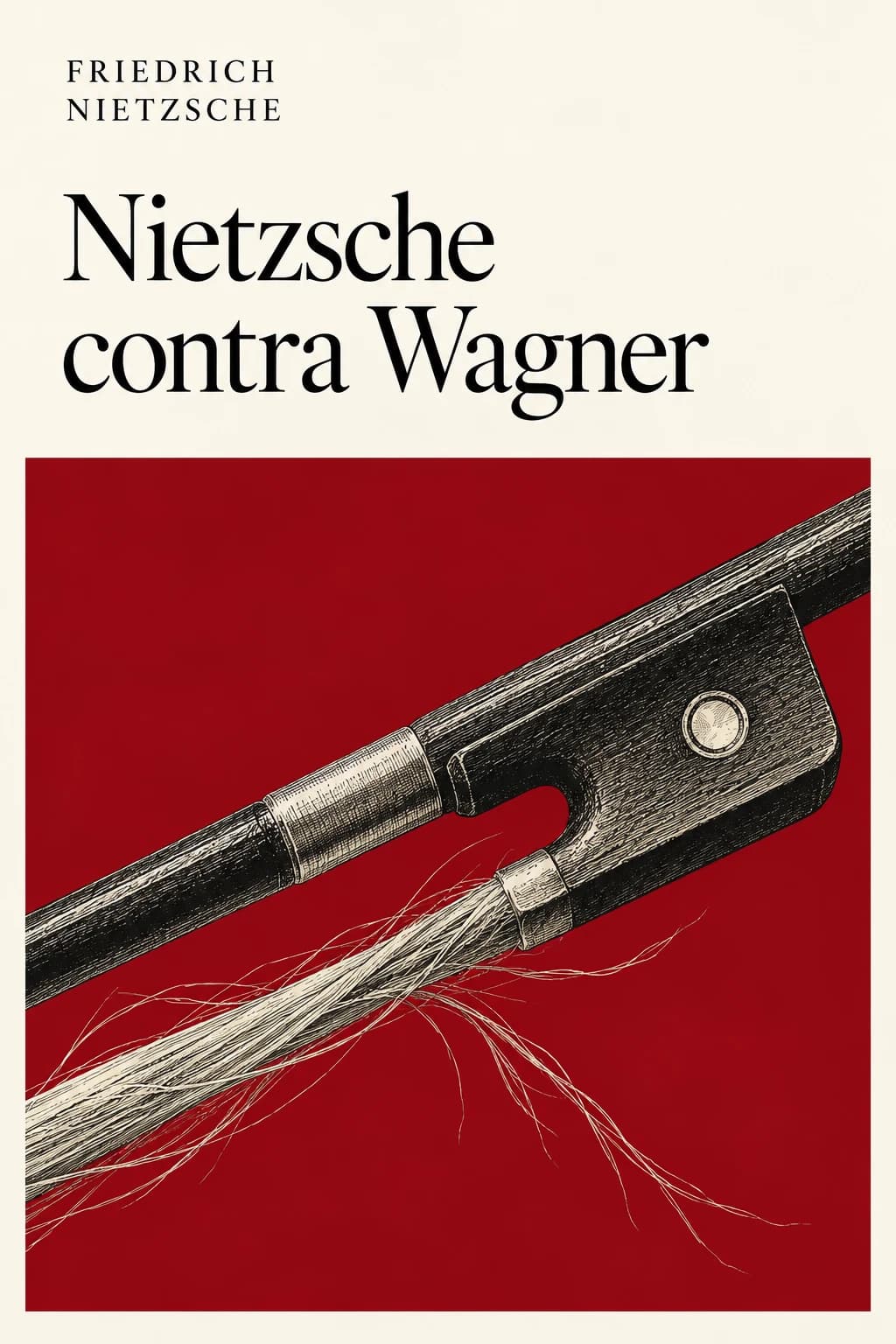
Nietzsche contra Wagner is a short book Nietzsche assembled in December 1888 from passages about Richard Wagner in his earlier works. Arranged under new headings, the excerpts tell the story of his relationship to Wagner: admiration for Wagner’s genius in expressing suffering, physiological objections to his music, a diagnosis of Wagner as an artist of decline, an attack on the Christian opera Parsifal, an account of the break between them, and finally Nietzsche’s own philosophy of suffering, convalescence and a lighter, healthier art.
What is the main idea of Nietzsche contra Wagner?
The main idea is that Nietzsche and Wagner are antipodes, standing for opposite relations to life. Nietzsche argues that art should be judged by the kind of life it serves. Some artists create out of overflowing vitality, like Goethe; others create out of exhaustion and hatred of life, and offer their audience intoxication, redemption or numbness. He places Wagner, like Schopenhauer, in the second group. Wagner’s endless melody, his theatricality and his late turn to Christian chastity in Parsifal are, for Nietzsche, symptoms of décadence.
What are the key takeaways from Nietzsche contra Wagner?
First, Nietzsche never stopped admiring Wagner’s gift for expressing suffering and small, intimate moods. Second, he treats aesthetics as applied physiology, judging music by its effects on breathing, walking and dancing. Third, he thinks Wagner’s unending melody dissolves rhythm and turns music into a servant of theatrical effect. Fourth, he distinguishes art born of abundance from art born of impoverished life. Fifth, he reads Parsifal as a betrayal of sensuality. Finally, he credits his own suffering and solitude after the break with giving him a deeper health and philosophy.
Why did Nietzsche break with Wagner?
In the book Nietzsche gives several reasons. He says he took leave of Wagner inwardly during the first Bayreuth festival in 1876, repelled by the theatre crowd and by Wagner’s accommodation to German nationalism and anti-Semitism. He then saw Wagner turn to Christianity in Parsifal, which he regarded as a surrender to the ascetic ideal. Philosophically, he came to see Wagner, like Schopenhauer, as an artist of declining life. Biographers add that the estrangement was gradual and also personal, and that Nietzsche’s account compresses years into a single dramatic moment.
What does Nietzsche mean by calling his objections physiological?
Nietzsche means that he judges music by its effects on the body rather than by abstract rules of beauty. Aesthetics, he says, is applied physiology. When Wagner’s music works on him, he cannot breathe freely, his foot wants a march or a dance and finds none, and his whole body protests. He wants music that brings relief, quickens life and lightens its weight. Behind the joke about needing throat pastilles lies a serious claim that runs through his late work: values and tastes are signs of health or sickness in those who hold them.
How does Nietzsche contra Wagner compare with The Case of Wagner?
Both books date from 1888 and both attack Wagner, but they differ in form and tone. The Case of Wagner, published that autumn, is a new and witty pamphlet that contrasts Wagner with Bizet’s Carmen and treats Wagner as the representative modern artist. Nietzsche contra Wagner is a compilation of older passages, some from as early as 1877, and it is more personal, including real praise for Wagner and an account of Nietzsche’s own suffering and recovery. It reads as evidence that his judgment had been long in the making.
Is Nietzsche contra Wagner worth reading?
Yes, especially for anyone interested in Nietzsche’s relationship with Wagner or in his philosophy of art. It is short, vivid and full of memorable images, such as Wagner as the Orpheus of secret misery and unending melody as walking into the sea. It also gathers some of Nietzsche’s finest pages, including We Antipodes and the epilogue on suffering and a second innocence. Readers should remember that almost everything in it appeared first in other books, so those who know his works well will find familiar material in a new arrangement.
Who should read Nietzsche contra Wagner?
The book is well suited to music lovers curious about why Wagner provoked such strong reactions, and to readers of Nietzsche who want a compact view of his thought on art, health and décadence. It works as a companion to The Birth of Tragedy, which shows the young Nietzsche’s hopes for Wagner, and to The Case of Wagner, which shows his mature mockery. Readers with no interest in Wagner may still value its final sections, which offer some of Nietzsche’s most personal reflections on illness and recovery.
How long does it take to read Nietzsche contra Wagner?
Nietzsche contra Wagner is very short, about 6,600 words in this translation by Anthony M. Ludovici and J. M. Kennedy, so most readers can finish it in under half an hour at an average pace. Many will want longer, since its compressed passages refer to Wagner’s operas, Schopenhauer, French Romanticism and Nietzsche’s other books. Reading it alongside The Case of Wagner makes for a satisfying afternoon and gives a full picture of Nietzsche’s final view of the composer who had once been his closest friend.