Written in 1873 and published only after Nietzsche’s collapse, this short essay asks where the human drive for truth comes from. It opens with a fable of clever animals who invent knowledge on a star that soon goes cold, then argues that the intellect began as a tool for survival through disguise, and that truth began as a social agreement about how things must be named.
Nietzsche’s central claim is that words are metaphors for nerve stimuli and that concepts arise by treating unequal things as equal, as the word “leaf” ignores what makes each leaf unique. Truths are worn-out metaphors whose origin we have forgotten. The essay ends by contrasting the rational person who shelters behind concepts with the intuitive, artistic person who plays freely with them.
Every concept is formed by equating unequal things, as the idea of a leaf ignores what makes each leaf distinct.
2
Truth as convention
Truth begins as a social peace treaty that fixes how things must be named, with the liar as its offender.
3
An army of metaphors
Truths are worn-out metaphors whose human origin has been forgotten, like coins whose faces have rubbed away.
4
Intellect as disguise
The intellect evolved to help weak creatures survive through dissimulation, so a pure drive to truth is the real puzzle.
5
Art frees the intellect
In myth and art the drive to make metaphors escapes rigid concepts and deceives without doing harm.
Summary by chapter
On Truth and Lies in a Nonmoral Sense in 6 chapters, in our own words.
Chapter 1
Part 1: The Clever Animals
The essay opens with a fable. Somewhere in a remote corner of the universe, on a star among countless solar systems, clever animals once invented knowing. It was, Nietzsche says, the haughtiest and most mendacious minute in the history of the world, and only a minute. Nature drew a few breaths, the star cooled, and the clever animals had to die. Even this story, he adds, fails to show how shadowy, fleeting and aimless the human intellect looks within nature. There were eternities when it did not exist, and when it is gone nothing will be changed.
“
In some remote corner of the universe, effused into innumerable solar-systems, there was once a star upon which clever animals invented cognition.
Friedrich Nietzsche
The point is to puncture human self-importance. The intellect has no mission beyond human life, yet its owners treat it as if the world turned around it. If we could talk with a gnat, Nietzsche says, we would learn that it too floats through the air with the same solemnity and feels itself the flying center of the world. The smallest puff of knowledge swells any creature up like a balloon, and just as a porter wants admirers, the proudest of men, the philosopher, imagines the eyes of the universe trained on his every thought.
Why, then, do we have an intellect at all? Nietzsche’s answer is that it was given to the weakest and most delicate creatures as a device for keeping them alive. Lacking horns or fangs, such beings survive by dissimulation. In humans this art reaches perfection: deception, flattery, lying, putting on a show, wearing masks, all circling around the single flame of vanity. Given all this, he finds nothing harder to explain than how an honest drive toward truth could ever have arisen. Its most general effect, he says, is deception, and the pride that comes with knowing spreads a blinding fog over the senses, flattering us about the value of existence itself.
Nietzsche presses the point with images of human ignorance. Our senses glide over the surface of things and play hide and seek on their backs. Every night we let dreams lie to us without moral objection. Nature hides from us even the workings of our own bodies, the coils of the intestines and the rush of the blood, and then throws away the key. Woe to the curiosity that could peer out through a crack in consciousness and see that humanity rests on something pitiless, greedy and murderous, hanging in dreams, as he puts it, on the back of a tiger.
Chapter 2
Part 1: The Peace Treaty and the Origin of Truth
Nietzsche traces the drive to truth to a social bargain. In a state of nature, the individual uses the intellect mainly to deceive others. But out of need and boredom people want to live together, so they make peace and try to banish the war of all against all. This peace treaty brings the first step toward truth. A uniform, binding way of naming things is fixed, and the legislation of language gives the first laws of truth. Only now does the contrast between truth and lie appear. Truth, on this account, does not begin with a lonely mind facing the world. It begins as a public agreement, a set of rules for speaking that lets people trust one another enough to live together.
“
The liar uses the valid designations, the words, in order to make the unreal appear as real
Friedrich Nietzsche
His example is simple. A liar uses the agreed words to make the unreal look real, saying “I am rich” when the correct word for his state would be “poor.” If he does this selfishly and harmfully, society stops trusting him and shuts him out. What people hate, Nietzsche observes, is not deception as such but its harmful consequences. In the same limited way they want truth. They want its pleasant, life-preserving effects, they are indifferent to pure knowledge with no consequences, and they are hostile to truths that might do damage.
That raises a deeper question: do the conventions of language actually match the world? Nietzsche’s answer is no. A word is the expression of a nerve stimulus in sound, and even inferring an outside cause from the stimulus is an unjustified use of causality. When we say “the stone is hard,” we name a subjective sensation. Languages give genders to things, making the tree masculine and the plant feminine in German, which he calls arbitrary metaphors. The word for serpent refers only to its winding, which would fit a worm as well. That there are so many languages shows that adequate expression was never the point.
The creator of language, Nietzsche argues, names only the relations of things to human beings, and does so through daring leaps. A nerve stimulus becomes an image: the first metaphor. The image is copied into a sound: the second metaphor. Each time we jump into a completely different sphere. He compares us to a deaf man who sees Chladni’s sound figures form in sand, traces them to vibrating strings and announces that he now knows what people mean by tone. When we talk of trees, colors, snow and flowers, we have only metaphors of things that do not correspond to their essence.
Chapter 3
Part 1: The Leaf and the Army of Metaphors
Next Nietzsche turns to concepts. A word becomes a concept when it must fit countless cases that are similar but never truly equal. Every concept, he says, arises by equating the unequal. No leaf is exactly like any other, yet the concept “leaf” is formed by dropping their differences, and it then suggests that nature contains, besides leaves, a model leaf from which all real leaves were copied by clumsy hands. The same happens with qualities. We call a man honest and explain his honest act by his honesty, which is like saying the leaf causes the leaves. We know only many unequal actions that we have lumped together and then turned into a hidden quality.
“
truths are illusions of which one has forgotten that they are illusions; worn-out metaphors which have become powerless to affect the senses
Friedrich Nietzsche
From here comes the essay’s famous definition. Truth, Nietzsche writes, is a mobile army of metaphors, metonymies and anthropomorphisms, a sum of human relations that were poetically heightened and adorned and that, after long use, seem fixed, canonical and binding to a people. Truths are illusions whose illusory nature has been forgotten, metaphors worn out and drained of sensuous force, coins whose faces have rubbed off so that they now count only as metal. The image explains why such truths feel solid: their metaphorical character has faded through use, and what was once a bold transfer of meaning now passes unnoticed as plain fact.
This explains where the feeling for truth comes from. Society requires us to be truthful, which in practice means to use the customary metaphors, or, in Nietzsche’s provocative phrasing, to lie according to a fixed convention in a style binding for all. Because we forget that this is what we are doing, we come to feel a moral obligation to call one thing red and another cold. The excluded liar teaches by contrast how venerable and useful truth is. As rational beings we then govern our lives by these paler, cooler abstractions rather than by raw impressions.
Nietzsche admires the result while denying its claims. Out of concepts humans build a pyramidal order of castes and grades, laws and privileges, as regular as a Roman columbarium, the vault where funeral urns stand in neat rows. They raise this vast dome of ideas on running water, an architectural feat greater than the bee’s, since the bee builds with wax it finds while humans must make their material themselves. But finding truth within this structure is like hiding something behind a bush and then finding it there. Define a mammal, inspect a camel and declare “Behold a mammal,” and you have a truth that is human through and through, with nothing in it true in itself.
Chapter 4
Part 1: Forgetting, Perception and the Laws of Nature
Humans live with calm and security, Nietzsche argues, only because they forget. The original world of metaphors, which once poured out of human imagination like a fiery liquid, has hardened, and we come to believe that this sun, this window, this table are truths in themselves. Above all we forget ourselves as subjects, and as artistically creating subjects. If we could step outside this prison of belief even for a moment, our self-consciousness would be destroyed. It already costs us effort to admit that insects and birds perceive a different world, and that asking which perception is more accurate is senseless, because there is no standard of correct perception to apply.
“
But the congelation and coagulation of a metaphor does not at all guarantee the necessity and exclusive justification of that metaphor.
Friedrich Nietzsche
Between subject and object, he argues, there can be no causality, accuracy or expression, only an aesthetic relation, a suggestive transfer, a stammering translation into a foreign tongue. For that reason he avoids the word “phenomenon,” since it wrongly suggests that the essence of things appears in experience. A painter without hands trying to express his picture through song would reveal more than the empirical world reveals about the essence of things. A perception repeated over millions of instances and many generations comes to seem necessary, just as a dream repeated forever would be judged real. But repetition does not make a metaphor the only correct one.
Nietzsche then faces the strongest objection: the laws of nature. Science finds rigid, reliable order from the telescope to the microscope, and its findings agree with one another. Surely that is no product of fancy. He gives two replies. First, if each of us perceived differently, sometimes as a bird or a worm, or saw red where another sees blue, no one would speak of such order. Second, we know a law of nature only through its relations to other laws, never in itself. What impresses us in it is mathematical rigor, the forms of time, space and number, and these we produce within ourselves as necessarily as a spider spins its web. The order we admire in the orbits of the stars is, at bottom, the order we brought to them.
Chapter 5
Part 2: Art, Myth and the Freed Intellect
The short second part begins by noting that language first built the structure of concepts and that science now continues the work. Like a bee building cells and filling them with honey, science keeps adding new storeys to what Nietzsche calls the great columbarium of ideas, the cemetery of perceptions, and tries to arrange the whole empirical world inside it. The seeker after truth builds his hut beside this towering structure for protection, because other powers press on him that offer quite different kinds of truth. Concepts, in this picture, are a shelter: the man of action binds his life to reason and its ideas so as not to be swept away and lose himself.
“
Intellect, that master of dissimulation, is free and dismissed from his service as slave, so long as It is able to deceive without injuring, and then It celebrates Its Saturnalia.
Friedrich Nietzsche
The chief of these is the drive to form metaphors itself, which Nietzsche calls the fundamental human drive, one we could not reason away without reasoning away humanity. It is not defeated by the rigid world of concepts. It finds a new channel in myth and, more broadly, in art, constantly scrambling the categories with new figures of speech and trying to make waking life as colorful, irregular and endlessly new as dreams. He cites Pascal: an artisan who dreamed for twelve hours every night that he was a king would be about as happy as a king who dreamed each night that he was an artisan. For the early Greeks, waking life was closer to dreaming, since any tree might speak as a nymph and Athena herself might be seen driving through the market of Athens beside Pisistratus.
Humans, he says, have an invincible tendency to let themselves be deceived, and they are delighted when a rhapsode tells epics as if they were real or an actor makes a king more kingly than any real one. Here the intellect, normally a servant helping a needy creature survive, is freed. As long as it can deceive without harm, it celebrates its holiday, throwing metaphors into confusion and shifting the boundary stones of abstraction. It might call a river a moving road that carries people where they wish to go. The scaffolding of concepts that needy humans cling to becomes, for the liberated intellect, a toy to be smashed and ironically reassembled, guided now by intuitions rather than concepts.
Chapter 6
Part 2: The Intuitive Man and the Rational Man
The essay closes with two human types. In some ages, Nietzsche says, the rational man and the intuitive man stand side by side, one afraid of intuition, the other scornful of abstraction, the second as irrational as the first is inartistic. Both want to master life. The rational man does it by meeting his most important needs with foresight, prudence and regularity. The intuitive man, an over-joyous hero, ignores those needs and treats as real only the life that is disguised as appearance and beauty. Neither, Nietzsche implies, has the whole truth; each simply chooses a different way of managing a world that concepts and intuitions both only partly grasp.
“
when a heavy thundercloud bursts upon him, he wraps himself up in his cloak and with slow and measured step walks away from beneath it.
Friedrich Nietzsche
Where the intuitive man prevails, as in early Greece, a culture can arise in which art rules over life. Nothing there betrays necessity: not a house, a way of walking, clothing or an earthenware jug. Everything seems an expression of sublime happiness, an Olympian cloudlessness, a playing at seriousness. The rational man uses concepts only to ward off misfortune and to minimize pain. The intuitive man, in the midst of his culture, gains a harvest from his intuitions: not only protection against harm but a steady stream of illumination, enlivenment and redemption. This is the essay’s quiet praise of the early Greeks, whose everyday life Nietzsche pictures as already a kind of art.
There is a price. The intuitive man suffers more when he suffers, and more often, because he does not learn from experience and keeps falling into the same ditch. He is as unreasonable in pain as in joy, crying out with no consolation. The Stoic, taught by experience and ruled by concepts, behaves very differently. In misfortune he performs a masterpiece of dissimulation, as the intuitive man did in happiness. He shows not a twitching human face but a dignified mask, does not cry out or even change his voice, and when the storm breaks, he wraps himself in his cloak and walks slowly away. The Stoic, too, is an artist of disguise, only in the service of endurance.
The ending is striking because it does not simply crown art over science. Both types disguise and dissemble; both are, in the essay’s own terms, users of illusion. What differs is the purpose: one disguises need to create beauty, the other disguises pain to keep control. Nietzsche never published the essay. It was written in 1873 and appeared only in 1896, after his collapse, yet it has since become one of his most widely read texts, a touchstone for later debates about language, metaphor and the limits of knowledge.
Who it’s for
Readers curious about how language shapes what we call true
Writers and poets interested in metaphor as the root of thought
Newcomers wanting a short, complete first taste of Nietzsche
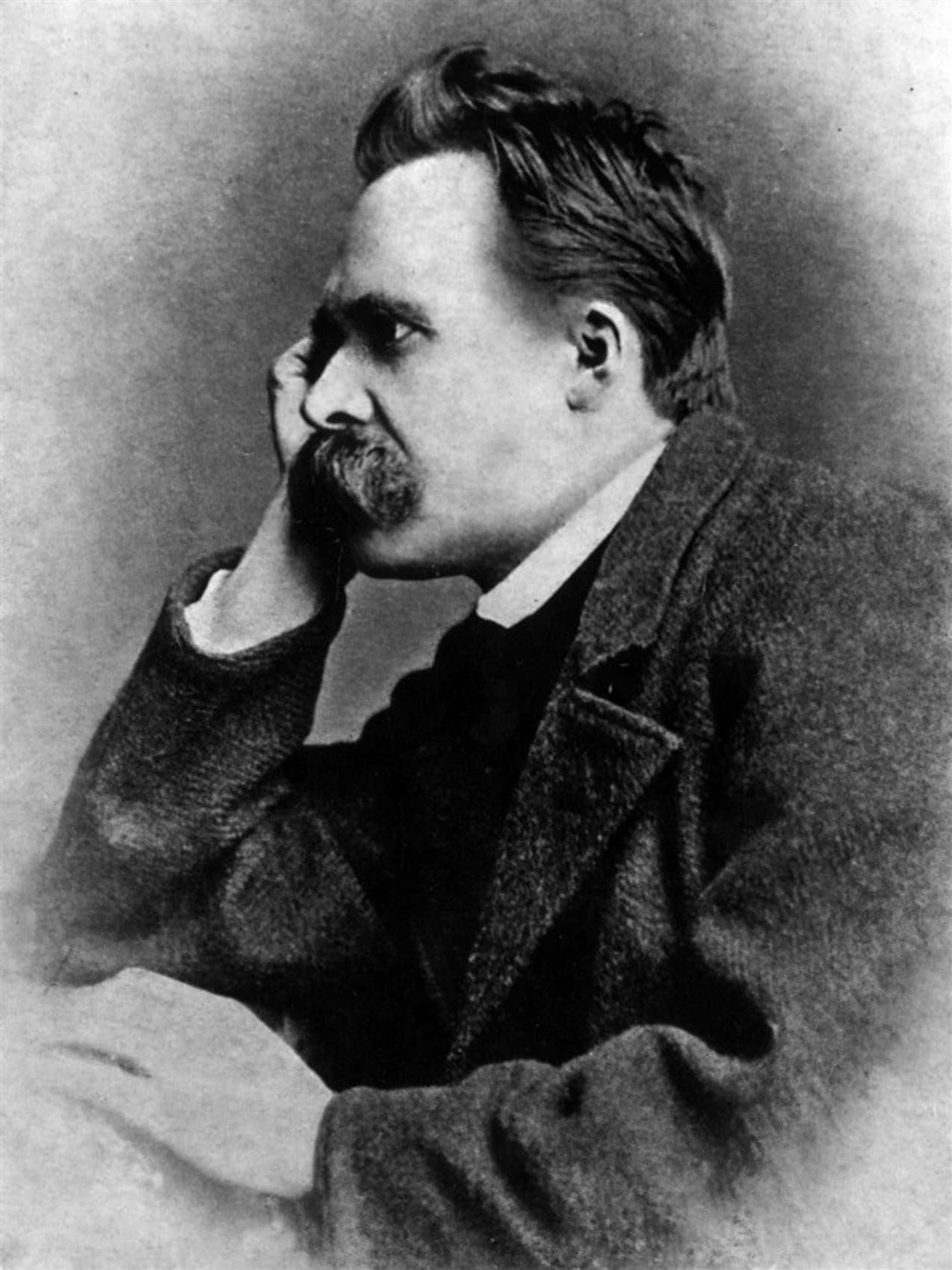
Friedrich Nietzsche was born on 15 October 1844 in Röcken, a village near Leipzig in Prussian Saxony, the son of a Lutheran pastor who died when Friedrich was four. He studied theology and then classical philology at Bonn and Leipzig, and in 1869, at just 24 and before he had formally completed his doctorate, he was appointed professor of classical philology at the University of Basel. There he became a close friend of Richard Wagner, whose music and cultural ambitions shaped his first book, The Birth of Tragedy, in 1872.
Chronic illness forced Nietzsche to give up his professorship in 1879. For the next decade he lived on a small pension, moving between the Swiss Alps, the Italian Riviera and Turin, and wrote the books for which he is best known: Daybreak, The Gay Science, Thus Spoke Zarathustra, Beyond Good and Evil, On the Genealogy of Morality and the works of 1888. In January 1889 he suffered a mental collapse in Turin from which he never recovered, and he died in Weimar on 25 August 1900.
After his collapse his sister, Elisabeth Förster-Nietzsche, took control of his papers and published selections from his notebooks, most famously The Will to Power, shaping his reputation in ways later scholars rejected. The critical edition by Giorgio Colli and Mazzino Montinari restored his texts. His ideas about the death of God, the will to power, eternal recurrence, the Übermensch and the genealogy of values went on to influence existentialism, psychoanalysis, modern literature and much of twentieth-century philosophy.
What is On Truth and Lies in a Nonmoral Sense about?
It is a short essay Nietzsche wrote in 1873 and never published, arguing that what humans call truth is a product of language, convention and forgetting. He begins with a fable of clever animals who invent knowledge on a dying star, explains the intellect as a tool of survival through dissimulation, and traces the drive to truth to a social peace treaty that fixes how things must be named. Words, he argues, are metaphors for nerve stimuli, and concepts arise by ignoring differences. The second part contrasts the rational man, who lives by concepts, with the intuitive, artistic man.
What is the main idea of On Truth and Lies in a Nonmoral Sense?
The main idea is that our truths are not copies of reality but hardened human metaphors whose origin has been forgotten. Language names only the relations of things to us, through a chain of leaps from nerve stimulus to image to sound, and concepts are formed by treating unequal things as equal. Society then demands that everyone use these agreed names, and that obligation becomes our moral feeling for truth. Nietzsche does not say science is useless; he says its order reflects the forms of time, space and number that humans themselves bring to the world.
What are the key takeaways from On Truth and Lies in a Nonmoral Sense?
First, the human intellect is tiny and recent in cosmic terms, and its self-importance is comic. Second, intellect evolved for survival, mainly through deception. Third, truth began as a social convention: the agreed way of naming things, with the liar as the one who misuses it. Fourth, words are metaphors and concepts erase differences, as the concept “leaf” erases the uniqueness of each leaf. Fifth, we feel secure only by forgetting that we are creative subjects. Sixth, the drive to make metaphors lives on in myth and art, where the intellect plays freely.
What does Nietzsche mean by truth as “a mobile army of metaphors”?
In the essay’s most famous passage, Nietzsche defines truth as a mobile army of metaphors, metonymies and anthropomorphisms: human relations that were poetically intensified and, after long use, seem fixed and binding to a people. Truths, he adds, are illusions we have forgotten are illusions, like coins whose faces have worn off so they count only as metal. The image of an army suggests something organized and powerful but also mobile, made by humans and serving human ends. The worn coin suggests that a living metaphor becomes a dead concept through habit.
Does Nietzsche think lying is good in this essay?
Not in the ordinary moral sense, which is the point of the title. He is describing truth and lies from outside morality, asking where these categories come from. He notes that society punishes liars not for deception itself but for harmful deception, and that people want truth mainly for its useful consequences. He even says that being truthful means lying according to a fixed convention. In the second part, he praises the freed intellect of art, which deceives without injuring. The essay questions the value we place on truth rather than recommending dishonesty.
Is On Truth and Lies in a Nonmoral Sense worth reading?
Yes. It is one of Nietzsche’s shortest and most quoted texts, and it can be read in well under an hour. Its opening fable and its definition of truth are among the best-known passages in modern philosophy. It is also an unfinished, unpublished piece, so some arguments are compressed and the second part is brief. Readers should take it as a provocative sketch rather than a complete theory. It rewards rereading, and it is an excellent entry point for anyone curious about Nietzsche or about debates on language and knowledge.
Who should read On Truth and Lies in a Nonmoral Sense?
It suits readers interested in philosophy of language, theories of knowledge or the relationship between science and art. Students meeting Nietzsche for the first time will find it a compact introduction to his skepticism about fixed truths. Writers and poets often value its account of metaphor as the root of language. Readers of later thinkers who took up its themes, such as theorists of language and interpretation in the twentieth century, will see where some of their ideas come from. No background is needed, though some familiarity with Kant helps with the passages on time, space and the thing in itself.
How long does it take to read On Truth and Lies in a Nonmoral Sense?
The English translation is about 5,400 words, so at around 250 words per minute it takes roughly 20 to 25 minutes to read straight through. It is divided into two numbered parts, the first much longer than the second. Because the prose is dense with images and arguments, many readers take closer to an hour, especially on a second reading. A summary like this one outlines its argument in a few minutes, but the essay itself is short enough that reading it in full is well worth the time.
How does On Truth and Lies relate to Nietzsche’s other early works?
It was written in 1873, the same year as Philosophy in the Tragic Age of the Greeks, which also argues that words are only symbols for relations and that philosophical concepts are inexact translations of intuitions. Its praise of the intuitive, artistic Greeks echoes The Birth of Tragedy of 1872. Its doubts about the value of truth return in later works such as Beyond Good and Evil, where Nietzsche openly asks why we want truth rather than untruth. The essay therefore works as a bridge between his early writings on Greek culture and his mature critique of knowledge and morality.