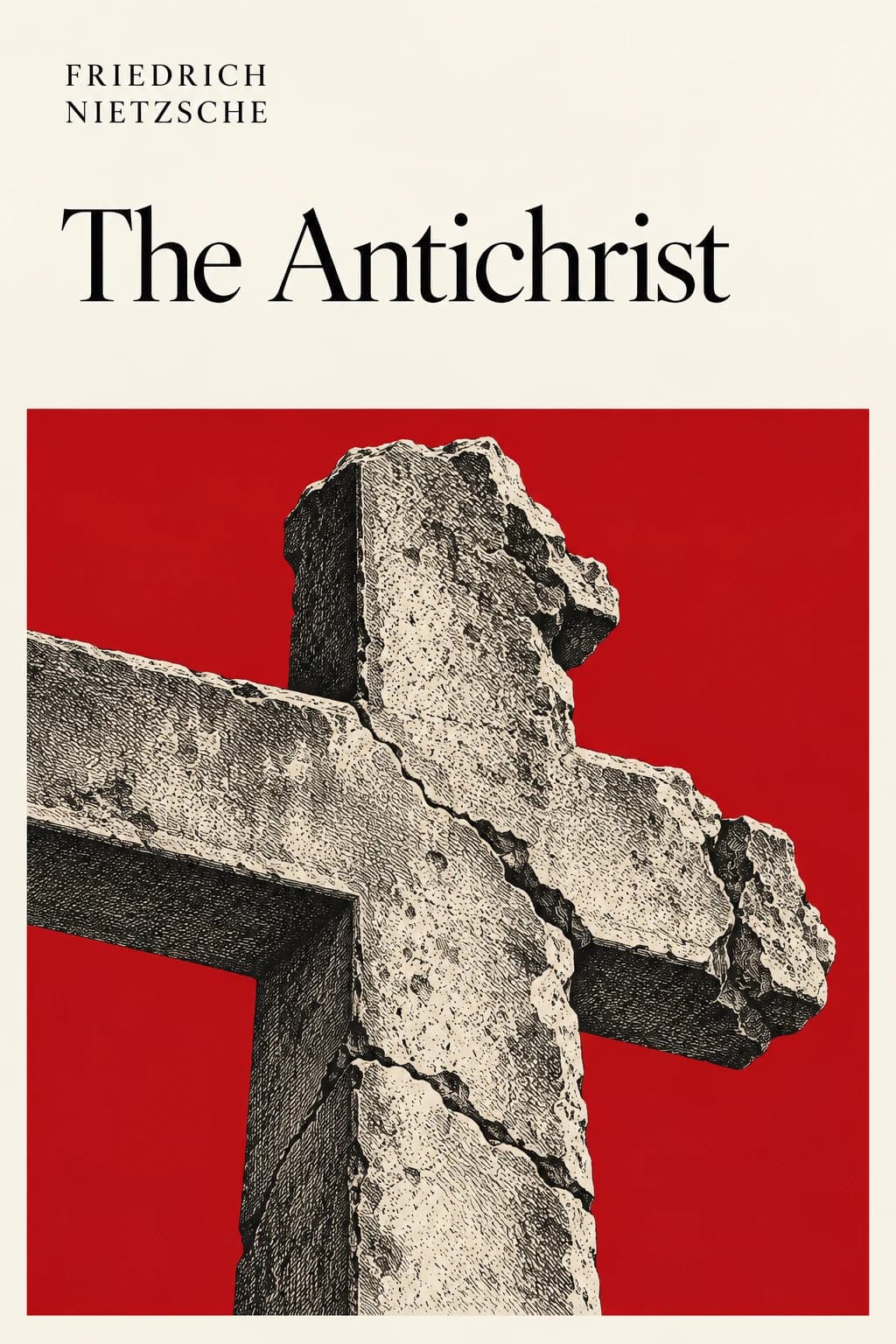
Nietzsche’s attack on Christianity belongs to his final project of revaluing values. The work asks readers to consider what their moral judgments strengthen or weaken.
“What is good?—Whatever augments the feeling of power, the will to power, power itself, in man.”
Written in September 1888 and published in 1895, The Antichrist is Nietzsche’s most direct attack on Christianity. In 62 short, furious sections he asks what Christian values do to the people who live by them, and answers that pity, humility, faith and the hope of a beyond weaken life and turn people against their own bodies, senses and world.
The book’s surprise is its portrait of Jesus. Nietzsche separates the gentle practice he finds in the Gospels, a life of non-resistance and inner blessedness, from the church built on his death, and blames Paul for turning that practice into a religion of sin, judgment and immortality. He ends by calling for a revaluation of all values.
Values themselves can be judged by asking whether they strengthen life and the feeling of power or weaken them.
2
Décadence and pity
Nietzsche reads pity, humility and faith as symptoms of exhausted instincts that spread suffering instead of overcoming it.
3
Jesus against Christianity
Jesus lived a practice of non-resistance and present blessedness, which the church later turned into a doctrine he never taught.
4
Paul as founder
Paul built Christianity on the death and resurrection, making guilt, judgment and personal immortality its centre of gravity.
5
Faith is not proof
Neither the comfort a belief brings nor the martyrs who die for it shows that the belief is true.
Summary by chapter
The Antichrist in 12 chapters, in our own words.
Preface
Nietzsche wrote The Antichrist in September 1888, in the last productive autumn before his collapse in Turin in January 1889, and it was published only in 1895. He first planned it as the opening book of a larger work called the Revaluation of All Values, which H. L. Mencken, whose translation is used here, renders as the transvaluation of all values. By the end of 1888 Nietzsche had begun to speak of this single book as the whole Revaluation. The German title, Der Antichrist, can mean both the Antichrist and the anti-Christian, and Nietzsche plays on both senses: he presents himself as Christianity’s opponent and as the figure its theology most feared.
“
First the day after tomorrow must come for me. Some men are born posthumously.
Friedrich Nietzsche
The short preface tells readers at once that the book is not written for everyone. It belongs, Nietzsche says, to the rarest of men, perhaps none of whom is yet alive, and possibly to those who have understood his Zarathustra. He lists the conditions a true reader must meet. Such a reader carries intellectual integrity to the point of hardness, is used to living on mountain tops, and looks on the noise of politics and nationalism as beneath him. He never asks whether a truth will profit him or ruin him. He has courage for forbidden questions, the experience of seven solitudes, new ears for new music and a new conscience for truths not yet heard.
The preface closes with a provocation that sets the tone for everything that follows: these few are his readers, and the rest are merely humanity, over whom one must rise in power, in loftiness of soul and in contempt. Readers should take this as a signal of genre. The Antichrist is a polemic, deliberately extreme in voice, and it does not try to persuade the doubtful by gentle steps. Its arguments are real and often sharp, but they arrive wrapped in insult, exaggeration and prophecy, and part of reading it well is learning to separate the case Nietzsche makes from the theatre in which he makes it.
Chapter 1
Power, Décadence and Pity (§§1–7)
The book proper opens with a gesture of fellowship: let us look each other in the face, Nietzsche writes, we are Hyperboreans. In Greek myth, as Pindar records, the Hyperboreans lived beyond the north wind, in a happiness no road could reach. Nietzsche borrows them as an image for the few who have found their way out of the modern labyrinth. Modern people, he says, sickened on lazy peace, cowardly compromise and a tolerance that forgives everything because it understands everything. Against that soft south wind he sets his own formula of happiness: a Yes, a No, a straight line, a goal.
“
What is good?—Whatever augments the feeling of power, the will to power, power itself, in man.
Friedrich Nietzsche
Section 2 then states his standard in the form of a blunt catechism. Good is whatever increases the feeling of power in a human being; bad is whatever comes from weakness; happiness is the feeling that power is growing and resistance is being overcome. He wants not contentment but more power, not peace at any price but war, not virtue but efficiency, meaning virtue in the Renaissance sense of virtù, free of moral acid. Then come two of the book’s most notorious lines: the weak and the ill-constituted shall perish, and practical sympathy for them, which he calls Christianity, is more harmful than any vice.
The question he sets himself, he explains in section 3, is not what will replace humanity but what type of human being should be bred and willed as the most valuable. Such higher types have appeared before, but always as lucky accidents, and they were often feared. Out of that fear the opposite type was cultivated: the tame, herd animal, which Nietzsche identifies with the Christian. He denies that history is progress, claiming the European of his day falls below the European of the Renaissance. Christianity, he says, waged war on the higher type and corrupted even strong minds, as with Pascal, who blamed original sin for the damage that Christianity itself had done to his intellect.
Sections 6 and 7 introduce the book’s key diagnostic word, décadence. A creature is corrupt, Nietzsche says, when it loses its instincts and prefers what harms it, and he insists he means this physiologically rather than morally. Life is an instinct for growth and the accumulation of power, and he claims humanity’s highest values have been emptied of it. Pity is his chief example. It depresses vitality, makes suffering contagious and preserves what is ripe for destruction. Schopenhauer was right, he says, that pity denies life, which is why Schopenhauer prized it. Aristotle, by contrast, treated pity as dangerous and saw tragedy as a purge for it. The philosopher, Nietzsche concludes, must be a doctor willing to use the knife.
Chapter 2
Theologians, Philosophers and Kant (§§8–14)
Nietzsche names his enemy in section 8: theologians and everyone with theological blood in their veins. He includes far more than clergy. Any idealist who claims a higher vantage point from which to look down on the senses, on science, on honour and on good living shares the theologian’s habit. Such people praise humility, chastity and poverty, which Nietzsche thinks have done more damage to life than any vice. The pure soul, he says, is a pure lie. As long as the priest, whom he calls a professional denier and poisoner of life, is honoured as a higher kind of person, the question of what truth is cannot even be properly asked.
“
Whatever a theologian regards as true must be false: there you have almost a criterion of truth.
Friedrich Nietzsche
The theological instinct, he argues in section 9, is the most widespread and best hidden form of falsehood. Its typical product is faith, which he defines as closing one’s eyes to oneself once and for all so as not to see an incurable lie. Wherever theologians gain power, true and false trade places: what harms life is called true, and what strengthens it is called false. Section 10 turns on Germany. The Protestant pastor, Nietzsche says, is the grandfather of German philosophy, and the Tübingen school shows that this philosophy is theology in disguise. Kant’s success was a theological success, because his scepticism opened a back stair to the old ideals of a true world and a moral world order.
Section 11 attacks Kant as a moralist. A virtue, Nietzsche insists, must be our own invention, arising from personal need; every person must find their own virtue and their own categorical imperative. Duty for its own sake, goodness grounded in impersonal and universal rules, is a sacrifice to the Moloch of abstraction. To work, think and feel without inner necessity or pleasure, as a mere automaton of duty, is a recipe for decline. Section 12 extends the charge: most philosophers treat beautiful feelings as arguments and conviction as a test of truth, which is no surprise once one sees that the philosopher descends from the priest.
Against all this, Nietzsche presents the free spirits as already a revaluation of values in themselves. The methods of science, he notes in section 13, were despised for thousands of years, and their practitioners were treated as enemies of God. Section 14 describes what modern knowledge has unlearned. We no longer derive humanity from spirit or the divine but place it back among the animals: the strongest because the craftiest, yet the sickliest and most estranged from its instincts, though also the most interesting. Following Descartes’s view of animals as machines, he denies free will and treats consciousness as a sign of imperfection, a groping that uses up nervous energy. The pure spirit, he says, is pure stupidity.
Chapter 3
An Imaginary World and the Christian God (§§15–19)
In section 15 Nietzsche claims that Christian morality and religion have no point of contact with reality. They offer imaginary causes, such as God, the soul, the ego and free will, and imaginary effects, such as sin, grace, punishment and forgiveness. They supply an imaginary natural history, an imaginary psychology that misreads ordinary bodily feelings as repentance or temptation, and an imaginary goal in the kingdom of God and the last judgment. This fictional world is worse than a dream, he says, because dreams at least reflect reality while this one falsifies it. Its source is hatred of the natural. And who wants to lie their way out of reality? Only someone who suffers from it.
“
In him nothingness is deified, and the will to nothingness is made holy!
Friedrich Nietzsche
Section 16 offers a theory of where gods come from. A people that believes in itself honours its own god, projecting onto him its joy, its pride and the conditions of its success. Religion of this kind is a form of gratitude. Such a god must be able to harm as well as help, to be feared for his anger and admired for his victories. But when a people declines and begins to see submission as necessary, it remakes its god. He becomes humble and timid, counsels peace of soul and love of enemies, and becomes the god of every private person. Nietzsche sums it up: either gods are the will to power, and so national gods, or they are incapacity for power, and so merely good.
Section 17 pushes the argument further. When the will to power declines, the weak do not call themselves weak; they call themselves the good, and they turn the god of their masters into a devil. Nietzsche rejects the view, which he finds even in the historian Ernest Renan, that the passage from the god of Israel to the Christian god of pure goodness was progress. To him it is a shrinking. God becomes a staff for the weary, the god of the sick and of the sinner, a democrat among gods. Then the metaphysicians, those albinos of the intellect as he calls them, spin him into an ideal, a pure spirit, an absolute, and finally a thing in itself.
Section 18 delivers the verdict. The Christian concept of God, as patron of the sick, spinner of cobwebs and pure spirit, is among the most corrupt ideas ever devised, the low-water mark of the god-making instinct. Instead of transfiguring life and saying an eternal Yes to it, this god declares war on life and nature, and becomes the formula for every slander against the here and now. Section 19 adds a complaint about the strong peoples of northern Europe, who accepted this god rather than discarding him. In two thousand years, Nietzsche notes, not a single new god has been created, and the pitiful god of what he mockingly calls monotono-theism still reigns.
Chapter 4
Buddhism and Christianity (§§20–23)
Nietzsche pauses in section 20 to compare Christianity with Buddhism. Both, he says, are nihilistic religions of décadence, but they differ sharply, and the difference is instructive. Buddhism is a hundred times more realistic. It grew out of centuries of philosophical thought, had already disposed of the idea of God before it appeared, and faces problems coolly. It does not speak of sin but of suffering, and so it stands, in Nietzsche’s phrase, beyond good and evil. He traces it to two physiological conditions: an excessive sensitivity to pain and an over-refined spirituality that has lost interest in the self in favour of the impersonal.
“
It does not speak of a “struggle with sin,” but, yielding to reality, of the “struggle with suffering.”
Friedrich Nietzsche
Buddha’s response, as Nietzsche describes it, is a kind of hygiene. He prescribes life in the open air and travel, moderation in food, caution with intoxicants and with any passion that heats the blood, and freedom from worry about oneself or others. There is no prayer, no asceticism and no categorical imperative, and even the monastery can be left at will. Above all Buddha teaches against revenge and resentment, summed up in the refrain that enmity never ends enmity. He even makes a kind of egoism a duty, steering the weary mind back to its own well-being, and Nietzsche compares him to Socrates, who also raised self-concern into a morality.
Section 21 sets the two religions side by side. Buddhism needs a mild climate, gentle customs, no militarism and an educated class to begin among, and within it perfection is treated as normal rather than as a distant goal. Christianity, in contrast, voices the instincts of the subjugated. Its favourite pastime is the examination of sin and conscience; it loves concealment and the darkened room; it despises the body. Nietzsche notes that after the Moors were driven out of Spain the public baths were closed, and that Cordova alone had 270. Section 22 adds that when Christianity reached the barbarian peoples of the north it met strong but untamed people, and tamed them in the only way it knew, by making them sick.
Section 23 explores the psychological ingenuity of Christianity. Buddhism simply says I suffer, but the barbarian needs a reason for suffering, and the devil supplied one. Christianity also understands that it matters little whether a thing is true as long as it is believed. Hope, Nietzsche observes, is a more powerful stimulant than any fulfilment, which is why the Greeks counted it among the evils in Pandora’s box. Love is the state in which people see things most decidedly as they are not, and so Christianity gave believers a person to love: a young god, a beautiful saint, a virgin. Faith, hope and charity, he concludes, are the three Christian ingenuities.
Chapter 5
Israel, the Priests and the Moral Order of the World (§§24–27)
In sections 24 to 27 Nietzsche turns to the origins of Christianity. His first claim is that it was not a revolt against Judaism but its consequence, a further step in what he calls the logic of the Jews. He describes the ancient Jews as a people who, facing the question of whether to exist at all, chose to survive at any price, and he refers back to his Genealogy of Morality, where he contrasted noble morality with a morality born of resentment. These pages contain sweeping generalizations about Jews as a people that modern readers rightly find offensive. They sit oddly beside his remark here that Christian anti-Semites fail to see they are themselves products of the tradition they attack, and his mockery of anti-Semites later in the book.
“
Psychologically considered, “sins” are indispensable to every society organized on an ecclesiastical basis; they are the only reliable weapons of power
Friedrich Nietzsche
Section 25 offers what Nietzsche presents as a history of how natural values were reversed. In the age of the kings, he says, Israel’s god Yahweh expressed the nation’s pride, power and hope; people looked to him for victory and for rain, and the prophet Isaiah still imagined an ideal king who was both warrior and judge. When internal anarchy and the Assyrians shattered those hopes, the old god should have been abandoned. Instead the idea of him was changed. Priests now interpreted every fortune as a reward and every misfortune as punishment for sin. This moral order of the world, he says, stood cause and effect on their heads and robbed chance of its innocence.
Section 26 describes the priests’ rewriting of history. The great age of Israel was reinterpreted as an age of decline, the Exile as a punishment, and the nation’s heroes as either bigots or sinners. A will of God had to be revealed, so holy scriptures were produced, and Nietzsche notes drily that they specified exactly what tithes and choice cuts of meat the priest should receive. From then on the priest was present at every natural event, birth, marriage, sickness, death and meals, and sanctified each one, which for Nietzsche means drained it of its own value. Sin became indispensable, because forgiveness meant submission to the priest.
Section 27 places Jesus within this story. The small rebellion that took his name, Nietzsche argues, was aimed at the Jewish church in exactly the modern sense of the word: at the good and the just, at caste, privilege, order and formalism. He calls Jesus a holy anarchist who stirred up outcasts and sinners, and a political criminal in so far as that was possible in such a community. That, he says, is what brought him to the cross, as the inscription on the cross shows. He died for his own guilt, Nietzsche insists, and there is no ground for believing he died for the sins of others.
Chapter 6
The Psychology of the Redeemer (§§28–35)
These sections are the heart of the book and its most surprising part. Nietzsche says he is not interested in the scholarly hunt for contradictions in the Gospels that he had enjoyed at twenty while reading David Friedrich Strauss’s Life of Jesus. He wants the psychological type of the redeemer, which may survive in the Gospels in spite of them, just as Francis of Assisi shows through his legends. He rejects Renan’s portrait of Jesus as a hero or a genius. Nothing is less heroic, he says, than a teaching whose deepest sentence is resist not evil. The good news is that true life is not promised but present, within each person, and that everyone is equally a child of God.
“
This “bearer of glad tidings” died as he lived and taught—not to “save mankind,” but to show mankind how to live.
Friedrich Nietzsche
To explain this type Nietzsche reaches for physiology. He compares it to an extreme sensitivity to touch that makes contact with anything solid painful, and that turns into a flight from reality into an inner, intangible world: the kingdom of God is within you. In the German he suggests that a word other than genius should be used here, and early editions suppressed the word he chose, idiot, a term that echoes Dostoevsky’s novel. Section 30 names two traits: an instinctive hatred of reality and an instinctive exclusion of all hostility, so that love becomes the only remaining possibility of life. He calls this a sublime development of hedonism and links it to Epicurus.
Nietzsche argues that this type reached us badly distorted. The first disciples lived in a world he likens to a Russian novel and had to translate a life of symbols into crude categories such as prophet, messiah, judge and wonder-worker. He regrets that no Dostoevsky lived near this most interesting décadent. The peaceful preacher of the mount and the fields, a new Buddha on unfamiliar soil, clashes with the aggressive enemy of theologians found in parts of the Gospels, and Nietzsche attributes the aggressive features to later propaganda, along with the second coming and the last judgment. With a little freedom of language, he says, one could call Jesus a free spirit: he cares nothing for anything fixed, for the letter kills.
What the Gospels actually teach, in Nietzsche’s reading, is a way of life rather than a belief. There is no guilt, punishment or reward. The true Christian does not resist, makes no distinction between foreigner and native, is angry with no one, avoids the courts and does not swear oaths. Jesus needed no ritual or prayer; blessedness was a state of the heart, not a reward after death. Son and Father are symbols for the feeling of transfigured life, not persons in a theology, and Nietzsche scorns the church for turning them into a virgin-birth story like the Greek myth of Amphitryon. Jesus’s death was simply the last act of this practice. Before his judges and on the cross he did not resist, and he loved those who harmed him.
Chapter 7
Paul and the Invention of Christianity (§§36–43)
With the type of Jesus established, Nietzsche turns to what was made of it. The history of Christianity, he says in section 37, is the history of an ever cruder misunderstanding of an original symbolism, as the faith spread among rougher masses and absorbed the cults of the Roman underworld. That the church kneels before the very opposite of what the Gospel meant is, for him, world-historical irony. Section 38 is a cry of disgust aimed at his own time. Earlier ages could be excused; today, he says, it is indecent to be a Christian. Statesmen who act in thoroughly unchristian ways still take communion, and a prince at the head of his armies calls himself a Christian without shame.
“
The very word “Christianity” is a misunderstanding—at bottom there was only one Christian, and he died on the cross.
Friedrich Nietzsche
Section 39 contains the book’s most quoted claim. There was only one Christian, and he died on the cross. What was called the Gospel afterwards was its reverse, a dysangel or bad tidings. Being Christian, Nietzsche argues, is a matter of practice, not of holding certain beliefs to be true, and such a life remains possible in any age. Faith has usually been a cloak behind which instincts did as they liked, as in Luther’s case. Section 40 describes the disciples’ shock at the shameful death. They asked who had killed him and answered that it was the ruling Jewish class. Revenge, the least evangelical of feelings, took hold, and Jesus was turned into the kind of theologian and accuser he had never been.
Then came the question of how God could allow it, and the answer, in section 41, was that God sacrificed his son for the forgiveness of sins: the innocent punished for the guilty, which Nietzsche calls appalling paganism. Jesus had abolished the very idea of a gap between God and humanity. Paul gave the new teaching its logic, in Nietzsche’s account, by staking everything on the resurrection and the promise of personal immortality. Section 42 names what died on the cross: an original attempt at a Buddhist-style peace movement, offering real rather than promised happiness. Buddhism, he says, promises nothing but fulfils; Christianity promises everything but fulfils nothing.
Nietzsche portrays Paul as the opposite of Jesus, a genius of hatred who nailed the redeemer to his own cross. Paul needed not the life but the death and the resurrection, and he rewrote the history of Israel so that all the prophets pointed to his saviour. Nietzsche calls the vision on the road to Damascus a hallucination and says Paul wanted power. Section 43 explains why the doctrine of personal immortality matters so much. When life’s centre of gravity is placed in a beyond, life loses its centre altogether, and ordinary virtues like pride, cooperation and care for the common good become temptations. The equality of immortal souls, he argues, flattered every vanity and undermined what he calls the pathos of distance, the sense of rank on which he thinks all higher culture depends.
Chapter 8
Reading the New Testament (§§44–49)
Section 44 treats the Gospels as evidence of corruption already present in the first community, and Nietzsche admits they give a psychologist rare pleasure as a masterpiece of refined self-deception. He repeats his harsh claims about Jewish priestly inheritance, again in racial language. His more substantive point concerns the moral rhetoric of the early communities. They say judge not, yet they condemn their enemies to hell. They turn their enforced humility into a duty and a proof of piety, and they claim God, truth, light, love and life as if these words were synonyms for themselves. Morality, he says, is the best device ever found for leading mankind by the nose.
“
As a matter of fact no man can be a philologian or a physician without being also Antichrist.
Friedrich Nietzsche
Section 45 is a short anthology of New Testament verses, each followed by a sarcastic comment. After Mark’s saying that cities which reject the disciples will fare worse than Sodom and Gomorrah, he writes simply: how evangelical. After the promise that some standing there would see the kingdom of God come with power, he quips that the lion, the traditional symbol of Mark, has lied well. Matthew’s teaching that one should seek first the kingdom and all things will be added gets the reply that this is, to put it mildly, an error. He ends with Paul’s words that God chose the foolish and weak things of the world to shame the wise and strong, which he reads as the purest expression of a morality of revenge.
Section 46 tells readers to put on gloves before opening the New Testament. Nietzsche says he searched it in vain for a single free, kindly or upright touch, and that after reading Paul he turned with relief to the Roman satirist Petronius. Whatever the early Christians attacked, he adds, is honoured by the attack. The only figure in the whole book worthy of respect is Pilate, whose noble Roman scorn produced its one valuable saying: what is truth? Section 47 sharpens the charge. The point is not that God cannot be found but that what has been worshipped as God is a crime against life. Faith forbids science, and Paul’s real enemies were the philologists and physicians of Alexandria. The physician says incurable; the philologist says fraud.
Sections 48 and 49 retell the opening of Genesis as a parable about priests and knowledge. The old God, bored in his garden, creates man for entertainment, then the animals, then woman, his second mistake. Through woman man tastes the tree of knowledge, and God is seized by mortal terror, because science makes people godlike. So man is driven out of paradise and given toil, childbirth, sickness, old age and finally war, all to keep him from thinking, and when knowledge still grows God sends the flood. The moral, Nietzsche says, is that the priest fears only one thing: science, the sound understanding of cause and effect. Sin, guilt and punishment were invented to destroy that understanding and keep people in need of a saviour.
Chapter 9
Faith, Martyrs and Convictions (§§50–55)
Section 50 examines what Nietzsche calls the proof by power: faith makes one blessed, therefore it is true. He points out first that the blessedness is only promised, and second that even real pleasure would prove nothing. There is no reason why true beliefs should feel better than false ones, and the experience of every disciplined mind teaches the opposite. Intellectual integrity means being severe with one’s own heart, scorning beautiful feelings, and making every Yes and No a matter of conscience. His conclusion reverses the believer’s formula: faith makes blessed, therefore it lies.
“
Man has had to fight for every atom of the truth, and has had to pay for it almost everything that the heart, that human love, that human trust cling to.
Friedrich Nietzsche
Section 51 grants that faith can produce happiness, but adds that a visit to an asylum shows how little that proves; faith does not move mountains but puts them where there were none. Nietzsche claims that Christianity needs sickness and that one is not converted to it but must first be sick enough for it. The Christian movement, he argues, was not the decay of ancient nobility but a gathering of the disinherited from every direction. Section 52 defines faith as not wanting to know what is true, and contrasts the theologian with the philologist, whose art is reading well, with caution and patience. A god who cured our colds at just the right moment, he jokes, would be so absurd that he would have to be abolished even if he existed.
Section 53 argues that martyrs prove nothing about truth. Anyone who flings a truth at the world with a martyr’s passion shows too little intellectual conscience to need refuting. The more conscience a person has, the more modest they are about what they know: to know in five cases and delicately refuse to know more. Persecutors have always made the same mistake, giving their opponents the glamour of martyrdom, when the best way to dispose of a cause is to put it respectfully on ice. Is the cross an argument? Nietzsche answers with lines from his own Zarathustra: blood is the worst witness to truth, and it poisons even the purest teaching.
Sections 54 and 55 turn to conviction itself. Great minds are sceptics, Nietzsche says, and Zarathustra is one. People of fixed conviction are prisoners; they cannot see far enough. A great passion may use convictions as tools, but it does not submit to them. The need for faith, for something unconditional, is a need of weakness, typical of those who cannot set their own goals; he names Savonarola, Luther, Rousseau, Robespierre and Saint-Simon as fanatic types. Recalling an aphorism from Human, All Too Human, he then asks whether there is any real difference between a conviction and a lie. Lying, he says, is refusing to see what one sees, and party loyalty demands exactly that. He cites anti-Semites who demanded respect for their convictions and replies that lying on principle makes no one more respectable.
Chapter 10
The Law of Manu and the Order of Rank (§§56–57)
Every priesthood lies, Nietzsche admits at the end of section 55, from Confucius and the Law of Manu to Mohammed, the Christian church and even Plato. What matters, he argues in section 56, is the purpose of the lie. Christianity’s ends are visibly bad: denial of life, contempt for the body and degradation through sin. To make the contrast he turns to the ancient Indian law book known as the Law or Code of Manu, which he praises as far more intelligent than the Bible. In it nobles, philosophers and warriors keep the upper hand, and procreation, women and marriage are treated with reverence. He quotes its sayings about the purity of women against Paul’s grudging advice that it is better to marry than to burn. Scholars note that Nietzsche knew Manu from a French version now regarded as unreliable.
“
A high civilization is a pyramid: it can stand only on a broad base; its primary prerequisite is a strong and soundly consolidated mediocrity.
Friedrich Nietzsche
Section 57 explains how such a law book works. It sums up centuries of experience and experiment, and at a certain point the wisest class of a people declares that the experiment is over. To protect the result, it builds a double wall: revelation, which says the laws came from God complete and without a history, and tradition, which says they have always been followed. God gave it and the fathers lived it. A law book never gives its reasons, because reasons would invite argument. The aim is to make right living unconscious, a matter of instinct, because only then does mastery in the art of living become possible. This, Nietzsche says, is the purpose of every holy lie.
He then describes the order of castes as a formulation of nature rather than an arbitrary rule. Every healthy society, he claims, contains three physiological types: the most spiritual, the strong and spirited, and the mediocre majority. The highest caste, which he calls the fewest, has the privileges of beauty and goodness; its members find happiness where others find disaster, in the labyrinth, in hardness and in difficult tasks, and they rule not because they want to but because they are what they are. The second caste are the guardians of law and order, the warriors and the king, who take on the rough business of governing.
Nietzsche insists that mediocrity is not to be despised. A high culture is a pyramid, and its base is a broad, contented middle. Handicrafts, trade, farming and most of science and art suit mediocre ability, and the exceptional person treating ordinary people gently is simply doing his duty. What he hates are the socialists, whom he calls apostles to the lowest caste, because they teach workers envy and revenge. Wrong, he says, never lies in unequal rights but in the claim to equal rights. The anarchist and the Christian, he concludes, share the same ancestry. Readers should know that in Twilight of the Idols Nietzsche also criticized Manu’s cruel treatment of the outcast Chandala, so his praise here is a polemical contrast rather than a full endorsement.
Chapter 11
Rome, the Renaissance and the Verdict (§§58–62)
In section 58 Nietzsche asks whether a lie preserves or destroys, and answers that Christianity, like anarchism, destroys. The Roman Empire was in his eyes the most magnificent organization ever achieved under difficult conditions, strong enough to survive bad emperors, and Christianity was its vampire. He claims Epicurus had already fought the same enemy in the form of underground cults that preached guilt, punishment and immortality, as Lucretius shows, and that educated Rome was Epicurean when Paul arrived. Paul’s genius, he says, lay in seeing how the cults of Osiris, the Great Mother and Mithras could be fused into one power under the symbol of God on the cross. Nihilist and Christian, he adds, rhyme in German, and do more than rhyme.
“
This eternal accusation against Christianity I shall write upon all walls, wherever walls are to be found—I have letters that even the blind will be able to see
Friedrich Nietzsche
Section 59 mourns what was lost. The Greeks and Romans, Nietzsche says, already possessed everything needed for a scientific culture: the art of reading well, the alliance of natural science with mathematics and mechanics, and above all the sense of fact, the last and most valuable of the senses. All of it, he claims, was undone not by an earthquake or by Germanic invaders but by pale vampires who sucked it dry. Section 60 adds that Christianity later destroyed the Moorish culture of Spain, which he thinks was closer to modern taste than Greece or Rome. He calls the crusades a higher form of piracy and praises the emperor Frederick II for the motto war to the knife with Rome, peace and friendship with Islam.
Section 61 accuses the Germans of destroying the Renaissance, which Nietzsche defines as an attempt to revalue Christian values from within, at the very seat of the church. He imagines its consummation in an image meant to shock: Cesare Borgia as pope, a triumph of life enthroned where Christianity had ruled. Then Luther, a German monk, came to Rome, saw only corruption, and by attacking the church restored it. The Reformation, Leibniz, Kant, the wars of liberation and the new German empire are in his view a series of futile substitutes, and Protestantism the least clean and most indestructible form of Christianity.
Section 62 pronounces sentence. Nietzsche condemns Christianity as the greatest corruption imaginable. It lives on distress and creates distress to make itself immortal. Its doctrine of the equality of souls before God is, he says, Christian dynamite, leading to revolution and the modern idea of overthrowing every social order. He promises to write this accusation on every wall and ends by proposing a new calendar, reckoned not from the first day of Christianity but from its last, which is today: the revaluation of all values. Nietzsche also drafted a mock Law against Christianity to follow the book, but it was held back from early editions and does not appear in this translation.
Who it’s for
Readers who want the sharpest secular critique of Christianity, made with real psychological insight
Anyone curious how Nietzsche separates the figure of Jesus from the church that bears his name
Students of Nietzsche who have read the Genealogy of Morality and want its argument applied to religion
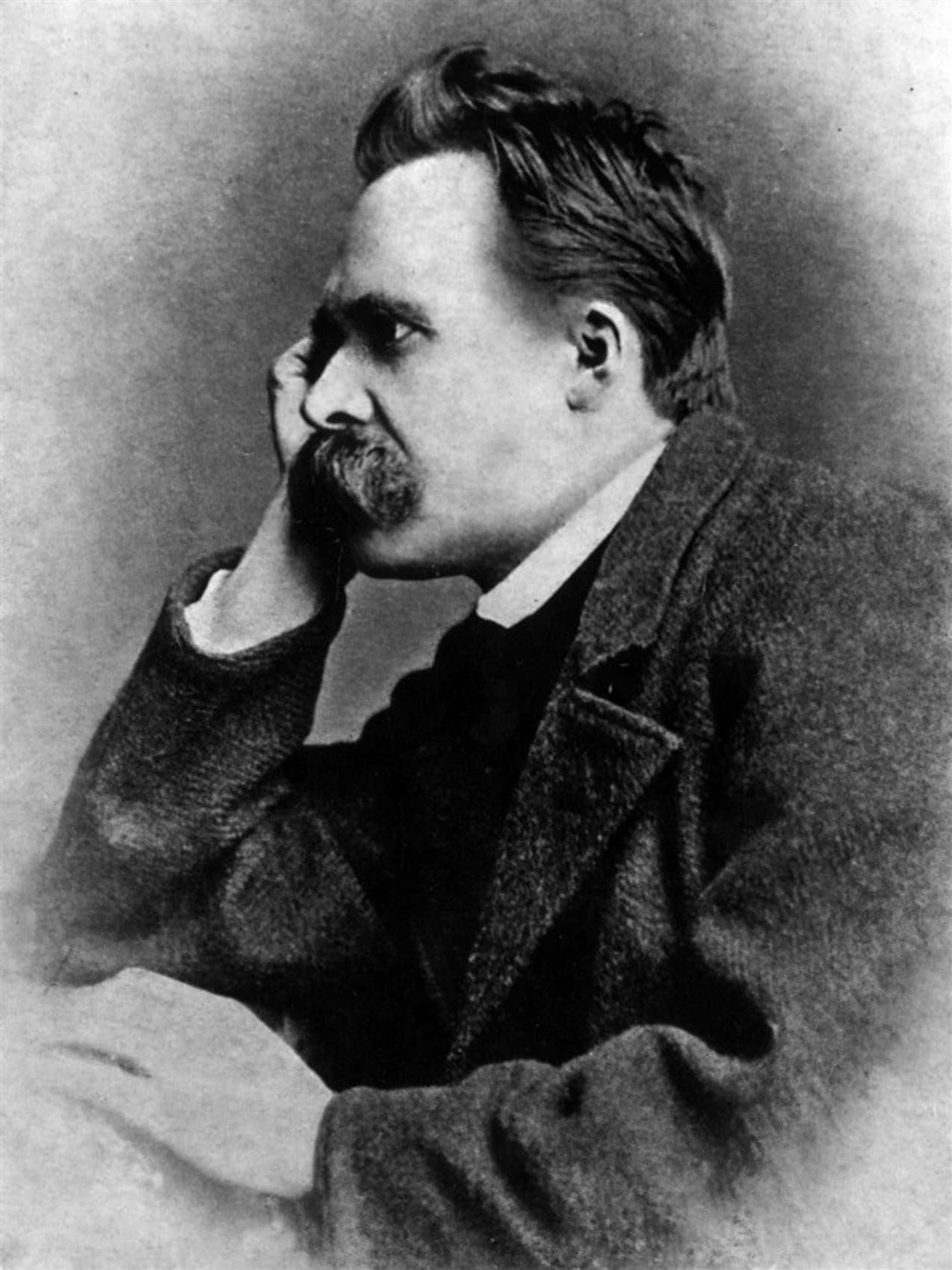
Friedrich Nietzsche was born on 15 October 1844 in Röcken, a village near Leipzig in Prussian Saxony, the son of a Lutheran pastor who died when Friedrich was four. He studied theology and then classical philology at Bonn and Leipzig, and in 1869, at just 24 and before he had formally completed his doctorate, he was appointed professor of classical philology at the University of Basel. There he became a close friend of Richard Wagner, whose music and cultural ambitions shaped his first book, The Birth of Tragedy, in 1872.
Chronic illness forced Nietzsche to give up his professorship in 1879. For the next decade he lived on a small pension, moving between the Swiss Alps, the Italian Riviera and Turin, and wrote the books for which he is best known: Daybreak, The Gay Science, Thus Spoke Zarathustra, Beyond Good and Evil, On the Genealogy of Morality and the works of 1888. In January 1889 he suffered a mental collapse in Turin from which he never recovered, and he died in Weimar on 25 August 1900.
After his collapse his sister, Elisabeth Förster-Nietzsche, took control of his papers and published selections from his notebooks, most famously The Will to Power, shaping his reputation in ways later scholars rejected. The critical edition by Giorgio Colli and Mazzino Montinari restored his texts. His ideas about the death of God, the will to power, eternal recurrence, the Übermensch and the genealogy of values went on to influence existentialism, psychoanalysis, modern literature and much of twentieth-century philosophy.
The Antichrist is Nietzsche’s direct assault on Christianity, written in September 1888 and published in 1895. In 62 numbered sections he argues that Christian values are symptoms of décadence, a loss of healthy instinct, and that they have worked against life for two thousand years. He compares Christianity unfavourably with Buddhism, traces it to the priestly reinterpretation of ancient Israel, and blames Paul for turning Jesus’s way of life into a doctrine of sin, judgment and immortality. The book ends with Nietzsche’s condemnation of the church and his call for a revaluation of all values.
What is the main idea of The Antichrist?
The main idea is that values should be judged by what they do to life. Nietzsche defines good as whatever increases the feeling of power and bad as whatever comes from weakness, and by this standard he finds Christian virtues such as pity, humility and faith to be expressions of exhaustion that teach people to despise the body, the senses and this world in favour of a beyond. His second major idea is that Christianity betrays its founder. Jesus, in his reading, lived a practice of non-resistance and inner blessedness, while the church built a religion of guilt, punishment and reward on his death.
What are the key takeaways from The Antichrist?
First, Nietzsche judges values physiologically, by whether they strengthen or weaken life. Second, he sees pity as a depressant that multiplies suffering. Third, he treats theology and much of philosophy, including Kant, as hostile to reality and to science. Fourth, he ranks Buddhism above Christianity for its realism and its hygiene against resentment. Fifth, he argues that priests gained power by inventing sin and a moral order of the world. Sixth, he separates Jesus from Christianity and makes Paul the true founder of the church. Finally, he holds that faith, conviction and martyrdom are no evidence of truth.
How does Nietzsche distinguish Jesus from Christianity?
Nietzsche treats Jesus with a strange mixture of sympathy and diagnosis. He sees him as a gentle figure who taught a way of life, not a creed: no resistance to evil, no anger, no judgment and a blessedness experienced here and now as a state of the heart. In his view this practice was distorted after the crucifixion by disciples seeking revenge and explanation, and above all by Paul, who built a theology of sacrifice, resurrection and personal immortality. Hence his claim that there was only one Christian, and he died on the cross.
Why does Nietzsche prefer Buddhism to Christianity?
Nietzsche counts both as religions of décadence, but he thinks Buddhism is far more honest. It does without God, speaks of suffering rather than sin, and answers human weariness with practical hygiene: fresh air, travel, moderate diet, calm and above all freedom from resentment. It demands no prayer, no asceticism and no categorical imperative. Christianity, in his account, invents guilt, enemies and an afterlife to explain and exploit suffering. He sums up the difference in a single line: Buddhism promises nothing but fulfils, while Christianity promises everything but fulfils nothing.
Why does Nietzsche call pity dangerous?
In section 7 Nietzsche argues that pity drains strength. A person who pities loses energy, and suffering spreads through pity instead of being contained. He also claims that pity works against the selection that strengthens life by preserving what is failing. Schopenhauer had made pity the foundation of morality, and Nietzsche replies that this is exactly why pity serves a life-denying philosophy. He contrasts Aristotle, who saw pity as a dangerous state to be purged through tragedy. Many readers find this argument harsh, and its biological language belongs to nineteenth-century debates about evolution.
How should readers approach the book’s remarks about Jews?
Honestly and with care. In several sections Nietzsche makes sweeping and hostile generalizations about Jews as a people, sometimes in racial language, as part of his argument that Christianity inherited a priestly way of valuing. These passages are offensive, and they should not be explained away. They should also be read alongside other evidence: in the same book he ridicules anti-Semites, and his letters of this period show contempt for the anti-Semitic movement, including his brother-in-law Bernhard Förster. His central target is the priestly type and its morality, but the language he uses about Jews remains a real flaw.
Is The Antichrist worth reading?
Yes, for readers prepared for a deliberately ferocious book. It is the most direct statement of Nietzsche’s case against Christianity, compressed and energetic, and its portrait of Jesus as a figure betrayed by his followers is one of the most original things he wrote. It also shows his late method clearly: judging ideas by their effects on life and asking who benefits from them. Its weaknesses are just as visible. It often substitutes insult for argument, its history is speculative, and some passages are offensive. It is best read as a polemic and an argument, not as a neutral history of religion.
Who should read The Antichrist?
The book suits readers interested in the philosophy of religion, in the history of early Christianity, and in Nietzsche’s mature thought. Believers who want to understand the strongest secular critique of their faith will find it useful, as will skeptics who want to see that critique made with real psychological insight. Students of Nietzsche should read it after On the Genealogy of Morality and Twilight of the Idols, which supply the concepts it uses. Readers looking for a balanced account of Christianity or a gentle introduction to Nietzsche would do better to start elsewhere.
How long does it take to read The Antichrist?
The Mencken translation runs to about 27,500 words, so most readers can finish it in roughly two hours at an average pace. Its 62 sections are short, many under a page, which makes it easy to read in several sittings. Some sections, especially those on the psychology of Jesus and on Paul, reward slower reading, and a reader new to Nietzsche may want to allow extra time to follow the references to Kant, Schopenhauer, Renan and the Bible. A summary like this one covers its argument in a fraction of that time.
How does The Antichrist relate to On the Genealogy of Morality and Twilight of the Idols?
The Antichrist builds directly on both. Nietzsche refers readers to the Genealogy of Morality for his account of noble morality and the morality of resentment, and The Antichrist applies that account to the history of Israel, the early church and Paul. Twilight of the Idols, written just before it in 1888, shares its vocabulary of décadence, instinct and the true world, and also discusses the Law of Manu. Where the Genealogy is an analysis and Twilight a quick survey, The Antichrist is a single sustained attack, meant as the first part of his planned revaluation of all values.