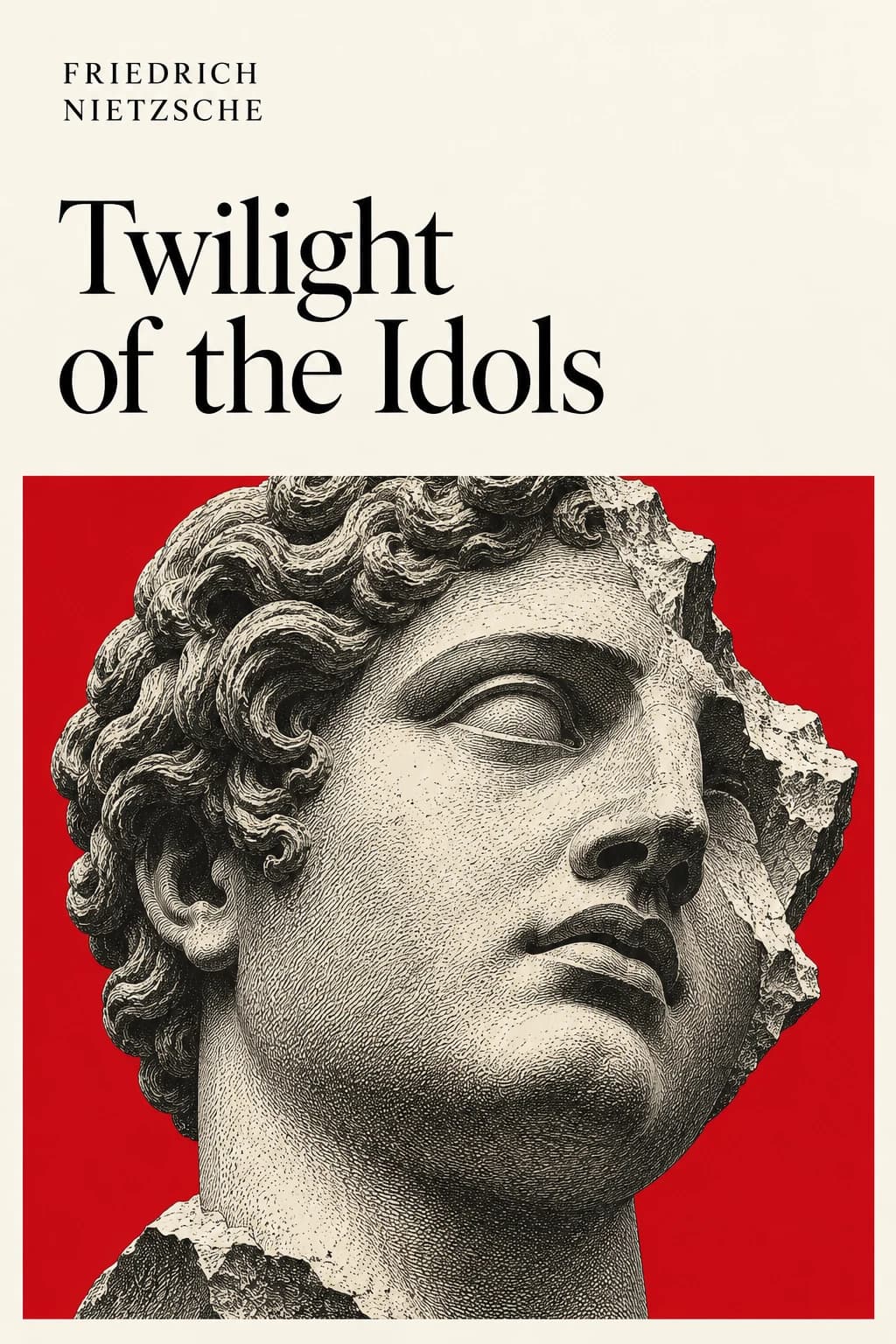
This compact reckoning with philosophical idols moves between sharp maxims and attacks on the habits through which a culture confuses its values with truth.
Written in the late summer of 1888 and subtitled “How to Philosophize with a Hammer,” this short book taps the revered ideas of Western thought to hear whether they ring hollow. Nietzsche takes on Socrates’ faith in reason, philosophers’ contempt for the senses, the idea of a “true world” beyond this one, free will, and moralities that wage war on the passions.
Between a volley of famous maxims and a closing tribute to the ancients, he attacks German culture and the nineteenth century, praises Goethe’s Dionysian affirmation of life, and compresses the history of metaphysics into a single page. It is often read as the best compact introduction to his mature philosophy, published just as his working life ended.
Revered ideals can be sounded out with a hammer, like a tuning fork, to reveal what hollowness or weakness they conceal.
2
Reason and the senses
The senses do not lie; philosophy’s hatred of change and its faith in Being come from the seductions of grammar.
3
Morality as a symptom
Moral judgments express a condition of life, declining or ascending, rather than timeless truths about good and evil.
4
The true world as fable
Once the idea of a truer world beyond this one collapses, the very contrast between reality and mere appearance disappears.
5
Innocence of becoming
Free will and guilt were invented to judge and punish, and denying them restores the innocence of existence.
Summary by chapter
Twilight of the Idols in 14 chapters, in our own words.
Preface
Twilight of the Idols, subtitled “How to Philosophize with a Hammer,” was written in the late summer of 1888, one of Nietzsche’s last working years. Its German title, Götzen-Dämmerung, parodies Wagner’s opera Götterdämmerung, the twilight of the gods. The short preface, dated Turin, 30 September 1888, presents the book as a break from heavier work. Nietzsche says he is engaged in a gloomy and hugely responsible task, a “transvaluation of all values,” and that anyone attempting it must sometimes run out into the sunshine to shake off a seriousness that has grown crushing.
“
There are more idols than realities in the world: this constitutes my “evil eye” for this world: it is also my “evil ear.”
Friedrich Nietzsche
Cheerfulness, he insists, is no luxury. Nothing succeeds without high spirits, and surplus strength alone proves strength. One of his remedies is war, since a wound stimulates the powers of recovery. For years, he says, his motto has been a Latin line whose source he keeps from “learned curiosity”: increscunt animi, virescit volnere virtus, the spirit grows and strength is renewed by a wound. Another remedy, even more to his taste, is sounding out idols. There are more idols than realities in the world, Nietzsche says, and he wants to put questions to them with a hammer and hear the hollow sound that betrays a puffed-up interior.
The hammer here is less a sledgehammer than a doctor’s percussion hammer or a tuning fork: an instrument for tapping and listening. Nietzsche calls the book the recreation of a psychologist and also a great declaration of war. This time, he says, the idols being tapped are not the idols of the age but eternal idols, the oldest, most convinced and most inflated of all, and the most hollow. They are believed in more than any others, and the most exalted of them are never even called idols. The playful tone, in other words, is part of the method: the book attacks the gravest subjects in philosophy while insisting on lightness.
Chapter 1
Maxims and Missiles
The first chapter is a volley of forty-four short sayings, arrows fired before the main argument. Some of them have become among the most quoted lines in philosophy. Maxim 8, “From the military school of life,” states that what does not kill me makes me stronger. Maxim 12 says that whoever has a why to live can bear almost any how, and adds the jab that man does not strive for happiness; only the Englishman does that. Maxim 33 lists the small things that make for happiness, such as the sound of a bagpipe, and concludes that without music life would be a mistake.
“
From the military school of life.—That which does not kill me, makes me stronger.
Friedrich Nietzsche
Many of the maxims sharpen ideas developed later in the book. Is man only God’s mistake, or God only man’s mistake (§7)? Aristotle says that to live alone one must be either an animal or a god; Nietzsche adds a third case, that one must be both, a philosopher (§3). He distrusts all systematizers, since the will to a system is a lack of integrity (§26). Against Flaubert’s claim that one can only think and write sitting down, he replies that the sedentary life is the real sin against the Holy Spirit, and only thoughts that come from walking have value (§34).
Other sayings are psychological darts. The trodden worm curls up, which reduces its chance of being trodden on again; in the language of morality, that is humility (§31). Remorse is indecent, since one should not play the coward toward one’s own deeds (§10). Whoever looks for beginnings becomes a crab: the historian looks backward and ends by believing backward (§24). A few maxims about women are characteristic of Nietzsche’s provocations elsewhere. The chapter closes with a series of “questions of conscience,” such as whether one is genuine or only an actor, and with the formula of his happiness: “a Yea, a Nay, a straight line, goal.”
Chapter 2
The Problem of Socrates
In every age, Nietzsche begins, the wisest have judged life the same way: it is no good. Even Socrates, dying, said that to live is to be sick a long time and that he owed a cock to Asclepius, the god of healing. Once people would have said that this consensus of the sages proves something true. Nietzsche suggests instead that it proves something sick. The sages must have agreed in some physiological respect to take the same negative attitude toward life. Judgments about the value of life can never be true; they are only symptoms. The living cannot judge life because they are a party to the dispute, and the dead cannot judge it for other reasons.
“
To be obliged to fight the instincts—this is the formula of degeneration: as long as life is in the ascending line, happiness is the same as instinct.
Friedrich Nietzsche
He then turns to Socrates himself. Socrates came from the lowest people, and he was famously ugly, which for the Greeks was almost a refutation. A foreign physiognomist once told him to his face that he was a monster harboring every vice, and Socrates answered, “You know me, sir!” Everything about him seems exaggerated, a caricature: his auditory hallucinations, interpreted religiously as “the demon of Socrates,” and above all the strange equation reason equals virtue equals happiness, which Nietzsche calls the weirdest equation ever seen and opposed to all the instincts of the older Greeks.
With Socrates, Greek taste turned toward dialectic, and Nietzsche reads this as the victory of the rabble over noble taste. Before him, giving reasons was bad manners; what needs to be proved is not worth much, and those with authority command rather than argue. Dialectic is a last-ditch weapon for those with no other, and perhaps a form of revenge: the dialectician makes his opponent prove he is not an idiot. Yet Socrates fascinated the Athenians. He offered a new kind of contest, and he saw that his own case was not unique. Everywhere the instincts were in anarchy, and he offered a remedy: make reason a tyrant to counter the tyranny of the instincts.
Nietzsche’s verdict is that the remedy was itself a symptom. When philosophers and moralists believe they can escape decadence by fighting it, they only change its form. Reason at any price, a life made bright, cold, cautious and conscious against the instincts, was another illness, not a return to health. Having to fight the instincts is the formula of decadence; while life is ascending, happiness and instinct are the same. Nietzsche ends by imagining that Socrates understood this at the end. He wanted to die, and he whispered to himself that Socrates is no physician, and only death is a physician here.
Chapter 3
“Reason” in Philosophy
Philosophers, Nietzsche says, suffer from a peculiar idiosyncrasy: a lack of historical sense and a hatred of becoming, which he calls their “Egyptianism.” They think they honor a thing by removing it from history and making it a mummy. For thousands of years they have handled only mummified concepts. Death, change, age, growth and procreation count for them as objections or even refutations. Since they cannot find Being, they look for the deceiver who hides it, and they find it in the senses. Their moral is to say no to the body, to history and to everything the senses believe.
“
“Reason” in language!—oh what a deceptive old witch it has been! I fear we shall never be rid of God, so long as we still believe in grammar.
Friedrich Nietzsche
Nietzsche makes an exception of Heraclitus, though even he was unjust to the senses. The senses do not lie at all, Nietzsche argues; what we make of their testimony introduces the lie of unity, substance and permanence. Insofar as they show becoming and change, they tell the truth. He praises the nose, which no philosopher has honored, as one of our finest instruments, and observes that science reaches exactly as far as we have trusted and sharpened the senses. Heraclitus will be right forever in saying that Being is an empty fiction; the “apparent” world is the only one.
The second idiosyncrasy is confusing the last with the first. Philosophers put the most general, emptiest concepts, the last wisps of evaporating reality, at the beginning, as cause of all things. The highest must not have grown from the lowest. So Being, the Absolute, the Good, the True and the Perfect must be causa sui, and since they cannot contradict one another, they merge into the idea of God, the emptiest thing posited as the first and most real. Nietzsche calls these the brain diseases of morbid cobweb-spinners, and adds that humanity has paid dearly for taking them seriously.
Where does this error come from? From language, Nietzsche answers. Grammar was formed in an age of crude psychology, and it sees doers and deeds everywhere. It believes in the will as cause and in the ego as a substance, and projects this onto all things, creating the concept of a “thing” and of “Being.” Hence his line that we will not be rid of God as long as we believe in grammar. The chapter ends with four theses: the reasons given for calling this world apparent prove its reality; the “true world” is built from the marks of nothingness; inventing another world is revenge on this one; and dividing the world into true and apparent, as Christianity and Kant do, is a symptom of decline. The tragic artist, by contrast, says yes to everything questionable and terrible: he is Dionysian.
Chapter 4
How the “True World” Ultimately Became a Fable: The History of an Error
This page-long chapter, one of Nietzsche’s most famous, compresses the history of Western metaphysics into six stages, each with a parenthetical stage direction. In the first, the true world is attainable for the wise, the pious and the virtuous; they live in it and are it. This is the oldest and simplest form of the idea, a paraphrase of “I, Plato, am the truth.” In the second, the true world is unattainable for now but promised to the wise, the pious and the virtuous, or “to the sinner who repents.” The idea becomes subtler and more elusive: it becomes a woman, it becomes Christian.
“
We have suppressed the true world: what world survives? the apparent world perhaps?... Certainly not! In abolishing the true world we have also abolished the world of appearance!
Friedrich Nietzsche
In the third stage, the true world is unattainable and unprovable, but even as a thought it is a consolation, an obligation and a command. This is the old sun seen through fog and skepticism, the idea grown pale, northern and “Königsbergian,” a reference to Kant. In the fourth, the true world is unattained and therefore unknown, so it can neither console nor oblige: the grey of dawn, reason’s first yawn, the cock-crow of positivism. In the fifth, the true world is a useless, superfluous idea, so let us abolish it. It is broad daylight, breakfast, the return of good sense and cheerfulness; Plato blushes, and all free spirits make a din.
The sixth stage is the turn that gives the chapter its force. Having abolished the true world, what is left? The apparent world, perhaps? No: with the true world we have also abolished the apparent one. Without a “true” world to contrast it with, “appearance” loses its meaning. The stage direction reads: noon, the moment of the shortest shadow, the end of the longest error, the high point of humanity, “Incipit Zarathustra,” Zarathustra begins. Nietzsche thus places his own work at the moment when the old two-world picture has fully dissolved and the world can be affirmed on its own terms.
Chapter 5
Morality as the Enemy of Nature
Every passion, Nietzsche begins, has a phase when it is merely disastrous and a much later phase when it is “spiritualized,” married to the intellect. Older moralities, especially the Church, knew only the first approach: kill the passions. The Sermon on the Mount says that if your eye offends you, pluck it out. Nietzsche compares this to dentists who pull teeth so they will stop aching. The Church’s cure is castration, extirpation of sensuality, pride, the lust to rule, possessiveness and revenge, and to attack the passions at their root is to attack life at its root. The Church’s practice, he concludes, is hostile to life.
“
The spiritualisation of sensuality is called love: it is a great triumph over Christianity.
Friedrich Nietzsche
Radical methods, he argues, are chosen by those too weak-willed to practice moderation, those who need a monastery or some gulf between themselves and a desire. The most poisonous attacks on the senses have come not from the impotent or true ascetics but from those who needed to be ascetics and could not manage it. Against this, Nietzsche praises two spiritualizations. The first is love, the spiritualization of sensuality. The second is the spiritualization of hostility: the realization that enemies are valuable. Even the new German Empire needs enemies more than friends. Within the soul too, one is productive only by being rich in opposing drives, and whoever renounces war renounces the grand life.
Nietzsche then lists the many things that “peace of the soul” may really be: the glow of rich animal health, the first sign of tiredness, gratitude for good digestion, the calm of the convalescent, the satiety that follows a strong passion, the senility of one’s will, or laziness persuaded by vanity to dress itself in moral clothes. Perhaps, he jokes, Twilight of the Idols is itself a kind of peace of the soul. He then states a principle. Every healthy morality is governed by an instinct of life. Anti-natural morality, which means nearly every morality taught so far, turns against the instincts of life, and in saying “God sees into the heart” it treats God as life’s enemy. Life ends where the kingdom of God begins.
A condemnation of life by a living being, Nietzsche continues, is only the symptom of a certain kind of life. To judge the value of life one would have to stand outside it. When we speak of values, life itself values through us. Even the morality that condemns life is therefore a judgment made by life, by declining, weakened and condemned life; Schopenhauer’s “denial of the will to life” is the instinct of decadence turned into a command. Finally, the moralist who says “man should be thus” forgets that each individual is a piece of fate. Against such moralists, Nietzsche says, we immoralists have opened our hearts to understanding and affirmation.
Chapter 6
The Four Great Errors
The first error is confusing cause and effect, which Nietzsche calls reason’s intrinsic corruption, canonized under the names religion and morality. His example is Luigi Cornaro, whose widely read book attributed his long life to his meager diet. In fact, Nietzsche argues, Cornaro’s unusually slow metabolism was the cause of both his frugal eating and his long life; a modern scholar on that diet would soon collapse. The same mistake runs through every moral formula of the kind “do this and avoid that, and you will be happy.” A well-constituted person does the right things because he is well constituted. Peoples do not decline because of vice and luxury; vice and luxury follow from decline.
“
We deny God, we deny responsibility in God: thus alone do we save the world.
Friedrich Nietzsche
The second error is false causality. We thought we knew what a cause was because we believed we caught it in the act in our own will. From the will we derived the spirit and the ego as causes, then projected these “inner facts” onto the world and created the concepts of thing, being and atom. But the inner world is full of phantoms. The will moves nothing and merely accompanies events; motives are surface ripples; the ego is a fable. There are no spiritual causes at all, Nietzsche concludes, and the whole edifice built on them has collapsed.
The third error is imaginary causes. In dreams, a distant cannon shot is given a cause after the fact, a whole little story in which the shot arrives at the end. Waking life works the same way: we explain our general feelings of well-being or discomfort by causes that make us feel at home. Any explanation is better than none, and familiar ones are preferred because they relieve fear. So morality and religion explain unpleasant feelings by sin, evil spirits or punishment, and pleasant ones by trust in God, a good conscience, faith, love and hope. All of these, Nietzsche says, belong to the psychology of error.
The fourth error is free will. Nietzsche calls it the most infamous trick of theologians to make humanity “responsible” in their sense and so dependent on them. The doctrine of the will was invented for the purpose of punishment, to find someone guilty. Christianity, he writes, is the metaphysics of the hangman. Against this he sets his own teaching: no one gives a human being his qualities, not God, society, parents or himself. No one is responsible for existing or for being as he is. One is a piece of fate and belongs to the whole, and there is nothing outside the whole that could judge it. Denying God and responsibility restores the innocence of becoming.
Chapter 7
The “Improvers” of Mankind
Nietzsche begins by restating his demand that philosophers stand beyond good and evil, which follows from his claim that there are no moral facts. Moral judgment, like religious judgment, belongs to a stage of ignorance in which the difference between the real and the imagined was not yet known. Taken literally it is nonsense. Read as a sign language, a symptomatology, it reveals a great deal about cultures that did not understand themselves. One must already know what morality is about, he says, in order to make use of it, much as a doctor reads symptoms without believing what the patient thinks they mean.
“
To express oneself in a formula, one might say:—all means which have been used heretofore with the object of making man moral, were through and through immoral.
Friedrich Nietzsche
His example is the claim to “improve” humanity. Two very different things have gone under that name: the taming of the human animal and the breeding of a particular type. Taming, Nietzsche says, is no improvement. Whoever knows what happens in a menagerie knows that an animal is weakened, made less dangerous and made sick there by fear, pain and hunger. In the early Middle Ages, when the Church was above all a menagerie, it hunted down the finest specimens of the “blond beast,” the noble Germanic warriors, and “improved” them into caged, sick sinners full of hatred for the instincts of life.
Breeding is the other model, and Nietzsche’s example is the Indian Law of Manu, which aims to breed four castes at once: priests, warriors, merchants and farmers, and servants. Stepping into it from the Christian atmosphere of hospitals and prisons, he says, is like breathing fresh air. But this system too had to be terrible, here against the outcaste “Chandala,” whom its rules kept weak by keeping them sick and filthy. Nietzsche’s quotations come from secondary French sources, especially Louis Jacolliot, which scholars regard as unreliable. He reads Christianity as the revolt of the Chandala against the morality of breeding, the triumph of the values of the low and the poor.
The chapter ends with Nietzsche’s formula for the psychology of the “improvers.” Both breeding and taming used means unworthy of their claims. To make morality, one must have the unconditional will to its opposite. The clue that led him to this problem was the “pious fraud.” Neither Manu nor Plato nor Confucius nor the Jewish and Christian teachers ever doubted their right to lie. All the means by which humanity was supposed to be made moral, he concludes, have been fundamentally immoral. The breeders and the tamers, for all their differences, are worthy of each other in their methods.
Chapter 8
Things the Germans Lack
Nietzsche opens with an attempt at fairness. Modern Germany has inherited and acquired a great store of ability and possesses manly virtues: self-respect, steadiness, diligence, endurance and a sobriety that needs a spur rather than a brake. Germans still obey without feeling humiliated. But power makes people stupid. Germans were once called a nation of thinkers; do they still think? Politics has swallowed up all seriousness, and the slogan “Germany, Germany above all” was, he fears, the death-blow to German philosophy. Asked abroad whether there are any German philosophers, poets or good books, he blushes and answers: “Yes, Bismarck!”
“
Culture and the state—let no one be deceived on this point—are antagonists
Friedrich Nietzsche
German intellect, he continues, has been dulled for nearly a thousand years by Europe’s two great narcotics, alcohol and Christianity, and recently by a third, music, which he calls constipating German music. Young scholars drink beer. His example of the damage is David Strauss, once a bold freethinker, who ended by writing a comfortable new gospel. He laments the lack of passion in German universities, where specialized science produces fragmentary human beings, and says Germany is becoming Europe’s flatland. He is still looking, he adds, for a German with whom he could be serious, and even more for one with whom he could be cheerful.
One cannot spend more than one has, Nietzsche argues, and a nation that pours its strength into power politics, commerce, parliaments and the military has none left for culture. Culture and the state are antagonists. All great ages of culture were ages of political decline; Goethe’s heart opened to Napoleon and closed to the patriotic Wars of Liberation. As Germany rose as a great power, France rose in importance as a power of culture. Germany has no thinker to set beside Goethe, Hegel, Heine and Schopenhauer. Its higher schools have forgotten both the goal of education and the means. They lack educators who are themselves educated, with his friend Jacob Burckhardt of Basel as a rare exception, and they train crowds of young men into useful servants of the state.
Nietzsche ends with what education should teach: to see, to think, and to speak and write. Learning to see means accustoming the eye to calm and patience, letting things come to it and postponing judgment; it is almost what is called strength of will, the ability not to react at once to a stimulus. Learning to think means treating thinking as a technique, something to be learned like dancing. Noble education, he says, must include dancing in every form: with the feet, with ideas, with words and with the pen. He remarks that the Germans have tolerated Kant, whom he calls the most deformed cripple of ideas there ever was, which says enough about their elegance.
Chapter 9
Skirmishes in a War with the Age: Impossible People (§1–7, 12–18)
The longest chapter, fifty-one numbered sections, is a series of raids on the culture of the nineteenth century. It opens with a list of “impossible people,” each given a malicious one-line epithet: Seneca, the toreador of virtue; Rousseau, or the return to nature in impuris naturalibus; Schiller, the moral trumpeter; Dante, the hyena who writes poetry in tombs; Kant, with “cant” as intelligible character; Victor Hugo, the lighthouse on the sea of nonsense; George Sand, the cow with plenty of beautiful milk; John Stuart Mill, or offensive lucidity. Renan is mocked for theology’s corruption of reason, and Sainte-Beuve as a genius of slander with Rousseau’s resentment in his blood.
“
When we renounce the Christian faith, we abandon all right to Christian morality.
Friedrich Nietzsche
The sharpest of these portraits concerns George Eliot and the English moralists. Having got rid of the Christian God, Nietzsche says, they think they must cling all the more to Christian morality. But Christianity is a system, a whole view of things. Take out its central concept, faith in God, and the whole thing breaks. Christian morality is a command whose origin is transcendent; it stands or falls with belief in God. If the English think they know by intuition what is good and evil, that only shows how deeply Christian valuation still rules them, so deeply that they have forgotten where their morality came from.
Several sections concern the psychologist’s craft. A born psychologist, Nietzsche says, does not observe for the sake of observing or take notes from life; the evil eye ruins experience, and he must let things come to him (§7). He compares Carlyle, a rhetorician tormented by the need for a strong faith he could not find, with Emerson, broader, more refined and above all happier, a man of taste who leaves indigestible things on his plate (§12–13). The most spiritual people, if they are also the bravest, live through the most painful tragedies, and honor life precisely because it sets its greatest hostility against them (§17).
Other sections mock the timidity of the age. Genuine hypocrisy is rare now, Nietzsche observes, because hypocrisy belongs to ages of strong faith; modern people simply abandon their faith, or acquire a second one and stay honest in both (§18). He condemns German “psychological tact” for misjudging Kant and calls Kant’s philosophy “backstairs philosophy” (§16). A mock examination paper in §29 says the task of higher schooling is to make man into a machine by teaching him to be bored, with the government official as the perfect man. Throughout, the tone is quick and combative, the work of a critic who says he is waging war on his time, and who uses his portraits of individuals to diagnose whole tendencies of the age.
Chapter 10
Skirmishes in a War with the Age: The Psychology of the Artist (§8–11, 19–24)
For art to exist at all, Nietzsche argues in §8, one physiological precondition is indispensable: intoxication, which Ludovici translates as “ecstasy.” It must first heighten the excitability of the whole machine. Sexual excitement, its oldest form, can produce it, and so can great desires and strong passions, festival, contest, cruelty, spring and an overcharged will. Its essence is a feeling of increased strength and fullness. In this state, §9 says, one gives to things out of one’s own abundance and transforms them until they reflect one’s power. This compulsion to transform into the perfect is art. The anti-artistic type, who impoverishes and thins things, is the genuine Christian, Nietzsche says, such as Pascal; there is no Christian artist, and Raphael, who said yes, was for that reason no Christian.
“
Nothing is beautiful; man alone is beautiful: all æsthetic rests on this piece of ingenuousness, it is the first axiom of this science.
Friedrich Nietzsche
Section 10 restates the pair of concepts from The Birth of Tragedy, Apollonian and Dionysian, now as two kinds of intoxication. Apollonian intoxication excites the eye, so that it gains the power of vision; painters, sculptors and epic poets are visionaries. Dionysian intoxication excites the whole system of feelings at once, the power of representation, imitation and transformation, a state in which the person cannot fail to respond to any signal. Music is a later specialization of this once larger capacity. Architecture belongs to neither: it is the great act of will, a kind of eloquence of power in forms.
Beauty, Nietzsche argues in §19 and §20, is nothing absolute. In the beautiful, humanity sets itself up as the measure of perfection and worships itself. Nothing is beautiful; only man is beautiful, and nothing is ugly except degenerating man. The ugly weakens and depresses us and reminds us of decay, while the beautiful increases our sense of power. In §21 and §22 he calls Schopenhauer a psychological case of the first rank: a brilliant attempt to enlist art, heroism, genius and beauty in the service of a nihilistic devaluation of life. Schopenhauer valued beauty as release from sexual desire, while Plato, Nietzsche counters in §23, said there would be no Platonic philosophy without the beautiful youths of Athens.
In §24 Nietzsche takes on “art for art’s sake.” The slogan is a fight against morality in art, but it shows that morality is still the enemy. Art is never purposeless, he argues: it praises, glorifies and selects, and so it strengthens certain valuations. Is art then a symptom of pessimism when it shows the ugly and terrible in life? No. What does the tragic artist communicate? His fearlessness before what is terrible and questionable. Before tragedy, the warlike part of the soul celebrates its Saturnalia, and the person accustomed to suffering, who seeks it out, praises his existence through tragedy alone.
Chapter 11
Skirmishes in a War with the Age: Critique of Modernity (§14, 33–46)
Section 14, “Anti-Darwin,” argues that the struggle for existence is the exception in nature, not the rule. Nature is usually marked by abundance and even absurd waste, and where there is struggle it is a struggle for power. Where struggle does happen, it does not favor the strong, as Darwinians assume, but the weak, who are more numerous and more clever. Species do not grow toward perfection. In §33 Nietzsche offers a natural value of selfishness: it is worth as much as the person who practices it. If he represents ascending life, his selfishness is valuable; if declining life, it is worth little, and the sick should not demand that the healthy sacrifice themselves to them.
“
Freedom is the will to be responsible for ourselves. It is to preserve the distance which separates us from other men.
Friedrich Nietzsche
The anarchist and the Christian, §34 argues, share an instinct of revenge. Unable to understand that his suffering comes from poverty of life, the anarchist needs someone to blame, and so does the Christian, who blames himself or projects the reckoning onto a last judgment. Altruistic morality, §35 says, is always a bad sign, the formula of decadence. In §36 Nietzsche provocatively says that the sick person is a parasite on society, and argues for the right to die proudly when it is no longer possible to live proudly, a death chosen freely, at the right time, clearly and joyfully, surrounded by one’s children and other witnesses.
Section 37 asks whether we have become more moral. Critics attacked Nietzsche for preferring Cesare Borgia to modern humanitarians. He replies that modern gentleness is a symptom of weakness rather than progress; our “humane” virtues are those of a tired age, and the pathos of distance, the gap between people and ranks, is disappearing. In §38 he gives his concept of freedom. Liberal institutions stop being liberal once they are established; they level and make people small, and he calls liberalism the herd-animalization of humanity. But while they are being fought for, they promote freedom powerfully, because war educates for freedom. Freedom is the will to self-responsibility, the will to keep distance, to become indifferent to hardship and to rule.
Section 39 says modern institutions fail because modern people have lost the instincts from which institutions grow: the will to tradition, authority and responsibility across centuries. Marriage, for example, can no longer be an institution once it rests on the idiosyncrasy of “love.” In §40 Nietzsche mocks the “question of the working-man”: having given workers military service, the right to organize and the vote, Europe should not be surprised that they regard their condition as distress. Great men, §44 argues, are explosive material in which energy has been stored up over generations. The criminal type, §45 says, is the strong person in unfavorable conditions, a strong person made sick; here Nietzsche calls Dostoevsky the only psychologist from whom he had anything to learn.
Chapter 12
Skirmishes in a War with the Age: Goethe and the Return to Nature (§47–51)
The chapter ends on a positive note. Beauty, §47 says, is no accident. The beauty of a race or family is the result of work accumulated over generations, of discipline in gesture and bearing; seventeenth-century France is an admirable example. Culture must begin with the body, not with the soul, which is why the Greeks remain the first event in culture, and why Christianity, with its contempt for the body, is the greatest mishap that has befallen humanity. In §48 Nietzsche explains what he means by progress. He too speaks of a “return to nature,” but it is not a going back. It is a going up, into a high, free, even terrible nature that plays with great tasks. Napoleon was such a return; Rousseau, whom Nietzsche calls the first modern man, “idealist and canaille in one person,” was the opposite.
“
it is my ambition to say in ten sentences what everyone else says in a whole book,—what everyone else does not say in a whole book.
Friedrich Nietzsche
Goethe, §49 says, was not a German event but a European one. He tried to overcome the eighteenth century by a return to nature, an ascent to the naturalness of the Renaissance, and so overcome his own century in himself. He did not turn away from life but put himself into it. He wanted totality and fought the separation of reason, sensuality, feeling and will. He disciplined himself into wholeness and created himself. Such a spirit, Nietzsche writes, stands amid the universe with a cheerful and confident fatalism, in the faith that only the individual is reprehensible and that in the whole everything is redeemed and affirmed. He no longer denies. Nietzsche calls this faith the highest of all and gives it the name of Dionysus.
The nineteenth century, §50 adds, aspired to everything Goethe had: universality in understanding and welcoming, daring realism, respect for facts. Yet the result was not a Goethe but chaos, a nihilistic sigh, an instinct of exhaustion that in practice keeps reaching back to the eighteenth century. It drifts toward maudlin romanticism, altruism, oversensitivity, pessimism in taste and socialism in politics, and in its last years looks like a brutalized eighteenth century, a century of decadence. Was Goethe, Nietzsche asks, only a beautiful “in vain” for Europe? He sees his own age as having learned breadth without the strength to unify it.
In the closing section, §51, Nietzsche declares Goethe the last German he respects. Asked why he writes in German when he is least read there, he says he wants to create things on which time tries its teeth in vain, and to have a little immortality in both form and substance. The aphorism and the maxim, in which he says he is the first master among Germans, are the forms of eternity. His ambition is to say in ten sentences what others say in a book, and what others do not say in a book. He has given humanity its deepest book, Zarathustra, and promises soon to give it its most independent one.
Chapter 13
Things I Owe to the Ancients, and The Hammer Speaks
The last chapter is a personal reckoning with antiquity. Nietzsche’s sense of style, he says, came from the Romans, not the Greeks. Sallust awakened his taste for the epigram, compact and severe, and no poet ever gave him the artistic delight of a Horatian ode, a mosaic of words in which each word radiates its power across the whole. The Greeks, by contrast, cannot be models of style. Plato in particular he distrusts: a mixer of styles, boring, already pre-Christian, with the good as his highest concept. Humanity has paid dearly, he says, for the “ideal” that let noble souls of antiquity misunderstand themselves and walk the bridge to the cross.
“
I, the last disciple of the philosopher Dionysus,—I, the prophet of eternal recurrence.
Friedrich Nietzsche
His cure for Plato has always been Thucydides, along with Machiavelli’s Prince. Both refuse to deceive themselves and see reason in reality rather than in morality. Thucydides represents the culture of the Sophists, the realist culture of the Greeks, and Plato is a coward before reality who takes refuge in the ideal. Nietzsche rejects the German habit of admiring the Greeks for their calm grandeur and exalted simplicity, which he calls a piece of German silliness. He saw the Greeks’ strongest instinct as the will to power, and their institutions as safety measures against the explosive material in one another. Their philosophers, from this view, were the decadents of Greek culture.
Nietzsche then returns to the subject of his first book. He says he was the first to take the Dionysian seriously, as an expression of overflowing strength, and credits Jacob Burckhardt with understanding its importance, while mocking the philologist Lobeck for dismissing the mysteries. In the Dionysian mysteries the Greeks affirmed eternal life, the eternal return of life, through the symbol of sexuality and the pains of childbirth, which sanctify pain itself. Tragedy, he argues against Aristotle, is not a purging of pity and terror but a way of going beyond them, to be oneself the eternal joy of becoming, a joy that includes joy in destruction. The Birth of Tragedy, he says, was his first revaluation of all values, and he ends by calling himself the last disciple of Dionysus and the teacher of eternal recurrence.
The book closes with a short coda titled “The Hammer Speaks,” a passage quoted from Thus Spoke Zarathustra, Part Three. The charcoal asks the diamond why it is so hard, since they are close relatives. The answer turns the question around: why are you so soft, so yielding, so fond of denial and self-denial? All creators are hard, and it must seem bliss to press one’s hand on millennia as on wax. The final words hang a new tablet over the reader: “Become hard.” Ending with this passage ties the book’s critical hammer back to Zarathustra’s demand for creators strong enough to write new values.
Who it’s for
Newcomers who want Nietzsche’s mature ideas in one short, punchy book
Readers curious why he called Socrates and Plato symptoms of decline
Lovers of aphorisms who want the source of “what does not kill me makes me stronger”
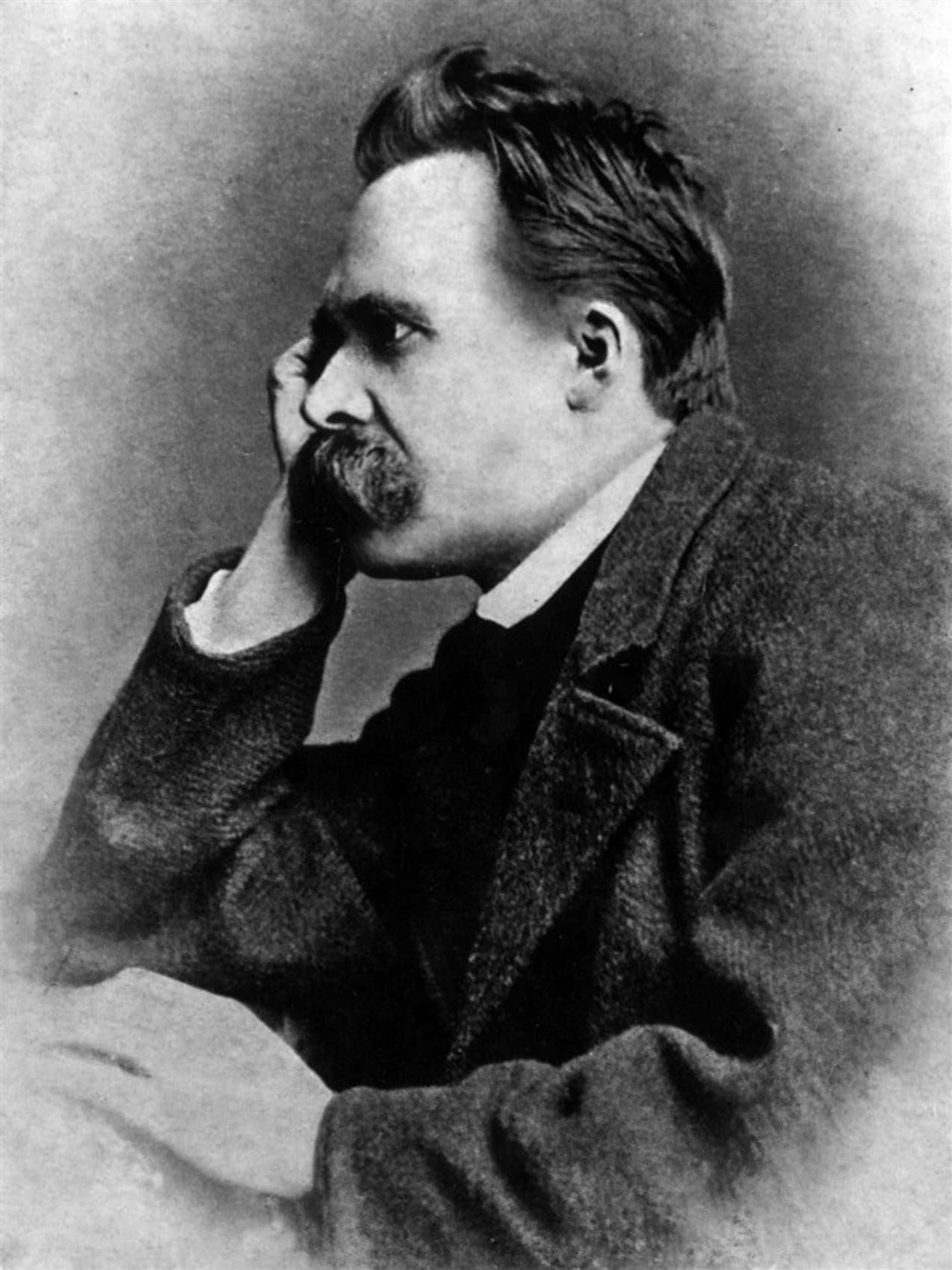
Friedrich Nietzsche was born on 15 October 1844 in Röcken, a village near Leipzig in Prussian Saxony, the son of a Lutheran pastor who died when Friedrich was four. He studied theology and then classical philology at Bonn and Leipzig, and in 1869, at just 24 and before he had formally completed his doctorate, he was appointed professor of classical philology at the University of Basel. There he became a close friend of Richard Wagner, whose music and cultural ambitions shaped his first book, The Birth of Tragedy, in 1872.
Chronic illness forced Nietzsche to give up his professorship in 1879. For the next decade he lived on a small pension, moving between the Swiss Alps, the Italian Riviera and Turin, and wrote the books for which he is best known: Daybreak, The Gay Science, Thus Spoke Zarathustra, Beyond Good and Evil, On the Genealogy of Morality and the works of 1888. In January 1889 he suffered a mental collapse in Turin from which he never recovered, and he died in Weimar on 25 August 1900.
After his collapse his sister, Elisabeth Förster-Nietzsche, took control of his papers and published selections from his notebooks, most famously The Will to Power, shaping his reputation in ways later scholars rejected. The critical edition by Giorgio Colli and Mazzino Montinari restored his texts. His ideas about the death of God, the will to power, eternal recurrence, the Übermensch and the genealogy of values went on to influence existentialism, psychoanalysis, modern literature and much of twentieth-century philosophy.
Twilight of the Idols, subtitled “How to Philosophize with a Hammer,” is a short book Nietzsche wrote in 1888 as a compact introduction to his philosophy. It “sounds out” the idols of Western thought to show that they are hollow: the belief in a “true world” beyond this one, Socrates’ equation of reason and virtue, morality that fights the instincts, free will, and the idea that humanity can be “improved.” It also attacks German culture and the nineteenth century, praises Goethe, Napoleon and Thucydides, and ends with Nietzsche presenting himself as the last disciple of Dionysus and the teacher of eternal recurrence.
What is the main idea of Twilight of the Idols?
The main idea is that the highest values of Western philosophy and morality are symptoms of declining life rather than eternal truths. Philosophers who prefer Being to becoming, reason to the senses and another world to this one are expressing a hostility to life. Morality that condemns the passions is, in Nietzsche’s phrase, the enemy of nature. Against this he defends the evidence of the senses, the innocence of becoming, the spiritualization rather than the extirpation of the passions, and a Dionysian affirmation of life including its terrible and questionable sides.
What are the key takeaways from Twilight of the Idols?
First, judgments about the value of life are symptoms, not truths. Second, Socrates’ faith in reason was a cure that was itself a form of decadence. Third, the senses do not lie; our concepts of substance and unity do. Fourth, the “true world” has become a fable, and with it the merely apparent world. Fifth, the Church fights the passions by castration instead of spiritualizing them. Sixth, religion and morality rest on four errors about causes and free will. Seventh, all attempts to “improve” humanity have used immoral means. Finally, the ideal is a Goethean, Dionysian yes to life as a whole.
What does “philosophizing with a hammer” mean?
In the preface Nietzsche explains that he wants to put questions to idols with a hammer and listen for the hollow sound that reveals they are puffed up and empty. The hammer is used “as with a tuning fork,” so the image is closer to a doctor tapping a patient’s chest than to smashing statues. It is a method of diagnosis: tapping revered ideas to hear what they are made of. At the same time, Nietzsche admits the book is a declaration of war, and its closing passage, “The Hammer Speaks,” uses the hammer as an image of the hardness he thinks creators need.
What is “How the True World Finally Became a Fable” about?
This one-page chapter tells the history of Western metaphysics in six stages. It begins with Plato, for whom the true world was attainable by the wise, moves through Christianity’s promise of it to the repentant sinner and Kant’s unknowable but consoling true world, then through positivism, which finds it useless, to its abolition. In the final stage Nietzsche argues that abolishing the true world also abolishes the “apparent” world, since the contrast loses its meaning. The stage is set at noon, the moment of the shortest shadow, with the words “Incipit Zarathustra.”
Why does Nietzsche criticize Socrates?
In “The Problem of Socrates,” Nietzsche treats Socrates as a symptom of decline in Greek culture. He points to Socrates’ low origins, ugliness and strange equation of reason, virtue and happiness, and argues that dialectic was the weapon of those with no other means, perhaps even a form of revenge. Socrates fascinated Athens because its instincts were in anarchy, and he offered reason as a counter-tyrant. Nietzsche’s point is that this remedy was itself a sickness: having to fight one’s instincts is the formula of decadence. He imagines Socrates admitting at his death that only death could cure him.
Is Twilight of the Idols worth reading?
Yes, and it is often recommended as the best short introduction to Nietzsche’s mature philosophy. It is brief, quotable and energetic, and it touches nearly all his major themes: the critique of metaphysics, morality, Christianity and modern culture, the will to power, the Dionysian, and eternal recurrence. Its famous maxims and the chapter on the “true world” are among his most read pages. It is also polemical and compressed, with passages on women, the sick and caste that many readers find offensive, so it rewards reading with attention to context and to his longer books.
Who should read Twilight of the Idols?
It is ideal for readers new to Nietzsche who want his late thought in compact form, and for students of philosophy interested in his critiques of Socrates, Plato, Kant and Schopenhauer. Readers interested in psychology will find his analysis of how we invent causes and assign blame. Those drawn to literature and art will enjoy his portraits of writers and his theory of art as intoxication. Readers who already know Thus Spoke Zarathustra or Beyond Good and Evil will find it a sharp summary of their ideas.
How long does it take to read Twilight of the Idols?
The Anthony M. Ludovici translation runs to about 30,000 words, so at an average pace of 250 words per minute it takes roughly two hours. Many chapters are short and self-contained, and the opening “Maxims and Missiles” and the one-page “How the True World Finally Became a Fable” can be read in minutes. The long “Skirmishes in a War with the Age” is best taken in several sittings. A summary like this one covers every chapter in well under an hour.
How does Twilight of the Idols relate to Nietzsche’s other late works?
Twilight of the Idols was written in the late summer of 1888, the same year as The Case of Wagner, The Antichrist and Ecce Homo. Its preface mentions the first book of a planned “Transvaluation of all Values,” which became The Antichrist. It summarizes ideas from Beyond Good and Evil and the Genealogy of Morality, and its account of the Dionysian looks back to The Birth of Tragedy. It was published in January 1889, the month of Nietzsche’s mental collapse, so it was among the last books he saw through to print.