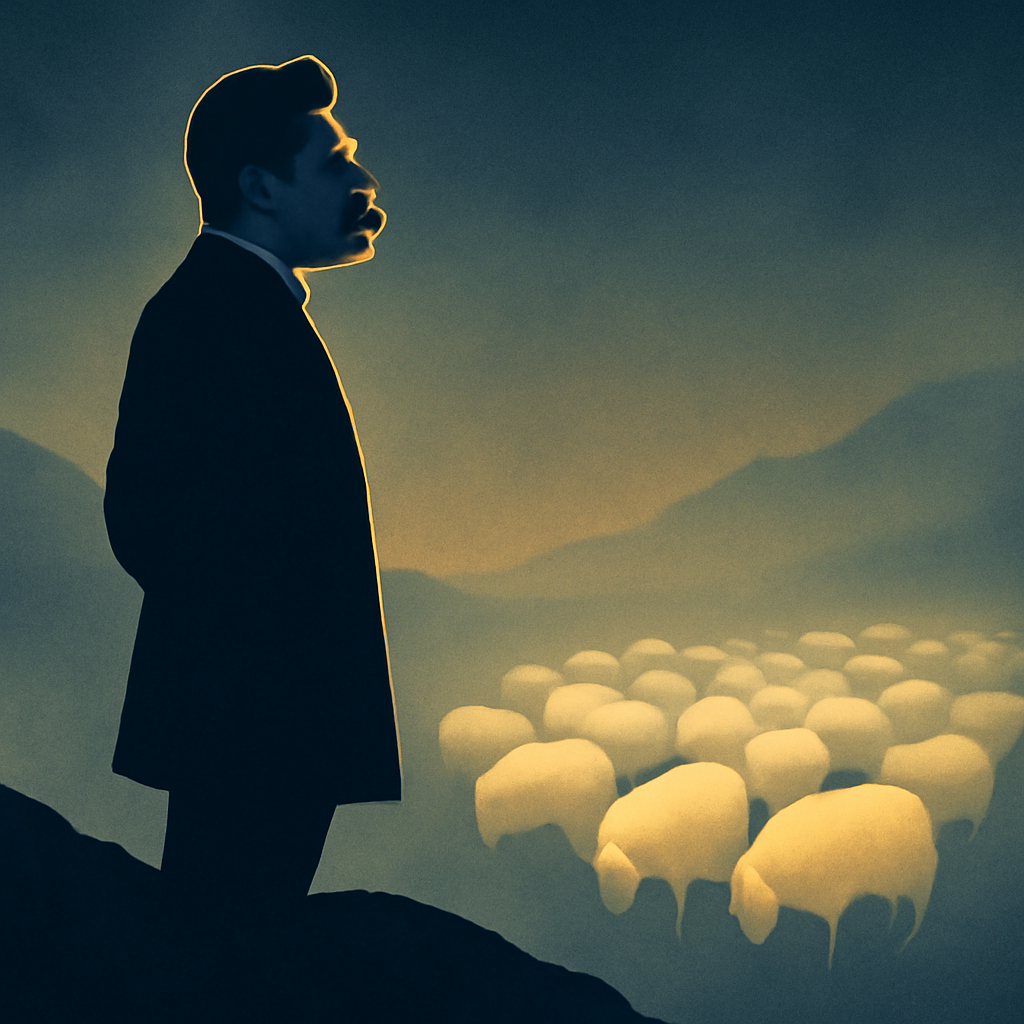
The Hammer of Truth: Waking Up From the Herd
The Genealogy of Guilt: Breaking the Chains of Ressentiment
The Engine of Life: Understanding the Will to Power
The Greatest Weight: The Test of Eternal Recurrence
Beyond the Human: The Path to the Übermensch
Amor Fati: The Art of Loving Your Fate

Transcript
Most people spend their entire lives borrowing beliefs they never chose. They inherit a moral framework from their culture, their religion, their family — and they never once ask where it came from or whose interests it serves. Friedrich Nietzsche, the German philosopher and cultural critic who lived from 1844 to 1900, called this the trap of the herd. He didn't mean it as a casual insult. He meant it as a diagnosis. His method was the hammer — not to destroy, but to tap, to sound out, to find which idols ring hollow. Think of a doctor tapping a knee to test the reflex. Nietzsche did the same to civilization's most sacred assumptions. What he found disturbed him deeply. The first idol he struck was the idea of God-given truth. His phrase "God is dead" is one of the most misread lines in all of philosophy. It is not a celebration. It is a warning. Nietzsche was describing a cultural and intellectual crisis: the traditional religious foundations of European values had lost their authority. The church no longer held the center. But here is the terrifying part, David — the moral consequences of that framework were still running the show. People had abandoned the source but kept the rules. That is a recipe for nihilism, for a world where inherited values persist without any honest justification. Nietzsche saw this as the defining danger of the modern age. Not that people stopped believing, but that they kept behaving as if they still did, without ever examining why. Now, the key idea here is what Nietzsche called herd-animal morality. In "Beyond Good and Evil," he describes contemporary European morality as exactly that — a system built for the herd, not for the individual. The herd prioritizes conformity, security, and shared rules. That is not inherently evil. Nietzsche actually acknowledged that herd morality may serve the needs of most people. But it becomes a trap the moment it claims to be the only valid morality. For example, suppose you feel a deep pull toward a creative or unconventional life, but every social signal around you says that ambition is arrogance, that standing out is selfishness. That pressure is the herd operating as a moral system. It doesn't argue with you. It shames you. Nietzsche's genealogical method — his way of tracing the historical and psychological origins of values — reveals that what feels like timeless moral truth is often just a power arrangement that got old enough to seem natural. That means the real danger isn't external. It's internal. Nietzsche identified a psychological mechanism he called ressentiment — a reactive hostility where the inability to act against a perceived enemy gets converted into moral condemnation of that enemy. The weak don't defeat the strong. They redefine strength as evil. This is slave morality in action, and Nietzsche argued it had shaped Western ethics for centuries. His critique of truth runs parallel: in his essay "On Truth and Lies in an Extra-Moral Sense," he argued that what we call truth is built from humanly created metaphors and conventions, not a transparent mirror of reality. His perspectivism holds that knowledge is always shaped by a particular standpoint. Remember, this is not a license for lazy relativism. Nietzsche evaluated interpretations by whether they enhance or diminish life. Some perspectives are more honest, more courageous, more life-affirming than others. The question he forces you to ask is not just "Is this true?" but "What psychological need does this belief serve, and whose interests does it protect?" This is where philosophy becomes personal, David. Nietzsche's ideal of the free spirit demands a Value Audit — a deliberate, uncomfortable examination of every belief you hold. Not to destroy them all, but to distinguish the ones you genuinely own from the ones you merely inherited. His critique of the herd is not a call to crude individualism. His positive vision requires self-mastery, the creation of values, and what he called giving style to one's character. That is hard work. It is far easier to let the herd think for you. But the takeaway from everything Nietzsche hammered at is this: meaning is not found. It is created — by individuals who have the courage to sound out the hollow idols of their society and build something real in the space that opens up. That is the challenge he is placing in front of you right now.