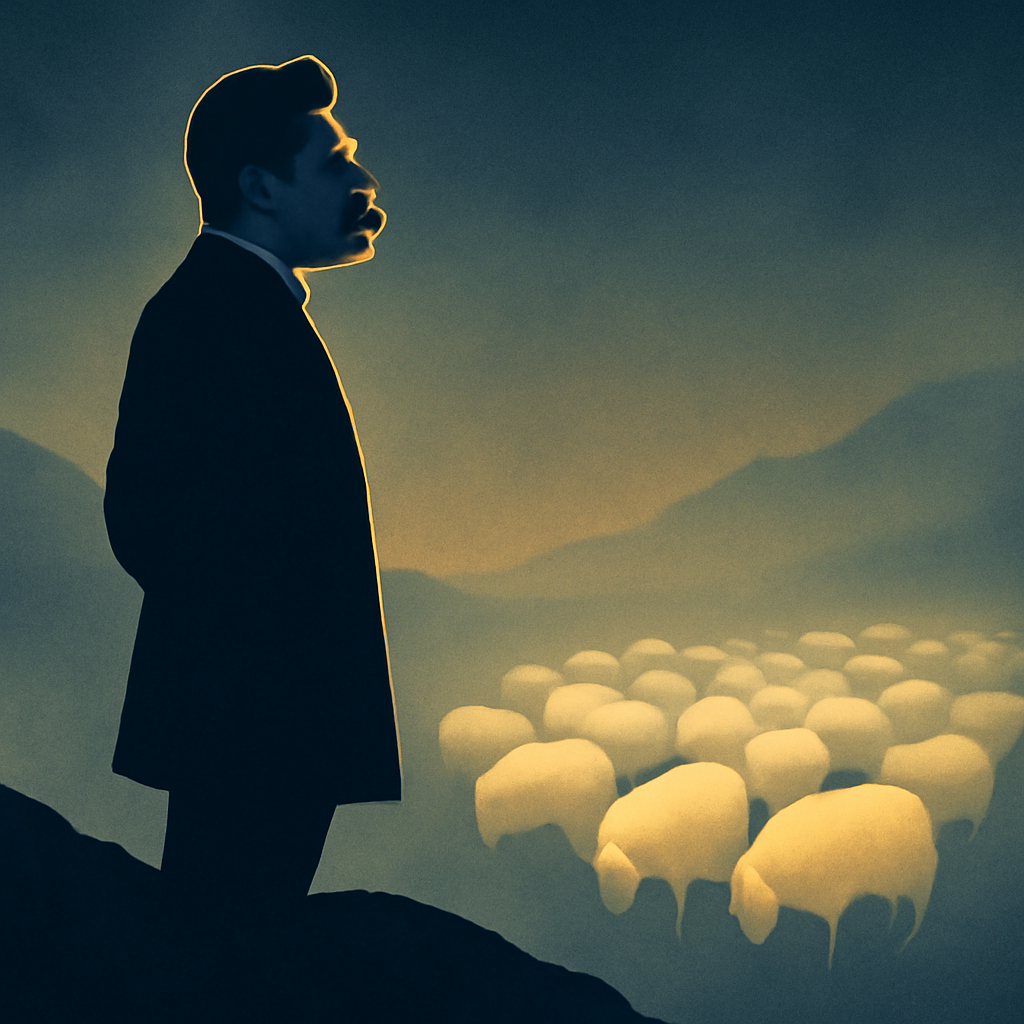
The Genealogy of Guilt: Breaking the Chains of Ressentiment
Nietzsche: The Architecture of Self-Overcoming
The Hammer of Truth: Waking Up From the Herd
The Genealogy of Guilt: Breaking the Chains of Ressentiment
The Engine of Life: Understanding the Will to Power
The Greatest Weight: The Test of Eternal Recurrence
Beyond the Human: The Path to the Übermensch
Amor Fati: The Art of Loving Your Fate

Transcript
SPEAKER_1: Alright, so last time we established that Nietzsche's hammer is really a diagnostic tool — tapping inherited beliefs to find which ones ring hollow. Now I want to go deeper into the actual book where he does that most systematically. On the Genealogy of Morality, published in 1887. SPEAKER_2: Right, and that book is where Nietzsche shifts from asking 'is this moral belief true?' to asking something far more unsettling — 'where did this belief come from, and whose interests did it serve when it was invented?' That's the genealogical method. It's historical and psychological at once. SPEAKER_1: So not 'is honesty good?' but 'why did honesty become coded as a virtue in the first place, and who benefited from that coding?' SPEAKER_2: Exactly. And the Genealogy has three treatises. The first contrasts master morality with slave morality. The second traces guilt back to debt — literally, the economic relationship between creditor and debtor. The third examines what Nietzsche calls the ascetic ideal, the strategy of giving suffering a meaning when it would otherwise feel meaningless. SPEAKER_1: Start with master versus slave morality, because I think that's where the real provocation lives. SPEAKER_2: So master morality begins with self-affirmation. The noble type says 'I am good' first — strong, creative, life-affirming — and then defines 'bad' as simply what is weak or base. It's a positive starting point. Slave morality works in reverse. It begins by defining the external enemy as 'evil,' and only then defines the powerless self as 'good' in opposition to that enemy. SPEAKER_1: So the slave doesn't say 'I am good.' The slave says 'they are evil, therefore I must be good.' SPEAKER_2: [short pause] That's the inversion Nietzsche calls the slave revolt in moral valuation. And the psychological engine driving it is ressentiment — he uses the French term deliberately. It's not just resentment as a passing emotion. It's a festering, revenge-oriented affect that builds up when direct retaliation is blocked. The person cannot act, so the hostility turns inward and eventually becomes creative — it produces an entire value system. SPEAKER_1: Creative is a strange word for something born from hatred. SPEAKER_2: It is, and that's Nietzsche's point. Ressentiment becomes creative precisely when it stops being just a feeling and starts generating moral categories. Think of Tall Poppy Syndrome — the cultural reflex to cut down anyone who rises above the group. On the surface it looks like a concern for fairness. But Nietzsche would ask: is this criticism coming from a genuine love of equality, or from hostility toward someone else's success that cannot be expressed directly? SPEAKER_1: That's the Motive Filter, right? The diagnostic tool for separating genuine ethics from disguised resentment. SPEAKER_2: Yes. The questions are simple but uncomfortable. Am I criticizing this person's action because it violates a value I hold even when I'm not the one affected? Or does my moral outrage intensify specifically when someone else is succeeding where I am not? If the answer to the second question is yes, that's a signal worth examining. Social media outrage loops are a modern laboratory for this — the intensity of the condemnation often tracks the success of the target more than the severity of the offense. SPEAKER_1: Mm-hmm. And Nietzsche connects this historically to priestly power, doesn't he? It's not just a psychological observation. SPEAKER_2: He does. In the first treatise he identifies the priestly type — and specifically the Jewish priestly tradition — as a major force in the revaluation of aristocratic values. His argument is that priestly power, unable to compete with warrior-aristocratic power on physical terms, redirected the contest onto moral terrain. Worldly strength gets reframed as sinful pride. Poverty and suffering get reframed as spiritual virtue. That's the inversion. SPEAKER_1: Now, the second treatise goes somewhere even stranger — guilt as debt. How does that work? SPEAKER_2: In German, the word Schuld means both guilt and debt. Nietzsche traces moral guilt back to the older economic relationship between creditor and debtor. The original logic was almost transactional: if you cannot repay a debt, the creditor is owed something — and pain inflicted on the debtor could function as compensation. Punishment, in this account, precedes any notion of moral responsibility or free will. SPEAKER_1: Wait — so punishment came before the idea that people deserve punishment? SPEAKER_2: That's Nietzsche's claim. Punishment served many functions historically — deterrence, compensation, spectacle — before it was moralized into the idea that the offender is guilty in a deep metaphysical sense. And when indebtedness gets connected to religion, especially indebtedness to God, it becomes effectively endless. The individual is permanently guilty before an ultimate creditor who can never be fully repaid. SPEAKER_1: That's where bad conscience enters, right? Because the aggression has nowhere to go. SPEAKER_2: [inhale] Exactly. Nietzsche argues that civilization forces instincts that once discharged outwardly — aggression, cruelty, the will to dominate — to turn inward. That inward turning is bad conscience. It's not initially a calm moral faculty. It's internalized cruelty directed against the self. And here's the counterintuitive part: Nietzsche also sees it as the origin of human psychological depth. The same pressure that produces self-torment also produces inwardness, creativity, and the capacity for self-formation. SPEAKER_1: So the soul, in Nietzsche's account, is almost a byproduct of repression. SPEAKER_2: He comes close to saying exactly that. The inward arena we call the self is created by social constraint. And there's one more piece worth naming for anyone sitting with this — Nietzsche treats forgetting as an active capacity, not a failure. Healthy forgetting prevents every past injury from becoming a permanent source of ressentiment. The person who cannot forget is the person most vulnerable to building an entire identity around grievance. SPEAKER_1: So the takeaway from this lecture — the key idea for David and everyone working through this — is that the Motive Filter isn't just a philosophical exercise. It's a practical check on whether a moral stance is rooted in genuine values or in blocked hostility that has dressed itself up as virtue. SPEAKER_2: That's it. And the genealogical method is the tool that makes the filter possible. When someone asks not 'is this belief true?' but 'where did this belief come from and what psychological need does it serve?' — that's when the real work of self-examination begins. Next, we'll look at what Nietzsche puts in place of ressentiment: the Will to Power as self-overcoming, not domination.