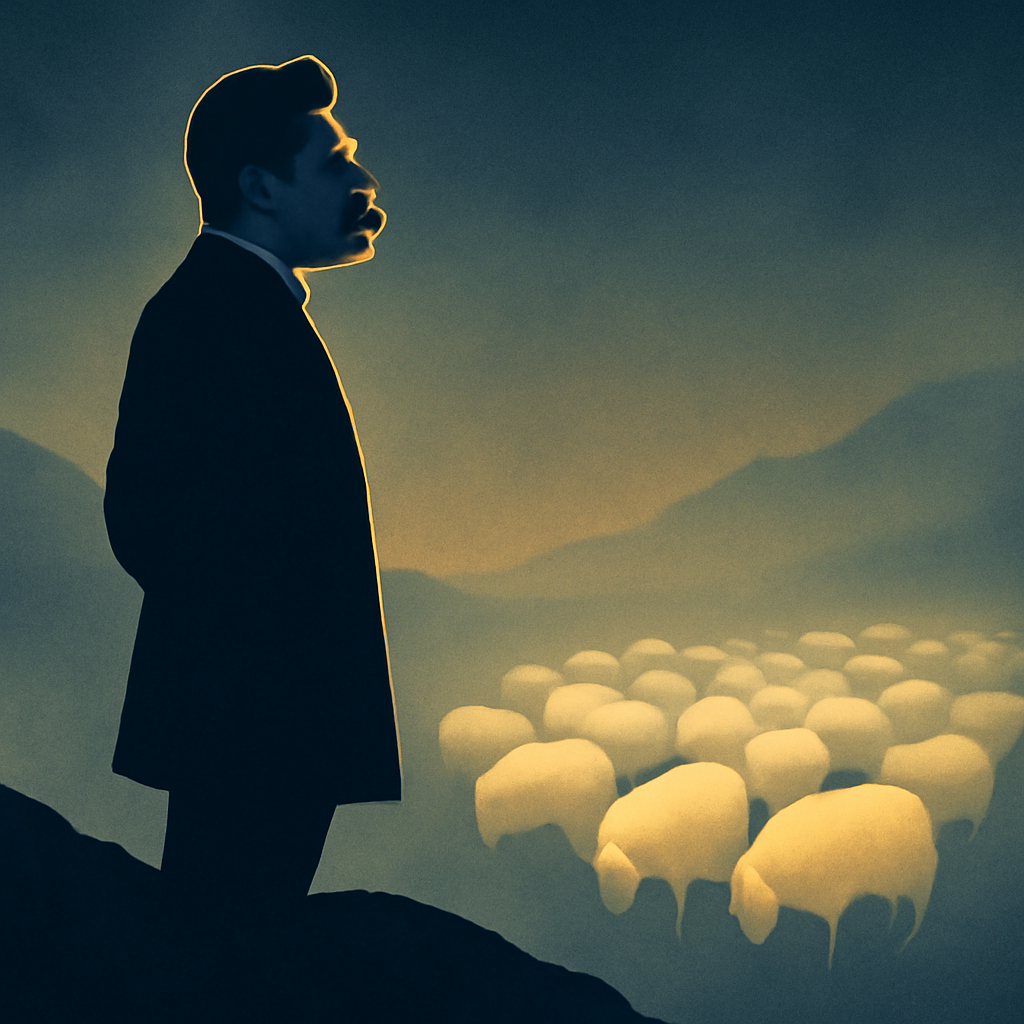
The Hammer of Truth: Waking Up From the Herd
The Genealogy of Guilt: Breaking the Chains of Ressentiment
The Engine of Life: Understanding the Will to Power
The Greatest Weight: The Test of Eternal Recurrence
Beyond the Human: The Path to the Übermensch
Amor Fati: The Art of Loving Your Fate

Transcript
Think of a person who has spent years doing everything right. Following the rules. Meeting expectations. Carrying every obligation placed on them without complaint. And then one day, something breaks open. They quit the safe career. They walk away from the inherited script. Everyone around them calls it a crisis. Nietzsche would call it the beginning. That moment of rupture is not the end of a story. It is part of the process of self-overcoming that Nietzsche dramatizes in Thus Spoke Zarathustra. He called it the Three Metamorphoses of the Spirit. And it is the architecture underneath everything we have been building in this course. In our last lecture, we introduced the concept of the Übermensch. Now, let's delve deeper into the Three Metamorphoses of the Spirit, focusing on their practical application in personal development. The Three Metamorphoses answer the next question. Once you decide to stop waiting, what actually happens? Nietzsche lays it out in Thus Spoke Zarathustra, written in a prophetic, parabolic style that reads more like scripture than philosophy. The structure is deliberate. Three stages. Three animals. One direction. This stage centers on discipline and the bearing of weight. The camel kneels and asks: what is heaviest? It wants the hardest burden. It seeks out difficulty, discipline, and tradition — not because it is forced to, but because it chooses to. This is the stage of reverence. The camel says yes to the weight of inherited knowledge, rigorous training, and genuine suffering. Think of a young musician who submits to years of scales before touching improvisation. That submission is not weakness. It is the foundation. Without the camel's discipline, the later stages have nothing real to rebel against and nothing solid to build from. The second metamorphosis is the Lion. The lion's task is to fight the great dragon. The dragon's name is Thou Shalt — every inherited value, every external command that claims absolute authority. The lion cannot create new values. But it can do something essential: it can say No. It clears the ground. It wins the freedom to create. That freedom is the lion's gift. But here is the counterintuitive part, David. The lion is not Nietzsche's final ideal. Rebellion alone is not enough. A person who only ever defines themselves by what they oppose has not yet become free. They are still chained to the thing they are fighting. That is the Lion's Trap. The third metamorphosis is the Child. The child is innocence. Forgetting. A sacred Yes. A new beginning. The child does not react against the dragon — the dragon is already gone. The child creates. This is the stage Nietzsche actually cares about. Not rebellion, but origination. The child represents the capacity to build new values from the ground up, rooted in embodied, earthly life rather than inherited commands or supernatural escape. [emphasis] This is where the Übermensch enters. Not as a destination you arrive at, but as a direction you move toward. The Übermensch is not about biological superiority or political domination. Instead, it represents an aspirational direction for personal growth and self-overcoming. Nietzsche contrasts the Übermensch with the last man — a figure who seeks comfort, security, and satisfaction rather than risk, creativity, or self-transformation. Zarathustra calls humanity a bridge between the animal and the Übermensch, not a destination. That framing matters, David. The Übermensch is an aspirational direction, not a checklist. The practical question it forces is not how to dominate others. It is this: which inherited values are governing you right now, and what would it mean to transform them through disciplined self-creation? Remember this clearly. The concept was later seized by Nazi interpreters, including Alfred Baeumler, who stripped it of its individual, creative meaning and recast it as collective racial superiority. Nietzsche's sister Elisabeth Förster-Nietzsche contributed to the conditions that made that distortion possible. The philosophical meaning is the opposite of what those appropriations claimed. The Übermensch is about individual self-overcoming and value-creation — not domination of others, not national identity, not biological hierarchy. The takeaway from everything here is this. Growth requires moving through all three stages in sequence. The camel builds the capacity to bear real difficulty. The lion breaks the authority of inherited commands. The child creates something new. If you are stuck in the lion stage — defining yourself entirely by what you oppose — the Sacred Yes exercise is the move forward. Ask yourself: what am I actually building, not just fighting? Name it. Commit to it. That shift from I am against this to I am building this is the transition from lion to child. That is the path Nietzsche is pointing toward. Not escape from the human. Transformation of it.