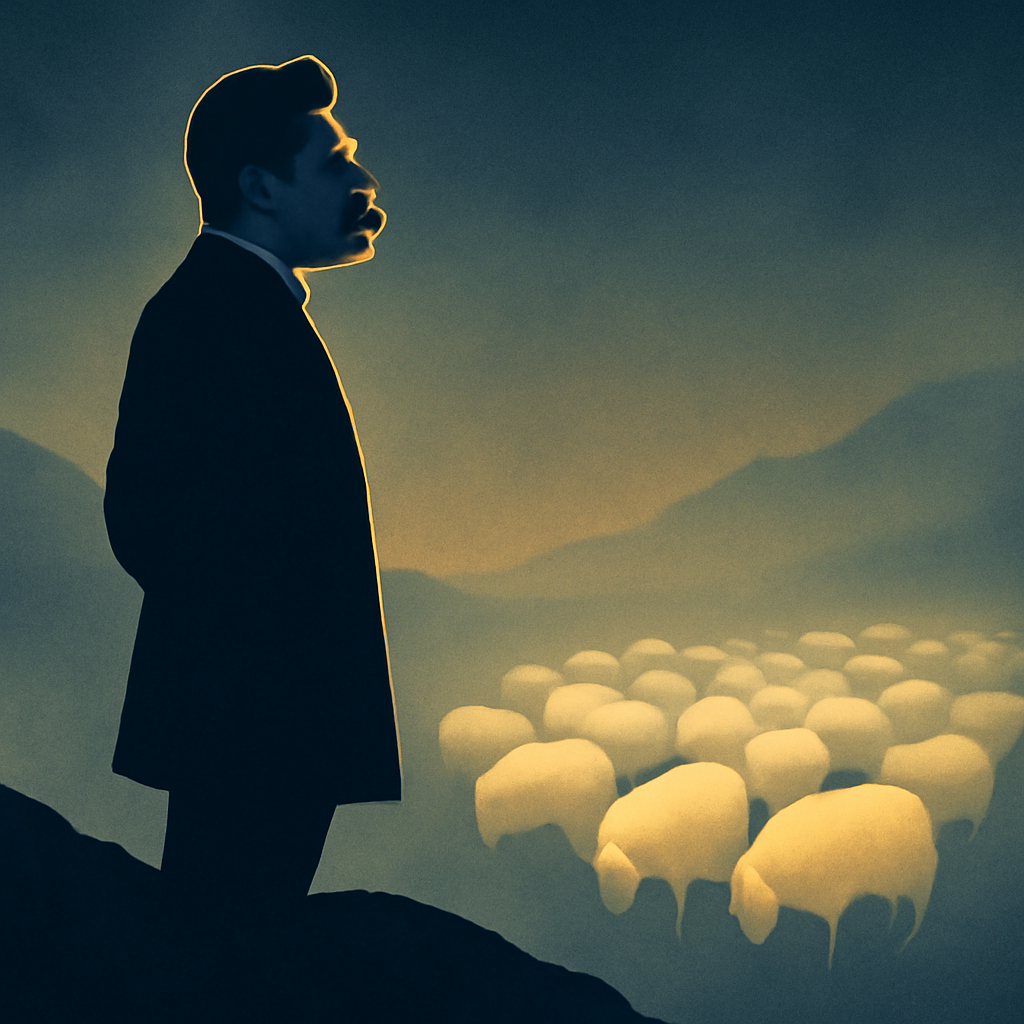
The Greatest Weight: The Test of Eternal Recurrence
Nietzsche: The Architecture of Self-Overcoming
The Hammer of Truth: Waking Up From the Herd
The Genealogy of Guilt: Breaking the Chains of Ressentiment
The Engine of Life: Understanding the Will to Power
The Greatest Weight: The Test of Eternal Recurrence
Beyond the Human: The Path to the Übermensch
Amor Fati: The Art of Loving Your Fate

Transcript
SPEAKER_1: Alright, so last time we explored the will to power. Now, let's delve into one of Nietzsche's most profound philosophical challenges: the concept of eternal recurrence. SPEAKER_2: He does, and it's one of the strangest tests in all of philosophy. Section 341 of The Gay Science. Nietzsche titles it 'The Greatest Weight.' A demon appears to someone in their loneliest moment and tells them their entire life will recur — endlessly, exactly as it happened. SPEAKER_1: And when he says entire life, he means everything? SPEAKER_2: Everything. Not just the major events. Every pain, every joy, every thought, every sigh — and everything 'unspeakably small or great,' to use his phrase. The recurrence is exact in detail, not a general replay of similar patterns. The same sequence, innumerable times, without end. SPEAKER_1: That's almost unbearable to sit with. SPEAKER_2: That's precisely the point. Nietzsche says if the thought gained power over someone, it would either transform or crush them. And the question it forces is simple but devastating: would someone want every moment of their life to recur forever? Not the highlight reel. Every moment. SPEAKER_1: So what makes it the heaviest weight? Why that framing? SPEAKER_2: Because it places a burden on each action in the present. Think of it this way — most people make small compromises daily. They take the easier path, they defer the harder choice, they tell themselves real life begins after this phase ends. The recurrence test asks: would someone will that compromise to repeat forever? If the answer is no, that's information. SPEAKER_1: So it's not a cosmological claim about how the universe actually works. It's more like a mirror held up to how someone is actually living. SPEAKER_2: Exactly — and this is where the interpretive debate gets interesting. Nietzsche's published presentations can be read at least three ways: as a cosmological doctrine about the structure of the universe, as an attitude-testing thought experiment, or as a normative ideal of life-affirmation. Most serious readers today emphasize the attitudinal reading. What does the thought reveal about a person's relationship to their own life? SPEAKER_1: Right — but how can infinite repetition increase freedom? That seems counterintuitive. Wouldn't it feel like a trap? SPEAKER_2: [short pause] It can feel like a trap when someone is already living as though they're waiting for something better. Nietzsche calls the highest type someone who wants what has been and is to be repeated into eternity — in Beyond Good and Evil, section 56. That's not fatalism. It's the opposite. It means living so fully and affirmatively that the idea of repetition becomes welcome rather than horrifying. SPEAKER_1: So the Waiting-Room Mindset — that's the philosophical challenge this concept exposes. SPEAKER_2: That's the name for it. Someone in the Waiting-Room Mindset treats the present as a corridor to somewhere else. The habits are recognizable: deferring meaningful work until conditions improve, choosing roles that feel safe rather than true, optimizing for approval rather than honest engagement. Eternal recurrence challenges this mindset by emphasizing the significance of each moment. SPEAKER_1: Mm-hmm. And Zarathustra actually struggles with this, doesn't he? The text doesn't present that struggle as easy. SPEAKER_2: He does, genuinely. In Thus Spoke Zarathustra, the title character undergoes a real emotional struggle with the recurrence of suffering before moving toward acceptance. That matters because it shows Nietzsche isn't pretending this is a comfortable idea. Affirming recurrence requires affirming life in its entirety — including the parts someone would rather not repeat. SPEAKER_1: So what kinds of actions would actually pass the test? For someone listening and running their own choices through this — what's the Recurrence Filter in practice? SPEAKER_2: could someone affirm this action even if it involved difficulty or suffering, knowing it would return forever? Actions rooted in genuine values, creative work that cost something real, relationships chosen honestly rather than out of fear — those tend to survive the filter. What fails are the compromises made to avoid discomfort, the choices made to manage others' perceptions rather than to express something true. SPEAKER_1: And Nietzsche connects this to the Dionysian attitude — the unconditional affirmation of life rather than a rejection of its suffering. SPEAKER_2: He does. He calls eternal recurrence the highest formulation of affirmation that can be attained. The Dionysian element is key: it's not about tolerating suffering or finding a silver lining. It's an unconditional yes — to the whole of existence, including what's painful. That posture pushes against the idea that life's value depends on progress toward some final purpose or escape beyond this world. SPEAKER_1: So the recurrence thought experiment is really a challenge to linear time as an ethical framework. SPEAKER_2: [emphasis] Precisely. A progress-centered view of time can let people defer accountability — imagining a future self who will do better, or a later chapter that redeems the current one. The recurrence thought experiment removes that escape. Every moment is already its own eternity. And for our listener working through this course, the takeaway is this: the Recurrence Filter isn't about achieving a perfect life. It's about closing the gap between the life someone is living and the life they could actually affirm. SPEAKER_1: That's a genuinely demanding standard. And it connects directly to what's coming next — because Nietzsche doesn't just leave people with a test. He offers a figure who embodies the answer. SPEAKER_2: The Übermensch and the Three Metamorphoses. That's where the architecture of self-overcoming becomes a lived path rather than just a philosophical challenge.