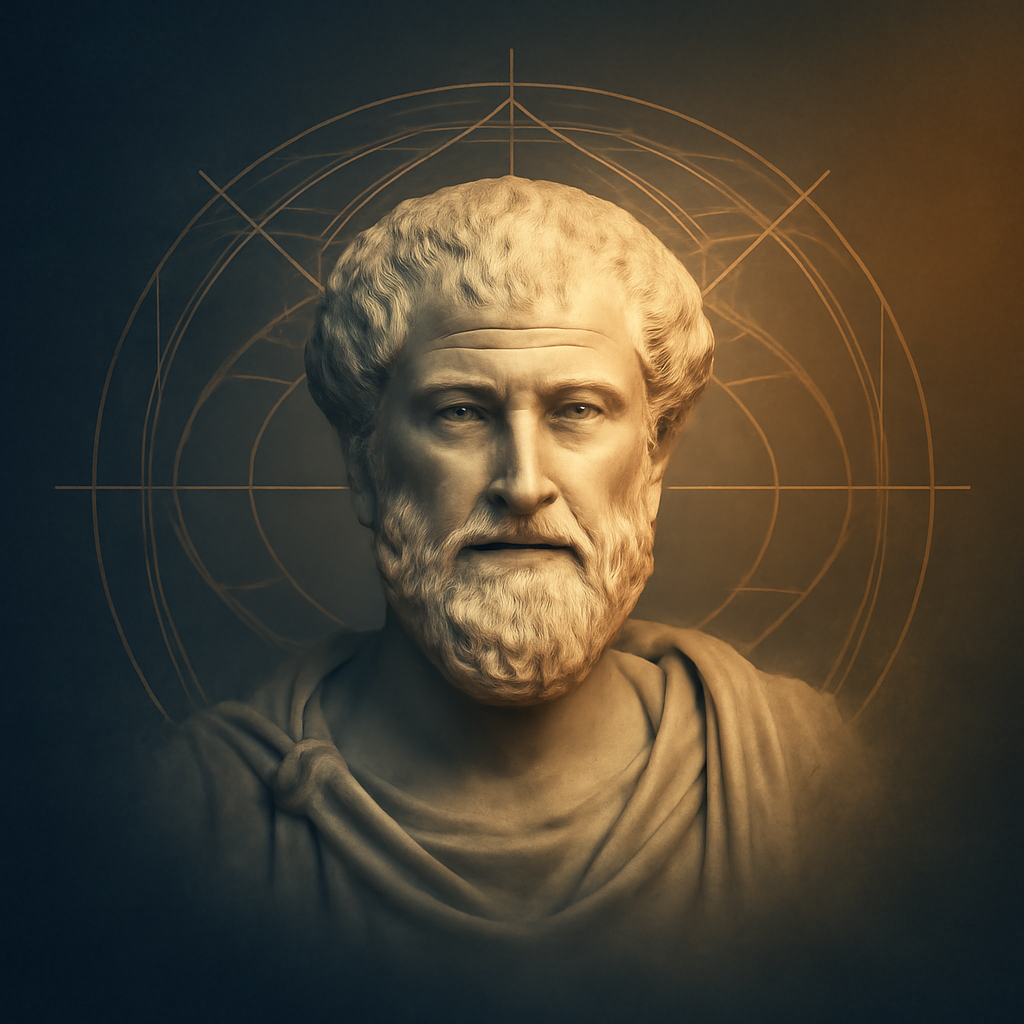
The First Scientist: Reality and the Four Causes
Aristotle: The Architect of Reality and Reason

Transcript
A man stands in the center of one of history's most famous paintings, arm extended, finger pointing firmly at the ground. That man is Aristotle. In Raphael's fresco "The School of Athens," his gesture is deliberate. His teacher Plato points upward, toward abstract ideals. Aristotle points down. Toward earth. Toward things you can touch, measure, and observe. That single painted gesture captures a philosophical revolution that reshaped how humanity understands reality itself. Here is what makes Aristotle's contribution so striking, Manu. He did not just theorize from a comfortable chair. He went outside. He cataloged over 500 animal species through direct observation, much of it conducted on the island of Lesbos. That makes him one of the earliest known practitioners of systematic biological research in recorded history. In 335 BCE, he founded the Lyceum in Athens. His students there became known as Peripatetics, a name drawn from the covered walkways where they held their philosophical debates while walking. The method was physical. The thinking was grounded. That combination was entirely new. Now, the key idea at the heart of Aristotle's philosophy is his doctrine of the Four Causes. He called them "aitia," a Greek word that translates more accurately as "explanations" or "factors" than the modern word "cause." Think of a house being built. The Material Cause is the wood, stone, and brick — the raw stuff. The Formal Cause is the blueprint, the shape and structure the house will take. The Efficient Cause is the builder, the agent who actually does the work. And the Final Cause is the purpose — shelter, warmth, a place for a family to live. For Aristotle, you do not truly understand the house until you can answer all four questions. Material alone gives you a pile of lumber. Purpose transforms it into a home. That Final Cause, the purpose, is where Aristotle's thinking becomes most powerful and most personal. He called this principle Teleology, from the Greek "telos," meaning end or goal. Everything in nature, he argued, moves toward a purpose. Consider an acorn. It is small, hard, unremarkable. But locked inside it is what Aristotle called potentiality — the capacity to become an oak tree. The acorn does not randomly become something else. Its entire structure is oriented toward that specific outcome. That means, for Aristotle, understanding the acorn requires understanding what it is striving to become. This is not mysticism. It is a framework for asking better questions about the natural world. And that framework, Manu, is what separates a random observation from genuine scientific understanding. The takeaway here is precise and worth holding onto. Aristotle insisted that to truly understand anything — an object, an organism, a human life — you must identify four things: what it is made of, what shape or form it takes, what brought it into being, and most critically, what purpose it serves. That last question, the Final Cause, is the one most people skip. It is also the one that reveals the most. Aristotle's shift from Plato's abstract ideals to observable, purposeful reality did not just change philosophy. It planted the seeds of the scientific method itself. Every biologist who classifies a species, every engineer who asks what a structure is for, every doctor who asks why a symptom appears — they are all, in some sense, still walking those covered pathways at the Lyceum, still asking Aristotle's four questions.