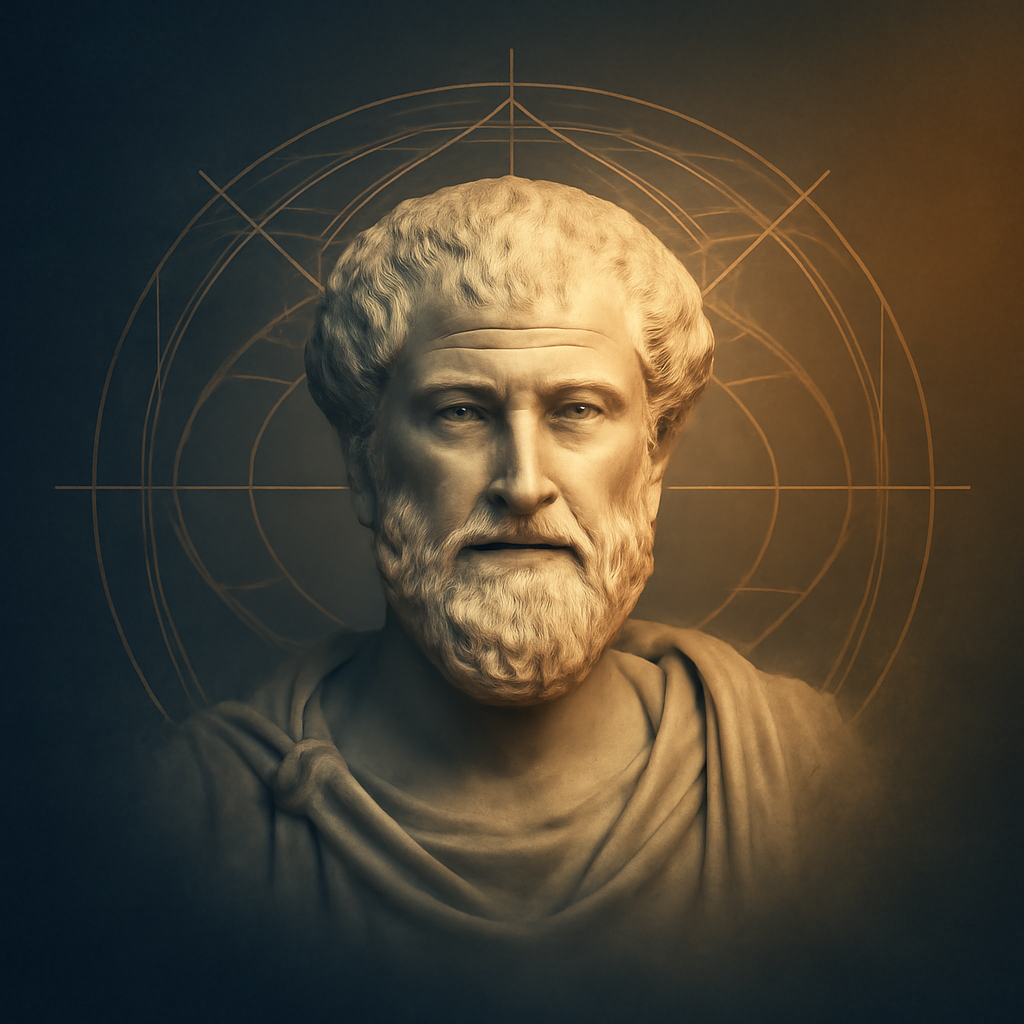
The Path to Flourishing: Virtue and the Golden Mean
Aristotle: The Architect of Reality and Reason

Transcript
SPEAKER_1: So Aristotle is focused on the human good — on what it means to live well. Now I want to know: what does that mean for a human life? What is the purpose we're striving toward? SPEAKER_2: That's exactly where Aristotle's ethics picks up. Aristotle calls it eudaimonia — usually translated as happiness, but flourishing is closer. Because for Aristotle, it's not a feeling. It's an activity. SPEAKER_1: Wait — not a feeling? That's going to surprise a lot of people. Most listeners would probably say happiness is exactly a feeling. SPEAKER_2: Right, and that's the crucial move. Aristotle defines eudaimonia as activity of the soul in accordance with virtue. It's something you do, not something that washes over you. Think of it like fitness — you can't be fit in a single moment. It's a sustained practice. SPEAKER_1: So it's tied to what humans specifically do well. The rational part. SPEAKER_2: Exactly. The human good is connected to our distinctive function: rational activity performed well. And to perform it well, Aristotle says we need virtue. He distinguishes two main types — intellectual virtues and moral virtues. SPEAKER_1: What's the difference between those two? SPEAKER_2: Intellectual virtues — things like wisdom and understanding — develop mainly through teaching and experience over time. Moral virtues are different. They come through habituation. You don't become courageous by reading about courage. You become courageous by doing courageous things, repeatedly, until it shapes your character. SPEAKER_1: So not X, but Y? It's not about knowing the right thing — it's about doing it until it sticks? SPEAKER_2: Precisely. Aristotle even makes a linguistic point here: the Greek word for ethical virtue, ethike, comes from ethos — meaning habit or character. The connection is built into the language. And what you're building is what he calls a hexis — a stable disposition. It shapes not just what you do, but what you feel, desire, and enjoy. SPEAKER_1: That's striking. So a truly virtuous person doesn't just act right — they actually want to act right. SPEAKER_2: virtue requires both correct action and the right motivation. The virtuous person chooses noble actions for their own sake, not out of fear or calculation. One good action doesn't make someone virtuous, just as one musical performance doesn't make someone a musician. SPEAKER_1: Now, the key idea everyone associates with Aristotle's ethics is the Golden Mean. How does that actually work? SPEAKER_2: So the mean sits between two vices — one of excess, one of deficiency. For example, take courage. The deficiency is cowardice — too little confidence. The excess is rashness — too much. Courage is the mean between them. Or think of temperance: the excess is overindulgence in bodily pleasures, the deficiency is a kind of insensibility to them. SPEAKER_1: Mm-hmm. And generosity fits the same pattern? SPEAKER_2: It does — generosity sits between wastefulness and stinginess. But here's what surprises people: the mean is not a fixed midpoint. It's relative to the individual and the circumstances. Aristotle himself says the virtuous mean is actually an extreme — in relation to what is best and right. It's not mechanical moderation. SPEAKER_1: So how does someone actually find that mean in a real situation? There's no formula, is there? SPEAKER_2: [short pause] That's where phronesis comes in — practical wisdom. It's the capacity to judge what should be done in particular, concrete circumstances. You can't reduce it to memorizing rules, because ethical judgment has to respond to situations as they actually are. Aristotle compares it to a skilled craftsperson — they don't mechanically apply a template. They read the material and respond. SPEAKER_1: So virtue sets the goal, and practical wisdom figures out the path. SPEAKER_2: Aristotle says exactly that. Virtue makes the goal right; phronesis determines the actions that lead toward it. And one more thing worth noting — Aristotle doesn't pretend external circumstances don't matter. Favorable conditions and external goods do affect a person's ability to live well. Flourishing isn't purely internal willpower. SPEAKER_1: The takeaway for anyone thinking about this is that flourishing isn't a destination — it's a practice. You build it through repeated choices, guided by practical wisdom, until virtue becomes who you are, not just what you occasionally do. SPEAKER_2: That's it. And that's what makes Aristotle's ethics feel so alive. It's not a rulebook. It's a description of how character actually forms — and why the daily choices, the small ones, are the ones that matter most.